How to Scale to 100+ Properties Without Losing Revenue Per Listing

Austin Whitaker
Enrich Revenue Management
Head of Revenue Management at Enrich Revenue Management
Want to outperform the market? Freewyld Foundry’s Revenue & Pricing Management service is driving an 18% performance lift for $1M+ STR operators, even in down markets. If you’re managing 10+ listings and want a free pricing audit, apply here
Most property managers think they’re crushing it when their portfolio hits 80% occupancy while the market sits at 65%. But here’s what they don’t see: they’re probably leaving 20-30% revenue on the table by underpricing the early booking window.
In this special crossover episode from PriceLabs’ Rev Labs Masterclass, Jasper joins Kyle Driscoll and Austin Whitaker to tackle one of the biggest challenges in short-term rental revenue management: what breaks when you scale from 10 properties to 50, 100, or more. As portfolios grow, the hands-on approach that worked for a handful of listings becomes impossible. But owners still expect individual attention and compare their property to every neighbor on Airbnb.
The solution isn’t what most operators think. It’s not about better pricing software or hiring more staff. It’s about shifting from reactive gap-filling in the next two weeks to proactive pacing management 60-90 days out. It’s about understanding when to change your hero photo instead of dropping your price. And it’s about recognizing that sometimes optimizing for owner psychology at 95% of maximum revenue beats chasing 100% with angry owners burning up your time.
You’ll learn:
- Why portfolio-level metrics hide individual listing revenue leaks (and how to catch them before they cost you thousands)
- The booking window management mistake that costs operators 20-30% in revenue (hint: it’s not what happens in the last two weeks)
- When your own listings actually cannibalize each other (it’s rarer than you think, but devastating when it happens)
- Why new listings should ignore revenue for 60-90 days and focus entirely on something else
- How to handle the owner who watches their neighbor’s pricing like a hawk and emails you every time there’s a $10 difference
We also talk about:
- Using Market Penetration Index (MPI) to track if you’re pacing ahead or behind the market
- The non-price factors that fix underperforming properties faster than rate cuts (cancellation policies, hero images, minimum stays)
- Strategic grouping in pricing tools (when to do it and when it just creates extra work)
- Learning from boutique hotel revenue management (what translates and what doesn’t)
- Balancing owner expectations when some prioritize ADR over total revenue
Mentioned in the Episode:
- How to Scale STR Revenue Management from 10 to 100+ Properties
- Revenue Management for Short-Term Rentals: Complete Guide
- World Cup 2026 Revenue Playbook
Follow Austin Whitaker:
- Website: enrichrevmang.com
Follow Kyle Driscoll:
This crossover episode delivers tactical, battle-tested strategies from revenue managers running thousands of properties. Whether you’re at 20 units or 200, you’ll walk away with specific changes you can implement this week to stop leaving money on the table.
Subscribe for more episodes every week on YouTube, Spotify, and Apple Podcasts.

World Cup 2026 Revenue Playbook
Your city-by-city pricing strategy guide for the biggest revenue opportunity in STR history. Demand tiers, team analysis, 5 costly mistakes to avoid, and an 8-step action plan.
Download Free GuideContinue Listening

September RM Update: Best Month in Company History, GuestyVal Takeaways, and an Airbnb Story
Jasper covers September 2026 portfolio performance: Freewyld Foundry up 37% year over year with 27% measurable impact above market, the highest in company history. Plus GuestyVal takeaways on AI in revenue management, the Vrbo commission change, and a personal Airbnb story.
The Javier Effect: A Custom PriceLabs Strategy for Unique STR Inventory
Javier Vasquez, a Freewyld Foundry revenue manager and former PriceLabs employee, walks through the custom Portfolio Occupancy-Based Adjustment strategy he built for a glamping dome portfolio with 97-98% occupancy year-round and 212-day booking windows.
Midterm Rentals with Frank Bosie: The Revenue Strategy Already Happening in Your Portfolio
Frank Bosie of Hostfully joins Jasper to break down the data behind midterm rentals, including why 39% of STR operators already have 30+ night bookings, how the occupancy math works, and when the hybrid approach beats a hard minimum-stay strategy.
The Challenge of Scaling Revenue Management
Jasper: Welcome to another episode of Get Paid for Your Pad. Today we are doing things a little bit different. I was recently on Pricelabs Masterclass with Kyle from Pricelabs and Austin, who is another revenue manager in the space. And we had a really interesting discussion around the topic of what happens when you scale a shorter rental portfolio from a revenue management side.
So if you have a handful of listings, you have a lot of time to spend on the individual listings. But as you grow, you have to divide your attention over the entire portfolio and you kind of start managing revenue a little bit more from the portfolio perspective. But then also you have to keep the interests of the individual owners in mind as well. And you have to communicate with them effectively as well. So there are some potential challenges that come up there.
And I thought our discussion was really insightful and really valuable. So I wanted to share that with the Get Paid for Your Pad audience. And so you are now going to listen to the recording of the masterclass. It's about one hour or so. There's a couple of questions at the end. And of course, as always, if you listen to this and you have any particular questions, feel always free to reach out to me personally at jasper at freewild.com. We always make sure that everyone gets a response.
So feel free to email us. And of course, if you're looking for a revenue management help, freewildfoundry.com slash report is where you can get a free revenue report from our team. So with that said, enjoy this podcast episode. Let's dive into the masterclass with Price Labs.
Introducing the Panel
Kyle: Welcome to another episode of Rev Labs by Price Labs. I'm your host, Kyle Driscoll. And I'm super excited today to be joined for the slide masterclass by Austin Whitaker, head of revenue management for Enrich Revenue Management, and my friend Jasper Rivers, head of revenue management with Free Wild Foundry.
And you'll see a couple of pop-ups as we go in. We'd love for you to answer on those, but let us know how many listings you're managing. But today we're going to be focusing on moving from listing level pricing to portfolio level pricing. Now we're going to get into the good stuff, which is our guests.
Now, most of our audience is familiar with you, Jasper. But for those that don't know you, why don't you give yourself a quick little introduction of yourself and Free Wild Foundry.
Jasper: Yeah, for sure. Yeah, I think most people probably know me from the Get Paid for Your Pad podcast. But yeah, at Free Wild Foundry, we've been managing revenue for over two years now. We're at just over 3,000 listings across 70 different portfolios. We work with larger portfolios, larger property managers of at least 1 million in yearly booked revenue. And it's been super fun and I'm excited to be here and hopefully bring some value to the audience.
Kyle: Absolutely looking forward to it. And as Jasper mentioned, he's also got the Get Paid for Your Pad podcast. This is going to kind of be a cross promotion. So you may be able to hear Kyle and Austin over there on the Get Paid for Your Pad podcast as well.
But now this is Austin's first time on our podcast. I am super excited. I'm really looking forward to it. Austin brings a dearth of knowledge. But Austin, you care to give yourself a little bit of background about yourself and introduce yourself?
Austin: Yeah, absolutely. And so Enrich has been operating for just over a year. That said, though, I've been in the space for quite a lot longer. Basically, my entire professional career, I'm an investor myself and got my start as a short-term rental focused realtor. I'm coming around with that background for understanding just how short-term rentals operate.
Of course, also have my own portfolio, but bringing my background in econometrics, which I studied in college, and to this, what I believe is made perfect for me, which is short-term rental revenue management, which has art and science to it. So very happy to be here. We have just about 60 clients and we work with large portfolios all the way down to single owners and really try to give really quality attention to our big portfolios and small clients as well.
Kyle: Excellent. And welcome, Austin. It's great to have you. And funny enough, both of our guests here are econometric graduates as well. They both got to focus on that. Your boy over here that's the host is a political science major. Yes, I like math, but you can't tell that that's probably why I'm the host over here.
What Breaks at Scale
Kyle: So, but let's go ahead and get started. Let's talk about our agenda. And first things first, we're going to talk about what we've observed that breaks its scale. And we're going to talk a little bit about avoiding demand cannibalization across your listings. If you're in a market and you've got a huge chunk of properties, how do you avoid having those listings kind of eat each other, so to speak?
We're also going to talk about moving toward attribute-based pricing. Then we'll get into a little bit about what we can learn from hotels. Finally, we're going to talk a little bit about balancing the occupancy, the rate, a little bit about owner expectations as well.
Now, most pricing strategies are built to optimize individual listings. But once you start to scale, you know, get up to 50 to 100 listings or more properties, those same strategies just stop working for a lot of people. And they can start working against you too. Sometimes you split demand. Sometimes it creates a little bit of internal competition. But ultimately, it could end up leading to a little bit of limited revenue.
So I want to start with you, Jasper. And you work with a lot of large property managers. And a lot of those property managers may be doing the revenue strategy themselves. Maybe they've got an in-house revenue manager. Maybe they don't. But what's something that you see that as these property managers start to grow, that kind of breaks at first? Is it, do they start losing out on occupancy? Do they start losing out on rate? They start missing their booking windows. What's your experience with that?
Jasper: The first thing that we notice is as the portfolio grows, you have to divide your attention over more listings, right? And the typical client that we work with, they usually do the revenue management themselves. And as you know, in the short-term rental business, there's 100,000 different things that you have to do. So there's always limited time to focus on the revenue management.
And as a result, they kind of lose focus on the individual listings. So oftentimes what we'll see is that the portfolio as a whole is looking pretty good. When you look at like forward occupancy and you look at all the different KPIs, it looks pretty good in the portfolio level. But then when you start digging into the individual listings, you see that they're missing a lot of stuff.
Especially if it's a portfolio with like multiple unit types, multiple bedroom types. Like a one bedroom has a much shorter booking window than a five bedroom. If you're looking at it from a portfolio level, you have to be very careful. Sometimes portfolios have different markets as well. So every market has its own dynamics. Even if it's like a different neighborhood in a city, it can still be quite different.
So I think that's just kind of like a natural thing that happens is that, you know, there's less time per listing to look at it. So like more things get missed. And typically that's where we see the most of the optimization when we jump in is having the attention for each individual listings versus just looking for fun.
Kyle: That's very interesting. Now, we just ran a poll that asked what's the biggest challenge. I asked our audience what was their biggest challenge as they're scaling. And roughly about 40% right now we're saying balancing ADR versus occupancy. Owner expectations is pretty high up there. Managing pricing across similar listings, not too much of a worry. And then maintaining consistent occupancy is not the primary focus either. So it is nice to hear that the audience is looking at that total revenue picture.
Balancing ADR versus occupancy. So I want to kind of lean into that with my next question for you, Austin. As you're bringing people in and start working with new clients, how do you talk to them about focusing in on that balance instead of keying in on a single metric? How do you talk to them about that balance?
Balancing ADR and Occupancy
Austin: Yeah, well, I mean, for starters, it's all about readjusting expectations, at least when I have this conversation. It's not, at the end of the day, ADR and occupancy equal revenue. And so we're all in the pursuit of increasing revenue at the end of the day. But balancing, it can be a difficult problem. And especially when you, as the portfolio gets bigger, especially if you manage multiple clients, even let's say small clients in one large market.
And so if you're like a manager and you're having that conversation with a single owner and they might have that question of, let's say you manage 50 in one market and it's not a huge market. And they might ask, well, why would one home rent versus the other? Are you going to prioritize another home over ours? And that's where really understanding about protecting rates, protecting that willingness to pay in the market. Because every guest, individual guest on the micro level has a willingness to pay.
And then you don't want to undercut yourself. So it's kind of explaining that. But I will say having a great revenue manager behind you, or at least just thinking that way, will always help ease a lot of those kind of concerns with owners.
Kyle: Yeah, absolutely. Now, I want to bring this back to you, Jasper, just a little bit. And I want to ask, when you are working with a property management company, maybe they don't have an in-house revenue manager. Maybe you've got somebody that's got multiple hats on. Where do you kind of see some of these companies missing out on that listing level optimization? That really being able to dial in that you were talking about?
The Booking Window Problem
Jasper: Yeah, I think the hardest thing is controlling booking window. So managing pacing. And so basically what that means is like really understanding for each of your listings, like what is the booking window? And what is my target for my occupancy different times of the booking window. If we're like 90 days in advance, people start booking, right? Where do I want to be like 60 days out? Where do I want to be 30 days out?
Like that's much harder to manage than managing like the next two weeks. Because the next two weeks, and that's what a lot of operators do, I think. And they have a lack of time. And they also probably have a lack of understanding of how to manage the earlier part of the booking window. Because it's more difficult and it requires more time.
And so typically what we see is that they focus very much on the next like two or three weeks, right? If there's a lot of gaps in the calendar, they'll start putting the manual overrides and taking the prices down. Just to kind of try and like squeeze as much occupancy out of it in the last couple of weeks. So I think that's the biggest challenge, I think.
But oftentimes the host might not actually realize that. Where you get situations where they come in and they're like, we're already doing great. We're like 80% occupancy over the year. You know, 65 is the average in the market. So we're beating the market. But what they don't know is that they're actually selling at like way too low ADR. And there's actually an additional 20 to 30% that we can squeeze out of it by leveraging the earlier part of the booking window, right? So I would say that's probably the biggest thing.
Kyle: Absolutely. Now, just all the polls that we've run and all the questions that Pricelabs has asked. A lot of the property managers that we talk to feel that there's kind of a breaking point around, you know, once I hit 20 units, once I hit 50 units, once I hit 100. You know, that scaling starts to become a little bit more difficult. This one's going to be for you, Austin.
Do you think, in your mind, is there a number of units that you would consider a breaking point for a property manager where they need to start looking a little bit differently? Obviously, we want to keep that personalized touch and have the individualized touch. But is there a breaking point where they should start looking at it a little bit differently? And what I'm getting at is start looking at groups and things like that, looking at a little bit different setting.
When to Start Looking at Groups
Austin: Well, yeah, it's funny you say that because actually it, and maybe getting too ahead of myself, I think that's generally how we price on the individual level is often how the sort of framework that we can expand out and manage on a portfolio level. So as an example, understanding different pockets of a market and its amenity types, where we see that type of listing rank in that particular market. And every market will be different. An Orlando market is very different from a more remote market where you only have 50 homes altogether.
So as far as a breaking point for an individual revenue manager or an individual operator, I don't think there's necessarily a particular point except for maybe, I mean, it depends greatly on the individual. And guessing your rates becomes a lot harder when you're managing, let's say, even 10. And so I think it depends greatly on the time commitment in and of itself too, right? If your operations are much more streamlined, then yeah, you might have some more time to spend on your revenue management.
Signs of Demand Cannibalization
Kyle: You kind of gave me a nice little segue into our second topic, which was having listings that kind of cannibalize your own listings. And the segue portion of it was the Orlando market for me, if anybody couldn't tell with that. But so if we're looking at, and I'm going to keep it with you, Austin, if we're looking at that Orlando market, what do you think are, and let's, I'm going to just give you a hypothetical. Let's say you're pricing 50 listings in Orlando. What do you think is the clearest sign that your own listings are really starting to fight for those same guests?
Austin: For me, it would be one clear winner with no in revenue without clear reasons why, at least on first brush. And you see one high performer in, let's say, a bracket of quality that you've identified in that market. So let's say you're mid to high end in that market. And what that mid to high end in the Orlando market, again, is pretty high, high level. People invest a lot of money in that market.
And you see in your portfolio, let's say one or two of, let's say, 20 in that bracket. That's just killing it compared to the rest. And that would lead me to want to understand why that's the case. And if our pricing strategies aren't quite up to snuff and giving in a really distributing that demand across those different numbers of listings.
Kyle: That makes a lot of sense. And Jasper, I kind of want to just bounce that same question over to you. What do you think is the clearest sign that you've got listings that are just fighting for that demand signal?
When Cannibalization Actually Matters
Jasper: Yeah, honestly, it's a little rare. I mean, most of the markets that we are in, we don't really dominate the market with our listings. We have a few where we are somewhat dominant, where this is only for like really high peak demand dates. This comes into play.
So I can give an example. Like we're in this small town in the Netherlands, actually, where there's a festival. What we see is that a lot of the inventory that we don't manage is priced way too low for those dates. So they tend to fill up first. And so what's left is our units of the market. In the market, like we have a high percentage of what's left still to book.
And then you get into an interesting situation where normally if there's a lot of other inventory left, then you kind of have to bring price down as we get closer to the date. Because otherwise, like you're going to leave occupancy on the table. But in this case, you now can kind of like set the price in the market. You can't control the market. So then it becomes a more question of like at what price point are people going to look for alternatives? They might start staying in hotels that are a bit further away. Maybe you go 20 minutes outside of town and you take an Uber. So there you kind of have pricing power.
What also comes into play there is are the units owned by our clients or not? Because if they are managing for other property owners, then we can keep the prices really high. And from a portfolio perspective, that might maximize revenue. But the few owners that are then going to sit empty, because if you have pricing power and if you fill up all of your units, then you're probably under sold. So you're going to, if you maximize revenue for the portfolio, you're going to end up with some empty units and those owners are going to be pissed off. So that's something that you got to manage in those situations.
Communicating with Owners
Kyle: Yeah. And that right there is one of the things that I'm really looking forward to us to discuss is that impact on the owners. So I just kind of want to stay with that. And Jasper, let's talk a little bit about that. What's your experience in having to communicate to those owners that unfortunately they did miss out on those boats? How do you kind of correct that? And how are you communicating to those owners about your overall strategy, like the whole portfolio picture?
Jasper: Yeah. I mean, look, at the end of the day, it depends a little bit on the type of owner that you're dealing with. Like some owners, they are very hands-off and they don't really pay attention. And some owners, they're constantly looking at Airbnb, typing in dates and checking like, hey, what are our property prices? What's our property price?
And first of all, they don't understand that we're managing a portfolio. And secondly, they don't really understand revenue management anyway. So they typically have one property that's kind of like their comp in their mind. That's the closest property to their own. And then they follow that property, like I say, very closely.
And so that's always a challenge because, yeah, that property happens to get booked at a higher price than theirs. Then you're going to get an email saying like, hey, what's going on? Like, why didn't we get the higher price? So it's always hard to manage those types of owners. So we always advise our clients, like find the owners that are hands-off, find like the investors, the people that are not emotionally so attached to their own property.
But if you do have those type of clients, like, you know, we make notes in Price Labs. Like, you know, unfortunately we have that note section. And so we know that an owner is watching everything. We usually try to find out what comp they're watching so that we can watch that too, so that we can prevent any issues by understanding what they look at and how they interpreted the data. And then we can make some adjustments.
And that's where it comes into an interesting kind of area where sometimes maximizing revenue for an owner is not the best strategy because they have not in the mindset of, I want to maximize revenue for my property. I know it sounds kind of weird, but they just have certain ideas in their head that what they want. They want like 500 bucks for Thanksgiving or for Christmas. And like, if your revenue could be up 20%, but if they're like the price for Christmas was 10 bucks lower, they'll complain about that.
So like, you got to really understand like the owner and it's worth money to save time if the owner is just happy. Because then you have more time to do your actual work of maximizing revenue versus having to come up with like different answers and different explanations to the owner. So it's a tricky thing, but, you know, just really put yourself in the shoes of the owner and like understand how they see the world and what their priorities are. And then taking that into account when you set up your pricing strategy to a certain extent, of course, right? You don't want to sacrifice a ton of revenue, but, you know, two strategies are kind of like probably going to do about the same amount of revenue and the owner has a preference. They just take that into consideration.
Kyle: Yeah. Now, Austin, I see you. I see you nodding along with this. So it seems like you're aligned with Jasper. So why don't you expand on what you're thinking there?
Understanding Owner Expectations
Austin: Yeah. I mean, I know so many different things. I won't remember all of them, but I think working with an individual owner or a manager who has individual owners, it's very important to know expectations for each unit. For me, it's all about clarity is kindness. So you start right out the gate with like understanding each owner.
And because some owners even value things other than just optimized and maximized revenue, they value higher ADRs and lower wear and tear on their property. I mean, that's something that you have to balance. And the ideal scenario with every unit, I don't think there'd be one owner that couldn't agree more with this, is they want the most revenue with the least wear and tear.
And so that's multiple different aspects. One, at a certain price, you invite a likelihood of a worse quality guest, adds more wear and tear on the property. And then two, the more occupancy you have or so more turnover you have, the more wear and tear you have as well. And so different owners have different goals in mind.
And so I always start on our onboarding process with framing that and understanding, hey, what is the goal of each of these? Because, of course, any neighbor wants to make the most money, but sometimes they don't want to make the most money possible. They want to make the most money within certain parameters, which has different ways of pricing.
Handling the Neighbor Comparison Question
Kyle: Absolutely. And now I think everybody in the audience, whether you're a revenue manager, whether you're a property manager, whether you're a cleaner, they've all heard these pain points of an owner that's very, very particular. And they're watching their neighbors like a hawk. So I'm going to throw you a question or it's the same question for each of you. But I want to know what is your most effective one sentence response to an owner when they ask you, why is my neighbor booked at 300? But I'm still empty. How do you answer that? And I'll start with you, Austin.
Austin: Yeah. I mean, a one sentence is hard because I tend to go up, go very long winded responses and I can't help it. But for me, I would say there's actually a great one word response is, I guess, the context of knowing that in this industry, it's incredibly unique. This isn't the airline industry for revenue management. This isn't even the hotel industry for revenue management. Majority of operators are not pricing professionally.
And so keeping that in mind is incredibly important and how we actually on the micro level look at individual comps. As an example, when I build comp groups out, I take out the homes that are underpricing. They might be a great comp, but I don't want them in my comp group if they are undercutting the market because how they price is another important detail to understand success. And they are not a comparable if they price half what they should be. So I would immediately jump to that first.
Kyle: And I kind of set us all up for failure by asking for one sentence because I think all three of us like to be a little long winded there. So Jasper, if you can condense it from like one to three sentences, how are you approaching that homeowner that's paying attention to what their neighbor is and knows that their neighbor's booked and they know they're not?
Jasper: First of all, it depends on like what we're priced at. So like if the neighbor booked at $300, we're at $400, then it's easy. It's like, yeah, we think we can get more. If we're priced lower, then I would look at the property and just try to find out like what's better about it. Because it's always good to encourage your owners to make improvements. So like maybe they can, you know, do some refurbishment or like add an amenity to the house. So I try to find a reason why that's the case. And then I respond to that. And then if I really can't think of anything, I'll just tell them that they're going to cancel. So or I ask Claude.
Portfolio vs Individual Optimization
Kyle: That's perfect. So I'm just going to go ahead and let's stick with this owner conversation. We will come back and talk a little bit about attribute pricing and what we can learn from hotels. But I really like talking about the owner side of this right now. And I'm going to stick with you, Jasper. How do you explain to a property owner that the property is priced one to protect the portfolio, the overall portfolio? And let's say they've got you're working with somebody that has 10 to 50 properties. How do you talk to them that we're looking at their whole kit and caboodle? We're not just looking at these individual properties. How do you go about having those conversations specifically with high season and high value types of evenings?
Jasper: Yeah, I mean, I wouldn't necessarily start a conversation around that we're maximizing the portfolio of our client. Because in the end of the day, of course, like we serve our clients. So our client's interest is first. But obviously, the owner's interest is also important because they are clients. But if a client has a question around how they're priced, I wouldn't default to talking about the portfolio level because that may make the client think, oh, so you guys are prioritizing other people over me.
So I would try always to keep the conversation on the individual listing. And honestly, like we optimize most of our listings. 99% of the time, we do optimize the individual listing to generate the maximum amount of money for each listing. So it's usually a pretty easy conversation.
Now, I mentioned that scenario, which is very rare and unique, where we do, you know, keep the prices higher. And we kind of accept that there's going to be a couple of units that that might stay empty. But those situations are extremely rare. So even though we are managing portfolios, like when we, well, we don't communicate to our clients' owners directly, but we provide advice for our clients on how to communicate. And sometimes we'll create little reports and stuff that they can provide to their owners. But we try to just focus on their unit when we communicate to them.
Kyle: And I think I framed that kind of poorly from my side. So my apologies, Jasper. When I kick it over to you, Austin, I want to ask the same question. But let's kind of frame it more as, let's say you're working with a property manager that has 50 properties. How do you go about talking to them that we're looking at these 50? Yes, we're doing the individual. But ultimately, we're trying to make sure that we're maximizing all 50 of those to get the best revenue total.
Austin: Yeah, absolutely. And I will say, though, on like the individual owner level, I've heard the objection of how are you going to prioritize maximizing my revenue while also maximizing the other 30 you have in this market? So it definitely does come up. And so I think the one important thing to understand is that, of course, the portfolio matters. But we really rank all of our listings when we're grouping them and figuring out how to price each whole entire portfolio.
Usually there's a distribution. Like we don't have all just one quality type home in one market, which there is some nuance in that. But when we have a varying quality level in one market, then those typically are grouped together rather than looking at specifically the big portfolio. And so I kind of trend down that way and understanding now, yes, very, very exactly what Jasper is saying, though. We still look at the individual level, but we also will evaluate that sort of like bracket quality level in each market as well.
And there's always nuance. There's never really not often you'll see one listing be exactly the same as another on every every angle. As an example, even the review type or review qualities could be different. Right. A 4.9 versus 4.8. And that can have some implications on a revenue conversion as well.
Using Groups Strategically
Kyle: Yeah. And and for our for our property managers that are in the audience, we totally understand what what you've got going on. You know, as you're scaling, we want to look at individual properties. The best way to maximize for each owner is to give them that that genuine touch and make sure that you're going in and setting it up, setting each individual up for success. But as you're scaling, we want to make sure that you know that there are tools that are available for you to really kind of speed the process up, so to speak.
If you're using Price Labs, making sure that you've got groups when you need those. Again, if you've got properties that are upper end of the market, probably don't need to throw those in groups and have them matched up with other things. But if you're working in an area where you've got a bunch of two bedroom condos that are basically the exact same, maybe some have an ocean view. Maybe some have ocean front. Maybe some of them have a pool. Some of them don't. Slicing and dicing that way can be helpful, especially inside of the tools.
Jasper, you work a little bit with boutique hotels. And I think that's something that we can bring into the short-term rental area from those hotels. Again, you don't want everything to be the exact same. But if you have some properties that are kind of cookie cutter, so to speak, or maybe they're all very similar, how do you think people should look at approaching portfolios like that and potentially going in and making sure that they're getting as much for all of those properties? I think that makes sense what I'm kind of asking, doesn't it, Jasper? If not, let me know and I'll go a little bit deeper into it. But how do you think taking what we're doing in boutique hotels, looking at room types, having occupancy move based on how those rooms are filling up? How do you think short-term rental operators can bring that thought into what they're doing right now?
Lessons from Boutique Hotels
Jasper: Yeah, well, first of all, you know, when you have a boutique hotel, it's typically one owner. And so, like, you then don't have that problem that, like, you can look at it as a building, essentially, right? And it doesn't really matter how much room one makes or room two, because it's all the same owner. So that kind of makes things a little bit easier.
So there you can play around with the portfolio settings that PriceLabs has for, you know, if a couple of rooms get booked, then it actually pushes the price up a little bit for the other rooms. So that's something that you can start doing there versus if you have, like, similar units in the market, but they're owned by different people, that is a challenge, right? Because it's like, if the owner sees, like, hey, a week ago, my price was 100, and now it's gone up. And we're still, why are you raising the price? Like, you need to get booked. So I think it makes it a little bit easier, actually, when people have, like, these boutique hotels.
And, you know, I think a couple of things that we learned is more on the distribution side, we've had setups where, let's say you have a hotel with, like, 12 rooms, and they're all, like, a little bit different. And so, like, people would list them individually, 12 booking.com listings, 12 Airbnb listings. That becomes a challenge because it takes a while to build up the reviews.
And so the other option is to slice them up into categories, right? So, like, put all the one bedrooms together, even though there might be slight differences in the units, right? But if they're largely the same, like, just creating one listing, that generates more revenue from our experience and having individual listing for all of your units. So those are just the two things, the main things that come to mind.
Kyle: Now, Austin, you don't have quite as much experience in the boutique hotel space, but you do work in a lot of markets where, you know, you've got five to ten condos that are in the same building. A lot of times you run into what Jasper's talking about where, hey, we've got three owners amongst those five to ten properties. So how would you kind of look at slicing that? How would you look at slicing that up and using groups to kind of target those and then also keep a little bit of an individual touch for each of those properties when you do have those owners in there?
Managing Condo Buildings
Austin: Yeah, absolutely. And actually, we just brought on a new hotel actually in Greece. That's very cool. But yeah, luckily, often, especially with individual condos, there's a lot more differentiators to where the demand might need some adjustments. Often we're talking about like a condo building. A lot of these are really have a lot of units. And so more watching the demand and might have a particular comp group made watching specifically the occupancy or demand for those type of units.
And so that's actually where I would trend more towards is maybe less looking at broad market trends and understanding, hey, where are these condos kind of falling in? Because we have so many, we likely have a lot of great data points where it's... And the one important thing to note is there's always nuance, but there is this sort of idea of safety in numbers where the more data points you have, the more educated decisions you can make. Because at the end of the day, something like pricing is short-term rental, but really just in general, it's a mixture of an art and a science. Art fully done with a lot of like educated decision-making in mind.
But for the individual condos, luckily, a lot of times, you know, you have differentiators with the view, with the listing quality, different review scores, stuff like that. But yeah, hopefully I answered that question well.
Diagnosing Underperformance
Kyle: Yeah, absolutely. And you led into kind of what I was thinking about for the next question, which is we've got those five to 10 condos that are all side by side. We've got three owners, but Jasper, Austin, myself, most of the audience know that those aren't apples to apples. Like there's going to be certain things that are different between those. Decor is going to be different, but ultimately the algorithm is going to be different. How they're positioned is going to be very different.
So I want us to step back a little bit and let's keep that in mind, those five to 10 condos that are beside each other. I want to think about we've got the ball rolling on seven of them. They're high in the algorithm. They're working really well. We're not having to go in and do too much manual overriding. Our strategy
Related Articles
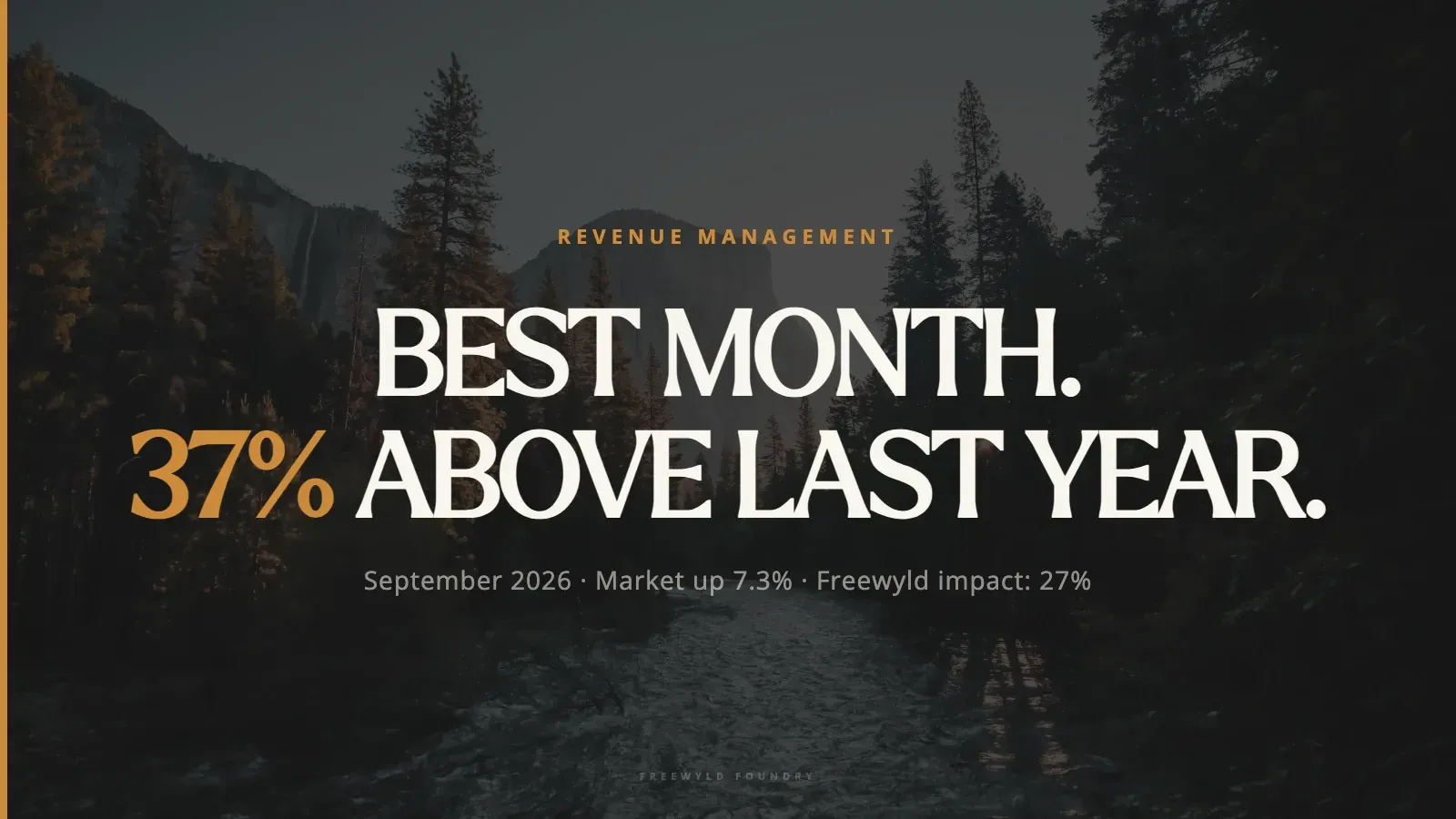
STR Market Update September 2026: Record Month, Vrbo's Commission Shift, and What AI Means for Revenue Management
September 2026 was the best month in Freewyld Foundry's history. Comparable units finished 37% above last September while the broader market grew 7.3%, producing a 27% measurable impact, the highest we have ever recorded. Here is what drove that gap, which markets led and which lagged, what Vrbo just changed about commissions, and what the industry learned about AI in revenue management at GuestyVal in Madrid.
PriceLabs Portfolio Occupancy-Based Adjustment: A Strategy for Unique STR Inventory
When your STR inventory runs at 97% occupancy year-round with a 212-day booking window, standard PriceLabs market factors actively work against you. Here is how to build a custom Portfolio Occupancy-Based Adjustment strategy for destination and unique inventory.
Midterm Rentals for STR Operators: The Data, the Math, and How to Start
Midterm rentals are already happening in most STR portfolios. 39% of short-term rental operators have received at least one 30+ night booking. Here is the data, the occupancy math, and how to be intentional about it without abandoning your short-term rental business.