How to Master Revenue Management for Short-Term Rentals: The Complete Guide
Revenue management is the practice of optimizing your pricing, availability, and distribution strategies to maximize the revenue potential of your short-term rental portfolio. For operators managing 30+ listings, the difference between reactive pricing and strategic revenue management can mean an 18% difference in annual performance. Yet most operators still treat revenue management as something to “check on when they have time.”
This guide will show you exactly how much time revenue management requires, which strategies drive 80% of results, and how to avoid the three biggest revenue-killing mistakes that even experienced operators make. These insights come directly from managing over $170M in bookings across 3,500+ properties.
Whether you’re just starting to take revenue management seriously or you’re looking to optimize an existing strategy, you’ll learn the specific frameworks that separate amateur pricing from professional revenue optimization.
Want a personalized analysis of your portfolio’s revenue opportunities? → Get your free revenue report and see exactly where you’re leaving money on the table.
What Is Revenue Management for Short-Term Rentals?
Revenue management is the practice of optimizing your pricing, availability, and distribution strategies to maximize the revenue potential of your short-term rental portfolio. Unlike simple dynamic pricing, true revenue management combines market data, booking patterns, competitive intelligence, and strategic pacing to make daily pricing decisions that compound over time.
The core principle is this: every booking contains strategic intelligence that expires quickly. A single booking for September during February might reveal an event you didn’t know about. If you miss that booking for two days, your entire portfolio could be booked at base rates before you realize what’s happening. This happens, especially with concerts and major events.
Revenue management requires three things working together:
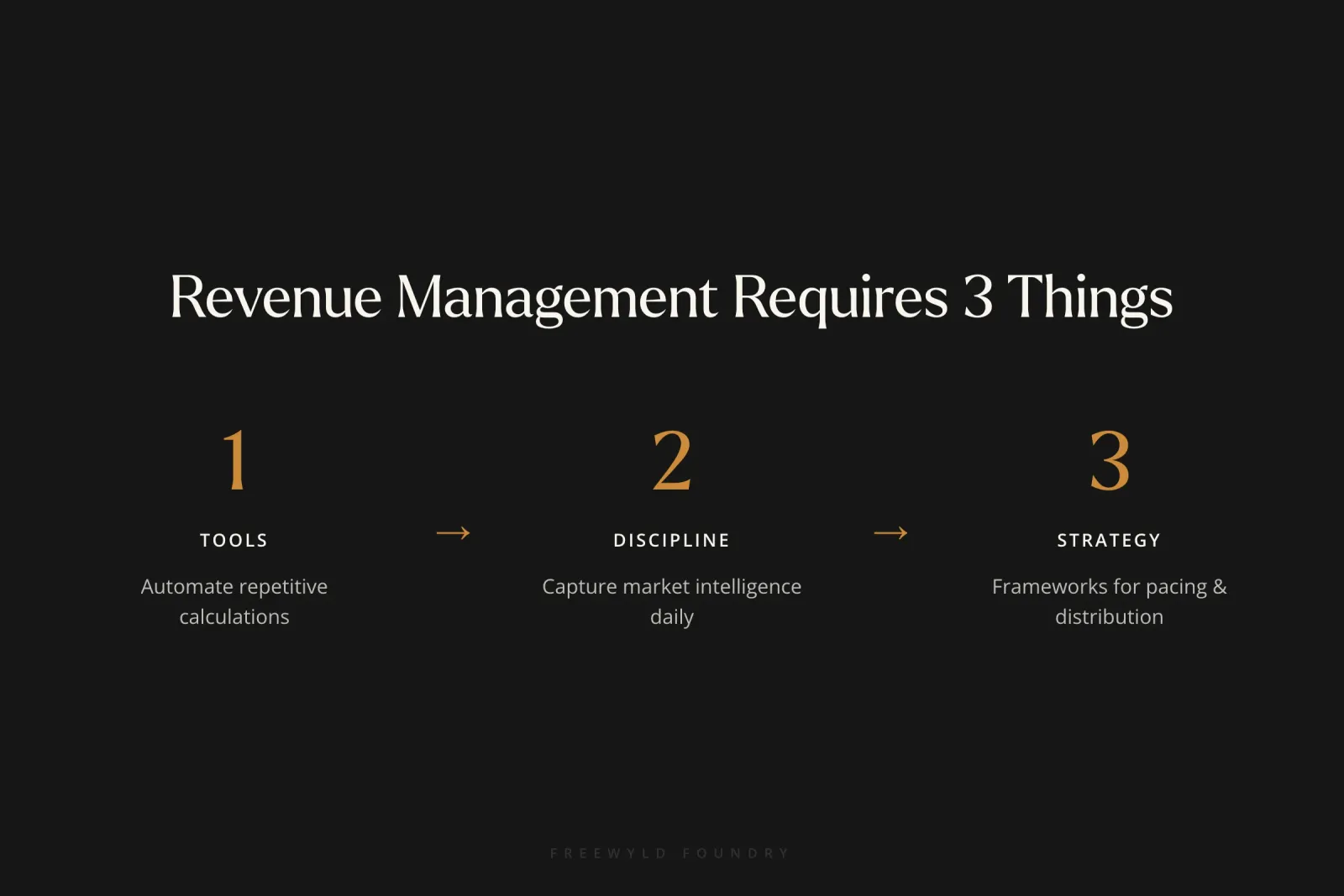
- Tools that automate repetitive calculations so you can focus on strategy instead of spreadsheets
- Daily discipline to capture every piece of market intelligence before booking windows close
- Strategic frameworks for pacing, minimum stays, and distribution that most operators never learn
According to Jasper Ribbers, co-founder of Freewyld Foundry, “If we’re mowing the grass and you’re using a scissor and I have a machine, but I also have a scissor, then I am at least going to do as good as you because I could still use the scissor. But if I’m using the machine, then I’m going to be doing it faster than you, right?”
This analogy perfectly captures why pricing tools aren’t optional anymore. A tool doesn’t just save time. It unlocks capabilities impossible with manual systems like dynamic minimum night stays, automated last-minute adjustments, and real-time pacing analytics.
Which Pricing Tool Should You Choose for Your Short-Term Rental?
Three major pricing tools dominate the short-term rental market: PriceLabs, Wheelhouse, and Beyond Pricing. Each connects to most major property management systems, but they differ significantly in functionality and user experience.
PriceLabs: Best for Detail-Oriented Revenue Managers
PriceLabs is the preferred tool at Freewyld Foundry for several specific reasons:
- User interface clarity: Data visualization through graphs and layouts makes it easy to understand pacing, competitive pricing, and market dynamics at a glance
- Constant innovation: New features like booking reports, customized reporting, neighborhood data graphs, and pacing graphs launch regularly
- Responsive team: Customer feedback often gets implemented quickly, showing they listen to actual revenue managers
The booking report feature alone has transformed how many operators analyze their portfolio performance. Instead of exporting data to spreadsheets, everything you need is already visualized in the dashboard.
Wheelhouse: Best for Feature-Rich Automation
Wheelhouse offers comparable functionality to PriceLabs with a different interface approach. It’s particularly strong for operators who want deep automation without manual oversight. The tool excels at complex rule-based pricing strategies and has robust integration with most major PMSs.
Beyond Pricing: Best for Simplicity Over Depth
Beyond Pricing offers less functionality than PriceLabs or Wheelhouse, but that’s an advantage for certain operators. If you want something straightforward that doesn’t require diving into every advanced feature, Beyond Pricing provides a clean, easy-to-use interface that handles core pricing well without overwhelming you with options.
When Beyond Pricing launched in 2014, it was the first widely available pricing tool. Jasper Ribbers switched from manual pricing that summer and saw immediate revenue increases. That early experience taught a crucial lesson: any pricing tool will beat manual pricing because you can replicate your manual strategy in the tool while accessing automation impossible to do manually.
How to Choose the Right Tool
Test all three during their free trial periods. The best tool for you depends on:
- Your cognitive preferences: Do you want depth or simplicity?
- Your PMS integration quality: Check which tool integrates most cleanly with your specific system
- Your comfort with data visualization: Which dashboard helps you understand market dynamics fastest?
- Your strategic approach: Detail-oriented managers typically prefer PriceLabs or Wheelhouse; operators wanting “set it and check it” often prefer Beyond Pricing
How Much Time Does Revenue Management Require?
The honest answer: it depends on how much revenue you want to capture. You can spend unlimited time on revenue management because there’s always more data to analyze, more strategies to test, and more optimizations to make.
Time invested in revenue management follows a diminishing returns curve. Going from zero to one hour per week creates massive impact. Going from one to two hours still drives significant results. But going from 12 to 13 hours per week? Almost no additional revenue.
The Optimal Time Investment for 30 Listings
For an average portfolio of 30 listings, here’s the minimum time allocation that captures 80% of potential revenue gains:

Daily (15-30 minutes):
- Review every booking that came in
- Update performance dashboard with data from your pricing tool
- Check which units are pacing ahead or behind last year
- Review occupancy for the next 7-14 days, especially weekends
- Adjust last-minute pricing based on market conditions and weather
Some days you’ll only need five minutes. If you get two last-minute bookings with nothing interesting to learn, you’re done quickly. Other days you’ll need the full 30 minutes when you get multiple bookings that reveal strategic opportunities.
Weekly (2-4 hours):
- Analyze pacing for current month, next month, and peak season
- Compare occupancy performance across your entire portfolio
- Evaluate whether base prices need adjustment
- Review seasonality settings
- Assess your OTA discounting strategy
- Consider adding or removing promotions on Airbnb and Booking.com
- Identify patterns in top-performing and underperforming listings
Monthly (half-day to full day):
- Comprehensive results analysis for the previous month
- Major strategy changes and documentation
- Education time: podcasts, webinars, courses
- Competitive analysis updates
- Minimum night stay profile review
- Cancellation policy evaluation by property type
Why Daily Review Is Non-Negotiable
You might wonder if you can just review everything weekly instead of daily. The short answer: no.
“We always say at FreeWild, we say every booking every day, right? You have to look at every single booking that comes in every single day. That’s the basis,” explains Jasper Ribbers.
Here’s why: every booking contains information that can lead to a pricing decision. If you get a booking today for September and realize there’s an event happening, you need to increase your prices immediately. If you don’t see that booking for a couple of days, your entire portfolio might be booked at base rates before you catch it.
This happens. Somebody books for a concert. If you don’t look at your bookings for a few days, you might miss the entire opportunity. By the time you notice, your properties are already booked at prices that don’t reflect the event premium.
For Larger Portfolios
If you’re managing more than 30 listings, these time requirements scale up. A 60-listing portfolio might need 30-45 minutes daily and 4-6 hours weekly. A 100+ listing portfolio probably requires a dedicated revenue manager spending multiple hours daily.. Loosening your minimum night stay profile usually leads to more bookings without sacrificing much revenue.
The key is matching your minimums to property type and season:
General Framework:
- 1-2 bedrooms: Rarely go stricter than moderate cancellation policy and 2-night minimums except peak weekends
- 3 bedrooms: Middle ground, can be 2-3 nights in shoulder season, 3-4 nights in peak
- 4-5+ bedrooms: Can justify stricter minimums (3-5 nights) in seasonal markets where last-minute cancellation cost is high
Many operators set blanket minimums across their entire portfolio without considering that different property types attract different booking patterns. A one-bedroom attracts last-minute weekenders. A five-bedroom attracts family reunions planned months in advance.
3. Leverage OTA Discounts Strategically
Many operators don’t utilize the discount features on Airbnb merchandising and Booking.com. This is a huge missed opportunity, especially on Booking.com.
You can lower your price in your pricing tool, but guests don’t know they’re getting a discount unless you make it visible on the platform.
“You can lower the price in your pricing tool, but the guest is not going to know that they’re getting a discount. So you have to apply these visible discounts, right? For the guest to understand that they’re actually getting a discount,” explains Jasper Ribbers.
Critical for Booking.com: Guests on Booking.com expect to see discounts. The platform has trained them to look for deals. Many operators onboard with Booking.com and don’t get traction because they don’t apply visible promotions. Booking.com offers numerous promotion types: early bird discounts, length of stay discounts, mobile-only deals, genius program discounts, and more.
For Airbnb: Similar principle applies. Early bird discounts for far-out bookings and length-of-stay discounts for weekly or monthly stays can drive conversion without sacrificing revenue since you’re targeting specific booking patterns you want to encourage.
Bonus: Listing Optimization Drives Real Revenue
Listing optimization technically isn’t revenue management, but it directly impacts revenue. One Freewyld client changed only the titles and added bullet points to the top of descriptions on a few listings. The result? In the next week, 70% of bookings came from just those updated listings.
“All he did was he changed the titles and he changed at the top of the description. He added like bullets of the major selling points. And literally like the next week, like 70% of the bookings came from the couple of listings where he made those changes,” says Jasper Ribbers.
Airbnb listing optimization checklist:
- Complete every section (don’t leave anything blank)
- Add captions to all photos
- Use bullet points for key selling features at the top of the description
- Complete the “where you’ll sleep” section
- Optimize titles with primary selling points, not just “Cozy 2BR Near Downtown”
Common Revenue Management Mistakes to Avoid
1. Using the Wrong Cancellation Policy
Many operators apply a blanket strict or firm cancellation policy across their entire portfolio. This doesn’t make sense in most markets.
Better approach:
- 1-2 bedrooms: Moderate policy maximum
- 3 bedrooms: Moderate or firm depending on market seasonality
- 4-5+ bedrooms: Firm or Airbnb’s new Limited policy (two weeks protection)
The Limited policy on Airbnb provides reasonable protection without scaring off guests who might book elsewhere if they see “strict” or “firm” policies.
2. Checking Revenue Data Sporadically Instead of Daily
You can’t manage what you don’t monitor. Weekly check-ins mean you miss booking patterns, event announcements, and competitive movements that require immediate response.
The discipline of daily revenue management routines isn’t about spending lots of time. It’s about spending 15 minutes at the right time to catch opportunities before they disappear.
3. Not Setting MPI Targets by Season
Most operators who even know about Market Penetration Index don’t set different targets for different seasons. They pick one number and try to hit it year-round.
But MPI strategy should flex:
- Low season: Get whatever occupancy you can, no MPI limit
- Shoulder season: Pace ahead at 150-200% MPI
- High season: Pace BEHIND at 70-90% MPI
The high-season strategy feels wrong because it contradicts everything you’ve heard about booking early. But when final occupancy will exceed 80%, quality inventory retains pricing power. Let the underpriced properties book first.
How to Get Better at Revenue Management
Getting better at revenue management requires consistent practice, just like getting better at tennis or any other skill. There’s no shortcut that replaces daily practice.
Free Resources to Learn Revenue Management
Start with these free education options:
-
This podcast: The Get Paid for Your Pad podcast has 700+ episodes covering every aspect of revenue management. Listen to every episode and implement the lessons, and you’ll capture 80% of what’s available.
-
Pricing tool education: PriceLabs, Wheelhouse, and Beyond Pricing all offer free webinars, help documentation, and training resources. Learning your tool deeply matters as much as learning revenue management principles.
-
Daily practice: Carve out 15-30 minutes every single day in your calendar. Make it non-negotiable. This daily practice compounds faster than any course or training.
Free Education Option
For operators who want to take revenue management to the next level, Freewyld Foundry publishes a library of free workshops and guides drawn from managing over $170 million in annual bookings.
The library covers everything from foundational concepts to advanced revenue management strategies for pacing, minimum night stays, OTA distribution, and seasonal strategy development.
Ready to dial in your revenue strategy? → Explore our free workshops and guides and learn the frameworks used to drive 18% performance lifts.
Frequently Asked Questions
What is the best pricing tool for short-term rentals?
PriceLabs, Wheelhouse, and Beyond Pricing are the three major options for revenue management. PriceLabs offers the best combination of functionality and user interface clarity, making it easier to understand pacing and competitive dynamics at a glance. Wheelhouse has comparable features with a different interface approach that some operators prefer. Beyond Pricing is simpler with fewer features, which works well for operators wanting straightforward pricing without complexity. Test all three during free trials to see which fits your workflow.
How much time should I spend on revenue management per week?
For a 30-listing portfolio, spend 15-30 minutes daily reviewing every booking and checking occupancy patterns, 2-4 hours weekly analyzing pacing and strategy, and half a day monthly on comprehensive performance review and education. Daily time captures immediate opportunities before they disappear. Weekly time allows strategic review of pricing and performance. Monthly time enables major strategy adjustments. This allocation captures 80% of potential revenue gains.
What is Market Penetration Index (MPI) in short-term rental revenue management?
Market Penetration Index (MPI) compares your future occupancy to the market’s future occupancy to determine if you’re pricing competitively. If the market is at 20% occupancy for July and you’re at 40%, your MPI is 200% meaning you have twice the market occupancy. Target MPI varies by season: no limit in low season under 40% final occupancy, 150-200% in shoulder season with 40-60% final occupancy, and 70-90% in high season exceeding 80% final occupancy.

Should I pace ahead or behind the market during high season?
Pace behind at 70-90% MPI during high season when final occupancy will exceed 80%. Early bookings in high season often come from guests cherry-picking underpriced properties. That first 10-20% of market occupancy typically represents deals, not quality inventory booked strategically. Quality properties maintain pricing power even 3-6 weeks out because supply becomes constrained. This counterintuitive strategy captures higher average daily rates without sacrificing significant occupancy.
How do OTA discounts affect short-term rental revenue?
OTA discounts increase conversion when made visible to guests, especially on Booking.com where users expect to see deals. Lowering prices in your pricing tool doesn’t show guests they’re getting a discount. Apply visible platform promotions like early bird discounts, length-of-stay discounts, and mobile-only deals. These targeted discounts drive bookings in specific patterns you want to encourage, like far-out bookings or weekly stays, without blanket rate reduction across all booking windows.
How often should I review my pricing strategy?
Review every booking daily to catch event announcements and booking pattern changes before opportunities disappear. Conduct weekly strategy reviews analyzing pacing, occupancy performance, and whether base prices need adjustment. Perform comprehensive monthly reviews examining previous month results, seasonality settings, minimum night stay profiles, and competitive pricing strategies. This cadence balances capturing immediate opportunities with strategic long-term planning.
What cancellation policy should I use for my short-term rental?
Match cancellation policies to property type and market characteristics. For 1-2 bedroom properties, use moderate policy maximum to avoid deterring spontaneous weekend bookings. For 3 bedrooms, moderate or firm depending on market seasonality. For 4-5+ bedroom properties, firm or Airbnb’s Limited policy (two weeks protection) works because family groups plan farther in advance. Blanket strict policies across your portfolio unnecessarily restrict bookings for smaller properties.
Should I hire a revenue manager for my short-term rental business?
Consider hiring a revenue manager when managing 30+ listings if you lack time for daily review and weekly strategy sessions, or when managing 60+ listings regardless of time availability because portfolio complexity requires dedicated focus. A skilled revenue manager should drive 10-18% performance lift that more than covers their fee. Evaluate candidates based on their daily discipline, strategic frameworks for pacing and seasonality, and communication style matching your preferences.
Conclusion
Revenue management isn’t magic, but it does require discipline. The operators who consistently outperform their markets aren’t necessarily smarter or working harder. They’re working more strategically with better systems.
Start with the daily discipline of reviewing every booking. Add a pricing tool if you haven’t already. Set MPI targets that flex by season. Optimize your minimum night stay strategies and OTA discount approaches.
Most importantly, remember that going from zero to one hour of weekly effort creates massive impact. You don’t need to spend 20 hours per week to see real results. You need to spend 15-30 minutes per day at the right time doing the right things.
The three categories that drive 80% of revenue increases are pacing strategy, minimum night stay optimization, and OTA discount utilization. Focus there first before diving into more advanced strategies. These fundamentals compound over time, creating sustainable performance improvements that separate professional operators from amateur hosts.
Want expert help increasing your short-term rental revenue? Get a free revenue report analyzing your portfolio’s biggest opportunities → Request your free report
Related Resources:
- Get Paid for Your Pad Podcast: All Episodes
- Free STR Revenue Resources: Workshops and Guides
- Freewyld Foundry Revenue & Pricing Management Services
Listen to the full conversation: Episode 700: Answering Your Revenue Management Questions
About Jasper Ribbers: Jasper Ribbers is co-founder of Freewyld Foundry, where he oversees revenue and pricing management for over $170 million in annual short-term rental bookings across 3,500+ listings. He has been actively involved in short-term rental revenue management since 2014 and co-hosts the Get Paid for Your Pad podcast, which has published over 700 episodes on revenue optimization strategies for professional operators.