Most hosts think of the Airbnb algorithm as a black box. Something mysterious that decides whether their listing shows up on page one or page seven. So they try random tactics. Lower the price. Add more photos. Update the title. Hope for the best.
The Airbnb algorithm isn’t random at all. It’s a system designed to do one job, match the right guest with the right property at the right time. And once you understand how it makes those decisions, you can work with it instead of guessing.
At Freewyld Foundry, we manage over $170M in bookings across 3,500+ properties for 70+ clients. We see algorithm behavior at scale every single day. Not theory. Not speculation. Actual booking data across dozens of markets, property types, and price points.
This guide breaks down exactly how the Airbnb algorithm works in 2026, which ranking factors drive the most impact, and what you can do this week to improve your position.
Key Takeaways
- The Airbnb algorithm optimizes for booking probability, not listing quality. It shows guests the listings most likely to result in a completed reservation, based on hundreds of signals.
- Click-through rate and conversion rate are the two metrics that matter most. If guests scroll past your listing or click but don’t book, you drop in rankings.
- Pricing is a ranking factor, not just a revenue lever. Overpriced listings get fewer clicks, lower conversion, and the algorithm learns to show them less.
- Review content matters more than star rating alone. Airbnb’s system reads your reviews and factors specific mentions (cleanliness, communication, accuracy) into relevance scoring.
- The new listing boost lasts roughly 2-4 weeks. How you perform during that window sets your long-term ranking trajectory.
- Wish list saves are a real ranking signal. They indicate demand even when a guest doesn’t book immediately.
- Most hosts optimize the wrong things. Title keywords matter less than you think. Guest satisfaction signals matter more than you think.
How the Airbnb Algorithm Works in 2026
The Airbnb search algorithm is a machine learning system that predicts which listings a specific guest is most likely to book. It doesn’t just rank listings from “best” to “worst.” It re-ranks them for every single search, based on who’s searching, when they’re searching, where they want to go, and what they’ve done on the platform before.
This is important. Two guests searching for the same city on the same dates will see different results. The algorithm personalizes based on:
- Past booking history. If a guest has booked cabins before, they’ll see more cabins. If they’ve booked luxury properties, they’ll see higher-end options first.
- Search behavior patterns. What they click on, how long they spend on a listing page, what they save to wish lists, what price range they typically browse.
- Device and location. Mobile users see slightly different results than desktop users. A guest searching from Europe gets different weighting than one searching from the US.
- Group composition. Families, couples, and large groups trigger different ranking preferences.
So when someone asks me, “Where does my listing rank on Airbnb?” my answer is always: it depends on who’s looking. Your listing might rank #3 for a family of four searching 90 days out, and #47 for a solo traveler booking tomorrow.
That said, there are universal factors the algorithm uses to score every listing. Think of these as the inputs the system evaluates before deciding where you show up.
The Ranking Factors That Matter Most
Not all ranking factors carry equal weight. After watching search performance data across our portfolio of 3,500+ listings, I’ve grouped them into three tiers based on actual impact.
Tier 1: The Signals That Control Your Visibility
1. Click-Through Rate (CTR)
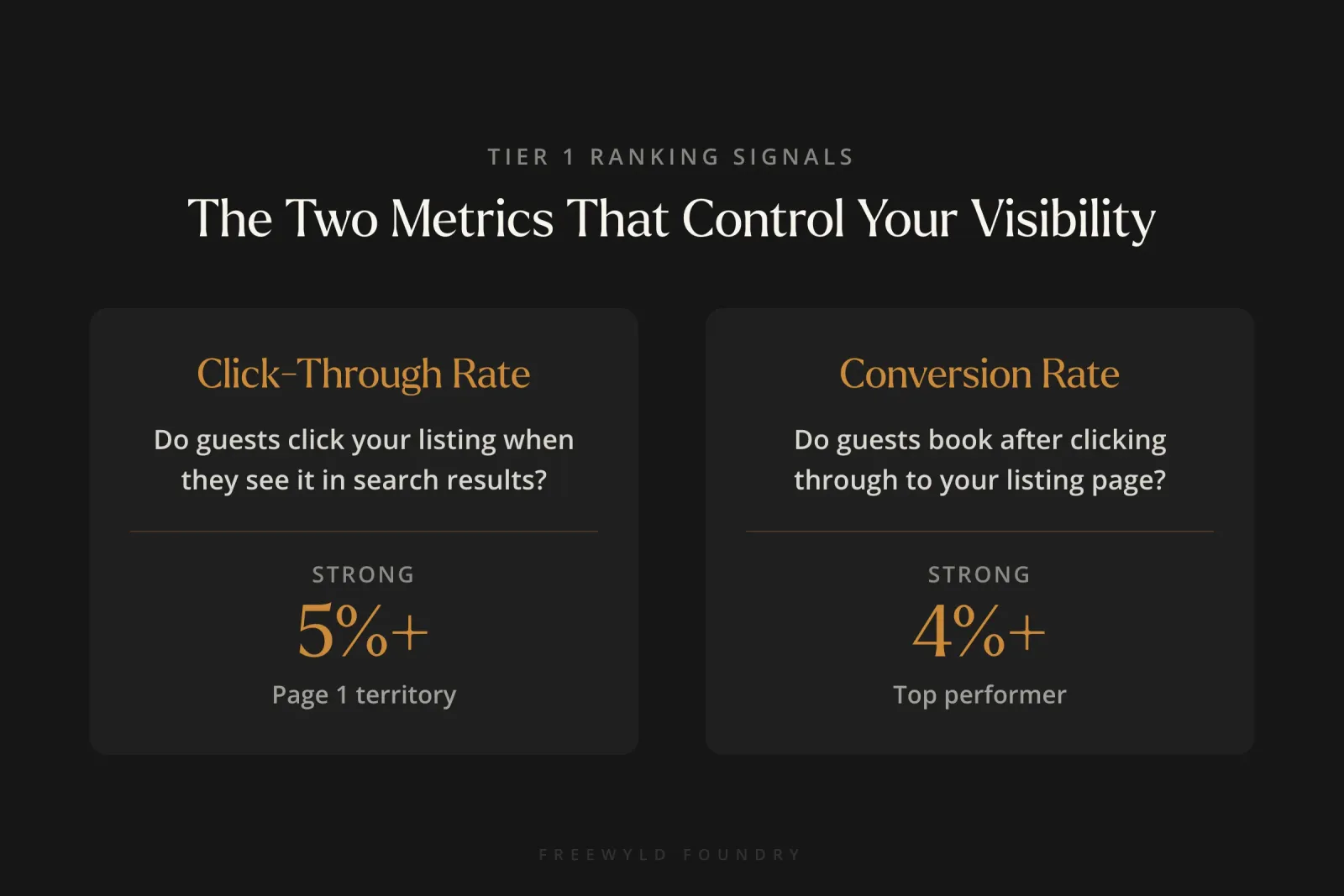
This is the percentage of people who see your listing in search results and click on it. Your thumbnail photo, price, title, rating, and any badges (Guest Favorite, Superhost) all influence CTR.
If your listing appears in search but nobody clicks, the algorithm interprets that as a signal that your listing isn’t relevant to that query. Over time, it shows you less.
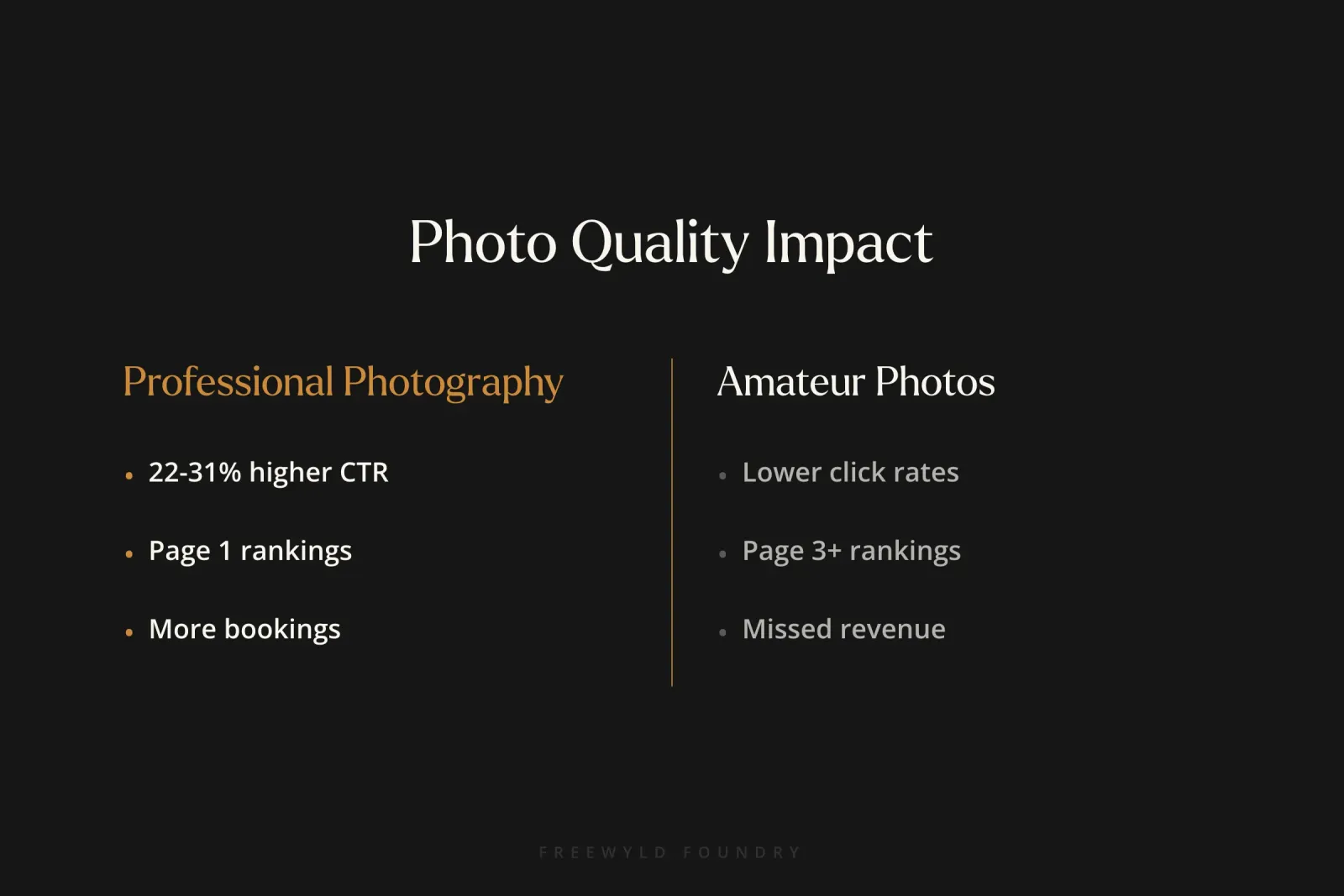
Here’s a number that might surprise you. Across our portfolio, listings with professional photography have 22-31% higher CTR than those with amateur photos. That’s not a marginal difference. That’s the difference between page one and page three.
2. Conversion Rate (Search-to-Book)
CTR gets people to your listing page. Conversion rate measures how many of those visitors book. This is where your description, amenities, reviews, pricing, availability, and cancellation policy all come together.
The algorithm treats conversion rate as a strong quality signal. A listing that converts at 4% will consistently outrank one that converts at 1.5%, all else being equal.
What kills conversion? A few common problems: overpriced listings for the market, restrictive cancellation policies, thin descriptions that don’t answer guest questions, and gaps in your calendar that make you look unreliable.
3. Price Competitiveness
Airbnb doesn’t just look at your price in isolation. It compares your price to similar listings in the same area, for the same dates, with similar amenities and ratings. If you’re 40% above comparable properties without a clear reason (unique property, prime location, exceptional reviews), the algorithm will deprioritize you.
This doesn’t mean lowest price wins. It means your price needs to make sense relative to what you offer. A well-priced listing at $350/night will outrank a poorly-priced one at $200/night if the $350 property converts better.
I talk about this a lot in the context of booking window strategy. Your pricing 60-90 days out directly affects your early search visibility, which sets the tone for your entire booking trajectory.
Tier 2: Strong Supporting Signals
4. Guest Satisfaction Score
This goes beyond your overall star rating. Airbnb tracks individual category scores: cleanliness, accuracy, check-in, communication, location, and value. Properties that score 4.9+ across all categories get preferential treatment.
Airbnb also analyzes the text of your reviews. Mentions of specific positive experiences (“the hot tub was amazing,” “great communication,” “exactly as pictured”) contribute to relevance matching. If a guest searches for a property with a hot tub and your reviews consistently mention your hot tub positively, that’s a ranking boost.
This is why a thoughtful approach to earning 5-star reviews isn’t just about vanity metrics. It directly feeds the algorithm’s understanding of what your property delivers.
5. Wish List Saves
When guests save your listing to a wish list, it tells the algorithm: “This property is desirable even when the guest isn’t ready to book right now.” It’s a demand signal that carries weight.
We’ve observed a clear correlation between wish list saves and sustained search visibility. Properties with high save rates maintain their rankings even during slower booking periods.
6. Response Rate and Time
Airbnb wants hosts who respond quickly and consistently. A response rate below 90% or an average response time over a few hours will hurt your ranking. The platform explicitly penalizes slow communicators because it hurts the guest experience.
7. Instant Book
Listings with Instant Book enabled generally rank higher than those requiring approval. Why? Because the algorithm knows Instant Book properties have higher conversion rates. Fewer friction points between search and confirmed booking.
Tier 3: Secondary Factors
8. Listing Completeness
Every field Airbnb gives you is a ranking input. Amenities, house rules, accessibility features, property description, photo captions. Blank fields are missed opportunities. The algorithm uses these fields for relevance matching, so a property that lists “dedicated workspace” will rank higher for remote workers than one that has a desk but doesn’t mention it.
9. Calendar Availability and Consistency
Frequent calendar changes, lots of blocked dates, and owner-use holds all signal to the algorithm that your listing may not be reliably available. This reduces how often Airbnb shows you.
Listings that maintain clean, open calendars with consistent availability patterns rank better. Period.
10. Host Track Record
Your overall hosting history matters. Cancellation history (host-initiated cancellations are severely penalized), listing suspension history, Superhost status, and years of experience all factor in.
How Pricing Directly Affects Your Search Rank
I need to spend extra time on this because it’s where I see the most confusion. Most operators think of pricing and search ranking as separate problems. They’re not. They’re deeply connected.
Here’s how the loop works:
- You set a price that’s too high for your market and property type.
- Guests see your listing in search results but the price doesn’t match what they expect for your thumbnail and rating. They scroll past.
- Your CTR drops.
- The few guests who do click see the high price, compare it to alternatives, and leave without booking.
- Your conversion rate drops.
- The algorithm now has two strong signals that your listing isn’t matching guest expectations. It starts showing you less.
- With fewer impressions, you get even fewer bookings. You panic and drop the price.
- Now you’re getting bookings, but at a much lower rate than you would have if you’d priced correctly from the start.
I see this cycle constantly. An operator comes to us and says, “I don’t understand why my bookings dried up.” When we pull the data, the answer is almost always the same. They overpriced during a key period, tanked their conversion metrics, and the algorithm adjusted.
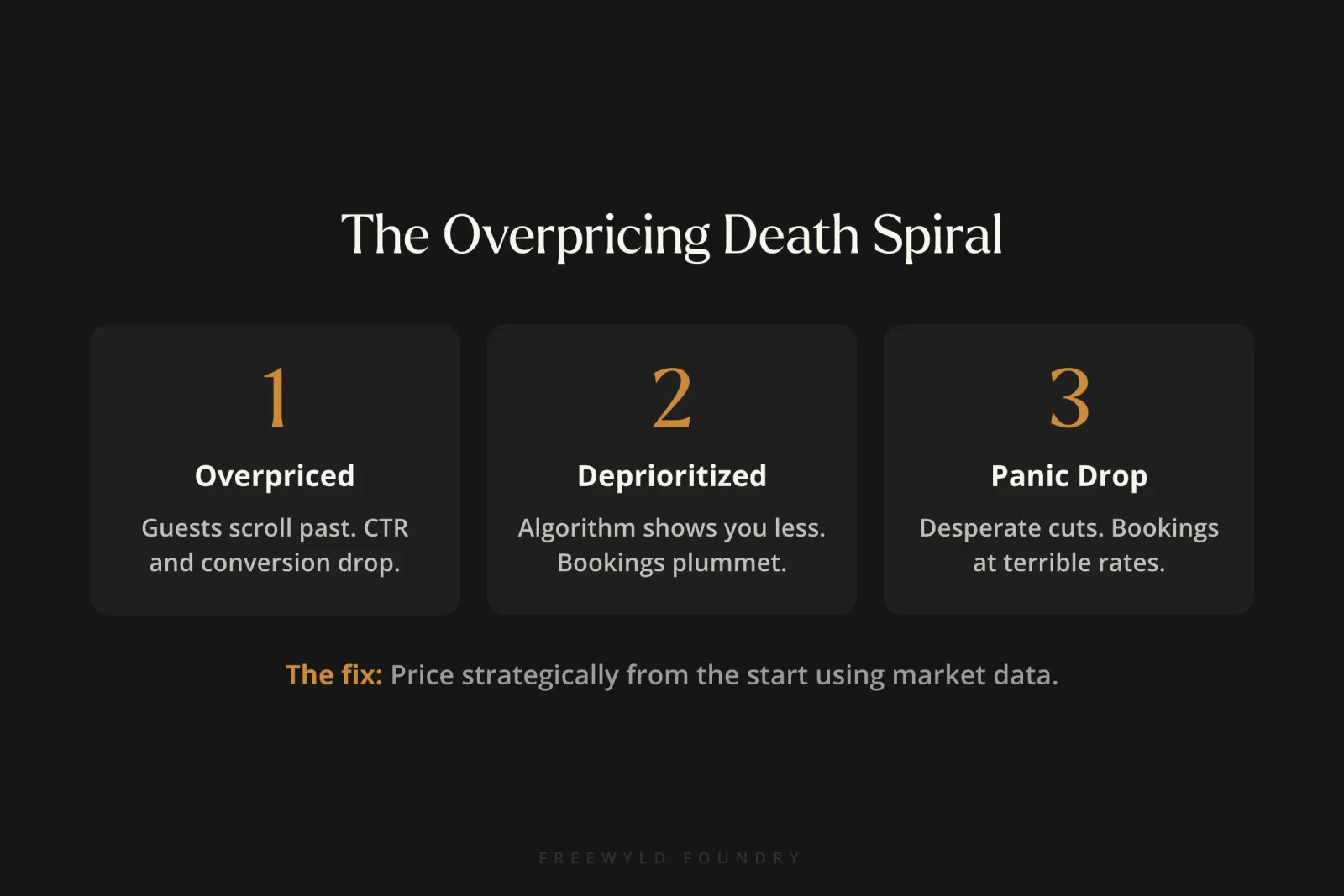
The fix isn’t to just lower your price. It’s to price strategically from the start, using market data, comp analysis, and pacing information. That’s exactly what we focus on with our revenue management approach.
One specific thing to watch: your minimum night stay settings. If your minimum is set to 3 nights but your market’s average booking is 2.1 nights, you’re invisible to a huge chunk of demand. The algorithm can’t show you to guests whose search parameters don’t match your availability settings.
The Review-Ranking Connection
Everyone knows reviews matter. But most hosts think it’s a simple equation: high rating equals high ranking. That’s only part of the story.
Here’s what’s happening in 2026.
Review recency matters more than review volume. A listing with 200 total reviews but only 3 in the last 90 days will often rank below a listing with 40 total reviews and 12 in the last 90 days. The algorithm weighs recent performance heavily because it’s a better predictor of current guest experience.
Review content is parsed by AI. Airbnb’s system reads every review and extracts sentiment, topics, and specific mentions. If multiple reviews mention “noisy neighbors” or “misleading photos,” those negative patterns affect your ranking even if your overall score stays above 4.5.
On the flip side, consistent positive mentions of specific features (“incredible view,” “spotless kitchen,” “perfect location for hiking”) improve your relevance matching for guests searching with those preferences.
Response to reviews signals engagement. Hosts who respond to reviews, especially negative ones, show the platform they’re engaged and accountable. This doesn’t magically erase a bad review, but it contributes to your overall host quality score.
The actionable takeaway? Don’t just chase star ratings. Actively shape the guest experience so reviews mention specific things you want to be known for. If you have an amazing outdoor space, make sure guests experience it and feel compelled to mention it.
For a deeper playbook on building a review system that drives ranking improvement, check out our guide on how to get your first 25 five-star reviews.
The New Listing Boost: Your One Shot to Set the Trajectory
When you launch a new listing on Airbnb, the platform gives you a temporary visibility boost. This is real. It’s documented. And it’s your single best opportunity to establish long-term ranking momentum.
Here’s how it works. Airbnb has no historical data on your new listing, no CTR, no conversion rate, no reviews, no guest satisfaction scores. So it gives you the benefit of the doubt and shows your listing to a wider audience than it normally would.
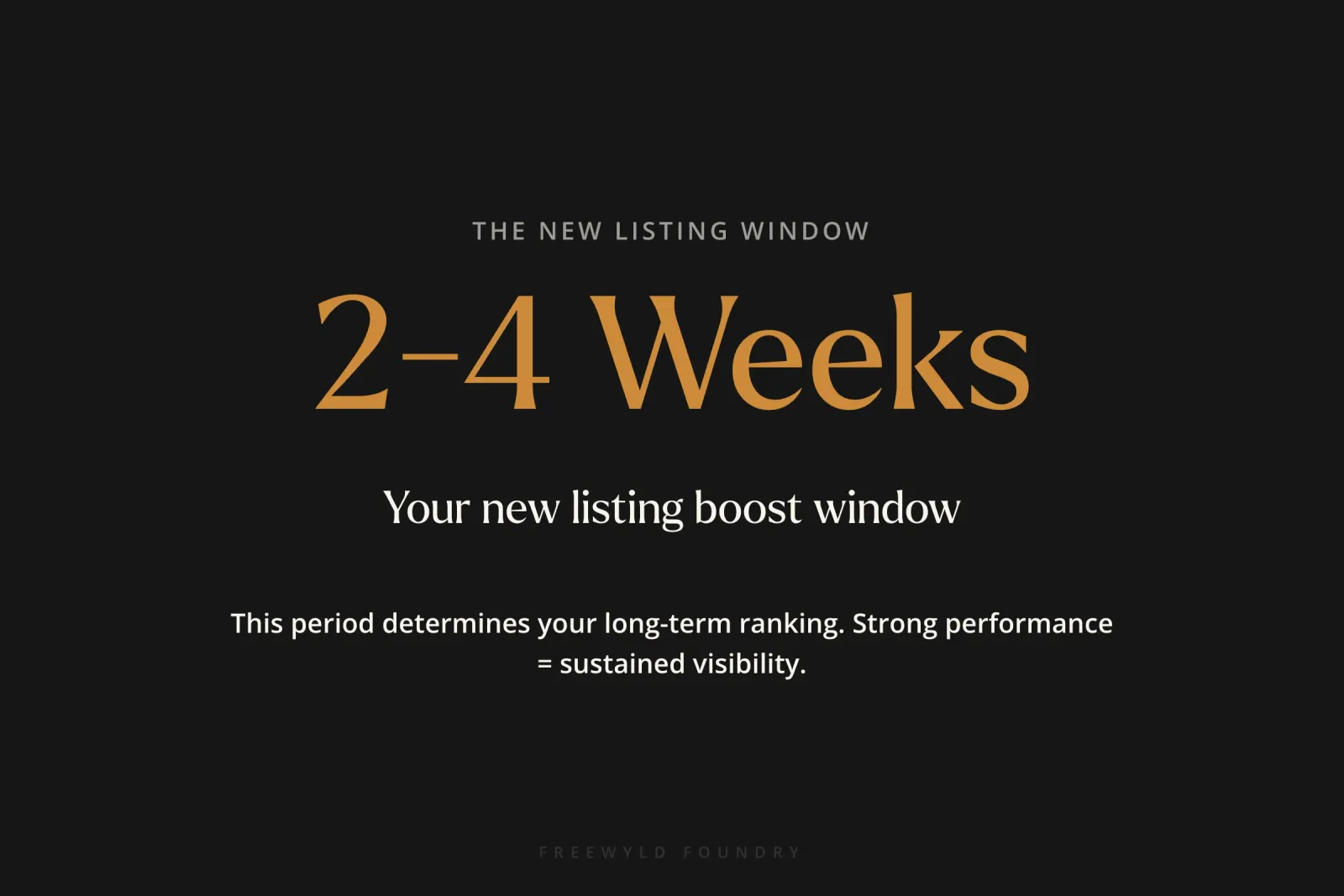
This boost typically lasts 2-4 weeks. During that window, the algorithm is collecting data fast. It’s watching:
- How many people click on your listing vs. scroll past
- How many of those clicks turn into bookings
- How guests rate their experience after staying
- Whether you respond to inquiries quickly
If your performance during this window is strong, the algorithm “learns” that your listing converts well and maintains your elevated ranking position. If your performance is weak (low CTR, few bookings, slow responses), you drop quickly and it becomes very hard to recover.
This is why I’m so adamant about having a proper launch strategy. You don’t get a second chance at the new listing boost.
How to Maximize the Boost Window
1. Professional photos before launch, not after. Your photos are live from day one. Amateur photos during the boost window waste your best visibility period.
2. Price 10-15% below your long-term target. Yes, you’ll leave some money on the table. But the bookings you capture will generate reviews, build conversion data, and signal to the algorithm that your listing performs. You can raise prices once your ranking is established.
3. Open your calendar wide. Maximum availability during the boost window means maximum data collection opportunities. Don’t block weekends for personal use during your first month.
4. Turn on Instant Book. Remove every barrier to conversion during this critical period.
5. Respond to every inquiry within 15 minutes. This sounds extreme, but the boost window is not the time to be casual about response times.
6. Nail the first 3-5 reviews. These set the tone for everything that follows. Personally check in with early guests. Go above and beyond. Make sure nothing goes wrong that could result in a sub-5-star review.
Your host profile setup also matters here. A complete, trustworthy profile with verified identity and a personal bio gives new guests confidence when your listing has zero reviews.
Common Misreadings of the Airbnb Algorithm
After years of managing revenue across thousands of listings, I’ve collected a pretty solid list of algorithm misconceptions. Here are the ones I hear most often.
Myth 1: “Lowering my price will boost my ranking.”
Partially true, mostly misleading. A lower price can improve your conversion rate, which does help rankings. But if you lower your price below what the market justifies, you attract price-sensitive guests who are more likely to leave mediocre reviews. Those reviews then hurt your ranking more than the price reduction helped.
Price needs to be competitive, not cheap. There’s a big difference.
Myth 2: “Keywords in my title affect search ranking.”
Airbnb’s search isn’t Google. Stuffing your title with keywords like “luxury beachfront paradise with pool and hot tub near downtown” doesn’t improve your algorithm ranking. Airbnb matches on amenities, location, and listing attributes, not title keywords.
What your title does affect is CTR. A clear, appealing title makes guests more likely to click. So optimize your title for humans, not for a search engine.
Myth 3: “The algorithm punishes me for high prices.”
No. The algorithm punishes you for prices that don’t match guest expectations. A $1,200/night listing that consistently converts at 3% will outrank a $150/night listing that converts at 0.5%. The algorithm cares about performance metrics, not price levels.
Myth 4: “I need to update my listing constantly to stay active.”
There’s no evidence that frequent listing edits improve ranking. What the algorithm does track is booking activity, response patterns, and guest outcomes. Your time is better spent ensuring great guest experiences than tweaking your description every week.
Myth 5: “Airbnb promotes Superhosts above everyone else.”
Superhost status provides some ranking benefit and a badge that helps CTR. But it’s not a guarantee of top placement. A non-Superhost listing with better conversion metrics, more recent reviews, and stronger pricing will outrank a Superhost listing that’s stale or overpriced.
Myth 6: “The algorithm is working against me.”
This one’s more of a mindset issue, but it matters. The algorithm isn’t adversarial. It’s trying to match guests with properties they’ll love. If your listing isn’t ranking well, it’s because the data tells the algorithm that guests aren’t responding to your listing the way they respond to others.
That’s good news. It means the fix is within your control.
Your Algorithm Action Plan: 7 Things to Check This Week
Enough theory. Here are specific steps you can take right now.
1. Audit your first five photos. Open your listing on a phone. Scroll through the first five images as if you were a guest. Do they tell a compelling story? Do they show the property’s best features? If your main photo doesn’t make someone stop scrolling, nothing else matters.
2. Check your price position against comps. Open an incognito browser. Search for your market, your dates, your property type. Where does your listing appear? What are similar properties charging? If you’re significantly above the median without a clear differentiator, you’ve found a ranking problem.
3. Review your minimum night stay settings. Pull up your market’s average booking length. If your minimum is higher than the market average, you’re filtering yourself out of a large percentage of searches. Our guide on minimum night stay strategy walks through exactly how to set this.
4. Read your last 10 reviews word for word. What themes emerge? Are guests consistently mentioning positives that match what you want to be known for? Are there recurring complaints you haven’t addressed? Remember, the algorithm is reading these too.
5. Verify your response rate and time. Go to your hosting dashboard and check your response metrics. Anything below 95% response rate or above 1 hour average response time needs immediate attention.
6. Complete every listing field. Check your amenities list. Check your house rules. Check your accessibility features. Check your photo captions. Every empty field is a missed relevance signal.
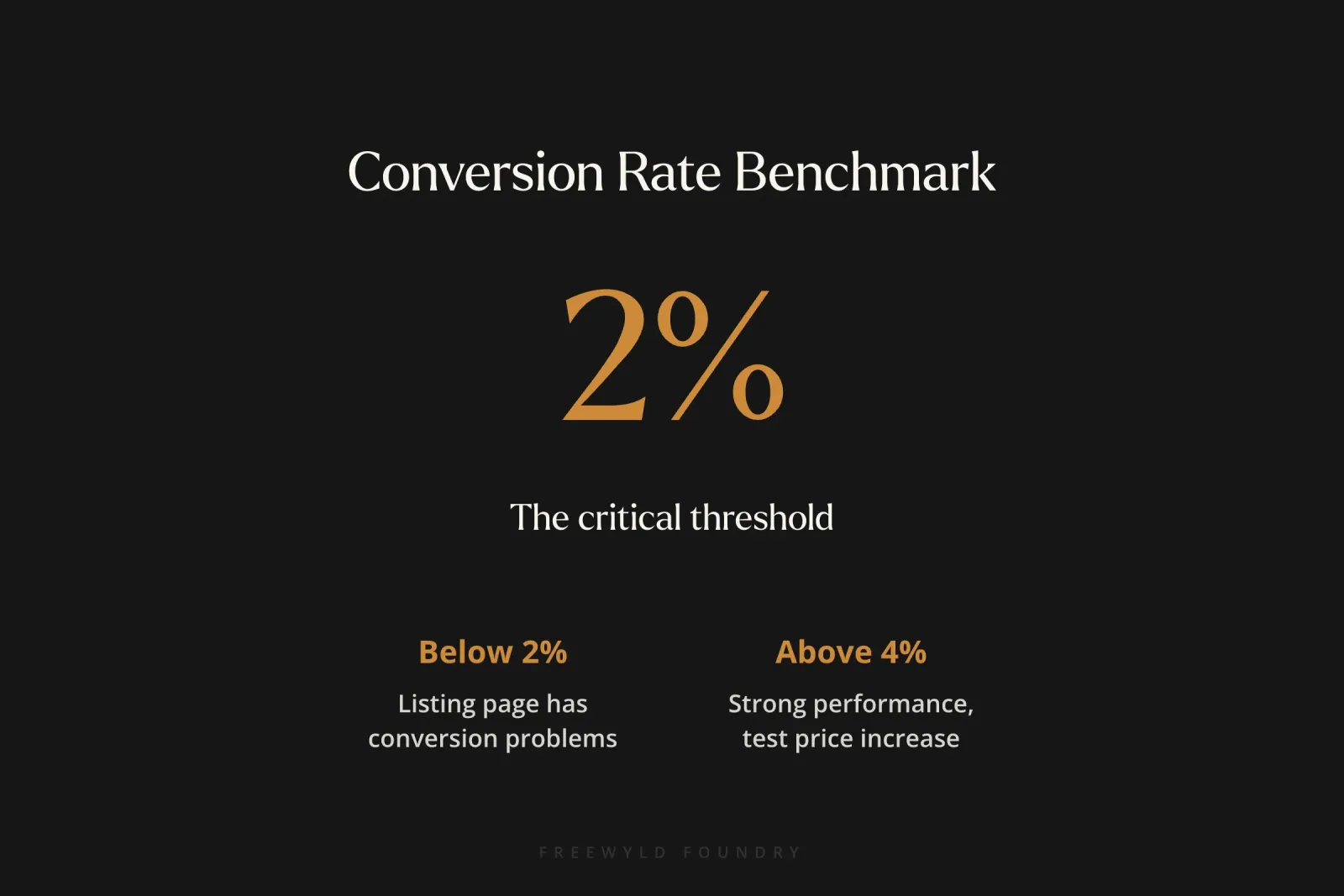
7. Track your conversion rate. In your Airbnb hosting dashboard, look at your views-to-bookings ratio. If it’s below 2%, your listing page has a conversion problem. If it’s above 4%, your listing is performing well and you should consider testing a price increase.
The Algorithm Rewards What Guests Want
If there’s one idea I want you to walk away with, it’s this: the Airbnb algorithm is a proxy for guest behavior. It doesn’t have opinions. It doesn’t play favorites. It watches what guests do, click, save, book, review, and it shows them more of what works.
So every algorithm optimization is a guest experience optimization. Better photos mean guests can accurately picture themselves in your space. Competitive pricing means guests feel they’re getting fair value. Fast responses mean guests feel taken care of before they even arrive.
When you frame it that way, “optimizing for the algorithm” stops feeling like gaming a system. It starts feeling like running a better hospitality business. Which is exactly the point.
See Where Your Listings Stand
Want to know how your properties perform against the algorithm factors that matter? We build custom revenue reports for operators that include search position benchmarking, pricing analysis, and specific recommendations for improving visibility and conversion.
It takes about 15 minutes and it’s free.
Request your free revenue report here and we’ll show you exactly where your listings stand, what’s holding them back, and what to fix first.
If you want to go even deeper on the pricing and revenue management side, our free workshops and guides cover the framework we use across our portfolio of 3,500+ listings.