Why Short-Term Rental Hosts Drop Prices Last Minute (While Hotels Charge More)
If you manage short-term rentals, you’ve probably noticed something frustrating. As your booking dates get closer, you feel pressure to drop your prices. But when you book a hotel or flight last minute, the prices skyrocket.
A 40-minute flight to Ibiza during peak season? $500. A two-hour ferry ride? Several hundred euros. Meanwhile, STR operators are slashing their nightly rates by 30%, 50%, or even 70% in the final weeks before arrival.
Short-term rental pacing is a revenue management strategy that measures how your future occupancy compares to the market’s future occupancy, helping you optimize pricing decisions based on competitive positioning. Understanding this concept is the difference between leaving money on the table and maximizing revenue across all seasons. This guide breaks down the pricing psychology, introduces the key metric you need to track (Market Penetration Index), and reveals when you should pace behind the market to maximize revenue.
Want to see how your pricing compares to top-performing operators? Get a free revenue report analyzing your portfolio’s pacing strategy.
What Is Short-Term Rental Pacing?
Short-term rental pacing is a revenue management strategy that measures how your future occupancy compares to the market’s future occupancy. It answers one critical question: Are you booking up faster, slower, or at the same rate as your competition?
According to Jasper Ribbers, Co-founder of Freewyld Foundry, “Short-term rental pacing is one of the most important concepts in revenue management. It’s also pretty tricky to understand, which is why we get so many questions about it.”
Think of short-term rental pacing like a race. If the market is 60% booked for the next 90 days and you’re only 30% booked, you’re falling behind. You need to adjust your pricing to catch up before it’s too late.
The opposite is also true. If you’re 80% booked while the market sits at 50%, you’re pacing ahead. You might have room to raise prices or maintain premium rates since you’re outperforming competitors.
Why Do Short-Term Rentals Drop Prices Last Minute?
The difference comes down to inventory structure and risk tolerance.
Airlines and Hotels Can Afford Empty Seats
Imagine an airplane with 100 seats. Historical booking patterns show that five more seats typically sell in the final week. If only 10 seats remain a week before departure, the airline can charge premium prices for those seats. Why? Because selling 90 out of 100 tickets is a successful outcome. They don’t need to fill every seat to be profitable.
Large hotel chains operate the same way. A 200-room Marriott can afford to leave rooms empty rather than discount. As Ribbers explains: “Four Seasons is never going to sell a room below a certain price. They’d rather leave the room unoccupied because they do not want to be associated as a brand with a low-cost option.”
STR Operators Face Different Pressures
Short-term rental operators don’t have that luxury, especially in the high season. Here’s why:
Single-unit risk: If you own one vacation rental, an empty weekend in peak season directly impacts your mortgage payment. You can’t absorb that loss across 100 other rooms.
Multiple owner problem: Even if you manage 100 properties, they likely belong to 20-40 different owners. When one property sits empty during prime season, that specific owner won’t be happy. You can’t tell them “but the other 99 are doing great.”
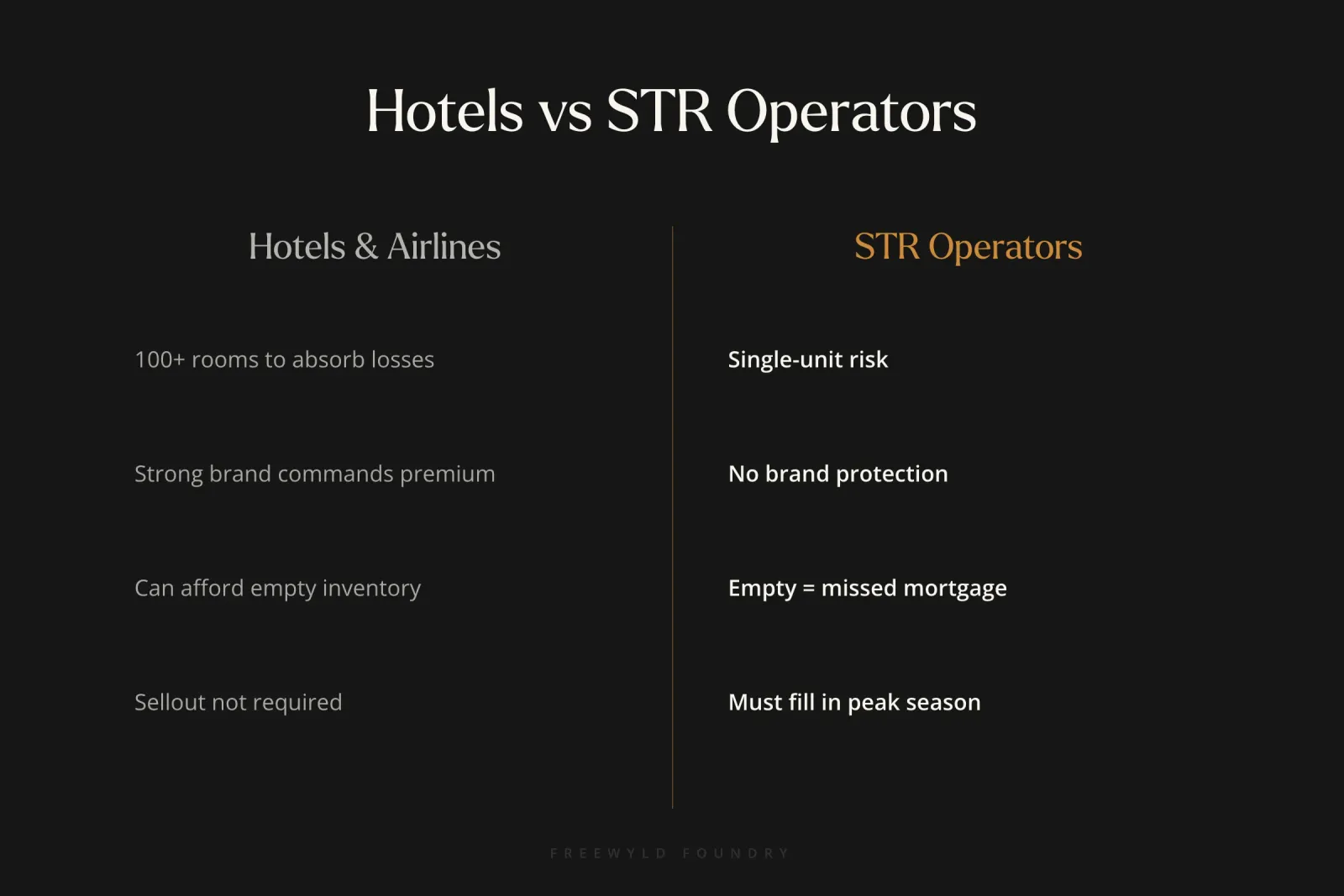
No brand protection: Ask people to name five short-term rental brands. They’ll probably say Airbnb. STR operators don’t have Four Seasons or Marriott-level brand recognition that justifies premium pricing regardless of occupancy.
Competitive pressure: Because most hosts think this way, they drop prices aggressively last minute. If everyone else lists similar properties at $100 per night in the final week, your $300 listing won’t get booked (unless it offers more value).
The Race to the Bottom
This creates a predictable pattern. Most hosts price high when dates are far out, then gradually lower prices as dates approach. By the final week, they’re often pricing near their minimum acceptable rate just to avoid an empty calendar.
According to Ribbers: “Most hosts take this strategy of lowering prices last minute because they want to maximize the chance to get booked. They don’t want to risk not getting booked, especially in the high season.”
The problem? This strategy often leaves money on the table. There are scenarios where pacing behind the market makes you more money, a concept explored in depth on our guide to proven revenue management strategies.
How to Measure Short-Term Rental Pacing (Market Penetration Index)
Market Penetration Index (MPI) is the single most important short-term rental pacing metric. It shows exactly where you stand compared to competitors.
The MPI Formula
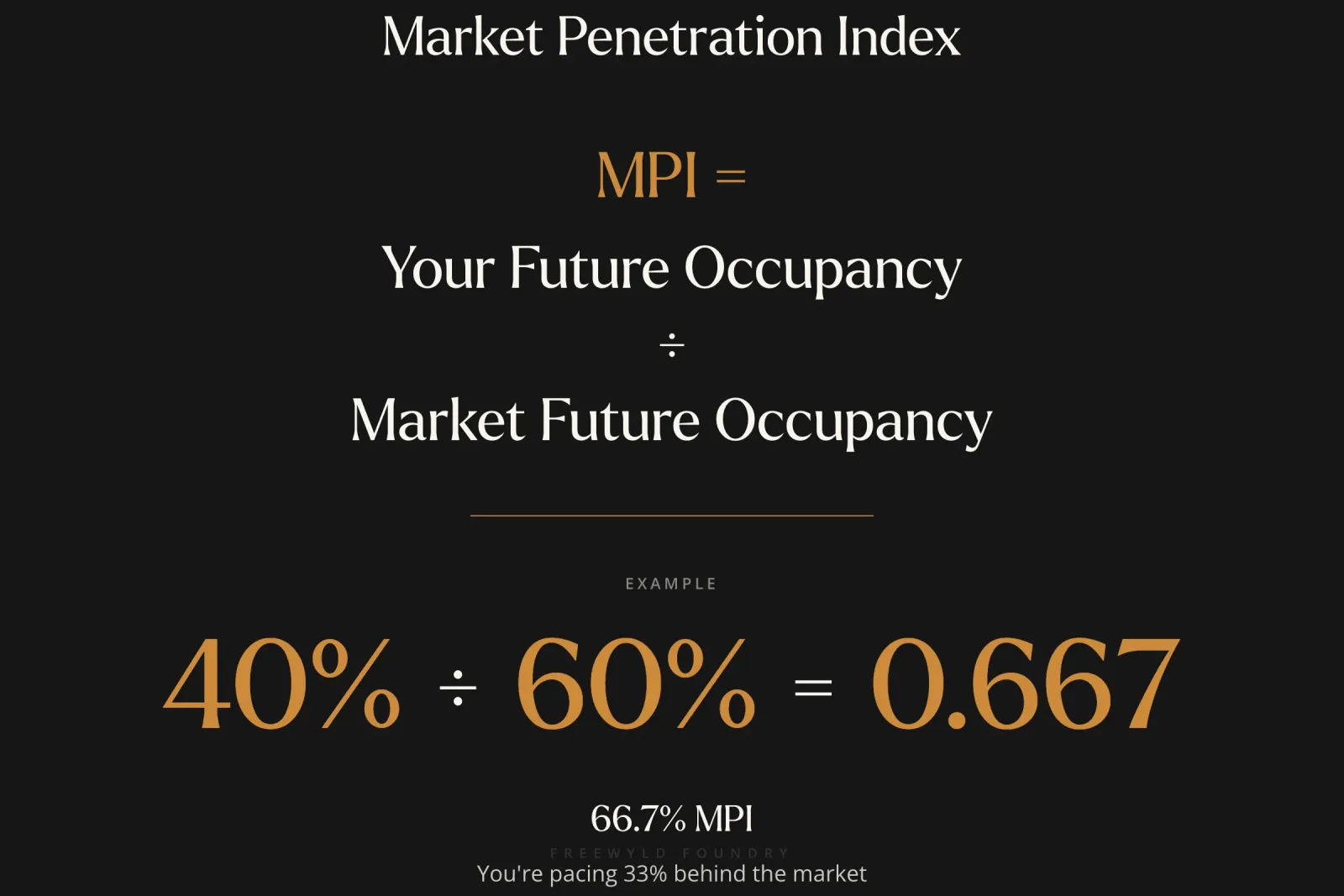
MPI = Your Future Occupancy ÷ Market Future Occupancy
Let’s say you’re looking at the next 90 days. Your properties average 40% occupancy. The market (your competitive set) sits at 60% occupancy.
40% ÷ 60% = 0.667 (or 66.7% MPI) article.
Real-World Example: Australian Christmas Strategy
Freewyld Foundry has a client in Australia where Christmas and New Year’s books 100% every year. According to Ribbers: “We are always pacing behind the market for Christmas and New Year just because most of the other operators in the area are selling their inventory too cheaply.”
The demand exists to fill every unit. Most operators underprice out of habit. By holding premium rates and pacing behind, this operator captures maximum revenue from the guaranteed demand.
When This Strategy Works
The last man standing strategy only works when:
- You’re confident the market will book near 100%
- Supply is limited relative to demand
- The event or season happens consistently (so you can verify historical data)
- Your property offers comparable value to sold-out inventory
The Risk
This strategy can backfire. During some major events, locals quickly list properties when they hear about premium pricing. Suddenly supply increases and late-priced units don’t book at all.
Ribbers cautions: “People have been burned by that strategy because in the last few weeks, a lot of local people decided to quickly put up an Airbnb listing. Supply increased and many people hoping to get booked at a very high price last minute actually did not get booked at all.”
When to Pace With the Market (High Season Strategy)
High season is when you want MPI between 90-110% (within 10% of market pace).
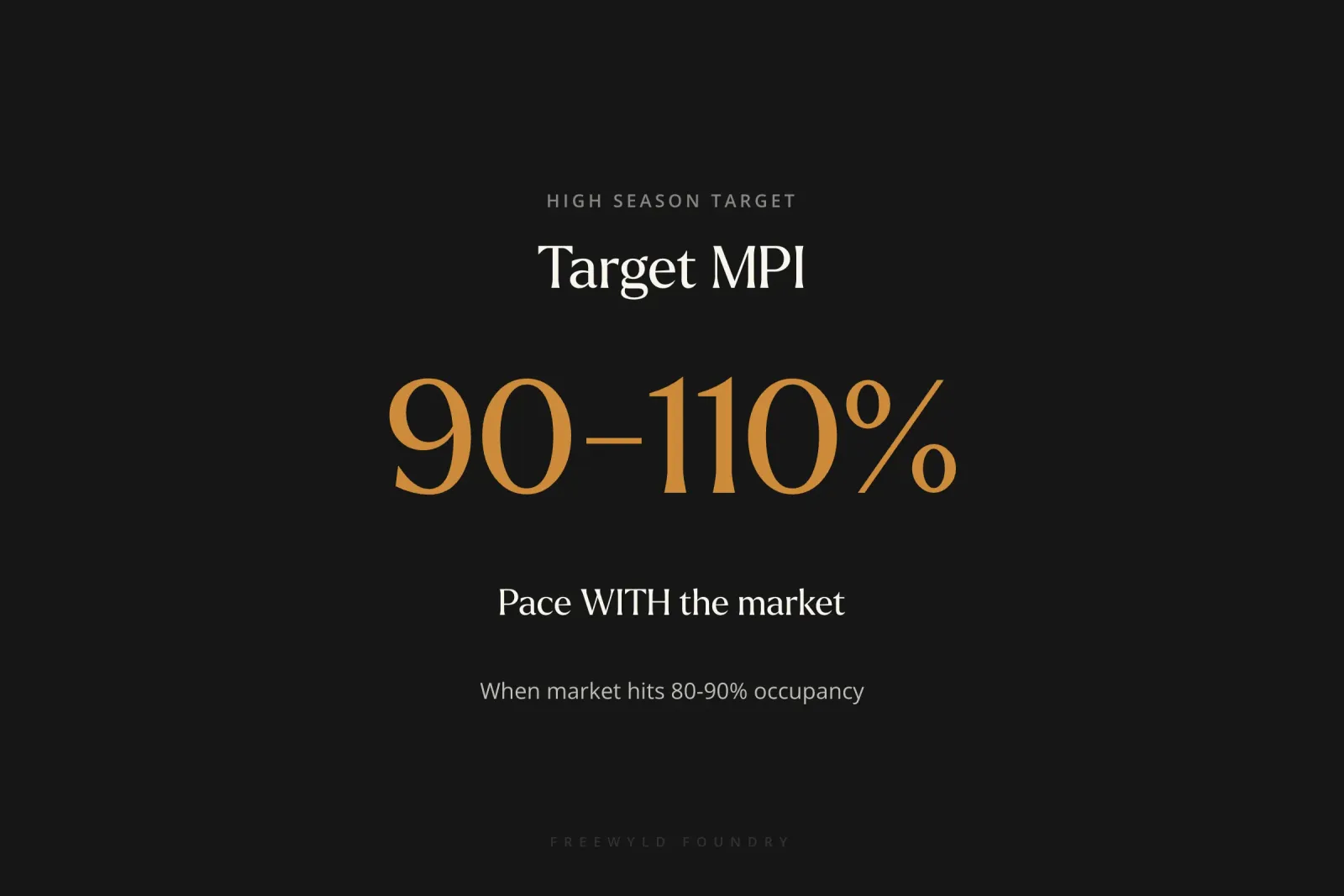
In periods where the market reaches 80-90% occupancy, you don’t want to rely on last-minute bookings. According to Ribbers: “If the market’s at 60%, you want to be around 60% as well. If you’re 50, 55, 65, 70, that’s fine. But if the market’s at 60% and you’re at 30%, you’re going to have to sell relatively more inventory later in the booking window. That’s going to hurt your overall revenue.”
Why This Matters for Short-Term Rental Pacing
Last-minute bookings in near-sellout periods force aggressive discounting. By the final week, desperate hosts drop rates 50-70% just to avoid vacancy. If you pace with the market early, you capture bookings at higher rates throughout the booking window.
This approach directly addresses common revenue management mistakes that cost operators thousands in lost revenue.
How to Implement
Step 1: Check your MPI for the next 30, 60, and 90 days using your pricing tool or manual calculation.
Step 2: For high-season periods (July 4th, Thanksgiving, peak summer weeks), target MPI of 90-110%.
Step 3: If your MPI drops to 70% or below two months before the dates, reduce prices to capture more bookings.
Step 4: Monitor pickup rate (bookings per week) to confirm your price adjustments are working.
Step 5: Gradually raise prices as you approach target MPI to maximize revenue.
When to Pace Ahead of the Market (Low Season Strategy)
Low season requires the opposite short-term rental pacing approach. When market occupancy sits at 40-50%, you want your properties at 60-80% or higher.
Why Occupancy Trumps Rate in Low Season
Ribbers explains: “The low season is not the time to try and get a higher price. It’s the time to focus on occupancy, not just to maximize revenue, but also because you want to continue to keep momentum on the OTAs.”
The hidden cost: “If you don’t get any bookings during the winter, it’s going to be really hard to get booked for the summer next time because your visibility of your listing for July is also going to be affected by the lack of bookings in January.”
OTA algorithms penalize properties with low booking activity. Empty January calendars hurt your July ranking. You’re not just losing winter revenue. You’re damaging your peak season performance.
Understanding these dynamics is crucial for operators who want to scale their STR management business sustainably.
The Strategy
Undercut competition early: When most operators still price relatively high at the beginning of the low-season booking window, go aggressive. Price close to your minimum to capture early bookings.
Focus on volume over rate: Every booked night maintains your algorithmic momentum. A $100 booking is better than a $150 empty night.
Don’t wait for competitors to drop prices: By the time everyone else discounts, the booking window is shorter and demand has moved to other markets.
Implementation Steps
Step 1: Identify your low-season months (typically when market occupancy drops below 50%).
Step 2: Set your pricing close to your minimum acceptable rate at the start of the booking window (120-180 days out).
Step 3: Target MPI of 120-150% (pacing 20-50% ahead of market).
Step 4: Accept that you’ll book earlier than competitors at lower rates.
Step 5: Track how this strategy impacts your high-season visibility and bookings over time.
Common Short-Term Rental Pacing Mistakes to Avoid
Mistake 1: Looking at Individual Unit MPI for Short Periods
MPI for one unit over one weekend is meaningless. You’re either 0% or 100% booked. The market might be 40% booked. This tells you nothing.
Instead, look at portfolio-level MPI across multiple units for periods of at least 30 days. If you manage 100 units, your MPI for a four-night Thanksgiving weekend reveals your true market position.
Mistake 2: Ignoring Pickup Rate
Current MPI without pickup context leads to bad decisions. An MPI of 60% looks bad. But if you’re getting six bookings per week (versus a normal 6-8 per month), you’re catching up fast. Don’t panic and over-discount.
This mistake often stems from not following a consistent revenue management routine that tracks both metrics systematically.
Mistake 3: Using the Same Strategy Year-Round
High season demands pacing with the market. Low season requires pacing ahead. Special events may call for pacing behind. One-size-fits-all pricing leaves money on the table.
Mistake 4: Trusting PriceLabs MPI Without Adjustment
PriceLabs includes unavailable days in MPI calculations. If your property is blocked for personal use, your MPI will show artificially high. Manually exclude unavailable inventory when calculating true market position.
Mistake 5: Forgetting Algorithm Consequences
Empty calendars don’t just lose current revenue. They damage future visibility. A vacant low season hurts your high-season ranking on Airbnb and VRBO, creating a downward spiral.
Operators who understand this connection between occupancy and visibility are better positioned to maintain 4.9 star Airbnb reviews by consistently attracting quality guests year-round. Additionally, avoiding Airbnb listing suspensions requires maintaining consistent booking activity throughout the year.
Frequently Asked Questions About Short-Term Rental Pacing
What is short-term rental pacing and why does it matter?
Short-term rental pacing is the comparison of your future occupancy rate to your competitive set’s future occupancy rate, expressed as Market Penetration Index (MPI). It matters because it reveals whether you’re booking faster, slower, or at the same rate as competitors, allowing you to adjust pricing strategy before it’s too late. Effective short-term rental pacing prevents last-minute discounting, maintains OTA algorithm visibility, and maximizes revenue by aligning your booking velocity with market demand conditions.
What is a good Market Penetration Index for short-term rentals?
A good MPI depends on the season and your market conditions. In high season when the market reaches 80-90% occupancy, target an MPI between 90-110% (pacing with the market). In low season with 40-50% market occupancy, aim for 120-150% MPI (pacing ahead). In guaranteed sellout scenarios like major events, you might intentionally pace behind with an MPI of 60-80% to capture last-minute premium pricing. The optimal short-term rental pacing strategy varies based on historical demand patterns and competitive dynamics in your specific market.
How do I calculate Market Penetration Index without PriceLabs?
Calculate MPI manually using this formula: Your Future Occupancy divided by Competitive Set Future Occupancy. First, determine your occupancy percentage for your target window (next 30, 60, or 90 days). Then research your competitive set’s occupancy for the same period using tools like AirDNA, Transparent, or manual competitor calendar checks. Divide your percentage by the market percentage. A result of 0.8 means 80% MPI (pacing 20% behind). A result of 1.2 means 120% MPI (pacing 20% ahead).
When should I lower my prices if I’m pacing behind the market?
Lower prices when you’re pacing significantly behind market (MPI below 70%) AND you have weak pickup (fewer than expected bookings per week). If your MPI is low but pickup is strong, your pricing is working and you’re catching up. Only adjust if both indicators show problems. In high season, address low MPI 60-90 days before arrival dates. In low season, be more aggressive earlier in the booking window (120-180 days out). Understanding when to adjust pricing is one of the key strategies that separates top-performing operators from average ones, similar to the tactics discussed in building systems that scale.
Does pacing behind the market ever make sense?
Yes, in “last man standing” scenarios where you’re confident the market will book 100%. This includes major concerts, festivals, sporting events, or seasonal patterns with proven historical sellouts. When the first 60-70% of inventory books at underpriced rates, the final 20-30% of available properties can command extreme premiums as desperate buyers exhaust other options. This short-term rental pacing strategy requires strong nerves and historical data confirming full market sellout. It’s particularly effective during events like the World Cup 2026 where demand exceeds supply.
How does low season pacing affect my high season performance?
Low occupancy in slow seasons damages your high season OTA ranking. Airbnb and VRBO algorithms favor properties with consistent booking activity. According to Jasper Ribbers of Freewyld Foundry, “Your visibility of your listing for July is also going to be affected by the lack of bookings in January.” Empty January calendars reduce your search ranking for July bookings, creating a compounding problem. Aggressive low-season short-term rental pacing (capturing bookings even at lower rates) maintains algorithm momentum for peak periods. This is why operators need to avoid common pricing mistakes that cost thousands throughout the year.
How often should I check my MPI for optimal short-term rental pacing?
Check your MPI at least weekly as part of your revenue management routine. For high-value periods (holidays, peak season, major events), monitor MPI daily starting 90 days before arrival. Combine MPI checks with pickup rate analysis (bookings per week) to understand both your current position and booking momentum. Properties with strong revenue performance typically review MPI for multiple time windows simultaneously: next 30 days, next 60 days, and next 90 days. Establishing a consistent approach ensures you catch pricing issues before they significantly impact total revenue, similar to the frameworks in our revenue management cadences guide.
Can I use short-term rental pacing for a single property?
Short-term rental pacing works best with portfolios of 5+ properties over periods of 30+ days. Single properties over short periods show MPI of either 0% or 100%, which provides limited actionable insight. However, single-property operators can still benefit by tracking MPI across longer windows (60-90 days) and comparing booking velocity (how quickly dates fill) against competitive set patterns over time. The key is understanding that short-term rental pacing becomes more statistically meaningful as you increase either the number of properties or the length of the measurement window, a concept explored in choosing the right revenue manager.
Conclusion
Short-term rental pacing works opposite to hotels and airlines because of fragmented inventory, owner structure, and lack of brand power. While this forces most operators into last-minute discounting, strategic pacing using Market Penetration Index can improve revenue.
The key insights:
Track MPI (your future occupancy divided by market future occupancy) combined with pickup rate to know where you are and which direction you’re heading. In high season, pace with the market (90-110% MPI). In low season, pace ahead aggressively (120-150% MPI) to maintain OTA momentum. In guaranteed sellout scenarios, consider pacing behind (60-80% MPI) to capture premium last-minute demand.
Different seasons require opposite strategies. One-size-fits-all pricing leaves money on the table.
Want expert analysis of your portfolio’s pacing strategy? If you manage $1M+ in annual short-term rental revenue, get a free revenue report analyzing your current pacing, competitive position, and specific opportunities to increase revenue.
Listen to the full conversation on the Get Paid for Your Pad Podcast where Jasper Ribbers breaks down short-term rental pacing strategies in detail. For more insights on common pitfalls that hurt revenue, explore our guide on revenue management mistakes that cost operators money.
About Jasper Ribbers: Jasper Ribbers is Co-founder of Freewyld Foundry, a Revenue and Pricing Management firm managing $170M+ in annual bookings across 3,500+ short-term rental listings. He specializes in data-driven pricing strategies and has helped 70+ operators achieve an average 18% performance lift above market rates. Connect with Jasper at linkedin.com/in/jasperribbers