July has been a quiet market. Broad growth is modest, the World Cup is wrapping up, and most operators are coasting through summer. That is precisely when the performance gap widens.
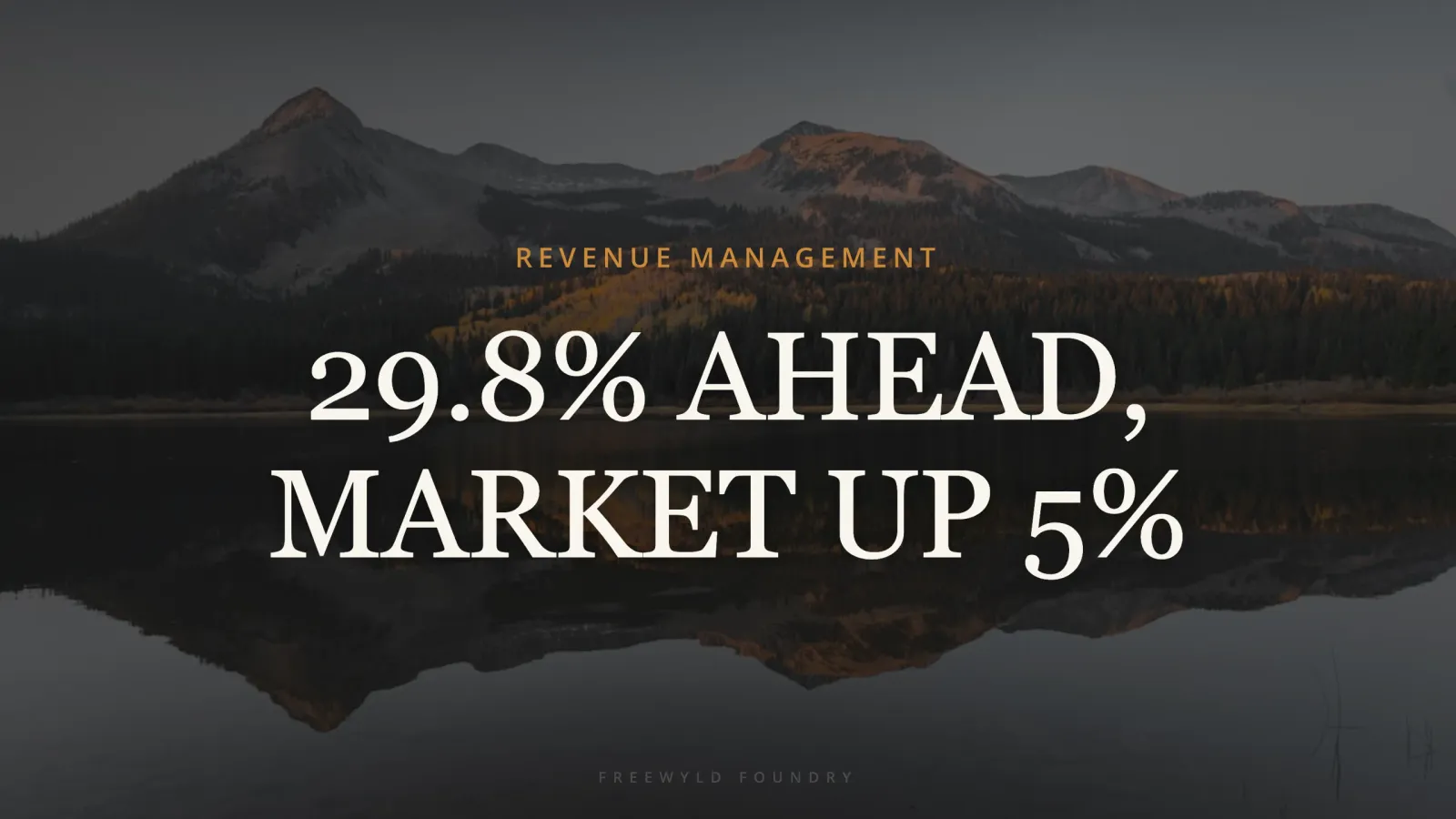
Freewyld portfolios are currently pacing 29.8% ahead of last year for July. The broader market is up around 5%. That gap was not built in the last two weeks. It was built across months of managing the full booking window while most operators focused only on filling next week.
There is also a meaningful strategic decision sitting in your Airbnb calendar right now. The top-rated guest discount Airbnb launched recently needs a proper strategy, not a quick toggle. And there is an August problem coming for most operators that is easy to fix if you move this week and expensive to ignore.
Here is the full picture.
Key Takeaways
- Freewyld portfolios are pacing 29.8% above last year in July. Broader markets are up approximately 5%.
- Most of that gap is built in the early booking window, not the last-minute scramble.
- August weekday demand softens sharply once schools return. If your seasonal pricing profile runs flat from Memorial Day to Labor Day, you are likely overpriced for mid-to-late August weekdays right now.
- The Airbnb top-rated guest discount is a 15% fixed discount for guests with 4.8+ ratings and 3+ reviews. It stacks with your other discounts. The math matters before you turn it on.
- A mobile-only discount is reportedly rolling out in select Airbnb markets. OTA discount strategy is becoming a discipline of its own.
- The World Cup semifinals and final are in Dallas, Atlanta, and New York this month. Last-minute demand spikes are possible in those markets.
July Performance: Markets at 5%, Freewyld at 29.8%
The July market is performing modestly. Most markets we are in are up around 5% year over year, with a few standouts.
Philadelphia is the clearest outlier. The city is outperforming significantly in July, almost certainly tied to the 250th anniversary of the United States. Philadelphia was where the Declaration of Independence was signed, and the festivities this year are drawing strong demand.
Beyond Philadelphia, markets are relatively flat. There is not a lot of broad tailwind to ride this summer. If you are performing well, it is coming from execution, not the market doing the work for you.
Freewyld portfolios are pacing 29.8% ahead for July. That number typically settles lower by month-end as the early-booking advantage normalizes. Final numbers will land somewhere in the 20 to 25% range, which is still a strong result given how quiet the overall market is.
| Market | July YoY | Notes |
|---|---|---|
| Philadelphia | Strong | 250th US anniversary driving demand |
| Halifax | Up | One of the stronger Canadian markets this month |
| Milwaukee / Wisconsin area | Up | Consistent performer in Freewyld’s portfolio |
| Most US markets | +5% avg | Flat to modest growth; no broad tailwind |
| Calgary and select Canadian markets | Down | Mixed results across Canada |
The August Problem You Need to Fix This Week
Most operators set a summer seasonal profile that runs flat from Memorial Day to Labor Day. That made sense when you set it up. It does not reflect what happens inside that window.
Schools in many US states return during the second and third week of August. When that happens, weekday demand drops noticeably. Families who were traveling mid-week are no longer available. The weekends stay strong, but Thursday night through Tuesday morning becomes harder to fill.
If your pricing profile is still running at summer rates for those weekdays, you are likely overpriced for dates that are increasingly difficult to book. The fix is straightforward: look at your August calendar now, identify the weekdays in weeks two through four of August, and make sure your rates are competitive for those nights.
The cost of doing nothing is those nights either go unfilled or get discounted last-minute at a worse rate than if you had adjusted proactively. Either outcome is worse than a small, planned adjustment now.
This is a concrete, time-sensitive action item. If you have a revenue manager or are working with a company, make sure they are looking at this. If you are managing yourself, it should be on your calendar this week.
Building the Performance Gap: The Early Booking Window
The 29.8% pacing advantage Freewyld has in July is not coming from last-minute fills. It comes from how we price the early part of the booking window.
The pattern most operators follow: watch the calendar, fill gaps in the next two or three weeks, drop prices when something looks unlikely to book. This approach handles last-minute pricing reasonably well. It leaves a significant amount of revenue on the table in the months before arrival.
Guests who book three, six, or nine months out are often willing to pay more. They are securing Christmas, Thanksgiving, a long-planned summer trip, or a peak weekend before it disappears. If your prices are set too high at that point in the booking window, they book something else and they do not come back.
Managing pricing competitively across the full window requires staying ahead of demand curves: understanding how your market paces, where the price-to-conversion threshold is at each point in time, and adjusting without waiting for the calendar to look urgent. That is what drives the early-window bookings that make up most of the performance advantage.
This year is not generating significant market tailwinds. If your portfolio is up meaningfully in July, it is almost certainly because of better early-window management.
The Airbnb Top-Rated Guest Discount: A Full Strategy Framework
Airbnb launched a 15% discount for guests with a 4.8 or higher guest rating and at least three reviews. The percentage is fixed. You cannot choose 10% or 20%. It is 15% or nothing.
To find it: Airbnb calendar, individual listing, click Discounts on the right side of your screen, look for Top Rated Guests below the weekly and monthly options.
Airbnb offers increased search visibility and a listing badge in exchange for enabling the discount. They have not specified exactly what the visibility improvement looks like.
Before you turn it on, understand the stacking math.
This discount adds on top of your other promotions. If you have an early bird discount active, a weekly discount, and then the top-rated guest discount, the compound effect can move your effective rate materially below your intended floor. Calculate your worst-case stacked rate before enabling it.
The price neutrality problem.
To maintain price neutrality with the discount on, you would need to raise your Airbnb base price by approximately 18%. Raising by exactly 15% does not work: a 15% discount off a price that includes a 15% markup leaves you below your original rate.
The practical problem: if you raise by 18%, every guest who does not have a 4.8+ rating and 3+ reviews is now paying 18% more than before. Depending on your market and your price position, this may move you outside the competitive range for the guest pool that is not qualifying for the discount.
One approach worth testing.
Raise your Airbnb markup by 5 to 10%, not the full 18%. Qualifying guests receive a meaningful real discount versus your previous pricing. Non-qualifying guests pay a modest premium. Your average rate is roughly neutral. You also get a natural filter: guests with established track records of five-star stays are more likely to be lower-risk, understand the review system, and less likely to leave a four-star review because they thought it meant “good.”
When Airbnb introduces a feature and explicitly wants hosts to use it, they typically reward adoption with algorithm visibility. That has been the consistent pattern. Whether this discount makes sense for your specific portfolio depends on your current OTA mix, your promotional stack, and your pricing headroom. There is no universal answer.
What to do right now.
Before enabling, audit your current promotions across Airbnb. Know your worst-case stacked rate. If it is still above your floor, the experiment is worth running. If stacking brings you below your floor, you either need to raise base prices first or stay out.
Mobile-Only Discount and the Growing Complexity of OTA Strategy
Hosts in select markets are reporting a mobile-only discount rolling out on Airbnb, mirroring the 10% mobile-only rate that Booking.com has offered for years. This has not appeared universally yet, but the direction is clear.
Each major OTA is building out its own promotional toolkit. Airbnb now has a top-rated guest discount, a mobile-only option in select markets, early bird, length-of-stay, weekly, and monthly discounts, all of which stack with each other. VRBO has its own set of promotions. Booking.com has Genius, mobile-only, and smart pricing.
If you are listed on multiple platforms, you now need a strategy for each one that accounts for how the discounts interact, what markup adjustments are required, and how your net rate compares across channels. Setting prices in a tool like PriceLabs and leaving OTA promotions on default is increasingly leaving money on the table or, worse, producing rates that are inconsistent and confusing to guests comparing options.
A dedicated episode on OTA discount strategy is coming in a future month. It warrants its own full treatment.
World Cup Final Stretch
The World Cup semifinals are being played in Dallas and Atlanta. The final is on July 19th in New York. If you have properties near any of those venues, expect last-minute demand spikes, particularly if a country reaches the final unexpectedly. Fans who did not plan to travel for earlier rounds will pay a premium for the final.
After July 19th, the World Cup is over. Markets that benefited from event-related demand will normalize. Operators who raised prices significantly for game markets should re-evaluate their positioning heading into the second half of summer.
Get a Free Analysis of Your Revenue Setup
If you are managing 15+ properties and generating $1M+ in annual revenue, apply for a free revenue report. Freewyld manages $170M+ in bookings across 3,500+ properties, and our clients average 18% above their market. We will show you specifically where your current setup is limiting revenue.
Apply at FreewyldFoundry.com/report
Listen to the Full Episode
July STR Market Update: World Cup Impact, July Pacing, and Airbnb’s New 15% Discount on Get Paid for Your Pad, EP 728. Jasper covers the full market breakdown, the Airbnb discount strategy in detail, and what to watch heading into August.
Related Articles
- STR Market Update June 2026: World Cup Results and Airbnb’s New Discounts - The June breakdown, World Cup city data, and the first look at Airbnb’s new guest discount.
- Price Labs Features Guide: 7 Tools You’re Not Using - How to configure PriceLabs to capture the revenue most operators miss.
- Best PMS for STR Revenue Management: 5 Systems Ranked - The software layer between your pricing strategy and the OTAs that book your units.
- How to Scale STR Revenue Management from 10 to 100+ Properties - The systems and structure required to manage revenue at scale without adding headcount.
FAQ: STR Market Update July 2026
How are STR markets performing in July 2026?
Broadly, markets are up around 5% year over year in July. Growth is modest and concentrated in a few standouts. Philadelphia is the clearest outlier, likely driven by demand around the 250th anniversary of US independence. Most other markets are flat to slightly up, with no significant broad tailwind.
Why is Freewyld pacing 29.8% ahead in July if the market is only up 5%?
The performance gap is built primarily through early booking window management. Most operators focus on last-minute pricing. Freewyld manages pricing competitively across the full booking window, capturing guests who book months in advance and are willing to pay a premium. That advantage compounds across a full month and a full portfolio.
What should STR operators do about August pricing right now?
Check your mid-to-late August weekday rates. If you are running a flat summer seasonal profile, your pricing likely does not account for the demand softening that happens once schools return. Weekday demand in the second and third weeks of August drops in most markets. Proactively lowering weekday rates for those dates is better than discovering the problem last-minute.
Should I turn on the Airbnb top-rated guest discount?
It depends on your current promotional stack and pricing headroom. Before enabling, calculate your worst-case stacked rate including all active discounts. If the floor is still acceptable, the experiment is worth running given Airbnb’s history of rewarding adoption with visibility. If stacking brings you below your rate floor, raise your base price first or stay out.
How does the Airbnb top-rated guest discount stack with other promotions?
It adds on top of early bird, weekly, monthly, and length-of-stay discounts. The compound effect can be significant depending on how many promotions you have active simultaneously. Audit your full promotional stack across Airbnb before enabling the top-rated guest discount.
What is the Airbnb mobile-only discount?
A 10% discount for guests booking via the Airbnb mobile app, similar to a feature Booking.com has offered for years. It is currently rolling out in select markets and has not appeared universally. If it launches broadly, it will stack with the top-rated guest discount and existing promotions, adding further complexity to OTA pricing strategy.
What happens to World Cup markets after July 19th?
The World Cup final is July 19th in New York. After that, event-driven demand disappears. Markets that raised prices significantly to capture World Cup guests should expect demand to normalize quickly. Operators in Dallas, Atlanta, and New York specifically should re-evaluate pricing for the remainder of July and heading into August.