Most STR operators do not realize they are already doing midterm rentals. They just are not being intentional about it.
39% of short-term rental operators have received at least one booking of 30 nights or longer. Those bookings happened organically, without a specific MTR strategy, without listing on midterm-specific platforms, and without adjusting amenities for a longer-stay guest. The demand found them anyway.
The conversation about midterm rentals tends to get framed as a choice between two business models. STR or MTR. Airbnb or Furnished Finder. Short stays or long stays. That framing misses what is happening in the market. Midterm rental is not a separate industry. It is a demand type that already overlaps with your existing business, and most operators just have not figured out how to capture more of it.
After managing $170M+ in bookings across 70+ client portfolios, here is what the data shows about midterm rentals, what makes the math work, and how to approach it without throwing out everything you have built.
Key Takeaways
- 39% of STR operators have already received at least one 30+ night booking, even without an MTR strategy
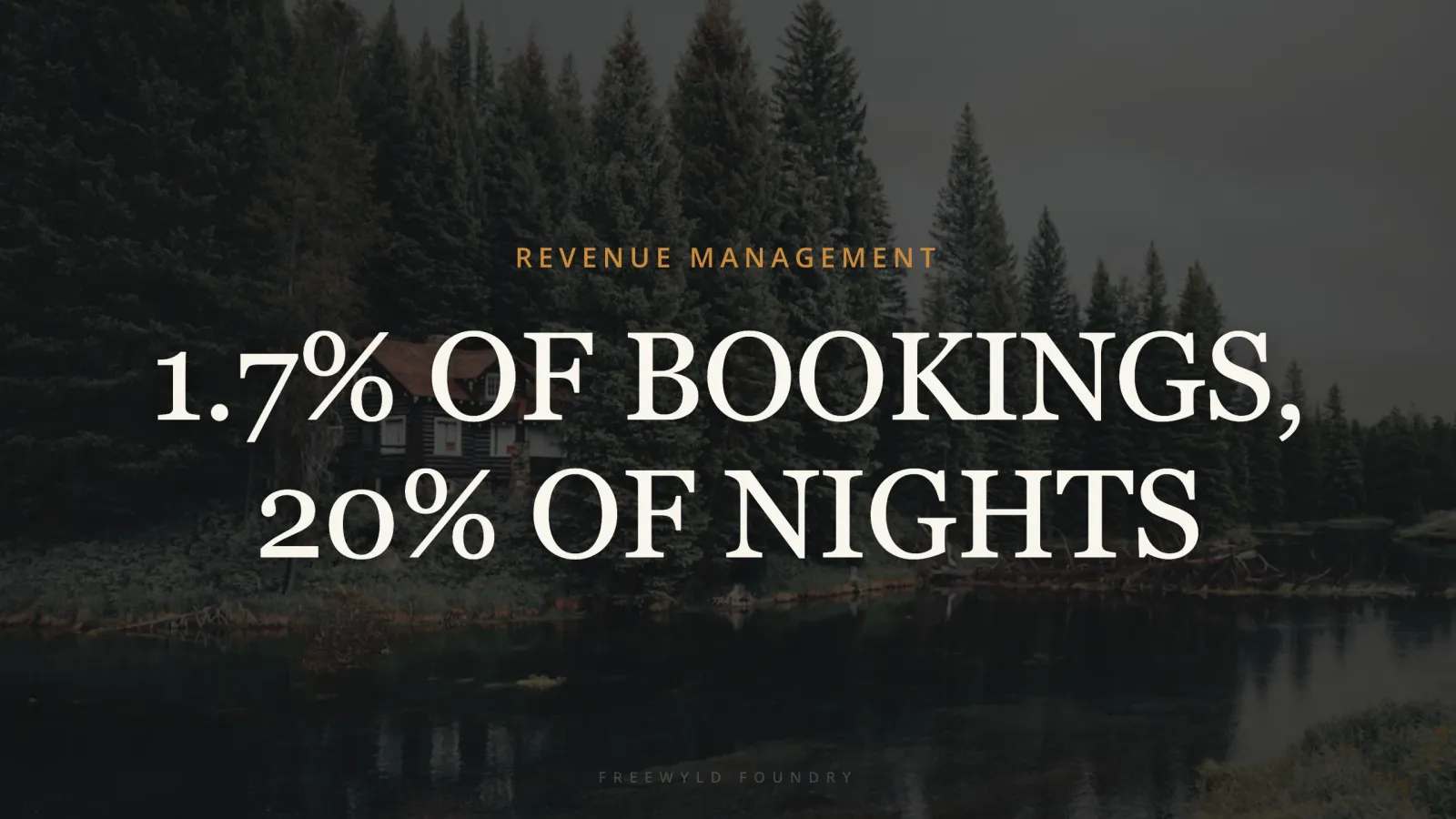
- Midterm rentals represent only 1.7% of reservations but 20% of booked nights, which means a few MTR stays have an outsized occupancy impact
- 100% midterm rental occupancy at the national average rate generates roughly the same gross revenue as 53% STR occupancy at the national average STR rate
- The hybrid approach, keeping your calendar open and adding long-stay discounts, consistently produces more MTR bookings than setting a hard 30-night minimum
- New listings should not pursue MTR early on: you need reviews and algorithm momentum first
- Midterm rental rates vary widely by market: California averages 95% of STR rates, while Connecticut and Pennsylvania average around 30 to 35%
- Top MTR operators use an average of 8 distribution channels versus 4.8 for operators with no MTR activity
The Stats That Changed How I Think About This
When I look at the data Frank Bosie from Hostfully shared on midterm rental activity across their platform, the first number that stops me is this one: 1.7% of reservations represent 20% of booked nights.
Read that again. Less than 2% of your bookings could be filling 20% of your occupied nights.
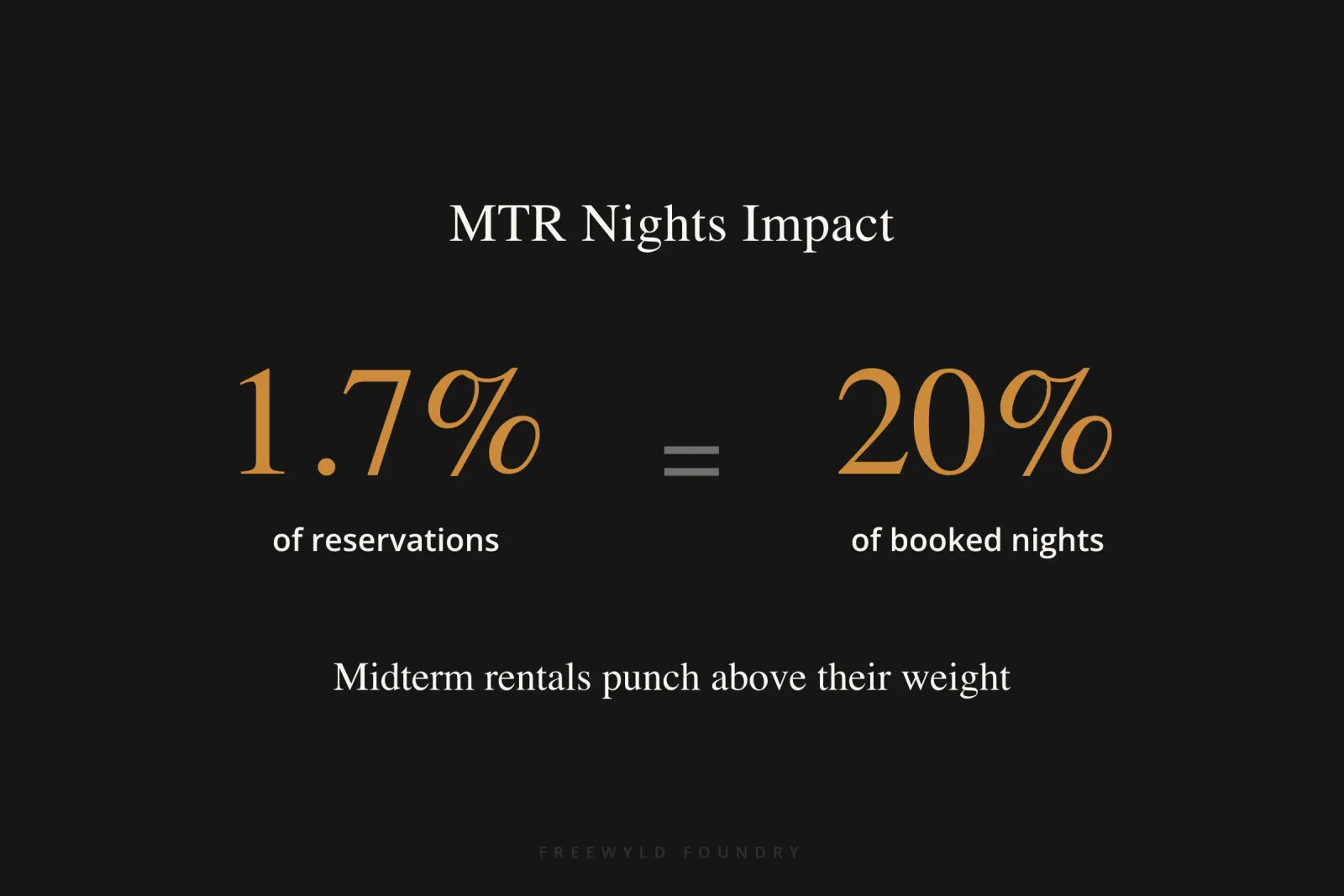
You do not need a lot of midterm rental reservations for them to meaningfully move your occupancy numbers. A handful of 30 to 60-day stays can fill a soft shoulder season or low season calendar in a way that twenty weekend bookings cannot: the nights are that concentrated.
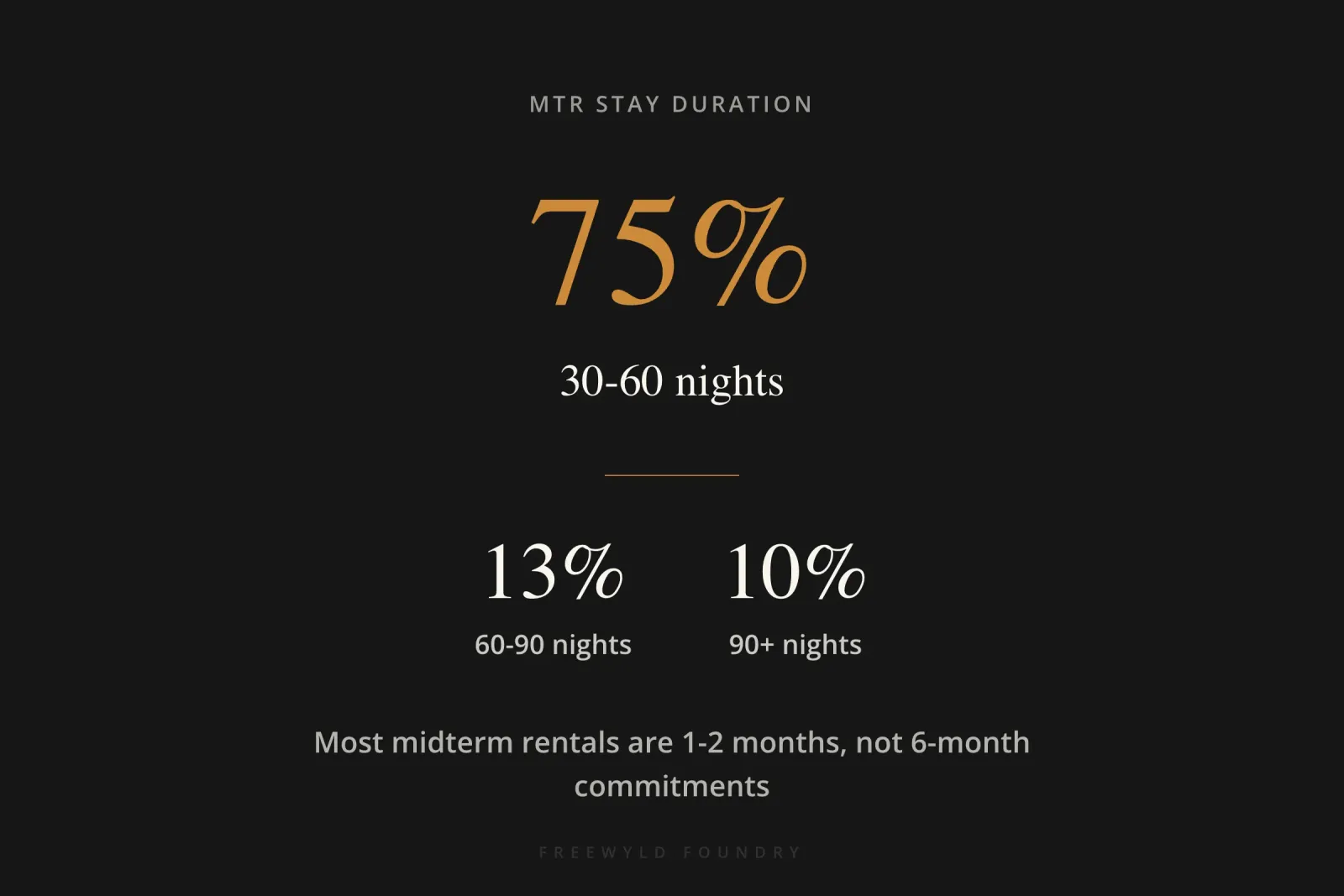
The other number worth sitting with: 75% of midterm rental stays are 30 to 60 nights. Another 13% are 60 to 90 nights. Only about 10% are 90 nights or longer. So when operators worry that midterm means locking a property up for six months, the data does not support that. Most of the time, you are talking about one or two months.
That changes the risk calculus considerably. A 45-day booking is not a six-month commitment. It is six weeks.
The Occupancy Crossover: When the Math Flips
The biggest objection to midterm rentals is the nightly rate. And it is a real objection. The national average STR nightly rate is around $315. The national average midterm rental rate is around $160. That is roughly a 50% discount for a longer stay.
At first glance, that sounds like a terrible trade. Here is why it is not, in a lot of situations.
Average daily rate only tells part of the story. What matters is how many of those nights you are filling. At those national averages, 100% midterm rental occupancy generates roughly the same gross accommodation revenue as 53% STR occupancy. This is the occupancy crossover.
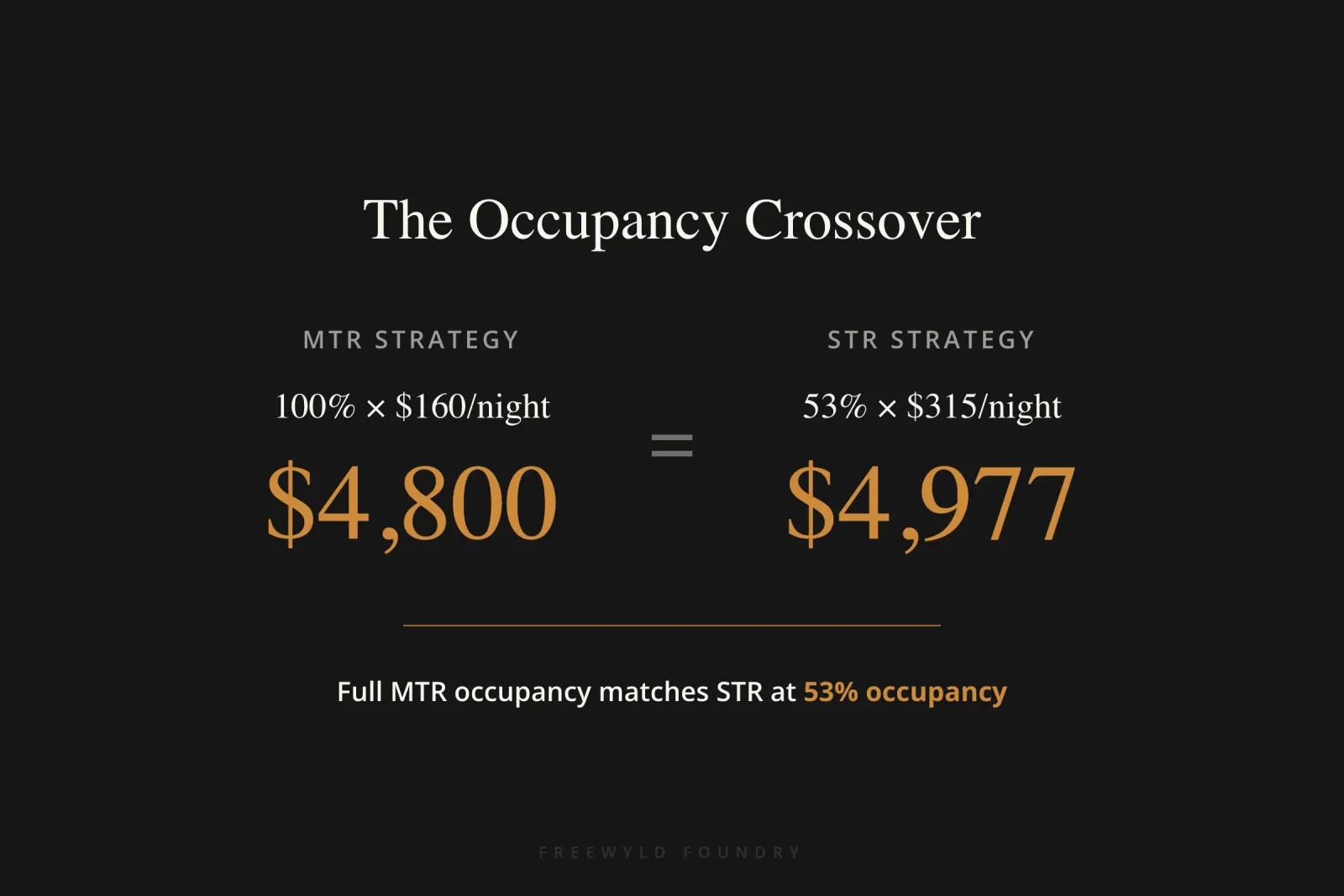
If your property is sitting at 35% occupancy in November because short-term rental demand is soft, a midterm tenant at $160 a night generating 100% occupancy is not a bad trade. You are generating significantly more revenue than a 35% occupancy STR month, with one check-in instead of ten, one turnover instead of ten cleanings, and zero vacancy gaps.
Understanding your booking window is where this analysis has to start. If your low season months are pacing poorly three months out, that is exactly the window where midterm rental demand becomes worth targeting. Snowbird travelers, corporate relocators, and travel nurses book months in advance. If your pricing is not set up to attract them, you will not see them in your calendar.
The operational math compounds the revenue argument. An average STR stay is about three and a half nights. To fill 45 occupied nights at that average, you need roughly twelve separate reservations: twelve check-ins, twelve turnovers, twelve cleaning cycles, twelve sets of guest communication. A single 45-day midterm booking covers the same occupied nights with one of everything. Fewer opportunities for something to go wrong, lower operational cost per occupied night, and significantly less management time.
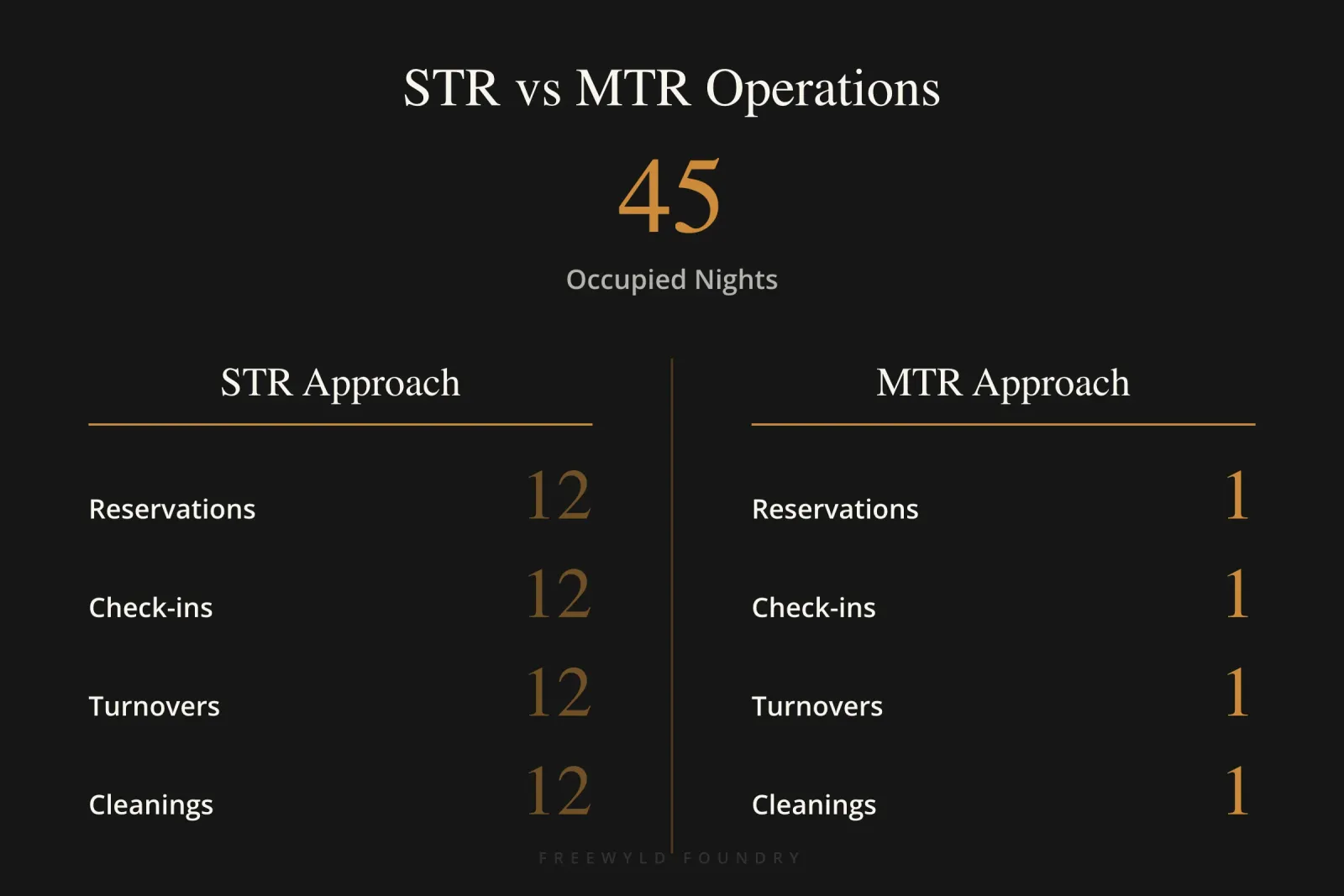
That cost-per-occupied-night math is something most operators overlook when running their STR revenue numbers, but it is one of the clearest advantages midterm rentals offer during soft months.
Why the Hybrid Approach Beats a Hard Minimum
The intuitive approach to midterm rentals is to set a 30-night minimum during your slow season and wait for long-stay bookings to come in. We have tried this. It does not work as well as you would expect.
The approach that consistently produces more midterm bookings is the hybrid: keep your calendar open to any length of stay, but add meaningful long-stay discounts (weekly and monthly) to create an economic incentive for guests who are considering a longer stay. On Airbnb, a 10 to 20% monthly discount signals to longer-stay travelers that your property is available and priced for them, without locking out the short-stay guest who wants to book the same period.
A guest considering a 60-day stay is often not set on a specific property. They are evaluating options. When they compare your listing with a competitive nightly rate and a clear monthly discount, against another listing with a 30-night minimum and no flexibility, your property is the easier choice.
We found that this hybrid strategy generated more midterm rental stays than the exclusive MTR approach. The reason is straightforward: you are not restricting your demand pool. You are attracting two types of guests instead of one.
This connects directly to distribution strategy. Midterm rental demand is fragmented. A travel nurse searching for a 60-day stay in Charlotte is not searching in the same place as a vacation traveler looking for a weekend in Charlotte. Top midterm rental operators average 8 active distribution channels compared to 4.8 for operators with no MTR activity. If you are only on Airbnb and VRBO, you are missing a portion of the demand that Furnished Finder, HomeAds, Blueground, and corporate housing platforms serve.
One Exception: Do Not Start MTR With a New Listing
This is the advice that saves operators real money, and most people figure it out the hard way.
If you have a new listing, do not pursue midterm rentals yet. You need reviews. You need search algorithm momentum. You need the initial guest traffic that teaches Airbnb your listing converts well.
The problem with an early MTR booking: if a guest books your new listing for two months, you get one review after they leave. On Airbnb, you need three reviews before a star rating even shows up. Airbnb also gives new listings a promotional visibility window during the first several weeks. If your calendar is locked into a single long-stay booking during that window, you lose the algorithm boost entirely.
I have seen operators put a brand new property on the market and land a 60-day booking in the first week. That sounds like a win. Then the booking ends, the property has one review and no rating, no algorithm momentum, and the operator has to start building that base from scratch without the new listing advantage.
Spend the first year or so focused on short stays. Get 30 to 50 reviews, establish a strong rating, and build your Airbnb search rank. Once that foundation is solid, a period with fewer bookings will not hurt you the way it would with a new listing. Launching a new STR unit for maximum revenue means short stays first.
Market Rate Differences Are Larger Than You Think
The 50% average discount for midterm stays is a national average. The actual number varies so much by market that the national figure is almost misleading.
In California, midterm rental rates average around 95% of short-term rental rates. The discount for a longer stay in California is close to nothing. If you are in a California market and someone wants to stay 45 days, you are getting near-STR rates for a much easier operational month.
Colorado comes in around 80% of STR rates. Still competitive.
Connecticut averages around 30% of STR rates. Pennsylvania is similar, around 35%. In those markets, the occupancy crossover math is the only thing that makes MTR work. You need very high occupancy to offset a 65 to 70% rate discount.
The explanation for these differences is supply and demand of longer-stay accommodation. In high-cost markets where professionals need extended housing, midterm rental rates stay high because alternatives (hotels, extended-stay properties, corporate apartments) are expensive. In markets where short-term rental supply is high and longer-stay demand is more price-sensitive, the discount widens.
Before assuming midterm rentals will work for your property, understand your market’s MTR rate range. AirDNA and Furnished Finder have market data. The gap between your STR rate and the achievable MTR rate in your specific market is the variable that determines whether the math works.
Tenancy regulations are the other variable to check. Some counties and states grant renter rights to guests who stay 30 nights or longer. This can limit your ability to remove a guest for non-payment or property damage without a formal eviction process. Smart operators understand their local rules before accepting a 30+ night booking. One property manager I spoke with limits stays to 28 nights specifically because of tenancy law in their county. That is the right call for their market.
What Midterm Guests Need (It Is Not What You Think)
Midterm rental guests have different expectations from vacation travelers, and if you do not understand those expectations, you will get bad reviews even from guests who had a fine stay.
A vacation traveler often books for experience: a pool, a hot tub, a view, proximity to a tourist area, Instagram-worthy design. A guest staying 60 days is thinking about livability. Can they work comfortably here? Can they cook real meals? Is there laundry in the unit? Is there parking? Is there enough storage for two months of luggage?
The amenities that matter most for midterm stays:
- Fast, reliable wifi (this is non-negotiable; slow wifi ends midterm rentals)
- A dedicated workspace: a proper desk and chair, not a bar stool at a kitchen counter
- A full kitchen with enough cookware to make actual meals
- In-unit laundry, not shared laundry
- Parking included in the rate
- Adequate storage: closet space, drawers, somewhere to put two bags and a suitcase
I stayed in one of my own properties in Colombia for three months and used it as a diagnostic. The experience told me exactly what was missing for a longer-stay guest. We added a standing desk after that stay. That one addition opened up the property to a different type of long-stay professional traveler, because most Airbnbs do not have one.
Properties near the right demand generators also outperform significantly for MTR. Hospitals, universities, military installations, major employer hubs, and downtown corporate corridors generate need-based demand: travel nurses on 13-week contracts, consultants on project assignments, relocating families, insurance-displaced households. That demand exists regardless of whether it is peak tourism season, which is the whole point. Midterm rental fills the calendar when vacation travelers are not traveling.
The Portfolio Size Signal
One of the clearest signals in the Hostfully data is the relationship between portfolio size and midterm rental activity.
7.3% of single-property operators have midterm rental bookings. Jump to operators managing 6 to 20 properties, and that figure is 69%. For operators managing larger portfolios, it is over 80%.
Experienced portfolio operators are treating midterm rentals as a revenue tool, not a separate business. When you manage 20 or 50 properties, you are constantly looking for ways to keep every unit generating revenue on every available night. A 45-day booking on a property that was pacing poorly in February is not a compromise. It is a win.
For smaller operators, the lesson is not that you need to scale to pursue MTR. It is that as your portfolio grows, the calculus around midterm rental changes. With one property, a 60-day booking during your best season is a bigger opportunity cost. With five properties, you can segment: short stays on your highest-demand units during peak season, midterm targeting on the units that historically struggle in slow months.
How to Start
You do not need to overhaul your business to test midterm rentals. Here is a practical starting point.
Step 1: Identify your soft months. Pull your occupancy data for the last 12 months and find the months where you are below 55 to 60%. Those are your MTR candidates.
Step 2: Check your local MTR rate. Search Furnished Finder for properties in your market. What are comparable units listing for on a monthly basis? That tells you whether the occupancy crossover math works in your market.
Step 3: Enable monthly discounts. On Airbnb, set a monthly discount of 15 to 25% (or whatever rate gets you to a competitive MTR price). Keep your calendar open to shorter stays. Do not set a 30-night minimum. Let the hybrid approach work.
Step 4: Check tenancy regulations. A quick conversation with a local real estate attorney or property manager who operates in your market can tell you whether 30+ night stays create any tenancy complications. Know before you accept.
Step 5: Audit your amenity list. Review your listing against the midterm guest checklist: dedicated workspace, full kitchen, in-unit laundry, parking, storage. Missing items are not necessarily deal-breakers, but add anything you can before targeting MTR.
Step 6: Expand distribution. List on Furnished Finder at minimum. Consider HomeAds and Blueground if your market has corporate demand. This is where the 8-channel average for top MTR operators comes from. Airbnb and VRBO reach vacation travelers. You need platforms that reach traveling professionals and corporate relocators too.
If you are working with a PMS like Hostfully, the integration layer is getting easier. Hostfully recently entered beta on a Furnished Finder integration that brings MTR bookings into the same calendar, guest communication, and payment system as your existing reservations. Managing a long-stay booking on a separate system with manual calendar blocking was one of the biggest operational friction points for MTR. That is starting to change.
The Question to Ask Yourself
The right frame for midterm rentals is not: should I be an STR operator or an MTR operator?
It is: when should this property be a short-term rental, and when might midterm make more sense?
July in a Florida beach market: probably short-term. January in that same market: midterm might be the better move. A high-demand summer weekend property near a ski resort: short stays during season, potentially MTR during the weeks the ski resort is not drawing vacation traffic.
Protecting your strong STR periods while using midterm rentals to fill the occupancy gaps is a more sophisticated strategy than committing to one model or the other. Most operators who do it well start with one or two soft months on one property, see how the demand responds, and expand from there.
If you want to understand where your portfolio has room to improve, whether on pricing, distribution, or low-season strategy, apply for a free revenue report. We manage $170M+ in bookings across 70+ client portfolios and we will show you exactly what the data says about your properties.
Listen to the Full Conversation
This article draws on a conversation with Frank Bosie, Senior Director of Partnerships at Hostfully, on the Get Paid for Your Pad podcast.
Listen on Acast | Watch on YouTube
Related Articles
- STR Distribution Channels: Which Platforms Should You Be On - The full breakdown of Airbnb, VRBO, Booking.com, and direct bookings, and when to expand beyond the major platforms.
- How to Price Short-Term Rentals in Shoulder Season - Shoulder season is where midterm rental timing overlaps most with STR pricing decisions. This covers the full shoulder season strategy.
- The 5 Best PMS Systems for STR Revenue Management - If you are managing MTR alongside STR, your PMS choice matters more. This compares the top options including Hostfully.
- STR Market Update August 2026 - The August market update that covers low-season positioning and why right now is the time to set up midterm rental pricing.