August is a complicated month for STR operators. The first half is high season in most markets. The second half is shoulder season, as schools go back and that weekend-trip demand starts to pull back. Getting August right means treating it as two separate revenue windows, not one flat profile.
This year, there was an additional wrinkle: Labor Day weekend fell in August in 2025 and in the first weekend of September in 2026. That single shift pulled meaningful demand out of August. If you looked at your August numbers and saw a 5 to 10% decline from last year, that calendar effect is likely most of the explanation. The good news is that September is already pacing 15 to 20% ahead because of it.
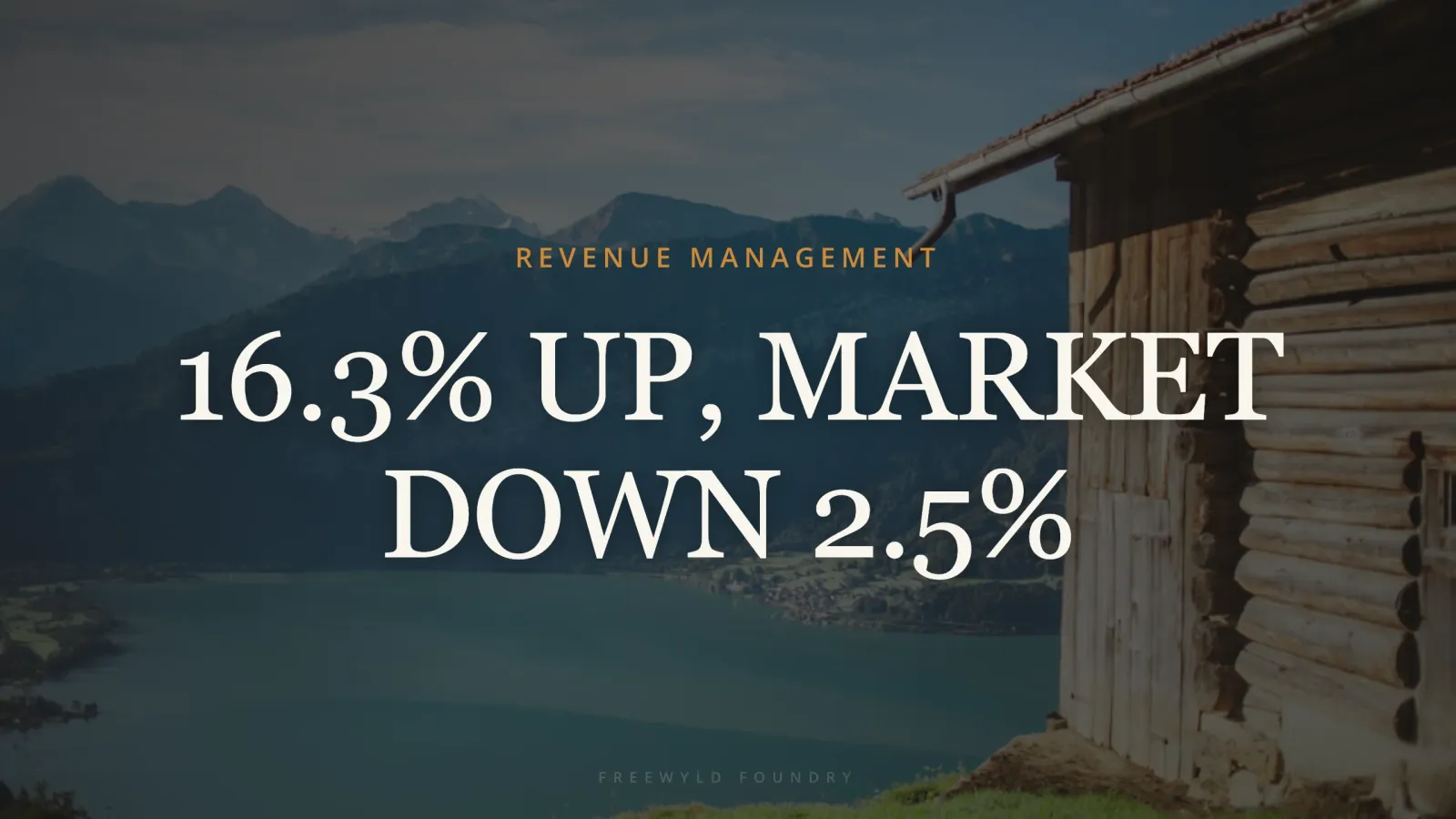
At Freewyld Foundry, we finished August as our highest-impact month on record. Comparable client listings, meaning properties that were active in both August 2025 and August 2026, were up 16.3% year over year while the broader market averaged a 2.5% decline. That produced a combined impact of 19.3% and just over $2.1 million in additional revenue for clients.
Here is what happened, what changed on the platforms, and what you should be focused on for the next two months.
Key Takeaways
- Freewyld client portfolios grew 16.3% in August on a comparable-unit basis while the broader market fell 2.5%, producing a 19.3% combined impact.
- The Labor Day weekend shift from August to September explains most of the market softness. September is pacing 15 to 20% ahead as a result.
- Branson MO, Chattanooga TN, and Myrtle Beach SC were down 20 to 25%. San Antonio TX, Columbus OH, and Milwaukee WI led the gains at 11 to 13%.
- Airbnb’s 15.5% host-only fee is rolling out to all hosts without a PMS in September and October.
- VRBO launched sponsored listings with a $5 minimum bid. Early movers may get the cheapest placement before most operators discover it.
- OTA discount stacking is now a serious revenue management discipline. A guest who is top-rated, on mobile, and books weekly can get a combined 35% or more off your Airbnb price. If your markup does not account for this, you are selling below your floor.
August by the Numbers
Across the 75 markets where we manage portfolios, comparable-unit revenue was up 16.3% year over year for our clients. The broad market fell 2.5%.
The way we calculate this matters. We take only listings that were active in both August of last year and August of this year, with no significant calendar blocks or external factors that would skew the comparison. This is what we call comparable units. A portfolio that has grown from 20 to 35 properties will show portfolio-level revenue growth almost automatically. Comparable units strip that out and show you how the same listings performed.
Managing the full booking window, not just the final two weeks of availability, is where most of the performance gap comes from. By the time a listing shows up in last-minute searches, the revenue upside is mostly gone. The operators who outperform do it by managing pricing across the entire window, months ahead, not just when a date is 10 days out.
That is not a small operational difference. It is the core reason comparable-unit results diverge from market averages over time.
Which Markets Won and Which Got Crushed
| Market | August YoY | Notes |
|---|---|---|
| San Antonio, TX | +13% | Strongest US performer in August |
| Columbus, OH | +12% | Consistent performer through summer |
| Milwaukee, WI | +11% | Strong local demand through August |
| Canada / Select Europe | +15% | Several markets up strongly |
| Branson, MO | -25% | Steepest decline in our network |
| Chattanooga, TN | -25% | Significant drop; demand shifted |
| Myrtle Beach, SC | -20% | Softer coastal demand late August |
| Fredericksburg, TX | -20% | One of Texas's toughest months |
| Kansas City, MO | -16% | Reversal after a strong World Cup July |
The markets that got hurt most in August tend to be leisure destinations where the August pullback is sharper than average. Branson and Chattanooga in particular felt the school-return effect earlier than coastal markets. Kansas City’s reversal after a strong July World Cup month rounds out the picture. The World Cup lifted those markets in June and July, then demand returned to baseline.
The OTA Discount Stack Problem
This is the most important operational shift in the past six months, and most operators are not thinking about it carefully enough.
Airbnb now has a stack of potential discounts that can apply to a single booking:
- Early bird discount
- Length of stay discount (weekly, monthly)
- Last-minute discount
- Top-rated guest discount (15%, for guests with 4.8+ ratings and at least 3 reviews)
- Mobile-only discount (10%, for bookings made through the Airbnb app)
Each of these can stack. A guest who is top-rated, books a week-long stay through the Airbnb app with an early bird discount active is potentially looking at a 30 to 40% total discount off your displayed price.
Here is where operators get into trouble. If your base price in PriceLabs is $200 per night and a guest receives a combined 35% discount, they book at $130. That works if your minimum acceptable rate is below $130. It is a problem if your minimum is $170 and you did not account for stacking when you set it.
The math for setting your channel markup is counterintuitive. If you want to break even at a 35% combined discount, you cannot add 35% to your price and call it done. You need to add more than that. Here is why: if your target price is $200 and you raise by 35% to $270, then apply a 35% discount, you get $175.50, not $200. You have to raise by a larger multiplier to net the original target after the discount is applied.
Most operators who activate these discounts without adjusting their markup end up selling units below their intended floor price. They see “more bookings” and miss that the effective rate dropped significantly.
VRBO handles this differently. On VRBO, promotional discounts (member deal, early bird, last-minute, mobile) do not stack with each other. The platform applies whichever single discount is highest. However, that promotional discount does stack with weekly and monthly discounts. So a member-deal guest booking a week still gets both the member deal and the weekly discount combined.
Booking.com has its own separate stacking logic that is complex enough to warrant its own analysis. The short version: treat every discount on Booking.com as potentially additive until you have verified otherwise.
If you want to go deeper on how Airbnb discounts and promotions work, the mechanics and channel markup math are covered in detail there.
Airbnb’s AI Pricing Model
Airbnb announced they are building an AI pricing model. Airbnb’s Q2 2026 results were strong: revenue up 17%, and their hotel business growing approximately 3x faster than the homes category.
As the platform grows, it is investing in tools that serve both guests and its own revenue objectives. That second part is the thing to hold onto when evaluating any pricing tool or recommendation Airbnb produces.
“Airbnb is not a great advisor. You can’t really trust Airbnb to advise you as a host on how to maximize your revenue, because obviously Airbnb has their own interests in mind with any recommendations they give.”
That is the clearest way to frame it. Airbnb’s account managers consistently advise hosts to lower minimum night stays, enable all discounts, and expand availability. Some of that advice is good for hosts. Some of it is good for Airbnb’s booking volume but neutral or negative for host revenue. When a pricing tool comes from the same company that benefits from higher booking volume regardless of your effective rate, approach its recommendations as a starting point, not a conclusion.
When the AI pricing model launches, test it carefully on a small portion of your calendar before committing. Compare actual booked rates and RevPAR against your current approach, not just occupancy.
VRBO Sponsored Listings: An Early-Mover Opportunity
VRBO launched a sponsored listings feature in August. You can now pay to have your listing appear at the top of search results for specific dates. The minimum bid is $5.
This is a pay-per-click advertising system applied to rental search. Like Google Ads, the cost of placement goes up as more hosts bid on the same inventory. In the early days of any bidding system, the cost of placement is lower because most people have not discovered it yet.
If you are on VRBO and want to test sponsored listings, the timing may favor you. A few of our clients have already started experimenting. The key metric to watch is incremental revenue from sponsored placements versus the cost of the bids. Since you are paying for visibility, not bookings, you need the conversion rate on your listing to be high enough to justify the spend.
For operators already working on getting their listing distribution right across channels, this is a natural next layer to explore on VRBO.
Airbnb 15.5% Host-Only Fee: What It Means If You Are Not on a PMS
If you are connected to a property management system, you are already on the host-only fee structure. Airbnb charges you the full service fee instead of splitting it with the guest.
If you are not using a PMS and you connect your pricing tool directly to Airbnb, you are being switched to host-only in September or October 2026, depending on your market.
This changes the math on your channel pricing. The displayed price to guests goes down (no guest service fee added on top), which can improve conversion. Your net revenue from Airbnb stays roughly the same if you adjust your Airbnb markup accordingly. If you do not adjust, your net take could drop.
If you are not on a PMS, reviewing the best PMS options for STR revenue management is worth doing before this transition forces your hand. Direct pricing tool integrations limit your ability to manage OTA-specific markups cleanly, and that limitation is becoming more expensive as OTA discounts and fee structures get more complex.
What to Focus On Now
Two things should be getting your attention over the next six to eight weeks.
Low season pricing and midterm rental positioning. Right now is when snowbirds and longer-stay travelers start looking for January, February, and March stays. If you are in a market where you can attract midterm rentals, your pricing needs to be competitive for those dates right now. If you are priced too high for a 30-day stay in February, you will miss the booking entirely, not just lose it to a competitor. People booking MTR stays for the winter are already searching.
Review your minimum night stays and pricing for the shoulder and low season months. Make sure you are not accidentally priced for peak demand during your quiet months. A 60-day MTR booking at a modest nightly rate often beats three weeks of last-minute weekend bookings at higher rates, with lower operational overhead and no vacancy gaps.
OTA discount strategy. Go through every discount you have enabled on Airbnb, VRBO, and Booking.com. For each one, understand whether it stacks with others and what the combined effect is at your typical average daily rate. Then check whether your channel markup accounts for the worst-case combined discount.
If you have the top-rated guest discount enabled on Airbnb along with a weekly discount and a mobile discount, run the math on what a mobile-booking, top-rated, week-long guest pays. Compare that to your minimum acceptable rate. If the effective rate is below your floor, your markup needs adjusting.
Avoiding the most common STR revenue management mistakes usually comes down to exactly this kind of detail work. The big-picture strategy matters, but the revenue you leave on the table usually lives in the specifics.
Fall Conference Season
A number of industry events are happening over the next two months. We will be at several of them.
- GuestyVal: September 16-18, Madrid
- Skift Global Forum: September 22-24, New York City
- VRMA International: October 4-6, Nashville (Freewyld Foundry has a booth)
- Host Expo: October 6-8, Bogota, Colombia
- Vacation Rental World Summit: October 8-9, Lyon, France
- Direct Booking Success Summit: October 17-19, online
- Skillfest: October 24-25, Barcelona
If you are attending VRMA Nashville and managing over $1 million in annual bookings, stop by our booth. We will put together a free revenue report that shows you exactly where your pricing strategy can improve. There is no pitch involved. If it is a fit, we will let you know how we can work together.
Where August Leaves You
August 2026 was a below-average month for most markets, largely because of a calendar shift that pulled Labor Day demand into September. For operators who understand that context, the appropriate response is to focus on September pacing (strong), lock in low-season positioning, and audit your OTA discount strategy before it erodes your effective rates.
The platform changes coming out of August, from Airbnb’s host-only fee expansion to VRBO’s sponsored listings launch, add operational complexity. That complexity favors operators who are paying close attention and adjust quickly.
If you want to know how your portfolio compares, apply for a free revenue report. We manage $170M+ in bookings across 3,500+ listings and we will show you where your pricing strategy has room to improve. Our clients average 18% above their market, even in months where most operators are running flat.
Listen to the Full Market Update
For the complete August breakdown including the full fall conference calendar, OTA discount math, and Jasper’s take on Airbnb’s AI pricing model, listen to Get Paid for Your Pad Episode 733.
Listen on Acast | Watch on YouTube
Related Articles
- STR Market Update July 2026: Freewyld at 29.8%, the Airbnb Discount Decision - The month-before context, including the full World Cup market analysis and the Airbnb top-rated guest discount breakdown.
- STR Market Update June 2026: World Cup Impact, Top Markets, and Airbnb’s New Discounts - The June results and the first look at Airbnb’s promotional discount rollout.
- The Complete Guide to Airbnb Discounts and Promotions - How Airbnb’s discount system works, how discounts stack, and how to set your channel markup correctly.
- STR Distribution Channels: Which Platforms Should You Be On - A full breakdown of Airbnb, VRBO, Booking.com, and direct bookings, including platform-specific strategy.