Most Airbnb hosts set a maximum nightly price. It feels like the smart move. You know your property, you know your market, and you have a number in your head that represents what your place is worth.
That number is almost always wrong. And it is almost always wrong in the same direction. You are capping yourself below what guests would pay.
I have been in short-term rentals since 2012. When I turned on Beyond Pricing for the first time in 2014, it tried to price my Amsterdam apartment above $400 for a week in September. I called support and told them the tool was broken. The founder explained that a massive medical conference was coming to town: 50,000 attendees, one week. I had no idea. I kept the price, the apartment booked, and I learned the most important lesson in revenue management: you do not get to decide what your property is worth. Your guests do.
After managing $170M+ in bookings across 70+ STR portfolios, I can tell you the same pattern repeats constantly. Operators with strong instincts, good listings, and real experience still leave money on the table because they make pricing decisions based on gut feel instead of data. The tactics below come from our team of nine dedicated revenue managers, each of whom manages dozens of properties every day. These are the moves that look wrong until they work.
Key Takeaways
- Setting a maximum price on your listing caps your revenue at below what guests would pay. Remove it.
- A single unchecked amenity can move a listing from page 8 to page 3 in Airbnb search overnight.
- When a listing is stuck at minimum price with no movement, the right answer is often to raise the price.
- Airbnb custom promotions can generate visibility and urgency without reducing your effective rate.
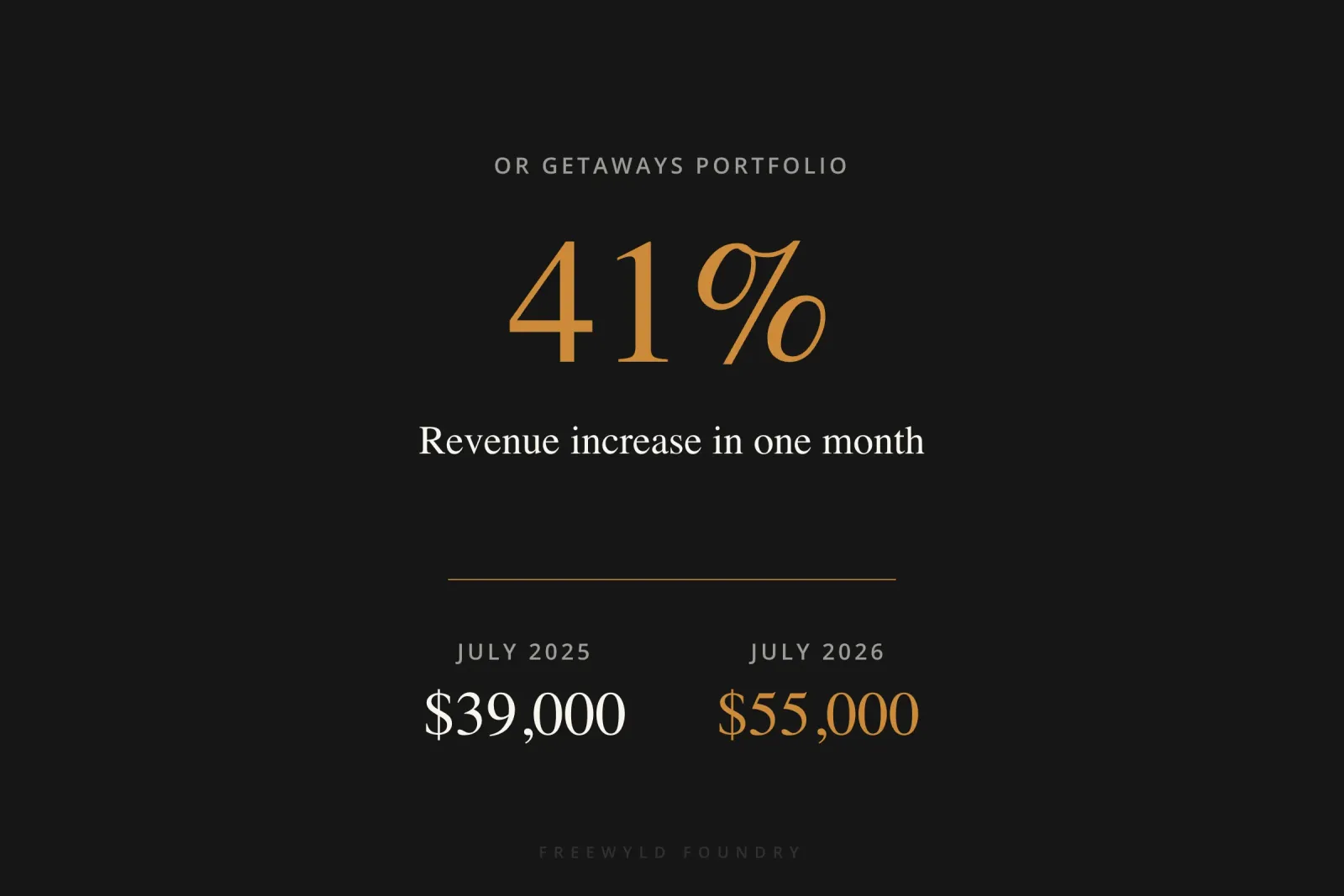
- The OR Getaways portfolio grew from $39,000 to $55,000 in a single month by holding prices instead of discounting.
Remove the Price Ceiling
The most common mistake I see from operators who join Freewyld is the maximum price setting. Almost everyone has one. It feels like reasonable caution: you do not want your listing to price itself out of the market.
But a maximum price does not protect you from anything. It protects your guests from paying you what they were willing to pay.
One of our revenue managers, Patrick Morton, managed his own properties for nine years before joining our team. He had a vacation rental he was confident was worth $650 a night at peak. That was his cap. He kept it there for years.
After joining Freewyld and removing the ceiling, the property booked at $1,000.
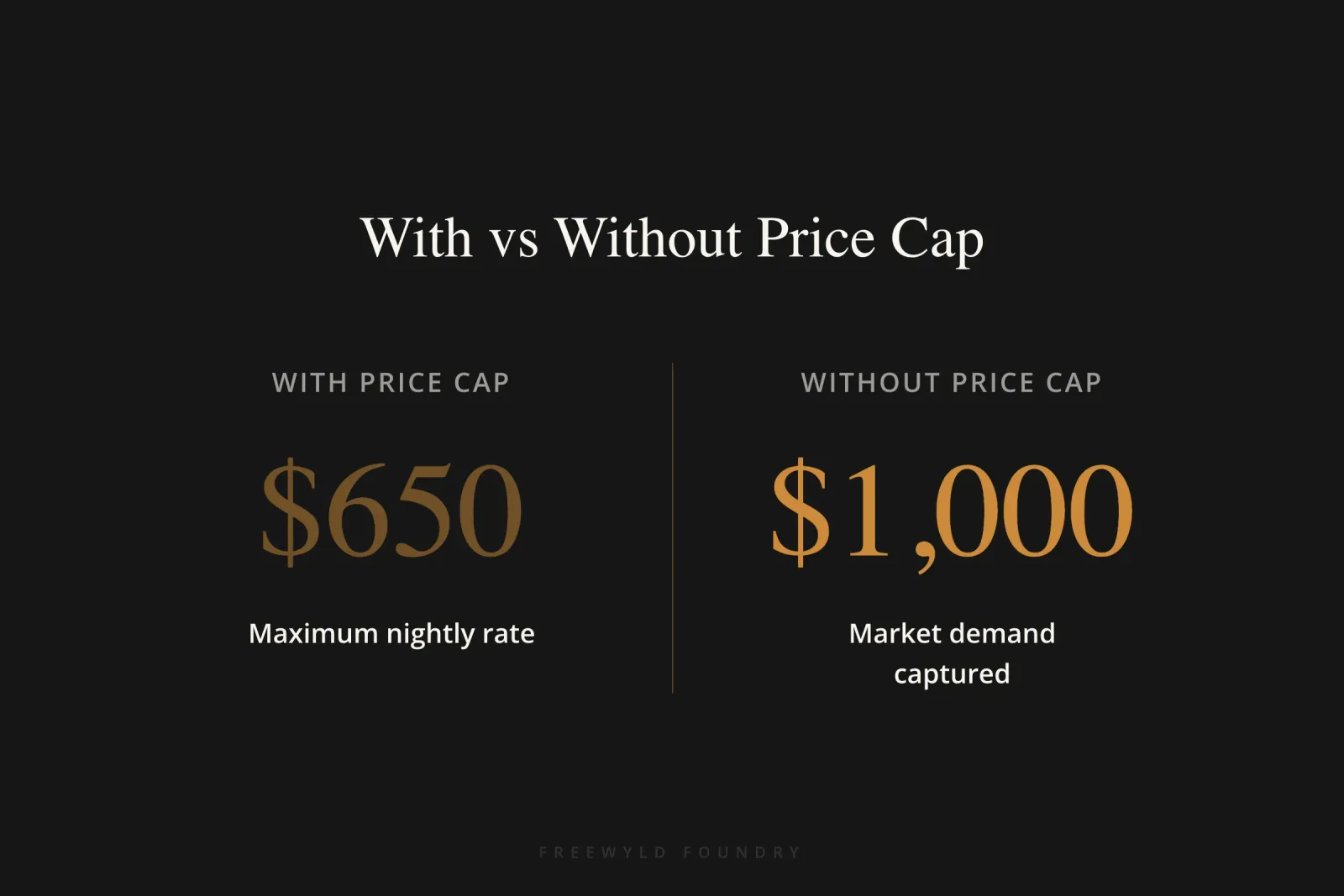
That is not unusual. When you put a cap on your listing, you are telling Airbnb and its guests that nothing above that number is acceptable. So when demand spikes, whether from a conference, a holiday weekend, or a seasonal surge you were not tracking, your listing never captures it. You are capped while the market moves past you.
The fix is straightforward: set your maximum price extremely high, or remove it entirely, and let the pricing data calibrate the upper end. The data does not care what you think the property is worth. It cares what guests are paying across comparable listings right now.
Run a Listing Optimization Audit Before Touching Your Pricing
Your pricing strategy can only work if your listing ranks high enough to be seen. A perfectly optimized price on a page 6 listing does nothing.
Airbnb’s search algorithm has added completeness checks that affect every listing on the platform. If you have not filled out every section of your listing, including the guest guide, house manual, amenities list, and accessibility features, Airbnb marks it as incomplete. The platform does not show you this flag directly, but it penalizes you in search placement.
The audit that consistently moves listings up the rankings covers four areas.
Amenities: Go through the full Airbnb amenity list and check everything that applies to your property. The categories operators miss most are essentials (linens, towels, toilet paper), ceiling fans, and laundry mat nearby. More on that last one in a moment.
Photos: The first five images control most of your click-through rate. If they are not your strongest shots in the best order, you are losing potential guests before they read a single word of your description.
Text fields: Guest guide, house manual, check-in instructions, directions, neighborhood description. Every field you leave blank registers as an incomplete signal.
Ranking tools: RankBreeze and similar tools scan your listing against the algorithm’s completeness criteria and surface what is missing. The audit takes 15 minutes and almost always turns up at least one meaningful gap.
The Amenity Trick That Moves Listings From Page 8 to Page 3
This one deserves its own section because the impact is so specific.
One of our revenue managers was working with a client whose listing had stopped getting bookings. Pricing looked right. Reviews were solid. Nothing obvious was wrong. He ran it through RankBreeze and found two unchecked amenities: essentials and laundry mat nearby.
He checked them both. The listing went from page 8 to page 3 in search results. Three bookings came in the next day after a full week with none.
The laundry mat nearby amenity is one of the most commonly missed on the platform. Airbnb weights it as a meaningful ranking factor in markets where laundry access matters to guests. Most hosts forget to check it even when there is a laundromat two blocks away.
That single checkbox. Page 8 to page 3.

Right? These are not strategic overhauls. They are items your listing should have had checked from the beginning. A 15-minute audit can change your search placement overnight, and better placement means more clicks before your first pricing strategy even kicks in.
Raise Your Price to Get the Booking
This one sounds wrong. I understand that.
You have a listing sitting at minimum price. You have tried everything: optimized the amenities, applied promotions, dropped to your floor rate. The calendar is still open. What do you do?
Raise the price.
Our team discovered this through testing and now applies it regularly in specific situations. The theory is that when a listing stays at minimum price for an extended period, some guests start watching it with the expectation that the price will drop further. They are waiting you out, bookmarking the property and waiting for a deal that is not coming.
When the price moves up, even from $100 to $109, those watching guests see the change. The property that was $100 is now more expensive. The window appears to be closing. They book.
There is also a search algorithm component. Airbnb appears to reward active listing management. When you change a price, update an amenity, or modify a setting, the platform registers an engaged host. There is evidence this triggers a temporary visibility lift in search results, similar to how a new listing gets a boost when it first goes live.
This tactic works specifically when a listing is stuck at minimum with no movement and no obvious cause. When those conditions are met, raising the price is worth testing before you discount further.
Use Airbnb Custom Promotions for Visibility Without Discounting
Airbnb’s custom promotion tool is one of the most underused features on the platform. Most operators either ignore it or treat it as a straight discount. There is a smarter way to use it.
Here is how it works. When you apply a custom promotion, Airbnb calculates the “regular” price using your average rates across a recent window. If your average rate has been $200 and you apply a 20% promotion, your listing may still display at $200 but with a crossed-out higher average and a “20% off” badge.
You can apply a promotion that does not reduce your displayed price but adds urgency and social proof to the listing. Guests see a discounted premium property. Booking pace accelerates.
This is the same psychology behind airline pricing, hotel rates, and retail markdowns. The promotion signals scarcity and value that a plain $200 listing does not carry. The visibility boost from the “on sale” tag in Airbnb search also surfaces your listing to guests who filter for promotions.
The result: stronger booking pace, higher search placement, and no reduction in your actual average daily rate.
Case Study: OR Getaways, $39,000 to $55,000 in One Month
These tactics are not theoretical. Here is what they look like applied to a real portfolio.
OR Getaways is an owner-operator portfolio in Lincoln City, Oregon, managed by Patrick Morton on our team. The portfolio includes some of the largest vacation rental properties in the area, with limited comparable inventory in the market.
When Patrick took over, the natural instinct was to price carefully. The properties were already charging above comparable listings. The risk of pricing yourself out feels real when the calendar is sitting open.
Patrick held prices. He held them as the booking window stretched. He held them as other listings in the market sat empty. And the bookings came.
In July 2026, the OR Getaways portfolio brought in $55,000. The same period the prior year: $39,000. That is a 41% year-over-year increase in a single month. Not from adding inventory. Not from discounting.
 From trusting the data and holding when the signals said to hold.
“There is nothing better than seeing the client post in the Slack channel: did you see that booking that came in at $3,000 a night? Having that confidence when you see a few bookings come through, knowing you do not need to decrease the prices. That is huge,” Patrick told us on the Get Paid for Your Pad podcast.
The data does not lie. The demand was there. The job was to not talk yourself out of capturing it.
How to Apply This to Your Portfolio
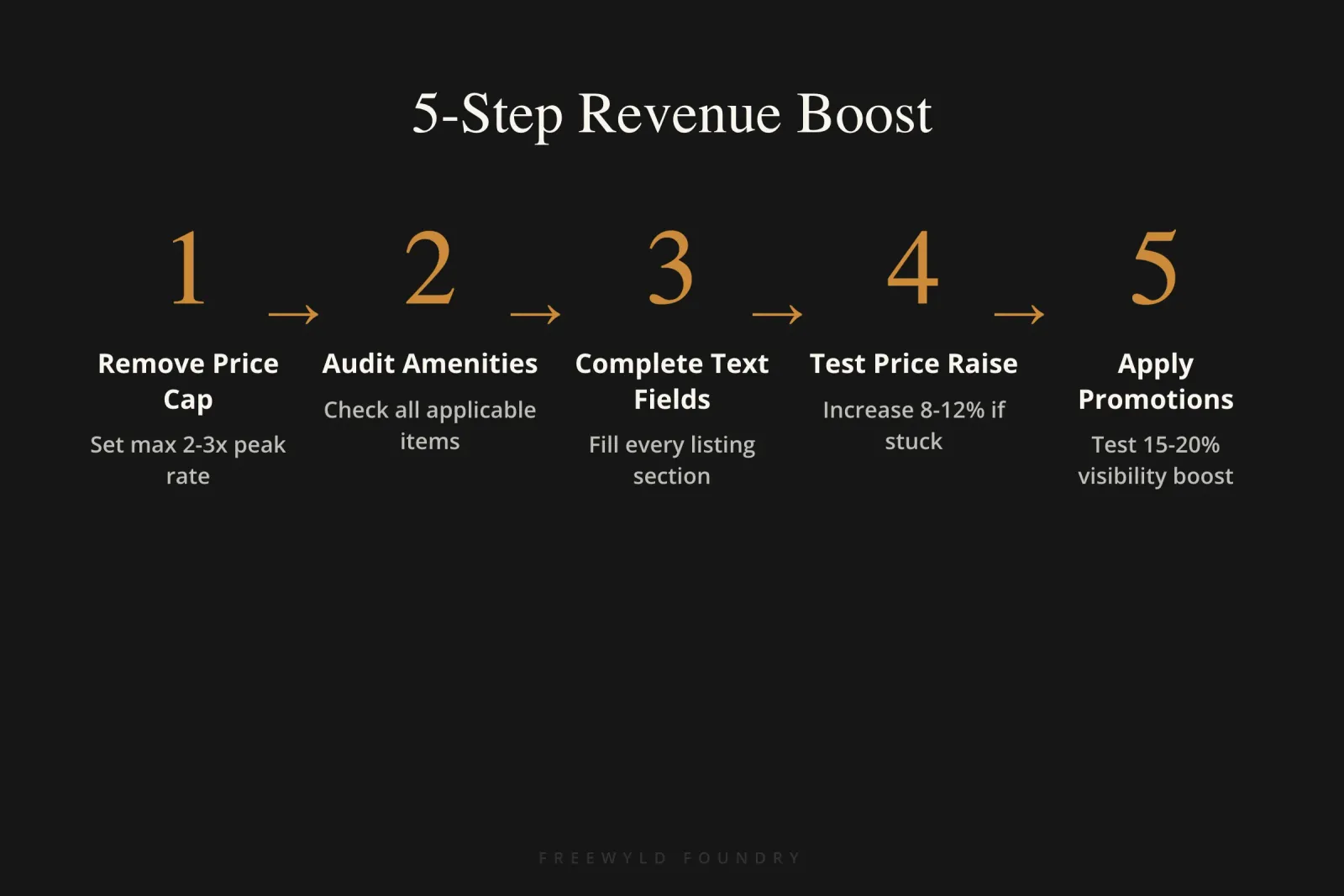
Step 1: Open your dynamic pricing tool (PriceLabs, Beyond Pricing, or Wheelhouse) and find the maximum price setting. Either delete it or set it 2-3x above your current peak rate. The algorithm will not automatically charge that number. It will just stop capping you when demand justifies a higher price.
Step 2: Run a listing completeness audit. Use RankBreeze or go through the full Airbnb amenity list manually. Focus on: essentials (linens, towels, toilet paper), ceiling fans, laundry mat nearby, pool heating, and any accessibility features that apply to the property. Check everything that is true.
Step 3: Fill out every text field in your Airbnb listing. Guest guide, house manual, check-in instructions, directions, and the neighborhood description. Each empty field is an incompleteness signal the algorithm is tracking against you.
Step 4: If a listing has been at minimum price for 5-7 days with no bookings, test a small price increase of 8-12%. Monitor booking pace for 48-72 hours.
Step 5: Experiment with Airbnb custom promotions during shoulder periods. Apply a 15-20% promotion and watch both visibility and booking pace. Track your effective rate before and after to confirm you are not cutting your rate.
The Professional Advantage
Here is what makes professional revenue management different from even a very diligent self-managed operator: repetition at scale.
Patrick sits in a weekly team brainstorm with eight other revenue managers, each running dozens of portfolios across different markets. They test the raise-price tactic across hundreds of listings. They track which amenities move rankings in which markets. They see the patterns that are invisible when you are managing one or two properties on your own.
“Every meeting we learn something new,” Patrick told us. “When you ask nine people what they think of a strategy and everyone’s on the same page, that serves as a huge confirmation that we’re doing something right.”
That collective data is the advantage. The tactics above work. They work even better when you have 50 data points telling you which ones apply to your specific market right now.
If you want that level of coverage on your portfolio, apply for a free revenue audit and we will show you where your biggest opportunities are.
Conclusion
The operators who leave the most money on the table are not the ones who are lazy or uninformed. They are the ones who are confident. They know their market, they have a sense of what their property is worth, and they trust their instincts.
The problem is that instincts cap your upside. Data does not.
Remove the price ceiling. Run the amenity audit. Test the raise. Use the promotions. These are not complex strategies. They are specific moves that consistently produce results when applied correctly, in the right conditions, with the right data behind them.
Ready to stop leaving money on the table?
Get your free revenue report. We will analyze your property’s performance and show you exactly where your pricing strategy can improve. We manage $170M+ in bookings across 70+ STR portfolios, and we will show you what is possible with professional revenue management.
Listen to the Full Conversation
This article draws on a conversation between Jasper Ribbers and Patrick Morton on the Get Paid for Your Pad podcast. Patrick is a revenue manager at Freewyld Foundry and has been working in short-term rentals for nine years.
Listen to Ep. 732: Secrets of a Pro STR Revenue Manager
Related Articles
- STR Revenue Manager vs Pricing Tool: Which Do You Need? - A side-by-side comparison of what a dedicated revenue manager does that a pricing tool cannot replicate.
- Airbnb Algorithm 2026: How Search Rankings Work - The full breakdown of Airbnb’s search ranking signals, including the listing completeness factors covered here.
- Dynamic Pricing Airbnb: How It Works and Why It Is Not Enough - Turning on a pricing tool is not revenue management. Here is what the difference looks like in practice.
- How to Choose the Right Revenue Manager for Your STR - What to look for before hiring a professional and what questions to ask.