The most common question I get from new STR operators is some version of “should I be on all the platforms?” The most common mistake is treating that as a yes or no question.
Which channels you should be on depends on your market, your stage, and how much operational complexity you are ready to take on. The answer for a beach house in Gulf Shores is different from a condo in downtown Chicago, and the answer in year one of your business is different from year five.
What does not change is the underlying data. Based on real booking numbers from Key Data, which pulls directly from property management systems rather than scraping, we know exactly how large each channel is and where. And that data shapes every distribution recommendation we make across our 75 client companies.
Here is what the channels actually look like, how they got there, and how to decide what makes sense for your portfolio.
Key Takeaways
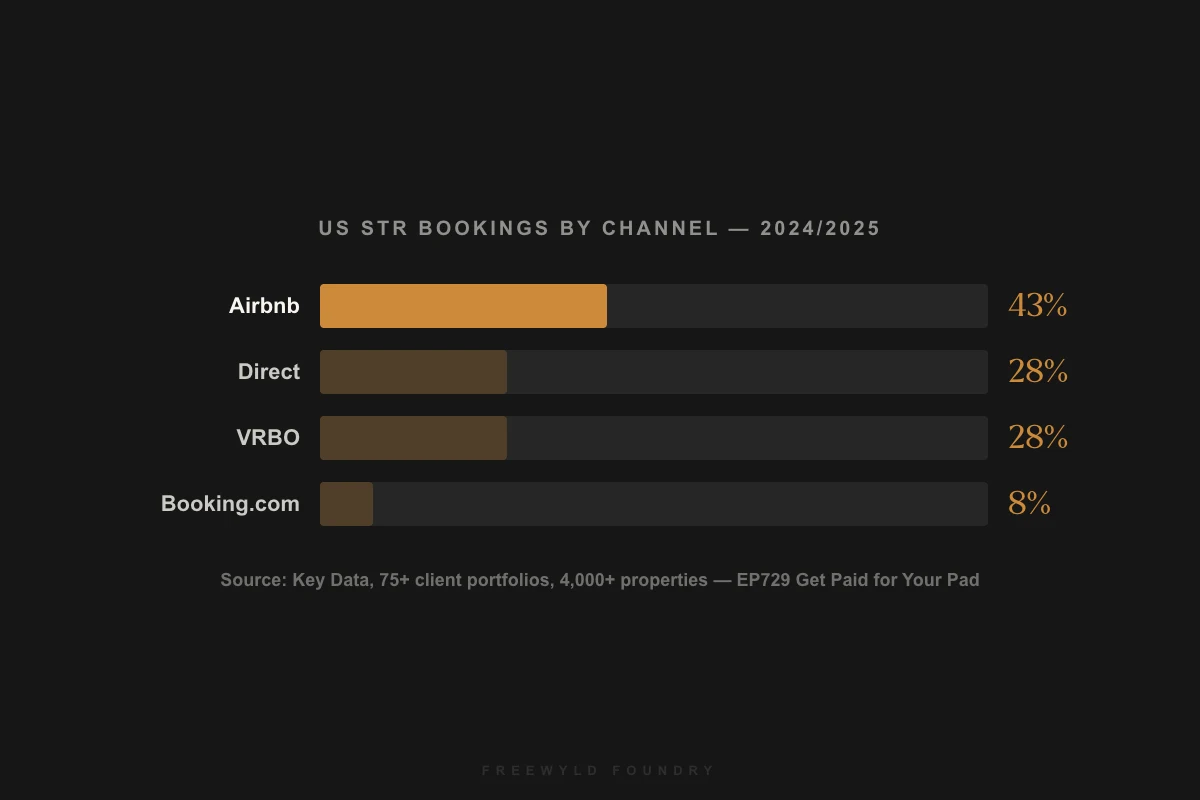
- In the US, Airbnb leads at 43% of STR bookings. Direct bookings and VRBO are tied for second at 28% each. Booking.com is third at 8%.
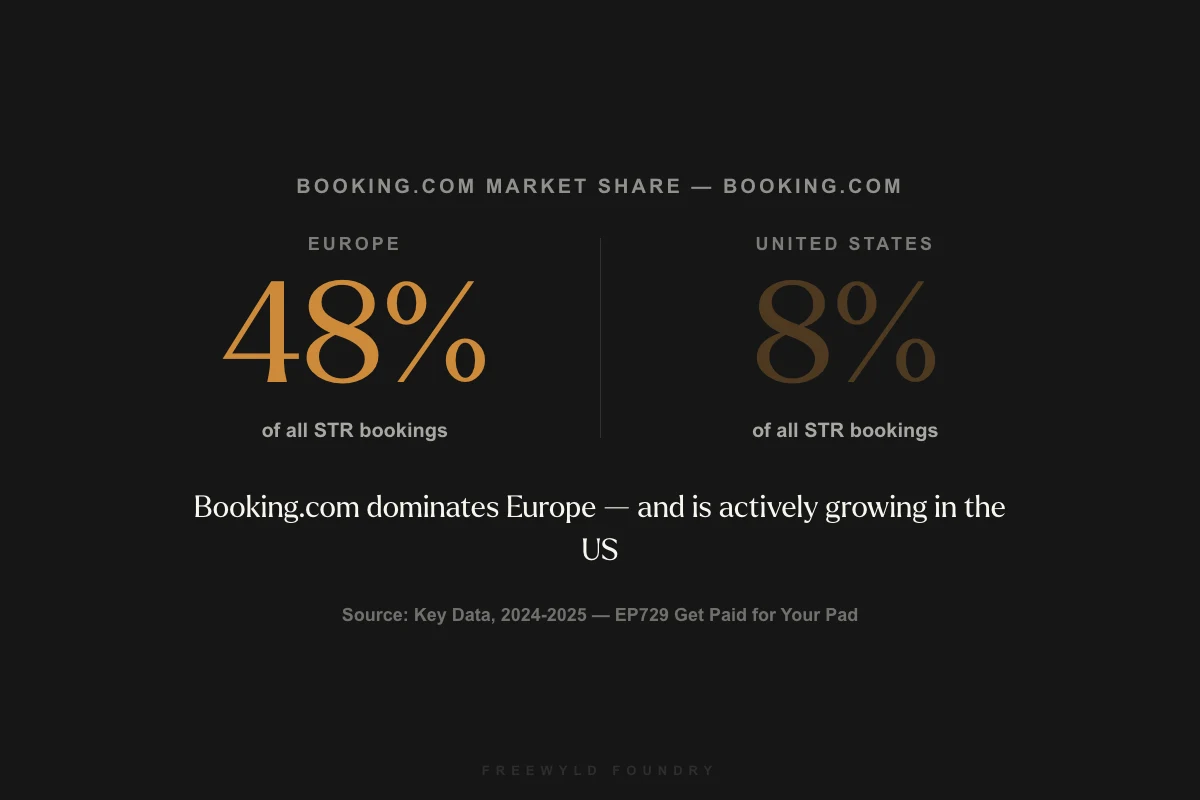
- In Europe, the picture reverses: Booking.com holds 48% market share and Airbnb drops to 40%. VRBO is nearly irrelevant at 2%.
- The three factors that should drive your channel decision are risk, revenue, and operational complexity.
- Airbnb and Direct bookings are the two channels closest to universal must-haves for STR operators at almost any scale.
- VRBO performs best in traditional vacation rental markets (beach, mountain, leisure destinations) and underperforms in urban areas.
- Booking.com is the most complex platform to onboard with, but it is the dominant channel for international travel and is growing aggressively in the US market.
- Being on one channel concentrates risk. If Airbnb blocks your listing, a channel-only business has no fallback.
A Brief History of Each Platform (and Why It Still Matters)
The three major OTAs were not built the same way, and those origins still explain where each platform performs best today.
VRBO was founded in 1995 by David Klaus, a Colorado ski property owner who wanted a way to rent out his condo and had no tool to do it. VRBO, Vacation Rentals by Owner, was built for vacation homes: properties designed specifically for holidaymakers, not rooms in someone’s primary residence. HomeAway acquired VRBO in 2006, then Expedia Group acquired HomeAway. The HomeAway brand is now retired. VRBO still reflects its origins: it is strongest in beach and mountain markets, skews toward an older demographic, and has almost no presence in urban areas where travelers historically stayed in hotels.
Booking.com was founded in 1996 in Amsterdam by Geert-Jan Bruinsma as a hotel booking platform for the Dutch market. It was acquired by Priceline Group in 2005. Because it started as a B2B hotel tool, its architecture was designed for hotel businesses rather than individual hosts, and that complexity is still visible today: more rate plans, more discount types, more configuration. It is also why Booking.com became the dominant travel platform in Europe and remains the go-to channel for international travelers worldwide. The international traveler base also explains why it over-indexes in cities with high tourist volume.
Airbnb launched in 2007 and gained real traction around 2009. It is the newest of the three platforms and also the most accessible: it was designed from the start for anyone to list, whether a room, a home, or an air mattress. That low barrier drove mass adoption and made Airbnb the dominant platform in the short-term rental space globally, even though it started more than a decade after VRBO and Booking.com.
The Actual Market Share Data
Most market data on OTA share comes from scraped sources, which have real accuracy limitations, especially for direct bookings, which cannot be scraped at all. Key Data is one of the few companies with genuine booking data, because they pull directly from property management systems. Their 2024 to 2025 numbers look like this:
| Channel | US Market Share | Europe Market Share |
|---|---|---|
| Airbnb | 43% | 40% |
| Direct bookings | 28% | 11% |
| VRBO | 28% | 2% |
| Booking.com | 8% | 48% |
A few things stand out in this data. Direct bookings are the second largest channel in the US, tied with VRBO, which most operators do not realize. VRBO is essentially not a factor in Europe. And Booking.com is the dominant European channel at nearly half the market, while only representing 8% of US bookings.
The other thing this data tells you is where international travel concentration matters. Booking.com’s 48% European market share does not stay in Europe: international travelers to the US, particularly in cities with heavy tourist traffic like Miami, New York, or Los Angeles, are often booking on Booking.com. If your market attracts international guests, the Booking.com 8% national average understates its relevance to you.
The Three Factors Behind Every Channel Decision
When advising clients on distribution, we use a three-factor framework.
Risk. Concentrating all your bookings on one channel creates a single point of failure. Airbnb can and does block listings, sometimes permanently and sometimes without clear recourse. We have had clients lose an Airbnb listing and then discover that their VRBO and Booking.com channels nearly compensated for it. As my friend Mark Simpson in the UK puts it: do not build your business on somebody else’s land. Your direct booking guest list is the one asset no OTA can take from you.
Revenue. More channels generally mean more bookings, because each platform surfaces your property to a different segment of travelers. The incremental revenue from a second or third channel is rarely as large as the first, but it is rarely zero either.
Complexity. Every channel you add brings additional work: a separate review profile to build, separate policies to manage, separate payout timing, and the risk of calendar conflicts if your channel manager has any sync delays. When you are managing five properties, this complexity is manageable. When you are at 50, the same complexity becomes a systems problem. Keeping your distribution stack simple is underrated, especially in the early stages of building a business.
The Airbnb-Only Case (and Its Trade-Offs)
We do have clients who run Airbnb-only portfolios and perform well. There is a legitimate case for it.
Airbnb’s algorithm rewards listings that generate consistent bookings on Airbnb. Calendars blocked by other platforms are visible, so Airbnb knows when you are splitting volume across channels, and that affects your visibility in search. When all your bookings are funneled through a single platform, your momentum on that platform compounds: more reviews accumulate faster, search ranking improves, and you can dominate a market niche relatively quickly.
The trade-off is concentration risk. If your Airbnb account gets flagged, suspended, or banned, the business stops. That is not a theoretical risk: it happens to operators at every scale. The question is whether the visibility advantage outweighs the exposure.
For operators early in building their portfolio who want to learn one system well before adding complexity, Airbnb-first is a reasonable starting point. The goal should be to get Airbnb dialed in, then add channels as operations allow.
How to Evaluate Each Channel for Your Market
The right channel stack depends on your specific market. Here is how to assess each one:
Airbnb is close to a universal starting point. It is the most accessible platform to onboard with, has the largest overall US market share, and is where most guests start their search. If you are in any market where STR activity exists, Airbnb should be your first channel.
Direct bookings are worth starting earlier than most operators think. You do not need a sophisticated booking site; most property management systems include a basic one. What you do need is a system for capturing guest contact information from every booking, regardless of where it originated. An email list of past guests is an asset that no OTA can take from you. Even if you rarely use it in year one, it compounds in value as your portfolio grows.
VRBO is worth adding if your market has meaningful leisure travel. A quick proxy: go to VRBO and search your area. If you see a large number of properties with substantial review counts, guests are actually using the platform there. If the listings are sparse and under-reviewed, the channel is not driving volume in your market and it is probably not worth the onboarding time.
Booking.com makes sense under three conditions: your market has significant international travel, you are in Europe or targeting European guests, or you have the operational capacity to handle a more complex platform. Booking.com’s onboarding has improved significantly in recent years, and they now offer Booking.com Pay, which removes the need for your own payment processor and eliminates most of the credit card chargeback risk that burned operators in the past. It is still the most complex platform to set up correctly. Factor that in when you decide whether to add it.
| Channel | Strongest markets | Complexity to add | Priority |
|---|---|---|---|
| Airbnb | Universal | Low | Start here |
| Direct bookings | All markets (long-term asset) | Low to medium | Add early |
| VRBO | Vacation/leisure, beach, mountain | Medium | Check your market first |
| Booking.com | International travel, Europe, urban | High | Add when operations allow |

Why Your Guest Email List Matters More Than Any OTA
Most operators think about direct bookings as a separate booking channel, which it is. But the more important framing is this: your guest database is the only part of your distribution stack that you own outright.
Every OTA can change its policies, adjust its algorithm, or ban your listing. None of them can take your email list. A guest who has stayed with you before and has your direct booking link can book with you regardless of what any platform does.
Building that list does not require a sophisticated marketing stack. It starts with a habit: collect the contact information of every guest who stays with you, regardless of where they booked. Send a follow-up email after checkout. Offer a small discount for direct bookings on their next trip. Over three to five years, that list becomes one of the most valuable assets in your portfolio.
We have seen this play out with clients whose Airbnb listings got flagged. The operators who had built direct booking channels had a fallback. The ones who were Airbnb-only did not.
Beyond the Big Four
There are dozens of other booking channels: Hopper, Wimstay, and many others. Some property management systems have direct integrations with channels outside the main four.
Based on data across our 75 clients, we have not seen any channel outside of Airbnb, VRBO, Booking.com, and Direct drive more than 5% of bookings for any client. That does not mean other channels are zero, but it does mean the complexity you add by listing on 10 additional platforms is rarely justified by the incremental bookings you get.
If your PMS has a frictionless direct integration with another channel and the setup time is minimal, it may be worth testing. But if it requires meaningful configuration and ongoing management, the returns are likely not there.
The Broader Point
Distribution is not a one-time decision. It is a configuration you revisit as your business grows, as your market evolves, and as the platforms themselves change. Booking.com is actively investing in growing its US footprint, which changes its calculus for US operators over the next two to three years. VRBO’s strength in leisure markets may shift as Expedia Group continues to integrate it further into their ecosystem.
Start with Airbnb. Build your direct booking infrastructure from day one, even if it just means collecting emails. Add VRBO if the data supports it in your market. Add Booking.com when you have the operational bandwidth to do it correctly.
The operators who get this right are not the ones on the most channels. They are the ones who run each channel they are on with discipline.
Want to see where your revenue stands?
Get your free revenue report and we will show you where your pricing and distribution strategy can improve. We manage over $200M in bookings across 75+ client companies, and we will show you exactly what professional revenue management can do for your numbers.
Listen to the Full Episode
This article is based on Episode 729 of the Get Paid for Your Pad podcast.
Listen on Acast | Watch on YouTube | Full Episode Notes
Related Articles
- Short-Term Rental Revenue Management Services: what a dedicated revenue manager does for a portfolio, and how to get a free audit
- July STR Market Update 2026: how Airbnb’s new 15% discount stacks with your other promotions and what to do about it
- Why STR Hosts Drop Prices Last Minute: the pacing strategy behind our top-performing client portfolios
- STR Revenue Manager vs. Pricing Tool: how to evaluate whether you need a tool, a service, or both