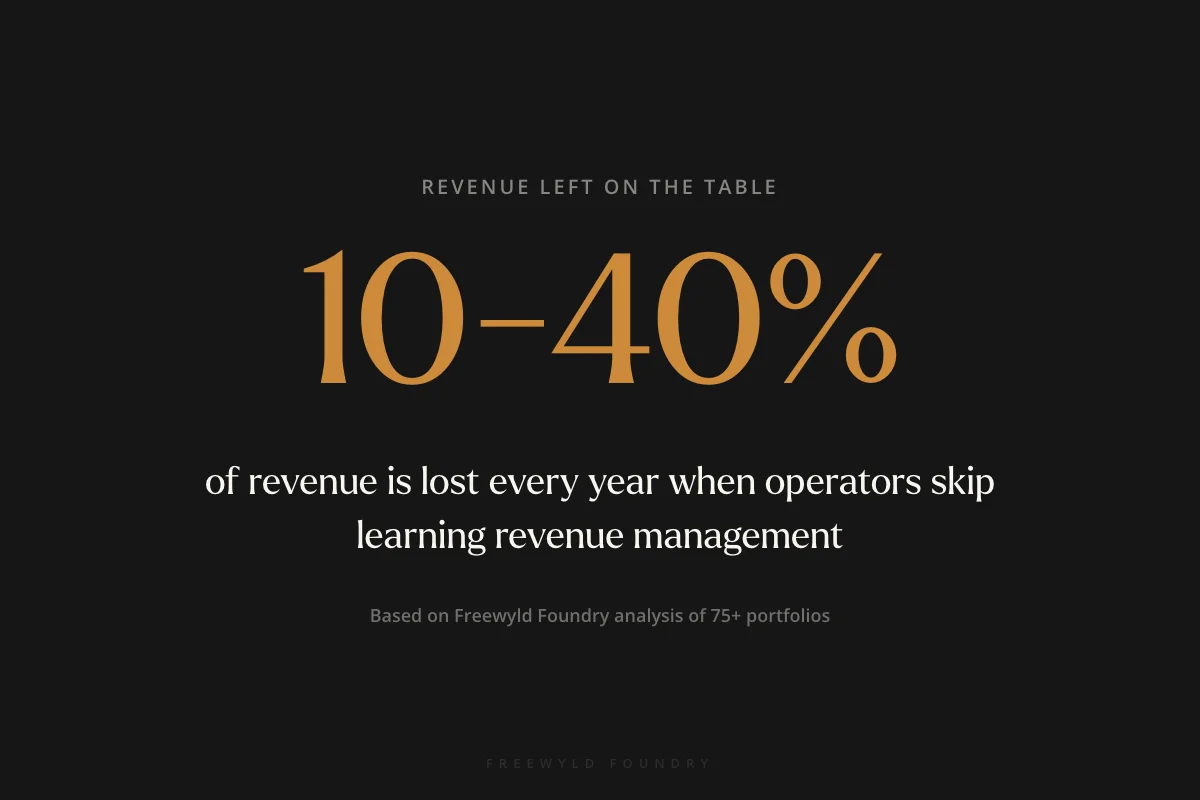
If you are doing revenue management in your short-term rental business and not actively investing in getting better at it, you are leaving 10 to 40 percent of revenue on the table. Every year.
That is not a marketing claim. It is what we see consistently after Managing $170M+ in bookings across 3,500+ properties. Most operators who come to us have the right tools in place. They have PriceLabs. They have a decent setup. But the strategy behind those tools is weak, often because no one ever taught them how to think about it.
Revenue management is not a hard science. You cannot calculate the optimal price. There are too many variables, too many moving parts, too many market-specific dynamics that shift week to week. Getting good at it requires real investment, not just setting it up once and hoping for the best.
The good news: there is a clear framework for how to learn it. After years of doing this, I have found three pillars that separate operators who get consistently strong results from operators who stay stuck. Experience. Resources. Community.
Here is how to build each one.
Key Takeaways
- Revenue management is a skill, not a feature. You cannot buy your way to good results with a pricing tool alone.
- There are three ways to fill the revenue management seat in your business. Choose deliberately, then commit.
- Experience comes from daily practice. Block 30-60 minutes every day.
- Every booking that comes in contains pricing information. Learn to read it.
- Not all revenue management content is education. A lot of it is marketing. Choose your teachers carefully.
- Community accelerates learning. Find two or three operators in non-competing markets and compare notes weekly.
- Switching between approaches constantly is one of the most expensive mistakes you can make.
Start by Deciding How You Will Fill the Revenue Management Seat
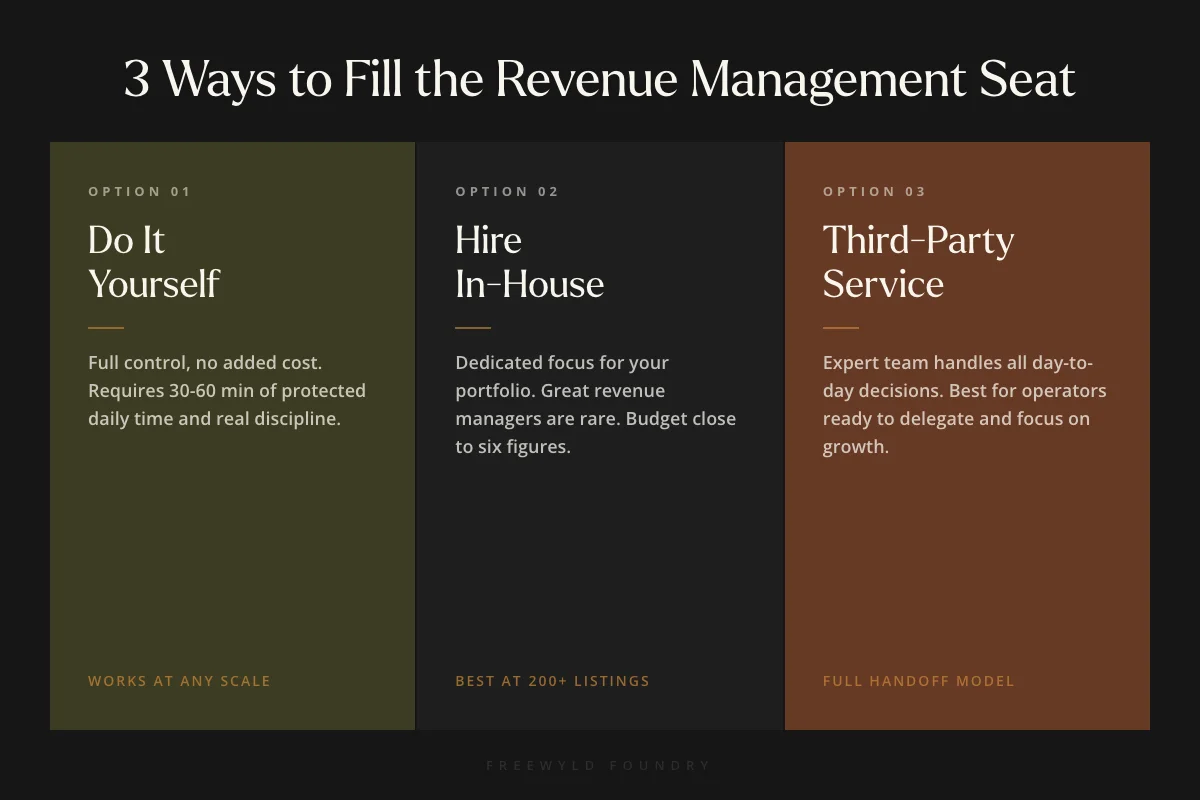
Before you invest time in learning, figure out which path makes sense for your business. There are three options.
Option 1: Do it yourself. Most founders of smaller short-term rental companies wear many hats, and revenue management is typically one of them. If that is you, the rest of this article is built for you. But doing it yourself only works if you treat it like a real discipline, not something you squeeze in when you have five minutes.
Option 2: Hire in-house. A dedicated revenue manager gives you more control and focus. The challenge is that great revenue managers are hard to find. At Freewyld Foundry, we have close to 10 revenue managers on our team, and it took us two years to build that bench. We worked with headhunting firms, ran a lot of interviews, and went through a long process. If you want someone skilled, expect to pay close to six figures. For a portfolio of several hundred listings or more, the math can work. For smaller operations, it usually does not.
Option 3: Work with a third-party service. This is what we do at Freewyld Foundry. A service company takes revenue management off your plate entirely. You set your parameters, share your goals, and let a team that has seen thousands of properties make the day-to-day decisions. This model works best for operators who are ready to let experts do what experts do, while they focus on operations and growth.
One important note on control: if you want to make every pricing decision yourself, a third-party service is probably not the right fit. The model works because the service has authority to act. Operators who try to manage a revenue management company the way they would manage an employee tend to get worse results, not better.
Make your choice deliberately. Whatever you decide, plan to stick with it. Switching constantly between approaches is one of the most costly mistakes in this business. There is always a learning curve, regardless of who manages your revenue. It takes up to a full year to learn a portfolio because you need to experience every season before you understand the market.
Pillar 1: Experience
There is no substitute for experience in revenue management. None.
This is the pillar most operators underinvest in. They buy a good pricing tool, read a few articles, set up their account, and assume they are doing revenue management. They are not. They are maintaining a setup. That is different.
Real experience means watching your calendar every single day. Seeing how demand builds at different points in the booking window. Learning how your market responds to different price levels at different times of year. Understanding which bookings contain signal and which ones are just noise.
The first thing I recommend to anyone managing their own revenue: block 30 to 60 minutes in your calendar every day, dedicated to pricing. Not to respond to messages. Not to handle maintenance issues. Just pricing. Start with at least half an hour. If you can protect a full hour, even better.
Read Every Booking Like a Signal
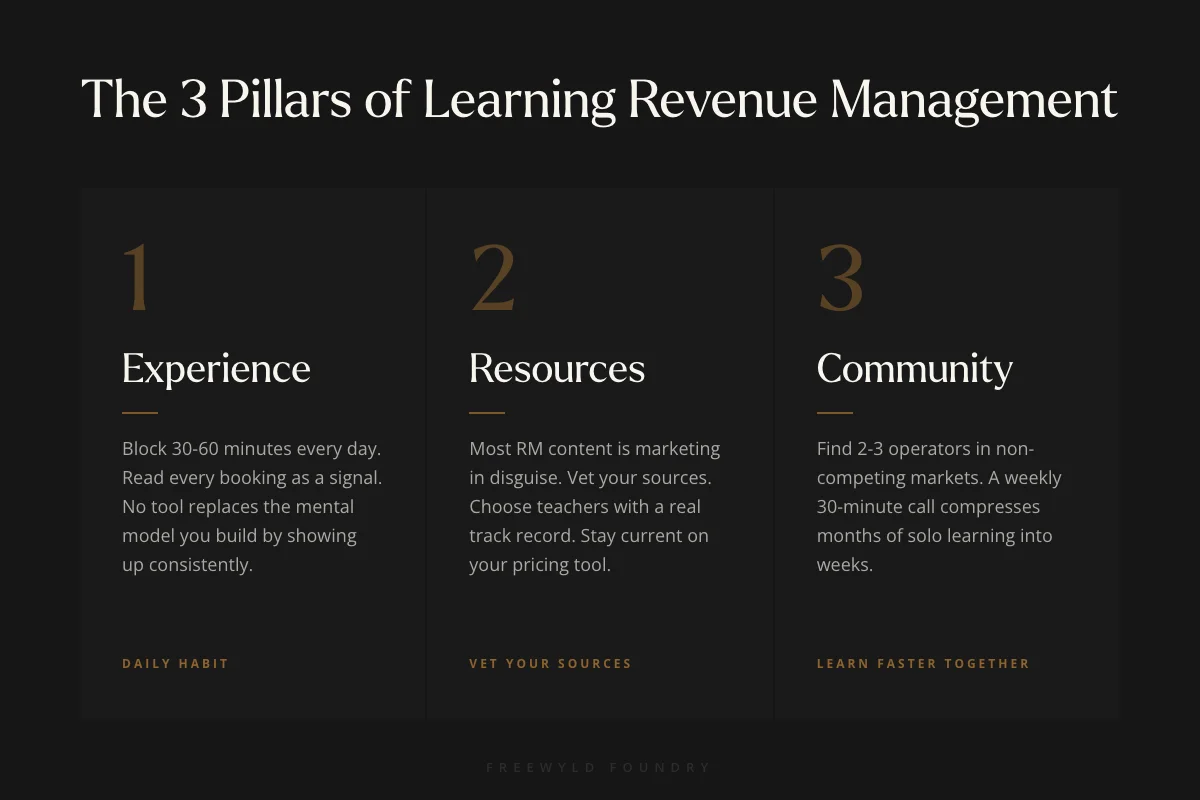
Every reservation that comes in tells you something. Not just “a booking arrived.” Specifically, it tells you how your pricing is performing at that moment in the booking window, for that particular stay date.
Here is the information a booking contains:
- The lead time: how far out did this guest book? If guests are booking six months out, your prices may be too low for that window.
- The stay dates: are you filling nights you expected to fill, or nights you were struggling with?
- The rate: did this guest pay close to your base price, or did they get a discounted rate?
One booking does not tell you much on its own. But over weeks and months, patterns emerge. You start to see when your market warms up. You see which stay dates fill first. You see where your pricing is working and where it is costing you.
This is how experience compounds. You are not just doing revenue management. You are building a mental model of your market that gets sharper every week.
Pillar 2: Resources
There is a lot of content about revenue management for short-term rentals. A lot of it is not designed to make you better. It is designed to market a product or build an audience.
That does not mean good resources do not exist. It means you need to choose carefully.
Before you learn from anyone, ask: how long have they been doing this? Do they have a real track record? Are they publishing specific, verifiable information, or are they making vague claims about revenue potential? There is no official certification for STR revenue management the way there is in the hotel world. That means the burden is on you to vet your sources.
Free Resources at Freewyld Foundry
At freewyldfoundry.com, we have built a library of free educational content specifically designed to make operators better at revenue management:
Workshops walk through our core strategy at a high level. The Pricing Power Workshop is a must-watch for anyone managing their own revenue. It covers pacing, which is the most important concept in revenue management: understanding where in the booking window you want to be booked, how to read your current position, and how to respond when you are ahead or behind. Pacing is the hardest concept to master, especially when your booking window is long.
Guides take many of the same concepts and present them in PDF format. If you prefer reading to watching video, these are a good starting point.
The blog covers specific topics in depth and is another place to build your knowledge at your own pace.
Your Pricing Tool Is Also a Resource
Most operators use PriceLabs and treat it as a set-and-forget tool. That is a mistake. PriceLabs updates its platform constantly: new features, new reporting, new functionality. Staying current on the tool is just as important as understanding the underlying strategy.
When I review a new client account, I almost always find inefficiencies in their PriceLabs setup, settings that made sense when they were configured but have since been made obsolete by new features. Make it a habit to read PriceLabs release notes and check their resource section. They have a podcast, masterclasses, and regular training. Use them.
The same principle applies to any pricing tool you use. Know the capabilities of your tool at least as well as you know the concepts behind the strategy.
Pillar 3: Community
Learning alone is slow. Learning with other people is faster, more enjoyable, and more likely to stick.
If you know other STR operators who are also managing their own revenue, reach out. Ask if they would be interested in a regular call to compare notes. Even two people thinking through a pricing decision together is better than one.
Ideally, connect with operators in different markets. No competitive overlap means no hesitation to share. You can discuss what you are testing, what results you are seeing, what mistakes you made, and what you wish you had done differently. Different markets also mean different problems, which means different lessons.
A weekly 30-minute Zoom call with two or three operators can compress months of solo learning into weeks. One person figures something out faster, explains it to the group, and everyone benefits. Then the next week, someone else has a breakthrough. It compounds quickly.
There are also industry masterminds you can join if you want a more structured format. These tend to attract serious operators who are actively investing in their business. The quality of the conversation is usually high.
The point is simple: do not try to learn revenue management in isolation. Find people who are working on the same problems and build a habit of thinking through it together.
Common Mistakes Operators Make When Learning Revenue Management
Most operators who struggle with revenue management are making one or more of these mistakes.
1. Treating it as a setup task, not an ongoing practice.
Revenue management is not something you do once and leave running. The market changes daily. Demand builds and releases. One big booking can shift your pacing. If you are not checking in every day, you are flying blind for most of the year.
2. Learning from content that is designed to sell, not educate.
There is a lot of noise in the STR education space. Some of it is useful. A lot of it is marketing dressed up as advice. Before investing significant time with a new source, check their credentials. How long have they been operating? What is their track record? Do they publish specific numbers?
3. Switching approaches too often.
This is one of the most expensive mistakes I see. An operator tries managing their own revenue for six months, does not see dramatic results, and switches to an in-house hire. Three months later, they sign up with a third-party service. Six months after that, they are back to doing it themselves.
Every switch resets the learning curve. Whoever manages your revenue, whether it is you, an employee, or a service company, needs time to understand your portfolio. That takes months. It takes experiencing every season at least once. When you switch too often, you never let anyone get past the learning phase.
Make your choice carefully. Then commit to at least a year before evaluating.
4. Expecting it to feel certain.
Revenue management involves a lot of judgment calls with incomplete information. Should you hold this price and risk an empty weekend, or discount now and lock in the booking? There is no formula that answers that definitively. The decision depends on your market, your booking window history, your current pacing, and dozens of other variables.
Operators who are uncomfortable with ambiguity tend to make reactive decisions, dropping prices too quickly or second-guessing their setup constantly. Getting comfortable with uncertainty is part of the job.
How to Start: A Practical First Week
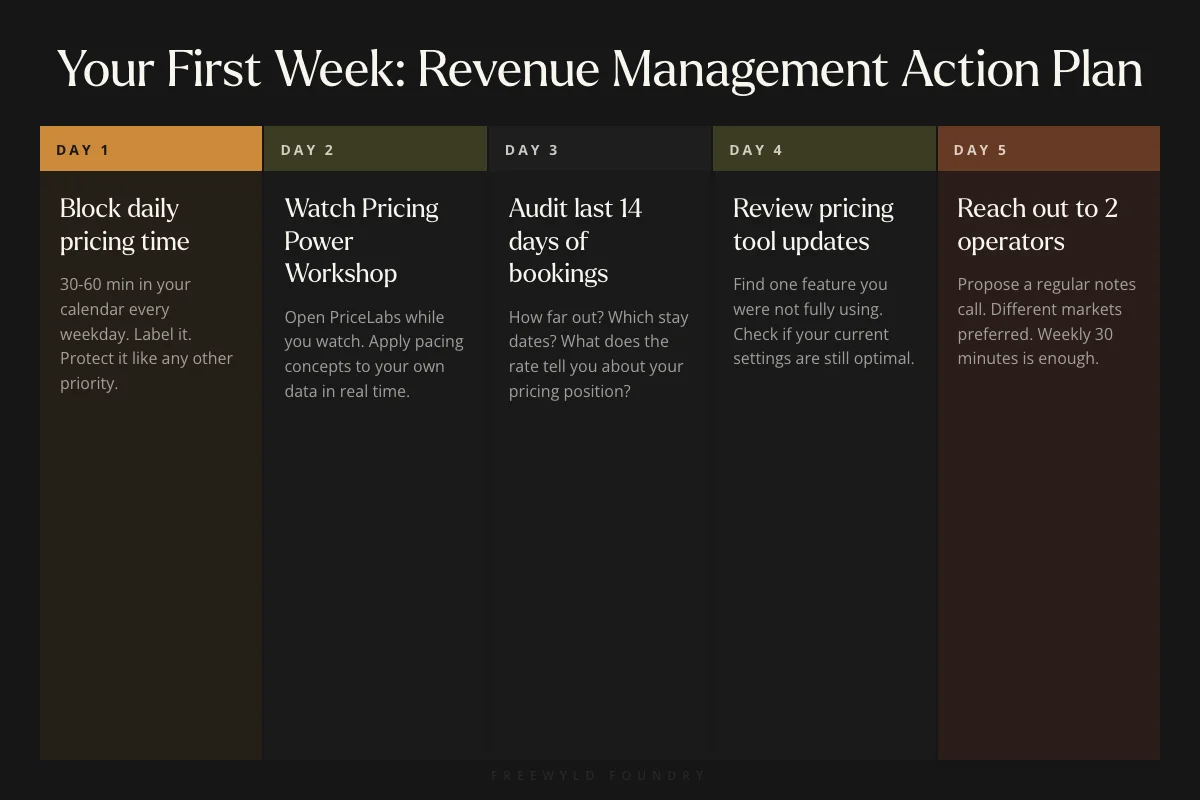
If you are going to take revenue management seriously, here is how to approach the first week.
Day 1: Block 30 to 60 minutes in your calendar every weekday, specifically for pricing. Label it. Protect it like any other priority appointment.
Day 2: Watch the Pricing Power Workshop at freewyldfoundry.com. Take notes on pacing. If you have PriceLabs, open it while you watch and look at your own data through the lens of what you are learning.
Day 3: Review every booking that came in over the last two weeks. For each one, ask: how far out did this person book? Was this stay date one I was worried about filling? What does this tell me about my pricing at that point in the window?
Day 4: Open your pricing tool and go through the latest release notes or documentation updates. Find one feature you were not fully using and understand how it works.
Day 5: Identify one or two operators you respect who are also managing their own revenue. Reach out and suggest a regular call to compare notes.
That is the foundation. The first four weeks will not feel like much. The first three months will feel like more. By six months, if you have been consistent, your results will start to reflect the investment.
What This Adds Up To
Revenue management is learnable. But it is not passive.
The operators who get consistently strong results are the ones who show up every day, watch every booking, ask why it came in when it did, and use that information to sharpen their approach. They learn from credible sources, stay current on their tools, and find other people to think through hard decisions with.
The operators who stay stuck are the ones who set up a pricing tool, check in occasionally, and wonder why their results are inconsistent.
The difference is not talent. It is practice.
Want to master revenue management yourself?
Check out our free workshops and guides, which walk through how to optimize your STR pricing, analyze booking windows, and maximize RevPAR.
Or if you would rather hand it off entirely: get a free revenue report and see exactly where your current strategy is leaving money on the table.
Listen to the Full Conversation
This article was informed by a solo episode of the Get Paid for Your Pad podcast.
Listen to EP727: 3 Ways to Get Good at Revenue Management
Related Articles
- Revenue Management Cadences: Daily and Weekly Routines That Boost Your STR Income - The specific daily habits that experienced revenue managers use every single day.
- STR Revenue Management: The Complete Guide for Property Managers - A full breakdown of what revenue management is, why it matters, and how to approach it.
- 5 Revenue Management Mistakes Costing STR Operators Money - The most common errors operators make, and how to fix them.
- STR Revenue Manager vs Pricing Tool: Which Do You Need? - What to look for when deciding whether to hire a revenue manager or rely on a pricing tool, and how to evaluate which model fits your business.