STR Revenue Management: Why Your Pricing Tool Isn’t Enough (And What Works)
Introduction
You’re using PriceLabs or Wheelhouse. You check your prices a couple times a week. Your occupancy looks decent at 70%, and you’re performing 20% better than market average. So your revenue management is handled, right?
Wrong.
STR revenue management is the strategic process of optimizing prices, availability settings, and booking policies to maximize total revenue across your portfolio through daily monitoring, data analysis, and continuous adjustment based on forward occupancy trends.
If you’re like 99% of short-term rental operators we audit, you’re leaving 10-40% of potential revenue on the table. We’re talking about $200,000 for a million-dollar portfolio or $2 million for a $15 million operation, just sitting there uncaptured because most operators treat revenue management as “that thing I do when I have time” instead of what it is: a core business function that deserves the same daily attention as operations and marketing.
The problem? Most operators think having a pricing tool equals having a revenue strategy. It doesn’t. Not even close.
In this guide, we’ll break down exactly why pricing tools alone fail, what actual revenue management looks like, and the specific strategies that consistently produce 25-40% revenue lifts for portfolios of all sizes. This isn’t theory. These are the exact methods our team at Freewyld Foundry uses to manage $170M+ in bookings across 3,500+ properties, achieving an average 18% performance lift above market for our 70+ clients.
Let’s start with the most expensive mistake in short-term rental revenue management.
What Is Revenue Management for Short-Term Rentals?
Revenue management is the strategic process of optimizing prices, availability settings, and booking policies to maximize total revenue across your portfolio. It requires daily monitoring, data analysis, and continuous adjustment based on forward occupancy trends, competitive positioning, and booking pattern changes.
Here’s what STR revenue management is NOT: Installing PriceLabs, setting your base prices once, and checking in when you remember.
Revenue management combines three critical elements:
Dynamic pricing strategy: This goes beyond letting your tool automatically adjust prices. It means setting optimal base prices, understanding your booking windows, monitoring your pacing against comparable properties, and adjusting your baseline pricing when market conditions change (which happens constantly).
Strategic availability management: This includes minimum night requirements, check-in/check-out restrictions, and gap night strategies. Most operators set these restrictions based on gut feeling or outdated industry advice, not actual booking pattern data from their market.
Policy optimization: Cancellation policies, advance booking windows, and instant booking settings all impact both your visibility on platforms and your conversion rates. Each decision carries invisible costs or benefits that most operators never measure.
The key insight? A pricing tool provides the mechanism for dynamic adjustment, but it cannot replace strategic oversight. If your base prices are wrong, the algorithm’s corrections won’t be enough. If your availability settings block your most common booking length, no amount of dynamic pricing will fix the problem.
According to Jasper Ribbers, who leads revenue management for portfolios generating $1M+ in annual bookings, “What I’ve learned is there’s a couple core fundamental concepts that you have to really understand and focus 80% of your time on. There’s a lot of stuff out there that you could be doing, but that doesn’t necessarily move the needle.”
The operators who succeed treat revenue management as a daily discipline, not a monthly check-in. They monitor specific KPIs, respond to booking signals, and adjust strategy based on data, not assumptions.
How Much Revenue Are You Leaving on the Table?
Based on audits of 100+ portfolios over the past year, here’s what we consistently find:
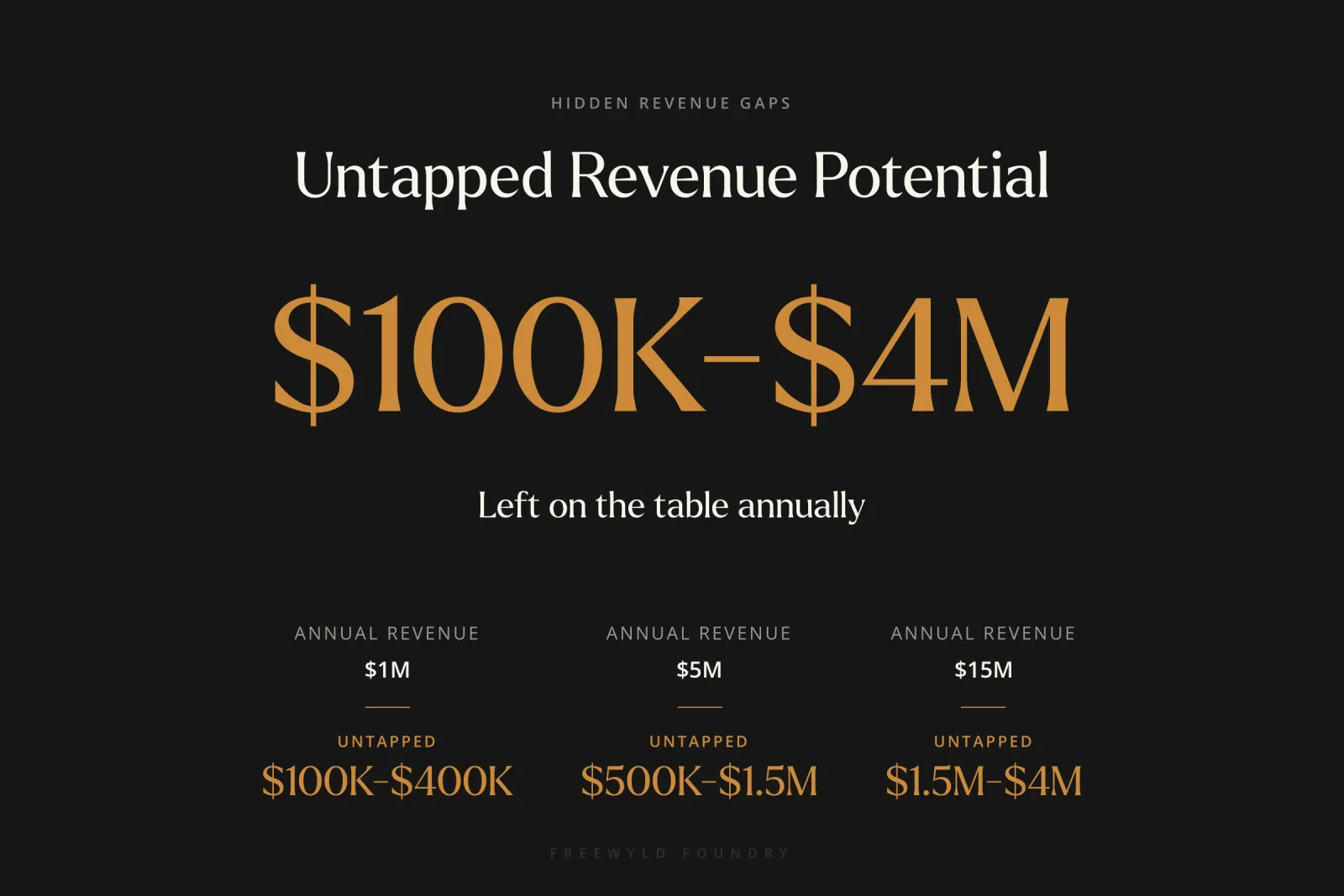
For $1M annual revenue operators: $100,000-$400,000 in untapped revenue
For $5M annual revenue operators: $500,000-$1.5M in untapped revenue
For $15M annual revenue operators: $1.5M-$4M in untapped revenue
These aren’t hypothetical projections. These are actual revenue gaps we identify by analyzing existing pricing strategies, availability settings, and pacing performance against market comparables. The problem is invisible. Nobody tells you “you’re leaving 30% on the table because your minimum stay settings don’t match booking patterns in your booking window.” You just see decent occupancy and assume everything’s fine.
This is exactly why 99% of operators we audit, even sophisticated $15M operations with dedicated teams, are leaving substantial money on the table. They lack the benchmark to know what optimal looks like.
What Are the Biggest Revenue Management Mistakes Operators Make?
Mistake 1: Treating Your Pricing Tool as Your Strategy
The most expensive mistake in STR revenue management? Thinking that having PriceLabs, Wheelhouse, or Beyond equals having a revenue strategy.
Here’s a real example: We audited an operator doing $1M in annual revenue. He’d been in vacation rentals for years, had a strong brand, beautiful properties. When asked about revenue management, his response? “I use PriceLabs.”
When we dug into his PriceLabs account, we found settings that had been configured in May 2023 and never touched since. The base prices set 18+ months ago were wrong for current market conditions. His minimum stay settings were blocking his most common booking lengths throughout most of his booking window.
Cost of this “set it and forget it” approach? $200,000 in annual revenue.
The $15M operator? Same story, different scale. Dedicated team member “managing” the pricing tool, but just monitoring that it was running. No daily pacing analysis. No strategic base price adjustments based on forward occupancy. No systematic review of availability restrictions against actual booking patterns.
Cost? Over $2M in untapped revenue.
Why this happens: Pricing tools have hundreds of settings. This complexity creates the illusion that if you’ve set everything up, you’re done. But these tools need daily oversight, strategic input, and continuous adjustment. They’re sophisticated calculators, not revenue strategists.
Mistake 2: Not Monitoring Your Pacing
Pacing is the single most critical metric in STR revenue management, and 95% of operators don’t track it systematically.
Pacing means monitoring your forward occupancy compared to similar properties in your market. It answers the question: “Is my property booking at the same rate as comparable units?”
Here’s why this matters: Every market has a booking window (the timeframe when people typically book). For some markets like Miami, it’s 2-3 weeks for most stays. For summer lake markets, people start booking 6+ months in advance.
If comparable properties in your market are 40% booked for a date 90 days out, and you’re only 10% booked, you have a problem. Either you’re overpriced, your marketing is weak, or your availability settings are too restrictive.
But most operators don’t look at this until 30 days out. By then, you’ve missed 80% of your booking window. You’ve lost all the guests who booked early at premium prices. Now you’re competing with everyone else who’s also trying to fill gaps at the last minute, which means lower prices and reduced revenue.
“If people are booking your type of property in your area, but they’re not booking yours, that’s a strong signal that your pricing might be too high. And if you’re not paying attention to that, you could just be sitting there and two weeks before Christmas you look at your portfolio and you’re like, I don’t have any bookings yet.”
- Jasper Ribbers, Co-founder, Freewyld Foundry
The pacing trap: Your pricing tool WILL make adjustments based on low occupancy. But if your base prices are wrong, those adjustments won’t be enough. PriceLabs might lower a $500 base price by 20% to $400 when it sees low occupancy. But if the competitive price is $200, you’re still overpriced and getting no bookings.
Mistake 3: Using Overly Restrictive Availability Settings
This is the silent revenue killer that most operators never connect to their results.
Common pattern we see: 2-night minimum within 30 days, 3-night minimum 30-60 days out, 4-night minimum 60-90 days out, 5-night minimum beyond 90 days.
Sounds logical, right? Protect your far-out inventory for longer, higher-value stays.
What if your market’s average length of stay is 2 nights? You just blocked 80% of your potential bookings from ever happening.
Let’s walk through the math:
- Your booking window is 5 months (150 days)
- Average length of stay in your market: 2 nights
- Your minimum stay settings: 2 nights only in the last 30 days
Result? For the first 120 days of your booking window, the vast majority of people searching can’t even book your property. You’re utilizing 20% of your booking window (the last 30 days) to capture 100% of your bookings.
Meanwhile, your competitors with more flexible minimum stays are capturing bookings throughout the entire 150-day window at higher prices because they’re not scrambling to fill inventory at the last minute.
“If the booking window is like five months, now you’re utilizing one out of five, 20% of the booking window. So you have to fill up all your occupancy in the last 20% of the booking window. If there’s a hundred people looking to book, the first 80 can’t book your unit, so you are losing 80% of demand.”
- Jasper Ribbers, Co-founder, Freewyld Foundry
Why operators do this: The logic makes intuitive sense. Longer stays feel more valuable. You want to “protect” your inventory. But this strategy only works if longer stays are common in your market. If they’re not, you’re just creating artificial scarcity that costs you money.
Mistake 4: Bias Toward Strict Cancellation Policies
Strict cancellation policies feel safe. Guest cancels? You keep their money. That’s visible, immediate value.
What you don’t see? All the bookings you never got because:
- Airbnb’s algorithm deprioritized your listing due to the strict policy
- Travelers filtered you out in search
- Potential guests looked at your policy and chose a competitor with more flexibility
Here’s the visibility problem: When a guest cancels and you keep $2,000 due to your strict policy, you see that benefit immediately. It reinforces your belief that strict policies protect you.
But you can’t see the $20,000 in bookings you lost over the same period because guests either never saw your listing or actively avoided it due to the policy.
According to our data tracking this across multiple portfolios, the invisible cost of strict policies (lost bookings, reduced visibility) typically exceeds the visible benefit (retained cancellation payments) by a factor of 3-5x.
The exception: High-demand periods where you’ll sell out regardless of policy. New Year’s Eve in Times Square? Sure, use a strict policy. But for 95% of your calendar? The flexibility gains more than it costs.
Mistake 5: Letting Base Prices Go Stale
We consistently find portfolios where base prices haven’t been updated in 12-24 months. These operators think their pricing tool is “handling it” with dynamic adjustments.
If your base price is $300 and market conditions have shifted to where $250 is competitive, your pricing tool might adjust down 15-20% based on low demand signals. But it’s working from a wrong starting point. The tool doesn’t know your base price is stale. It only reacts to demand patterns within the range you’ve given it.
What stale base prices cost you: Your tool makes micro-adjustments around a wrong number. It might move your $300 base to $255 when it should be at $200. You get fewer bookings, lower occupancy, and when you do book, it’s often at the last minute at discounted rates. The compounding effect across a portfolio of 20+ units is devastating.
Frequently Asked Questions About STR Revenue Management
Can’t my pricing tool handle revenue management automatically if I set it up correctly?
No pricing tool can replicate strategic human oversight. Tools make dynamic adjustments based on algorithms, but they can’t recognize market shifts, understand competitive positioning changes, or make strategic availability decisions. If your base prices are wrong, the tool’s adjustments won’t fix the problem. If your minimum stay settings don’t match actual booking patterns, no dynamic pricing will compensate. The most successful operators use pricing tools as sophisticated calculators that require daily strategic input, not as autopilot systems.
How do I calculate my market’s actual average length of stay?
Check your pricing tool’s market dashboard (most show this metric). Alternatively, manually track 10-20 comparable properties for 30 days. Note when they get booked and for how many nights. Calculate the average. Most operators are surprised to find their market’s average is 2-3 nights, much shorter than they assumed. This data should directly inform your minimum stay strategies.
What if my pacing is behind but I’m already priced below comp set?
If you’re priced competitively but still booking slower than comparable properties, you have a marketing or product problem, not a pricing problem. Check your photos (are they professional and bright?), your listing copy (is it compelling?), your reviews (recent and positive?), and your amenities (matching what travelers want?). Sometimes a listing audit reveals simple fixes like outdated photos or confusing descriptions that are suppressing bookings despite competitive pricing.
Should I hire someone in-house for revenue management or outsource it?
This depends on your portfolio size and the skillset of available team members. For portfolios under 25 units, an owner or team member dedicating 1-2 hours daily can handle this with proper training. For 25-100 units, you need someone spending 50%+ of their time on STR revenue management. Above 100 units, this should be someone’s full-time role. If you can’t find someone who naturally gravitates toward data analysis, spreadsheets, and daily number tracking, outsourcing to specialists often produces better results than forcing a team member to handle something outside their strengths.
How long until I see results from better revenue management?
Improvements happen in two phases. First, you’ll see immediate booking volume increases (within 2-4 weeks) as you capture bookings you were previously missing due to overpricing or restrictive settings. This “catch-up phase” can be dramatic (our case study showed 240% weekly booking increases). Second, sustained revenue increases of 15-35% typically stabilize after 60-90 days once your forward calendar is optimally positioned. The catch-up phase handles near-term improvements. The sustained phase comes from continuous optimization and never letting your strategy go stale again.
What are the most important metrics to track for STR revenue management?
Focus on RevPAR (Revenue Per Available Room), ADR (Average Daily Rate), forward occupancy compared to your competitive set, and booking window utilization. These metrics reveal whether your revenue strategy is working. Simple occupancy rates can be misleading because you can achieve high occupancy with terrible pricing. RevPAR combines both occupancy and rate performance into a single metric that shows true revenue effectiveness.
How do I identify comparable properties for pacing analysis?
Look for properties within your market that match your unit type (bedrooms, bathrooms), amenities (pool, hot tub, location features), and quality level. Don’t compare luxury units to budget properties. Your pricing tool’s competitive set feature usually does this automatically, but verify the selections make sense. Track 5-10 properties consistently rather than constantly changing your comp set, as consistency helps you spot meaningful trends.
Should I use different cancellation policies for different seasons?
Yes. During verified high-demand periods (holidays, major events, peak season dates where you consistently sell out), strict policies make sense because demand exceeds supply. For shoulder seasons and lower-demand periods, moderate or flexible policies typically generate more bookings by reducing buyer friction and improving your algorithmic visibility. The key is using data to identify true high-demand dates, not assumptions about what “should” be high demand.
Conclusion
STR revenue management isn’t about having the fanciest pricing tool or the most complex setup. It’s about daily discipline with a few core practices: monitoring your pacing, adjusting base prices based on forward occupancy signals, aligning availability settings with actual booking patterns, and treating this as a real business function that deserves the same attention as operations and marketing.
The operators leaving 10-40% of potential revenue on the table aren’t failing because they lack tools or knowledge. They’re failing because they think “I use PriceLabs” equals “I have a revenue strategy.” It doesn’t.
The good news? Most of the fixes are straightforward. Remove restrictive minimums that don’t match your market. Update base prices that haven’t changed in a year. Monitor your pacing weekly instead of your occupancy monthly. Make cancellation policies more flexible for non-peak periods.
These aren’t complex technical changes. They’re strategic shifts in how you think about and prioritize revenue management.
Start with the 15-30 minute daily review. Look at every booking. Ask what you can learn. Watch your pacing. Make small adjustments based on real data, not assumptions or industry conventional wisdom that might not apply to your specific market and properties.
Or, if you’re managing 15+ units doing $1M+ in annual revenue and this isn’t your natural skillset, bring in experts who do this all day, every day, across hundreds of portfolios and know exactly what optimal performance looks like for your market.
The invisible revenue sitting in your portfolio is the most expensive thing you’ll never see on a report. Make it visible.
Want to know exactly how much revenue you’re leaving on the table?
We perform detailed revenue audits for STR operators doing $1M+ in annual bookings. We’ll analyze your current pricing strategy, availability settings, and pacing performance, then show you exactly where you’re losing money and what changes will capture it. Get your free revenue audit
Related Resources:
- 5 Revenue Management Strategies to Crush Your Competition
- Why Your Revenue Manager Might Be Costing You Money
- Revenue Management Cadences: Daily and Weekly Routines
- Get Paid for Your Pad Podcast: 700+ Episodes
Listen to the full conversation:
Episode 664: Pricing Tools Don’t Think with Jasper Ribbers and Kaye Putnam
About Jasper Ribbers:
Jasper Ribbers is Co-founder of Freewyld Foundry, where he leads revenue management strategy for 70+ clients managing $170M+ in annual bookings. He hosts the revenue-focused episodes of the Get Paid for Your Pad podcast and specializes in helping $1M+ STR operators optimize their pricing strategies. Connect with Jasper on LinkedIn.