After years of host requests, Airbnb has finally rolled out seasonal cancellation policies. This feature lets you customize your cancellation rules for different dates throughout the year instead of using one blanket policy for all 365 days.
Airbnb seasonal cancellation policies allow short-term rental operators to apply flexible terms during shoulder season while protecting peak dates with stricter rules, maximizing both conversion and revenue protection throughout the year. For STR operators managing 10+ listings with $1M+ in annual bookings, this changes everything. You can now protect your highest-value dates (Thanksgiving, July 4th, local events) with stricter policies while maximizing conversion during shoulder season with flexible terms. Most hosts will probably use this feature wrong, or worse, not use it at all because Airbnb made implementation cumbersome.
In this guide, I’ll walk you through exactly how Airbnb seasonal cancellation policies work, the framework for choosing the right policy for different dates, and the step-by-step process for implementation (plus the major pain point Airbnb created). This is based on managing revenue for 70+ STR portfolios generating over $170M in annual bookings.
What Are Airbnb Seasonal Cancellation Policies?
Airbnb seasonal cancellation policies let you set different cancellation rules for specific dates on your calendar instead of applying one policy to your entire year.
Before this feature, you had to choose: either protect your high-value dates with a strict policy (and sacrifice bookings during slow periods) or maximize conversion with a flexible policy (and risk losing thousands when someone cancels your New Year’s booking 24 hours out). With seasonal policies, you can have both, applying strict rules only to your 10-20 highest-value dates per year.
The feature works by letting you select specific date ranges in your Airbnb calendar and assign custom cancellation policies just for those dates. Your default policy applies to everything else. So you might run moderate as your baseline but switch to firm for Memorial Day weekend, the entire month of July, and your city’s biggest annual festival.
Why This Feature Matters for Revenue Management
According to Jasper Ribbers, co-founder of Freewyld Foundry, “The conversion and visibility boost that you get from flexible policies, it’s not very visible because you don’t really know if you would have gotten that booking if you had a more strict policy.”
This invisibility problem causes most hosts to use policies that are too strict. You remember the pain when someone cancels a $3,000 booking last minute, but you never see the 15 additional bookings you got throughout the year because you had a flexible policy during shoulder season. Airbnb seasonal cancellation policies let you protect the dates where cancellation pain would be highest while staying flexible everywhere else.
How Do Airbnb Cancellation Policies Affect Your Revenue?
The relationship between cancellation policies and revenue involves a fundamental trade-off: visibility and conversion versus revenue protection.
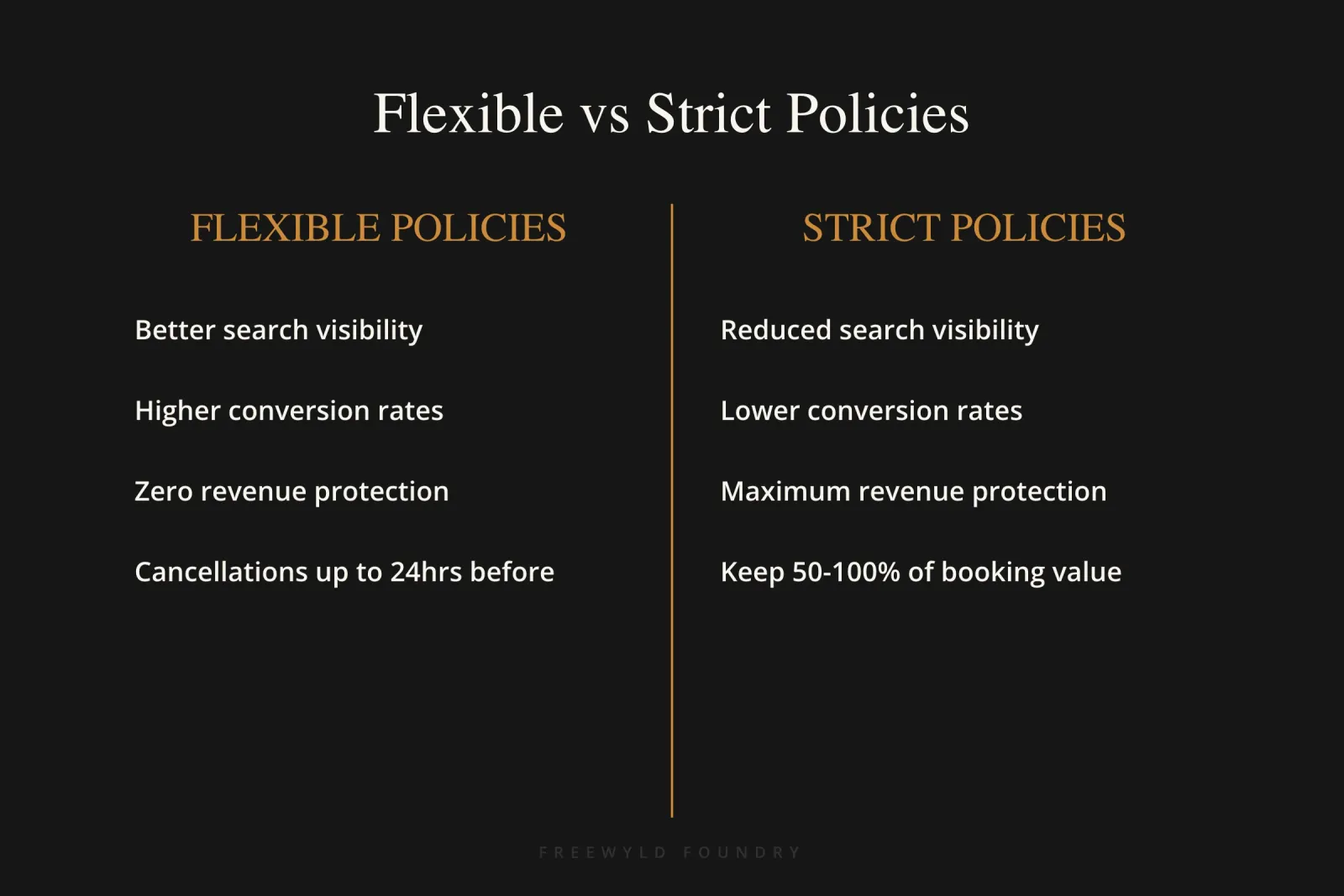
Flexible policies generate more bookings through two mechanisms. First, Airbnb’s algorithm gives you better placement in search results when you offer flexible terms. Second, guests convert at higher rates when they know they can cancel if plans change. But you sacrifice revenue protection because guests can cancel up to 24 hours before check-in for a full refund.
Strict policies protect your revenue when cancellations happen. With firm policies, guests who cancel 29 days out still pay you 50%, and cancellations within 7 days mean you keep 100% of the booking value. But you sacrifice visibility in Airbnb search and watch your conversion rate drop as guests choose more flexible listings instead.
Here’s the critical insight: the benefits of flexible policies are invisible (you just get more bookings without knowing why), but the costs are painfully visible (you lose a specific booking and know exactly how much money walked out the door). This psychological asymmetry makes hosts choose policies that are too strict for their market conditions.
Revenue Impact Example
One Freewyld Foundry client had a two-week booking made four months in advance at a premium rate. The guest canceled eight days before check-in (within the seven-day cancellation window on Booking.com) and immediately rebooked at a lower price. The host lost thousands of dollars on that single transaction.
That loss was visible and painful. But what’s invisible is whether a stricter policy earlier in the year cost them 5-10 bookings worth more than that single cancellation. According to Ribbers, “A lot of hosts, in my opinion, they probably have a too strict cancellation policy in general because of that very reason. When it hurts, you feel it, but the benefits, you don’t really notice them.”
The revenue-maximizing strategy typically involves more flexibility than feels comfortable, especially for property managers who answer to owners.
What Cancellation Policies Should You Use on Airbnb?
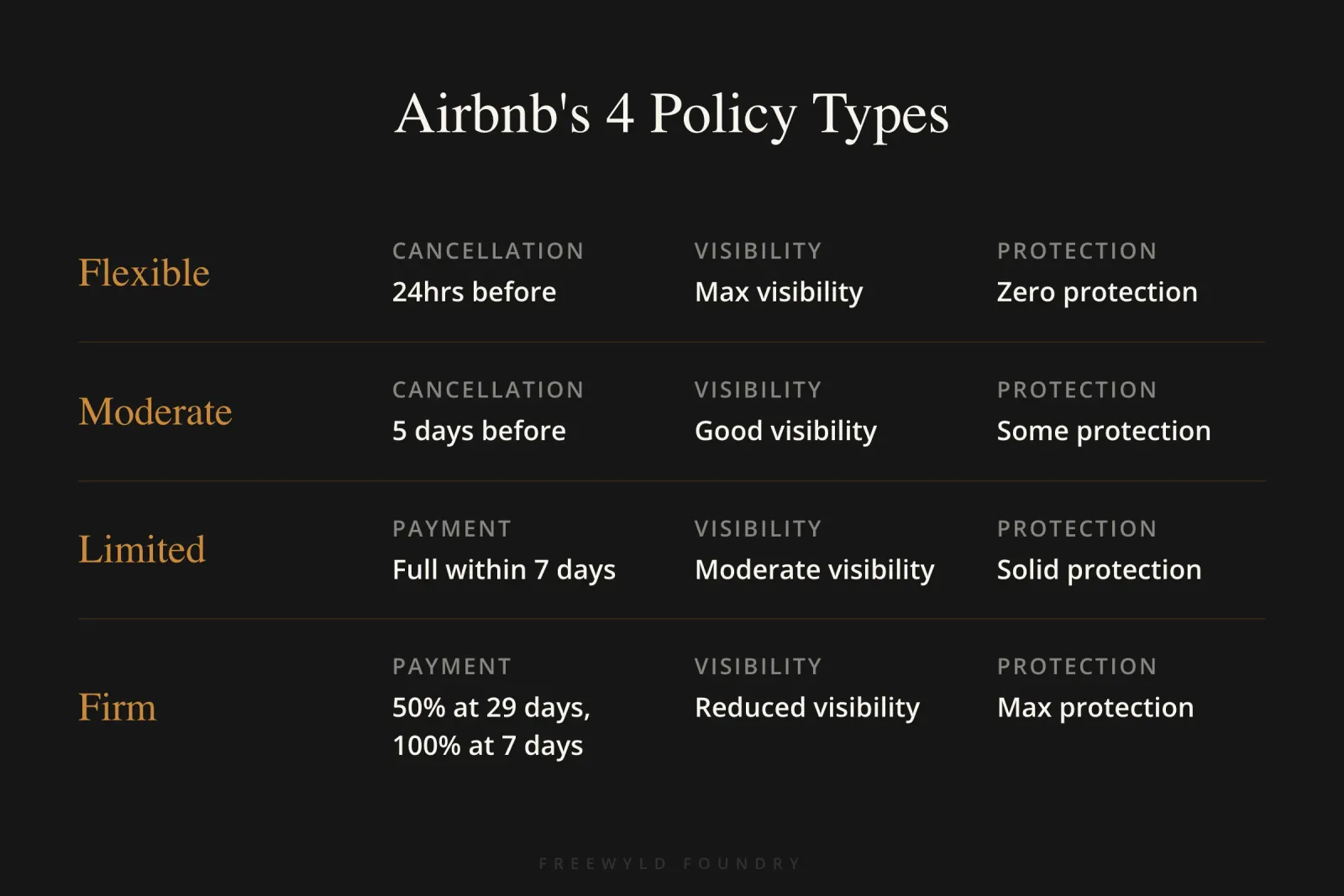
Airbnb offers four recommended cancellation policy types for most listings: flexible, moderate, limited, and firm.
Flexible Policy
- Guests can cancel up to 24 hours before check-in for a full refund
- Maximum visibility and conversion
- Zero revenue protection
- Best for: Low season dates, properties with very short booking windows, shoulder season
Moderate Policy
- Full refund if guests cancel at least 5 days before check-in
- Good visibility and conversion
- Some revenue protection for last-minute cancellations
- Best for: Shoulder season, properties with 1-2 bedrooms in typical markets
Limited Policy
- You keep the full booking value if guests cancel within 7 days of arrival
- Moderate visibility
- Solid revenue protection for the final week
- Best for: Mid-season dates, properties with 2-3 bedrooms
Firm Policy
- Guests who cancel 29 days out pay you 50%, cancellations within 7 days mean you keep 100%
- Reduced visibility and conversion
- Maximum revenue protection
- Best for: Peak dates, large properties (4+ bedrooms), dates with long booking windows
Note: Airbnb also offers “super strict 30 days” and “super strict 60 days” policies, but these are not recommended except in extreme circumstances. Airbnb severely punishes your visibility with these policies, and your conversion rate will tank. The old “strict” policy is no longer available to new hosts.
General Guidelines by Property Type
For properties with 3-5+ bedrooms in typical markets: Default to firm or limited policies. Larger homes typically attract larger groups who book further in advance (often 2-4 months out). This longer booking window means you need more revenue protection because you won’t have time to rebook if someone cancels last minute.
For properties with 1-2 bedrooms in typical markets: Default to flexible or moderate policies. Smaller units typically get shorter booking windows, meaning you have time to rebook if someone cancels. The conversion benefit from flexible terms typically outweighs the cancellation risk.
But these are just starting points. Your specific strategy depends on three critical factors.
What Factors Determine Your Optimal Cancellation Policy?
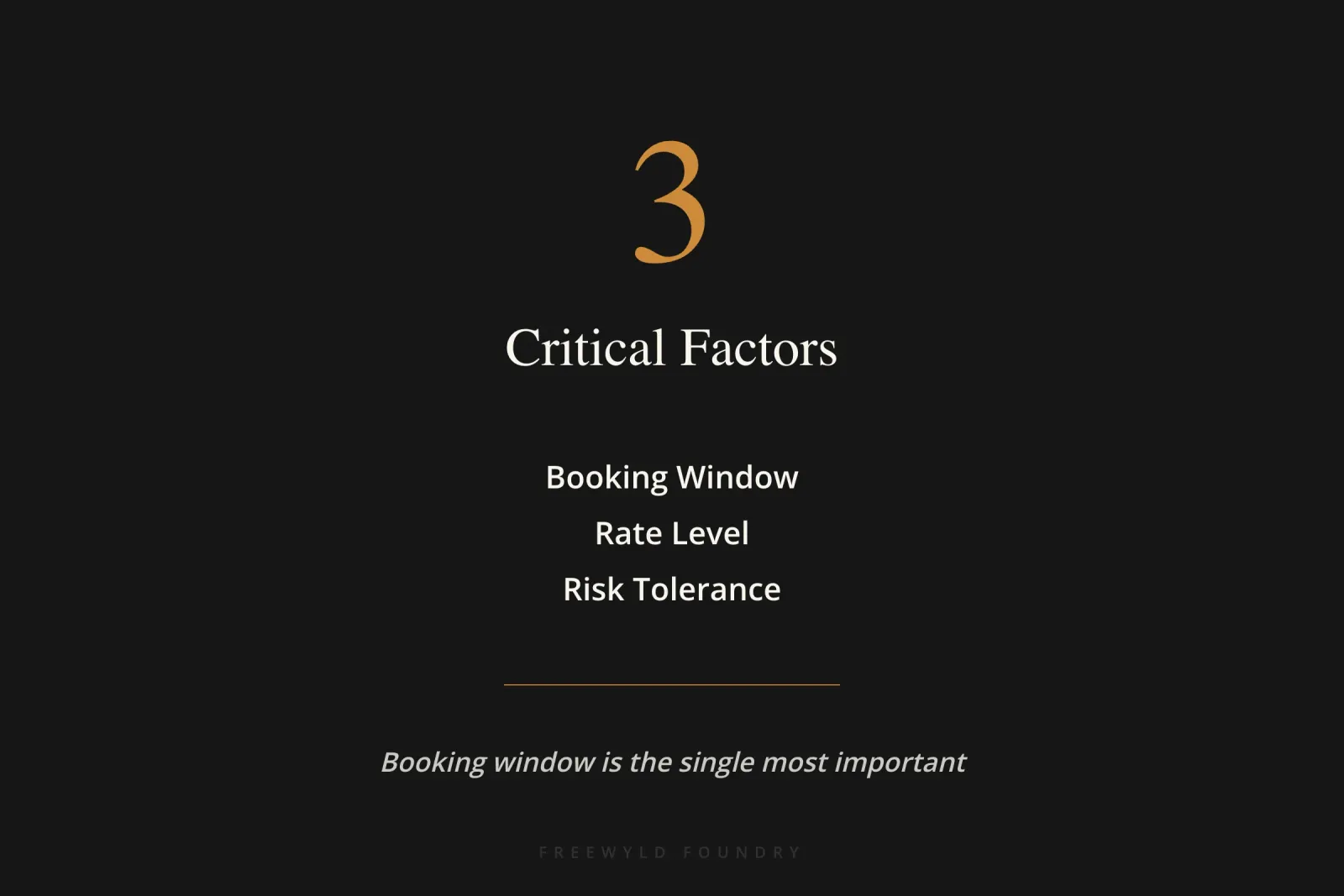
Three factors determine whether you should protect revenue or maximize conversion: booking window, rate level, and risk tolerance.
Factor 1: Booking Window
Your average booking window is the single most important variable in choosing cancellation policies. The longer guests typically book in advance, the stricter your policy should be.
Consider an extreme example: if nobody in your market books more than 5 days in advance, what’s the ideal cancellation policy? In this scenario, moderate offers the same protection as firm or limited because guests are already inside the cancellation window when they book. You might as well use the more flexible policy to maximize visibility, even if it doesn’t increase conversion much.
Now consider the opposite extreme: if everyone books exactly 3 months in advance, firm makes complete sense. If someone cancels in the final 30 days, you have no time to rebook because your entire market has already made their plans. You need the revenue protection.
According to Ribbers, “The longer the booking window, the more you want to protect your revenue. If somebody cancels, you’re not going to be able to rebook because people book three months in advance.”
Factor 2: Rate Level
The higher your rate, the more revenue protection matters. The lower your rate, the more you should bias toward conversion and visibility.
If you’re in January and rates are already at your $100 minimum, protecting that revenue isn’t critical. Someone cancels a three-night booking at $100/night, you lose $300. It’s not insignificant, but it’s not devastating. Meanwhile, the flexible policy might have generated 2-3 additional bookings throughout the month worth $600-900.
But if someone books New Year’s Eve at $1,000/night and cancels last minute, you lose $1,000 plus all the other nights in that booking. This is where revenue protection becomes critical. You want the strictest possible policy on your highest-rate dates.
Factor 3: Risk Tolerance (Business Model)
Your business model determines how much risk you should take. Owner-operators can afford to maximize revenue with flexible policies. Property managers should bias toward protection.
Here’s why: as an owner-operator, you can look at performance over the full year. Maybe you get unlucky and lose a $3,000 Thanksgiving booking to a last-minute cancellation. That hurts, but if your flexible policy generated $8,000 in additional bookings throughout the year, you still came out ahead by $5,000.
But if you’re a property manager and that Thanksgiving cancellation happens to your biggest client, they might not care about the invisible bookings you generated in February and March. They see that you lost their highest-value week of the year. According to Ribbers, “If you get that last-minute cancellation for New Year’s, your owner is not going to be happy. And they might cancel their contract with you.”
Property managers should use slightly stricter Airbnb seasonal cancellation policies than the revenue-maximizing strategy would suggest, to preserve client relationships. It’s better to leave some money on the table than to lose a $50K/year management contract over one bad cancellation.
| Factor | Bias Toward Flexible | Bias Toward Strict |
|---|---|---|
| Booking Window | <7 days typical | 60+ days typical |
| Rate Level | At or near minimum rate | 2-3x your minimum rate |
| Risk Tolerance | Owner-operator | Managing for owners |
| Property Size | 1-2 bedrooms | 4+ bedrooms |
| Season | Low/shoulder season | Peak summer or holidays |
How to Implement Seasonal Cancellation Policies on Airbnb
Here’s the step-by-step process for setting up Airbnb seasonal cancellation policies, plus the major implementation challenge Airbnb created.
Step 1: Choose your default cancellation policy for the majority of your dates. This should be the policy that makes sense for your shoulder and low season periods. For most operators, this will be moderate or flexible.
Step 2: Identify your 10-20 highest-value dates per year. These are typically holiday weekends (Memorial Day, July 4th, Labor Day, Thanksgiving, Christmas, New Year’s), your peak summer weeks, and any major local events (music festivals, college football games, conferences).
Step 3: Go into your Airbnb listing calendar. You have to do this individually for each listing in your portfolio.
Step 4: Select the date range you want to protect. Click and drag across the dates on your calendar.
Step 5: Look for the “custom settings” option that appears when you’ve selected dates. Click it.
Step 6: Choose “cancellation policy” from the custom settings menu.
Step 7: Select firm or limited for just those dates. Your default policy will apply to everything else.
Step 8: Repeat steps 3-7 for every other high-value date range in the year.
Step 9: Repeat the entire process for every single listing in your portfolio.
The Implementation Pain Point
According to Ribbers, “You actually have to go into your calendar. You have to click on an individual listing. And then you have to select the dates on your calendar. This is a major, major pain to implement this.”
There is no bulk editing option. You cannot select all listings and apply a policy to specific dates across your portfolio. If you manage 50 listings and want to protect 5 different event weekends per year, you’re looking at 250+ individual calendar edits.
For large portfolios, this represents hours of manual work. Worse, the feature hasn’t been rolled out to all markets yet. When you check your Airbnb calendar, the “custom settings” option might not even appear because the feature isn’t available in your area.
Hopefully Airbnb will add bulk editing capabilities, but as of now, you’re stuck doing this manually, listing by listing, date range by date range.
What Dates Should You Protect With Strict Cancellation Policies?
Your strictest policies should go on dates with three characteristics: high rates, long booking windows, and concentrated demand.
Holiday Weekends
- Memorial Day, July 4th, Labor Day, Thanksgiving, Christmas, New Year’s
- These dates typically book 2-4 months in advance
- Rates are often 2-3x your average
- If someone cancels, you have limited time to rebook
Peak Summer Weeks
- Your highest-demand weeks in June, July, or August (market-dependent)
- Often attract families who book 3+ months out
- Rates are at or near annual highs
- Cancellations in the final 30 days mean likely vacancies
Local Events
- College football games, music festivals, conferences, conventions
- Event attendees often book 6-12 months in advance
- Rates can be 5-10x normal rates
- No event = no demand, so cancellations are devastating
Long-Booking-Window Dates
- Any date where your market typically books 60+ days in advance
- The longer the booking window, the more protection you need
- Short booking windows mean you can rebook if someone cancels
According to Ribbers, “The low season, you want to be flexible. The high season, you want to be more strict. And the strictest policy should be on your highest value dates that have the longest booking window.”
Common Mistakes to Avoid With Seasonal Cancellation Policies
Mistake 1: Protecting too many dates Many hosts will get excited about this feature and start applying strict policies to 50% of their calendar. This defeats the purpose. You’re trying to maximize conversion on the 80% of dates that are medium-to-low value while protecting only the 10-20% of dates that are critical. If you protect too many dates, you’re back to the original problem of sacrificing bookings for protection you don’t need.
Mistake 2: Using the same policy for all property types A 5-bedroom home that books 3 months out needs different policies than a 1-bedroom that books 2 weeks out, even if they’re in the same market. Don’t apply a one-size-fits-all approach across your portfolio. Larger bedrooms need stricter default policies and more protected dates.
Mistake 3: Forgetting to protect shoulder dates around events If there’s a massive festival in your city on Saturday, don’t just protect Saturday. Protect Friday and Sunday too. Event attendees often extend their trips, and you want the same revenue protection on those adjacent dates.
Mistake 4: Not educating your owners If you’re a property manager implementing these policies, walk your owners through the strategy first. Explain why you’re leaving most dates on moderate or flexible, and show them which specific dates you’re protecting and why. Don’t let the first time they hear about your policy be when they ask why you lost a booking.
Mistake 5: Thinking strict policies eliminate all cancellation risk Even with firm policies, you’re not 100% protected. Guests who cancel 29 days out still pay you only 50% under firm policies. And some guests will claim extenuating circumstances to get full refunds regardless of your policy. Strict policies reduce risk but don’t eliminate it.
Frequently Asked Questions
What happens if I change my cancellation policy after someone has already booked?
Existing bookings keep the cancellation policy that was in place when the guest made their reservation. Your policy changes only apply to new bookings going forward. This protects both you and the guest, the contract terms don’t change after booking.
Can I use seasonal cancellation policies on Vrbo and Booking.com too?
As of now, this feature is specific to Airbnb. Vrbo and Booking.com don’t offer seasonal cancellation policy functionality yet. You’ll need to choose one policy for those platforms and live with the trade-offs. This is one reason many operators are shifting more inventory to Airbnb over time.
Should I use flexible policies during the low season even for large properties?
Yes, in most cases. If occupancy in your market drops to 20-30% during low season, there’s minimal revenue to protect. Even a 5-bedroom property should bias toward flexible or moderate policies during the slowest months. The conversion benefit typically outweighs the cancellation risk when demand is weak. According to Ribbers, “If your minimum rate is already applied, protection provides minimal value.”
How do I know what my average booking window is?
Pull a report from your PMS or channel manager showing booking date versus check-in date for the last 12 months. Calculate the average number of days between when guests book and when they arrive. Most PMS systems can generate this report automatically. If you don’t have access to this data, use 30 days as a baseline for 1-2 bedrooms and 60 days for 3+ bedrooms in typical markets.
Will using strict policies hurt my Airbnb search ranking?
Yes. Airbnb’s algorithm favors listings with more flexible cancellation policies because those listings convert better and create better guest experiences. You’ll see reduced visibility in search results when you use limited or firm policies. That’s the trade-off: less visibility but more revenue protection. This is exactly why you should only use strict policies on dates where protection matters.
How do Airbnb seasonal cancellation policies integrate with dynamic pricing tools?
Most dynamic pricing tools like PriceLabs don’t automatically adjust cancellation policies based on date or rate levels. You’ll need to manually implement Airbnb seasonal cancellation policies through the Airbnb calendar interface. However, your pricing tool can help identify which dates warrant stricter policies by showing you which dates have the highest rates and longest booking windows in your market data.
What should property managers tell owners about Airbnb seasonal cancellation policies?
Start by explaining the visibility and conversion trade-offs. Show them which specific high-value dates you’re protecting (holidays, peak summer, local events) and why those dates need stricter policies. Emphasize that flexible policies during shoulder season will generate more bookings overall, even if it means accepting some cancellation risk on lower-value dates. Use your revenue management data to demonstrate the strategy’s effectiveness over time.
Can I adjust Airbnb seasonal cancellation policies after initial implementation?
Yes, you can change your seasonal policies at any time, but changes only affect new bookings. Existing reservations maintain the cancellation policy that was active when guests booked. This means you can experiment with different policy combinations throughout the year and refine your approach based on performance data and market conditions.
Conclusion
Airbnb seasonal cancellation policies finally give hosts the tool they’ve needed for years: the ability to protect high-value dates without sacrificing bookings during slower periods. But most hosts will either ignore this feature (because implementation is tedious) or use it incorrectly (by protecting too many dates).
The winning strategy is simple: start with flexible or moderate as your default, then manually override only your 10-20 highest-value dates per year with firm or limited policies. Focus protection on holiday weekends, peak summer weeks, and local events that book far in advance and command premium rates.
If you’re an owner-operator, you can afford to take more risk with flexible policies because you can evaluate performance over the full year. If you’re a property manager, bias toward slightly stricter policies to protect your client relationships, even if it means leaving some revenue on the table.
The biggest challenge right now is implementation. With no bulk editing option, large portfolios will spend hours manually setting policies for each listing. Hopefully Airbnb improves this workflow, but for now, the operators who put in the work will gain a meaningful edge over competitors who stick with blanket policies all year.
Want expert help optimizing your pricing and cancellation strategy?
Freewyld Foundry provides white-glove Revenue & Pricing Management for STR operators with $1M+ in annual bookings. We manage $170M+ across 3,500+ listings and help clients achieve 18% above market performance through daily expert pricing oversight. Get a free personalized revenue report.
Related Resources:
- Revenue & Pricing Management Services
- Get Paid for Your Pad Podcast
- STR Revenue Management: The Complete Guide
Listen to the full conversation: Episode 714: Airbnb Rolls Out Seasonal Cancellation Policies
About Jasper Ribbers: Jasper Ribbers is co-founder of Freewyld Foundry and co-host of the Get Paid for Your Pad podcast. He specializes in data-driven pricing strategies and revenue optimization for short-term rental operators. Connect with Jasper on LinkedIn.