
Vrbo’s new commission structure went live on October 29th. If you’re on Vrbo and your commission changed, your markup needs to change with it, or you’ll start netting less on every booking without noticing why.
That alone is worth fixing this week. But the bigger problem goes beyond any single platform’s fee change. Every major OTA is now copying every other OTA’s discount programs, and those discounts stack. Vrbo rolled out discounts similar to what Booking.com has used for years. Airbnb followed with mobile-rate discounts and discounts for top-rated guests. Individually, each one looks small. Layered on top of each other, they can cut your effective rate by far more than most operators realize, sometimes down to a fraction of the price you think you’re charging.
After managing $220M+ in bookings across 4,000+ properties, this is one of the most common gaps we find when we open a new client’s account: a markup that made sense a year ago and hasn’t been touched since, while three new discount programs got switched on underneath it. Here’s what changed, why it’s happening across every platform at once, and how to calculate a markup that protects what you take home.
Key Takeaways
- Vrbo’s new commission structure is live as of October 29th. If your commission changed, your markup has to change too, or your net payout silently drops.
- Airbnb, Vrbo, and Booking.com are now actively copying each other’s discount programs, and new ones keep rolling out.
- Discounts stack. A handful of small discounts layered together can add up to a much bigger effective cut than any single one suggests.
- A markup set once and never revisited is one of the most common pricing gaps we find in new client accounts.
- The fix is knowing exactly how much discounts cost you, so your markup can absorb them without you losing margin.
- This has to be monitored on an ongoing basis. Every time a platform changes a discount or a fee, your markup math changes with it.
What Changed With Vrbo’s Commission Structure
Vrbo announced its new commission structure before VRMA Nashville, and it went live on October 29th. If you’re listed on Vrbo, the practical takeaway is simple: check your new commission rate against your old one. If it changed, and for most operators it did, your markup needs to be adjusted so your net payment stays where you expect it to be.
This is easy to miss because nothing about your listing looks different. The price you set is still the price you set. What changes is how much of that price reaches your account after Vrbo takes its cut. If you don’t update your markup to reflect the new commission, you absorb the difference without any obvious signal that it happened, until you reconcile your payouts and wonder where the money went.
If you manage your own Vrbo listings, this is a five-minute check worth doing today: confirm your current commission rate, and confirm your markup was calculated against that rate, not last year’s.
Why Every OTA Is Copying Every Other OTA’s Discounts
The Vrbo commission change is one piece of a bigger pattern. Across the industry right now, every major OTA is watching what the others are doing and matching it. Vrbo introduced discount programs similar to the ones Booking.com has used for a long time. Airbnb followed by rolling out its own discount programs, including a mobile-rate discount and a discount for top-rated guests.
None of this is coordinated. Each platform is independently trying to win the same thing: more bookings, more loyalty, more reasons for a guest to book on their site instead of a competitor’s. But the effect on operators is the same regardless of which platform started it. You now have multiple, overlapping discount programs live across your listings at any given time, and new ones get introduced often enough that a markup calculated six months ago is probably already out of date.
This isn’t a problem you solve once. Platforms change their fee and discount structures often enough that pricing strategy has to be treated as an ongoing practice, not a setup task you complete and forget.
The Real Problem Is Stacking, Not Any Single Discount
OTA discounts are not mutually exclusive, and that’s what catches operators off guard. A guest can qualify for a mobile discount, a loyalty discount, and a last-minute discount all on the same booking. Each discount applies on top of the last, which means the math is multiplicative, not additive, and it compounds faster than most people expect.
To see why this matters, look at what happens to a $300 night when three discounts stack. These numbers are illustrative, meant to show the mechanism, not a claim about any specific platform’s current discount percentages, since those change often and vary by program.
| Stage | Discount Applied | Resulting Rate |
|---|---|---|
| Your listed rate | None | $300 |
| Mobile discount | 10% off | $270 |
| Loyalty / repeat guest discount | 10% off the new total | $243 |
| Last-minute discount | 15% off the new total | $206.55 |
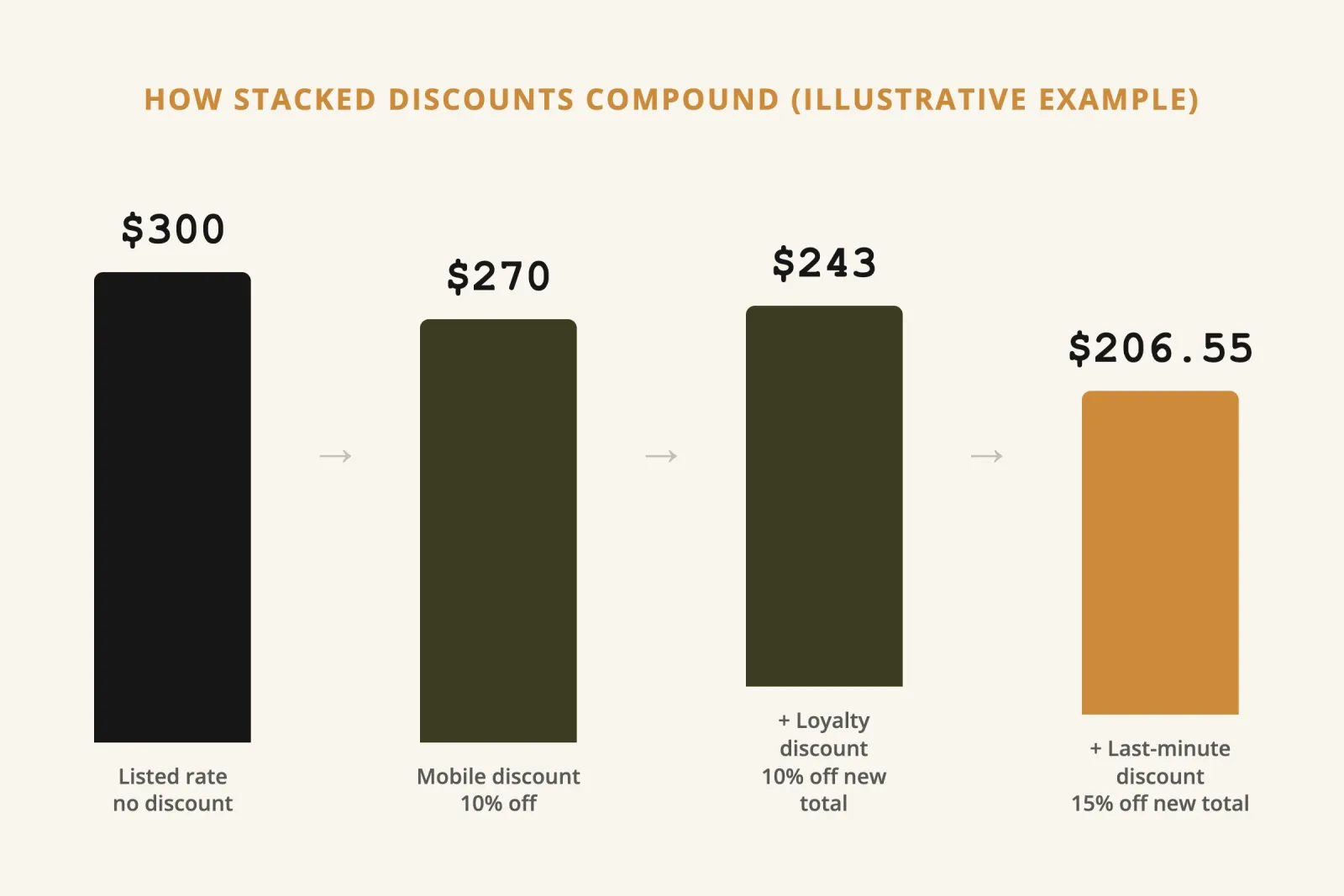
Three discounts that each sound modest on their own, 10%, 10%, and 15%, combine to just over 31% off your original rate. And that’s with only three discounts stacking.
In client accounts, we regularly see four or five discount programs stacking on the same booking, not three. At that point you’re not looking at a percentage off your rate anymore. You’re looking at a net payout around 30% of the price you originally pushed your pricing to, a much bigger cut than a flat 30% discount would be. The more programs stack, the worse the compounding gets, and it isn’t linear.
None of these discounts is bad for business on its own. Discounts can help fill dates that would otherwise sit empty. The danger is setting your base rate and markup without knowing how many of these can stack on a single booking, and getting blindsided by a net payout that’s far lower than what you expected when you set your nightly rate.
How to Calculate a Markup That Protects Your Net Rate
Turning off every discount program isn’t the fix. Some of them drive bookings you’d otherwise miss. Calculate your markup with the realistic worst case in mind, not the best case.
Step 1: List every discount program currently active on each platform. Not just the ones you remember opting into. Airbnb, Vrbo, and Booking.com all roll out new discount programs periodically, and some get switched on by default. Log into each platform and review your active promotions, not your memory of what you turned on.
Step 2: Identify which discounts can stack with each other. Platforms don’t always make this obvious, so test it. Some discounts are mutually exclusive, most are not. Assume they stack unless you’ve confirmed otherwise.
Step 3: Calculate your worst-case stacked discount, not your average case. If three discounts can realistically stack on the same booking, calculate the compounded reduction the way the table above does: each discount applies to the already-discounted total, not the original rate.
Step 4: Set your markup against the worst case, not the average. If your worst-case stacked discount is 30%, your markup on that channel needs to account for a 30% reduction reaching your floor price, not the 10% a single discount might suggest. This is the step most operators skip, and it’s the one that protects margin.
Step 5: Revisit this every time a platform announces a new discount or fee change. This is not a one-time calculation. Treat it the same way you’d treat any other part of your pricing strategy that needs ongoing attention, not a setting you configure once.
Common Mistakes Operators Make With OTA Markups
These overlap with the broader revenue management mistakes we see across STR portfolios, but they are specific enough to markup math that they’re worth naming on their own.
-
Calculating markup against a single discount instead of the stacked worst case. Most markup math accounts for one promotion at a time. Real bookings often qualify for several at once.
-
Setting markup once and never revisiting it. Every new discount program a platform introduces changes the math. A markup that protected your margin in January may not protect it in November.
-
Assuming discounts are optional and ignoring them in your pricing math. Some discount programs are opted into by default or tied to visibility. Even if you’d rather not offer them, the platform’s algorithm may still apply them, so your markup still needs to account for them.
-
Treating this as a one-platform problem. Because Airbnb, Vrbo, and Booking.com are actively copying each other, a markup strategy built for just one platform will fall behind as the others catch up with similar programs.
How to Apply This to Your Own Portfolio This Week
Step 1: Log into Vrbo and confirm your current commission rate against what your markup was calculated for. Adjust if it changed on October 29th.
Step 2: Pull up your active discount programs on Airbnb, Vrbo, and Booking.com, all three, not just one.
Step 3: Build your own version of the stacking table above using your actual active discounts, and calculate the realistic worst-case compounded discount.
Step 4: Compare that worst-case number to your current markup. If your markup doesn’t cover it, adjust it now rather than after you notice a payout that’s lower than expected.
Step 5: Put a recurring reminder on your calendar, monthly is reasonable, to repeat this check. New discount programs get introduced often enough that this isn’t a set-it-and-forget-it task. If keeping up with this monthly isn’t realistic on top of everything else you’re running, outsourcing revenue management is worth evaluating.
What This Adds Up To
None of this means discounts are the enemy. They fill nights that would otherwise sit empty, and platforms offer them because they work. The problem is invisible math: a markup calculated against yesterday’s discount landscape, eroded by today’s.
The operators who protect their margin through all of this know exactly how much a stacked discount costs them before it happens, and they treat their markup as something to maintain, not something to set once and forget. It’s the same discipline behind results like the same 32 listings generating 26% more revenue in Florida: nothing added to the portfolio, just pricing strategy that kept pace with the market.
If you want the fuller picture of how markup math fits into the rest of your pricing strategy, see our complete guide to STR revenue management.
Ready to stop leaving money on the table?
Get your free revenue report and we’ll analyze your property’s performance and show you exactly where your pricing strategy can improve. We manage $220M+ in bookings across 4,000+ listings, and we’ll show you what’s possible with professional revenue management.
Listen to the Full Conversation
This article was informed by a conversation on the Get Paid for Your Pad podcast.
Listen to EP739: VRMA Nashville Recap, AI, Private Equity, and What Changed in One Year
Related Articles
- STR Market Update: Vrbo Commission Change and AI in Revenue Management - A closer look at the mechanics of Vrbo’s old versus new commission structure.
- Revenue Management Cadences: Daily and Weekly Routines That Boost Your STR Income - The habits that keep a pricing strategy from going stale.
- STR Revenue Management: The Complete Guide for Property Managers - A full breakdown of the strategy behind the tools.
- STR Revenue Manager vs Pricing Tool: Which Do You Need? - How to decide whether a pricing tool alone is enough, or your portfolio needs a revenue manager watching the markup math too.