Every week, I talk to operators who outsourced revenue management and regret it. They hired someone, or signed with a service provider, and months later their revenue is flat or down. They’re frustrated, they’ve lost time, and they’re not sure if the problem was the person they hired or something they did wrong.
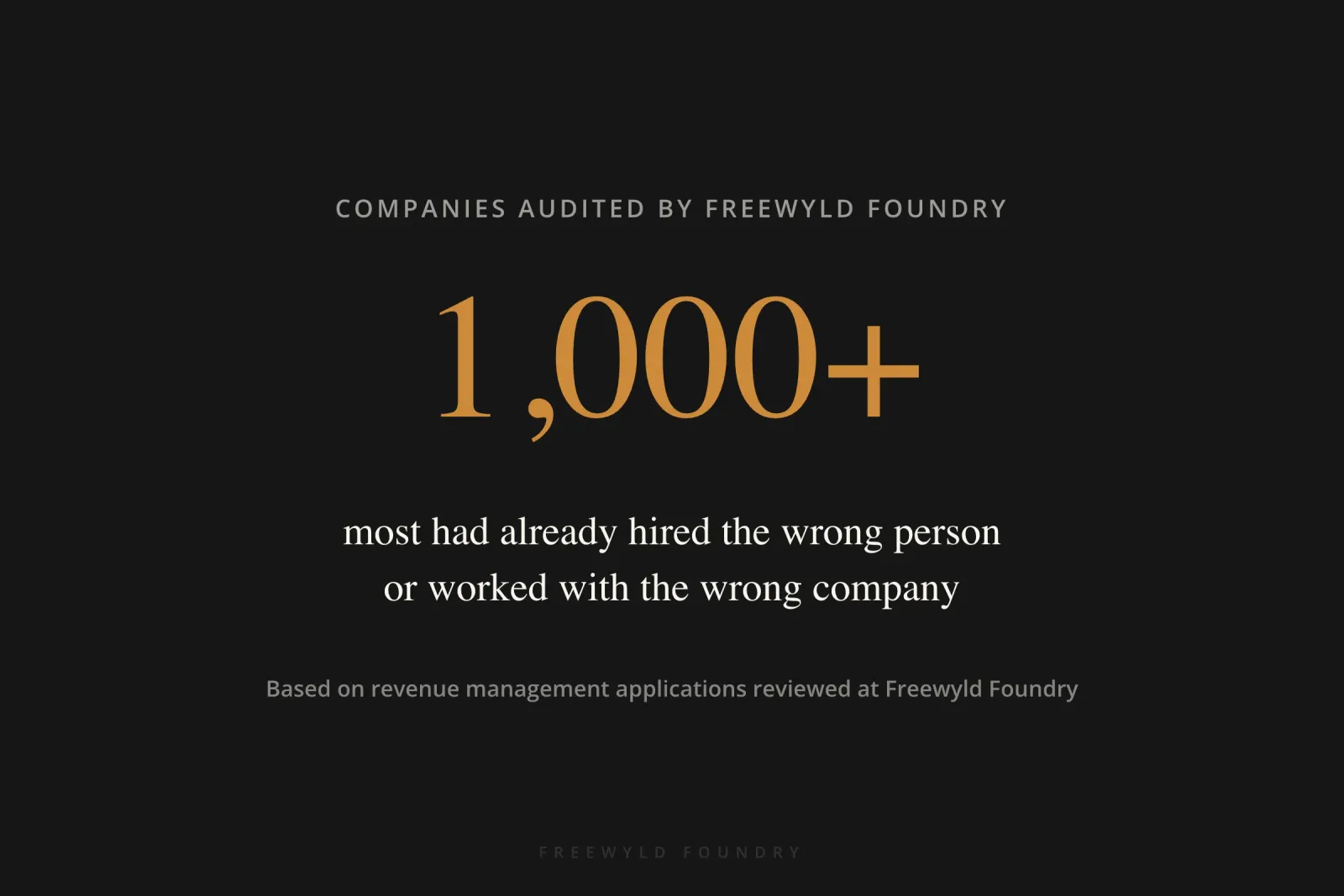
After reviewing more than 1,000 companies who applied for revenue management at Freewyld Foundry, I can tell you the answer is almost always: both. The provider wasn’t great. But the operator also wasn’t set up to get great results.
That’s the part nobody talks about. Outsourcing revenue management isn’t just about finding the right person or company. It’s about being ready to work with them. And most operators aren’t.
This article is the checklist I wish more operators had before they started. We manage $220M+ in bookings across 4,000+ properties at Freewyld Foundry, and we’ve seen every version of this go wrong. Here’s how to make sure it goes right.
Key Takeaways
- Revenue management requires rare analytical skills most STR operators don’t have time to develop at scale.
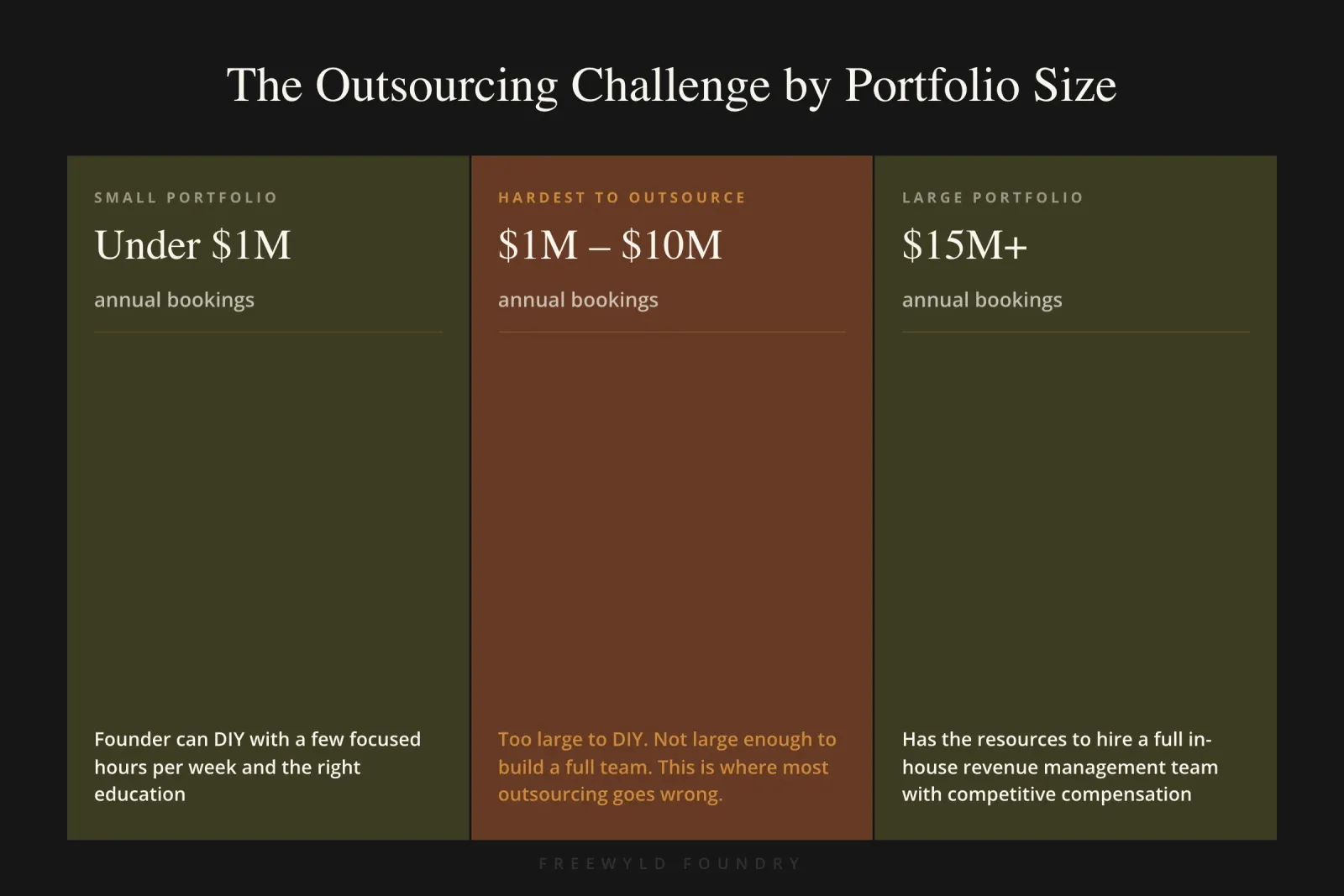
- Operators doing $1M to $10M in annual bookings face the hardest challenge: too large to DIY, too small to build a full internal team.
- Before outsourcing, you must be emotionally ready to let go. If you plan to micromanage, keep doing it yourself.
- The difference between setting boundaries and micromanaging is the difference between communicating constraints and giving pricing instructions.
- A real in-house hiring process takes weeks, not an afternoon on Upwork. Great revenue managers earn six figures and they have options.
- For service providers, the single most important requirement is that they manage pricing in your tool, not theirs.
- Monthly PDF reports are not enough. You need a live dashboard and direct communication, not a quarterly check-in.
Why Revenue Management Is Hard to Outsource
STR revenue management requires a specific set of skills that are rare in this industry. You need someone who is comfortable with data: reading graphs, interpreting demand signals, thinking in percentages, making pricing decisions under uncertainty. Hospitality, for all its strengths, doesn’t traditionally attract that profile.
The people who are great at this tend to come from hotel revenue management, where analytical rigor has been standard practice for decades. At Freewyld Foundry, we recruit from the hotel industry because the pool of qualified STR-native revenue managers isn’t large enough for the demand. We then put those hires through training on how short-term rental businesses work, because the nuances are real and they matter.
The practical implication: when you go looking for a revenue manager, most of what you’ll find won’t be good. That’s not cynicism. It’s just supply and demand. There are about 150 companies in the PriceLabs revenue management directory right now. Most are very small. Some are one-person shops that launched because the opportunity looked attractive. A small number are excellent. You need a process for telling them apart.
The $1M to $10M Problem
Most operators who struggle with this are doing between $1M and $10M in annual bookings. Here’s why that range is the hardest.
If you’re small, say five listings and a couple hundred thousand dollars in revenue, revenue management doesn’t take that much time. A founder who gets educated and dedicates a few focused hours per week can do a decent job. The stakes are real but manageable.
If you’re large, $15M, $20M, $25M, you have the resources to build a real internal team. You can hire a dedicated revenue manager at a competitive salary and support them with the systems and oversight they need to succeed.
The middle is where it breaks down. Your business has grown past the point where you can do it yourself without sacrificing something else. But you may not yet have the revenue to justify a full-time hire at the right salary, or the experience to know how to hire, manage, and evaluate someone in that role.
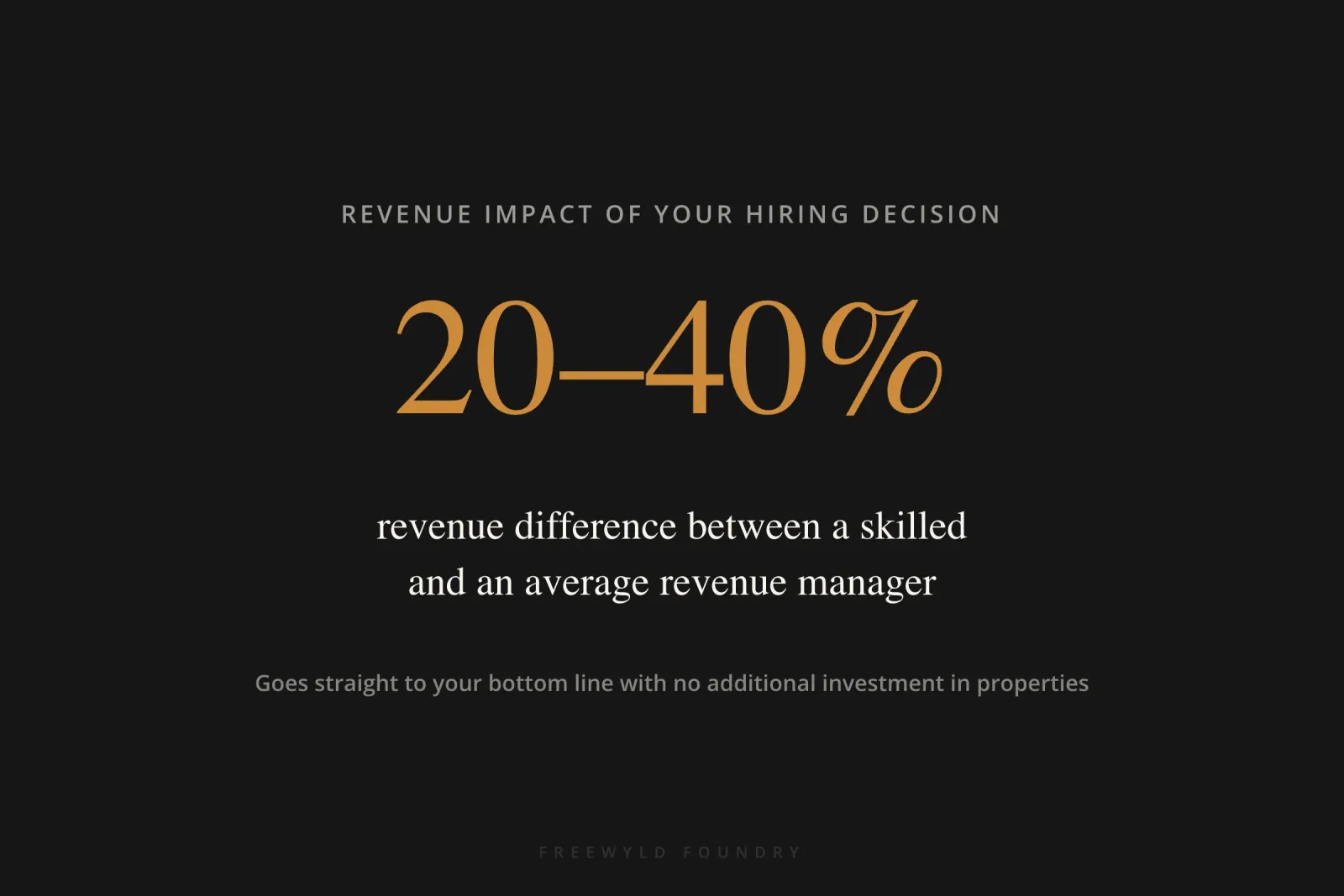
Revenue management at scale is one of the first functions worth outsourcing when a portfolio outgrows its founder. A good revenue manager versus a poor one can be a 20 to 40% difference in revenue. That’s not a small edge. That’s the difference between a good year and a great one, with no additional investment in properties or operations.
The Mindset You Need Before You Outsource
Before you hire anyone, you need to be ready to let them do their job.
If you’ve been managing your own pricing, you’ve built up strong opinions. You know your market. You know your properties. You’ve seen what works. That experience is valuable. It’s also the thing most likely to undermine the person you’re about to hire.
The distinction that matters here is the difference between leading and micromanaging. Micromanaging means telling a revenue manager exactly what price to set, reviewing every change, and second-guessing decisions before they have time to prove out. Leading means setting clear expectations, providing context and feedback, and holding the person accountable to results over a meaningful time horizon.
If you’re going to micromanage, don’t outsource. Seriously. You’ll frustrate a skilled person, limit their ability to do what they’re good at, and you’ll end up with worse results than if you’d kept doing it yourself. We’ve seen this pattern repeatedly at Freewyld Foundry with operators who came to us after bad experiences elsewhere. Often the experience was bad partly because they couldn’t let go.
This is about self-awareness in how you manage. The best operators I’ve worked with are clear on what they don’t know and willing to defer to the specialist they hire. The ones who struggle are the ones who’ve decided they already know best.
Setting Boundaries Without Limiting Performance
Letting go doesn’t mean removing yourself. There are legitimate constraints in your business that any revenue manager needs to understand, and communicating those is your job.
A minimum price that an owner requires. A check-out restriction that your cleaning team can’t support on certain holidays. A policy against same-day bookings because your operations can’t turn properties that fast. These are real constraints. They should be documented and shared before work begins.
The trap is when personal pricing opinions get presented as operational constraints. “I don’t want to go below $150 because I think that cheapens the property” is not a constraint. It’s a pricing opinion. And if your revenue manager is working around it, they’re probably leaving money on the table for you.
The rule I use: challenge every “constraint” by asking whether it reflects a real operational limit or a belief about what prices should be. The more freedom you give a skilled revenue manager, the better your results will be. That’s not a guess. That’s what the data consistently shows.
Hiring a Revenue Manager In-House
If you’re going to hire internally, treat it with the same seriousness you’d bring to hiring any senior role. This is not a position to fill quickly. A bad hire in revenue management is expensive: not just their salary, but the months of underperformance before you catch the problem and the time to find and ramp someone new.
There’s a book called “Who” that’s worth reading before you start. The hire-slow-fire-fast philosophy isn’t just a cliche. In revenue management, it’s exactly right.
Write a real job description
Get specific about responsibilities and what success looks like. Be honest about the analytical demands of the role and the type of thinker you need. Include the culture fit criteria too. A technically capable person who doesn’t fit your company’s working style will frustrate you even when they’re performing.
Build an application process that tests the skills
Don’t hire someone after a 20-minute Zoom call. Run at least two rounds of interviews and give candidates at least two test tasks that reflect real work. For revenue management, that means data interpretation, pricing logic, and market analysis. See how they think through ambiguous problems. How do they handle a market where demand signals are mixed? What do they prioritize?
Create an onboarding process before they start
When the person joins, they should immediately understand your company, your portfolio, your owners, your goals, and your systems. Don’t hand them a login and say “figure it out.” Build the onboarding before you hire so the first 30 days are structured, not improvised.
Know what accountability looks like
Before you post the job, decide how you’ll manage this person. What does a weekly check-in look like? How do you measure performance? What’s the timeline before you can fairly evaluate whether it’s working? Answer these questions in advance so you’re responding to situations rather than reacting to them.
Plan for when they’re not available
Revenue management is a seven-day function. Guests don’t stop booking on Saturday because your revenue manager is offline. You need a coverage plan for weekends, holidays, illness, and the inevitable moment when someone leaves. Contractors especially can walk with very little notice. We’ve experienced this firsthand. The disruption is significant without a documented plan.
Pay what the role is worth
Great revenue managers earn six figures. We’ve hired people who took pay cuts from $120K to $150K at prior companies to join Freewyld Foundry because they were excited about where we were going. If you’re offering $20K to $30K, you will not attract those people. You’ll attract someone who couldn’t get the better offer.
Run the math. If you’re doing $2M in bookings and a skilled revenue manager improves performance by 10%, that’s $200K in additional revenue. A $100K salary has an obvious ROI. A $25K salary that produces average results probably doesn’t.
Choosing a Revenue Management Service Provider
If you’re going the service provider route, the selection process matters as much as with an in-house hire. There are many options. Most are not great. Here’s what to evaluate.
| Criteria | In-House Hire | Service Provider |
|---|---|---|
| Best portfolio size | 30+ listings, $2M+ revenue | 10+ listings, $1M+ revenue |
| Typical cost | $60K-$120K/year salary | 1-5% of managed revenue |
| Key risk | Key-person dependency if they leave | Variable quality across providers |
| Red flag | Hired after a 20-minute Zoom call | Manages pricing in their own account |
| Weekend coverage | Requires a plan: guests book 7 days | Usually covered by the team |
| What success looks like | Structured onboarding, clear KPIs, weekly check-ins | Live dashboard, Slack access, RevPAR on comparable units |
Track record and operator experience
How long have they been in the business? How many listings do they manage? Are the founders and team members actual STR operators, or did they come from a background with no real exposure to how these businesses work?
This matters more than it might seem. Revenue management isn’t just pricing. It’s understanding why a listing stops booking (is it the price, or the reviews, or the listing quality?), when to hold rates versus when to move aggressively, and how operational context should influence pricing decisions. A team that has lived in this industry sees those connections. A team that hasn’t will miss them.
They must manage pricing in your tool, not theirs
This is non-negotiable for me. If a service provider manages your listings in their own pricing account and doesn’t give you access to see what they’re doing, that’s a red flag you should not ignore.
You lose visibility into their work. If you want to leave, you face a complicated transfer process that we’ve gone through multiple times when onboarding clients from other providers. It’s time-consuming and disruptive. And frankly, if a company isn’t willing to work transparently in an account you can access, ask yourself why.
When a provider works inside your PriceLabs account (or whatever tool you use), you can see exactly what decisions are being made, you can stop the engagement at any time with no obstacles, and you maintain full ownership of your pricing history and setup. Think of it like a restaurant with an open kitchen: you can watch what’s happening. That’s a sign of a company confident in the quality of their work.
Real customer support, not periodic reports
Revenue management requires ongoing communication between your team and theirs. They need to understand your operational constraints, your owner relationships, your seasonal patterns. You need to be able to flag anomalies, ask questions, and give feedback quickly.
A company that responds to emails in three days or only communicates through a monthly report is operating in a silo. That’s not a partnership. We run Slack channels with every client for daily communication and do weekly or biweekly Zoom calls specifically to maintain that relationship. The first few months with any new client are especially important because there’s a lot to learn about each portfolio.
A live dashboard, not a monthly PDF
You should be able to check your portfolio performance any day you want to, not wait for someone to send you a summary. Every day there are new bookings, new cancellations, and shifting demand signals. You need to see that in real time.
More importantly, the reporting needs to use the right metrics. Total portfolio revenue growth is a misleading KPI if your portfolio changed size. If you had 30 units last year and 60 this year, of course your total revenue went up. That tells you nothing about how well your revenue management is performing.
The right KPI is RevPAR on comparable units: the properties that were active in the same period last year, measured against the same properties now. That’s the only comparison that tells you whether performance improved. Any provider that isn’t reporting this way is either unsophisticated or deliberately obscuring results. Either is a problem.
The Most Common Outsourcing Mistakes
Based on the audits we’ve run across more than 1,000 companies that applied, here are the patterns that lead to bad outcomes:
-
Hiring too fast. Spending 20 minutes on a Zoom call and deciding “they seem good” is not a hiring process. Taking a shortcut here almost always leads to a slow realization months later that something is off.
-
Not being ready to let go. Hiring a revenue manager and then overriding their decisions constantly produces worse results than not outsourcing at all. If you’re not willing to trust the specialist, that’s a problem to solve before you hire, not after.
-
Setting too many restrictions. Every minimum price floor, every override, every “don’t touch this” instruction narrows the revenue manager’s ability to optimize. Some constraints are real. Many are preferences. Know the difference.
-
Working with a provider who uses their own account. No visibility, hard to leave, no continuity if you switch. Avoid this entirely.
-
Measuring the wrong things. Evaluating a revenue manager on total portfolio growth when you’ve added 30 new properties isn’t a fair comparison. Set up the right KPIs before you start, so you can evaluate performance accurately.
-
No communication structure. Expecting results without building in regular touchpoints is wishful thinking. Define how you’ll communicate, how often, and what you’ll review before the engagement starts.
Action Steps
Step 1: Decide if you’re ready to outsource. Ask yourself: am I prepared to let someone else make pricing decisions without me second-guessing every one? If the answer is no, spend a few weeks working on that mindset before you start the process. Tracking your own results for a quarter first can also give you the baseline you’ll need to evaluate whoever you hire.
Step 2: Document your real constraints. Write down every actual operational limit in your business: minimum prices required by owners, turnover restrictions, booking policy requirements. Then challenge each one. Is this a real constraint or a preference? The cleaner your constraint list, the more effective your revenue manager can be.
Step 3: Run a real hiring or vetting process. Whether you’re hiring in-house or evaluating service providers, spend the time upfront. Multiple rounds of evaluation. Test tasks. Reference checks. The cost of getting this wrong is always higher than the time it takes to get it right.
Step 4: Set up accountability from day one. Define what KPIs you’ll track, what time horizon is fair for evaluating results, and how you’ll communicate. Build the oversight structure before work begins so you’re measuring performance, not just hoping for it.
Get a Free Analysis of Your Portfolio
If you’re managing 15+ properties and generating $1M+ in annual revenue, apply for a free revenue report. We’ll review your pricing setup, identify where you’re underperforming relative to your market, and give you specific recommendations. We manage $220M+ in bookings and our clients average 18% above their market. We’ll show you what’s possible.
Apply at FreewyldFoundry.com/report
Listen to the Full Episode
How to Outsource STR Revenue Management Without Losing Control - Get Paid for Your Pad, EP 723. Jasper covers the full in-house hiring checklist, service provider red flags, and the mindset shift required before you outsource.
Related Articles
- STR Revenue Manager vs Pricing Tool: Which Do You Need? - How tools and human expertise fit together, and when you need both.
- How to Choose the Right Revenue Manager for Your STR Business - Detailed breakdown of the in-house vs. service provider decision.
- Why Your Revenue Manager Might Be Costing You 30% in Lost Revenue - How to evaluate whether your current approach is working.
- 5 Revenue Management Mistakes Costing STR Operators Money - The most common errors we find across hundreds of audited portfolios.