The Occupancy Illusion
You’re running 80% occupancy. Your calendar looks full. You’re beating the market average.
So why does your revenue feel… flat?
High occupancy doesn’t guarantee high revenue. In fact, you can run 80% occupancy and still leave 35% of your potential revenue on the table.
The culprit? The last minute pricing trap.
In this guide, you’ll learn exactly what the last minute trap is, how to identify if you’re stuck in it, and the precise strategy one portfolio used to increase their RevPAR by 35% without adding a single booking. We’ll break down the math, show you when to drop prices based on your market’s booking window, and explain why your approach needs to change across low season, shoulder season, and high season.
If you manage 15+ properties and your revenue performance doesn’t match your occupancy numbers, keep reading.
What Is the Last Minute Pricing Trap?
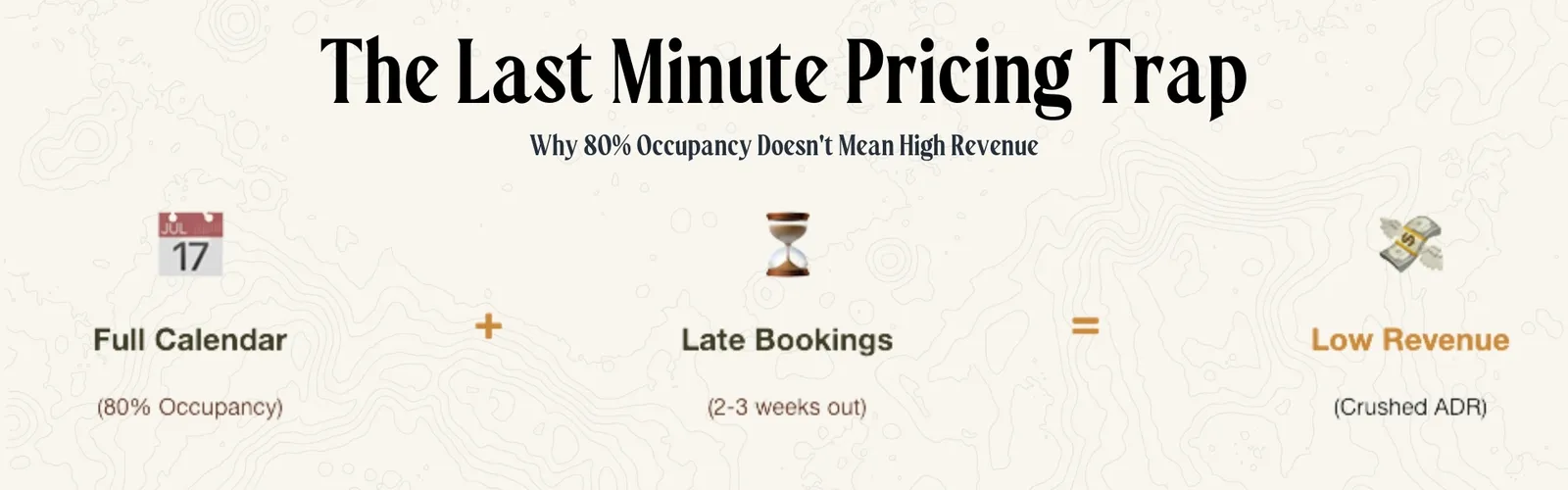
The last minute trap happens when the majority of your bookings come in during the final 2-3 weeks before check-in.
At first glance, this might not seem like a problem. Your calendar fills up. Guests are booking. You’re hitting your occupancy targets.
But here is what is happening:
When most of your inventory fills in those final weeks, you’re competing directly with every other operator who’s also dropping prices to avoid empty nights. Your listings are showing up in search results alongside dozens of other properties that are aggressively discounting to fill gaps.
The result? Your average daily rate (ADR) gets crushed.
You end up accepting bookings at $100, $120, maybe $150 per night, when those same nights could have been booked months earlier at $200, $250, or even $300.
Your calendar looks healthy. Your occupancy beats the market. But your revenue is nowhere near where it should be.
The Real-World Case Study: 35% RevPAR Increase, Same Occupancy
We onboarded a client earlier this year who was skeptical we could help them.
They had an in-house revenue manager. They were running around 80% occupancy. They were beating the market on every metric they tracked.
When they applied for our revenue management service, they told us straight up: “We’re not sure there’s much left to optimize.”
I pulled up their booking data. It took about five minutes to spot the problem.
80% of their bookings were landing in the final 2-3 weeks before check-in.
Their booking window wasn’t broken by accident. It was broken by design. They were overpriced far out, so early bookers scrolled past them and booked competitors. By the time their prices finally dropped low enough to compete, the only demand left was last minute.
And last minute demand comes with last minute pricing.
The Fix Was Simple
We made one adjustment: we lowered their far-out prices.
Bookings started shifting. Instead of coming in 2-3 weeks before arrival, they started landing 3-6 months ahead.
Their occupancy? Stayed exactly the same.
Their RevPAR jumped 35%.
Same number of nights booked. Same properties. Same markets. Just 35% more revenue.
How is that possible?
The Math Behind the Last Minute Trap
Let’s break down the math so you can see exactly why booking window timing matters more than most operators realize.
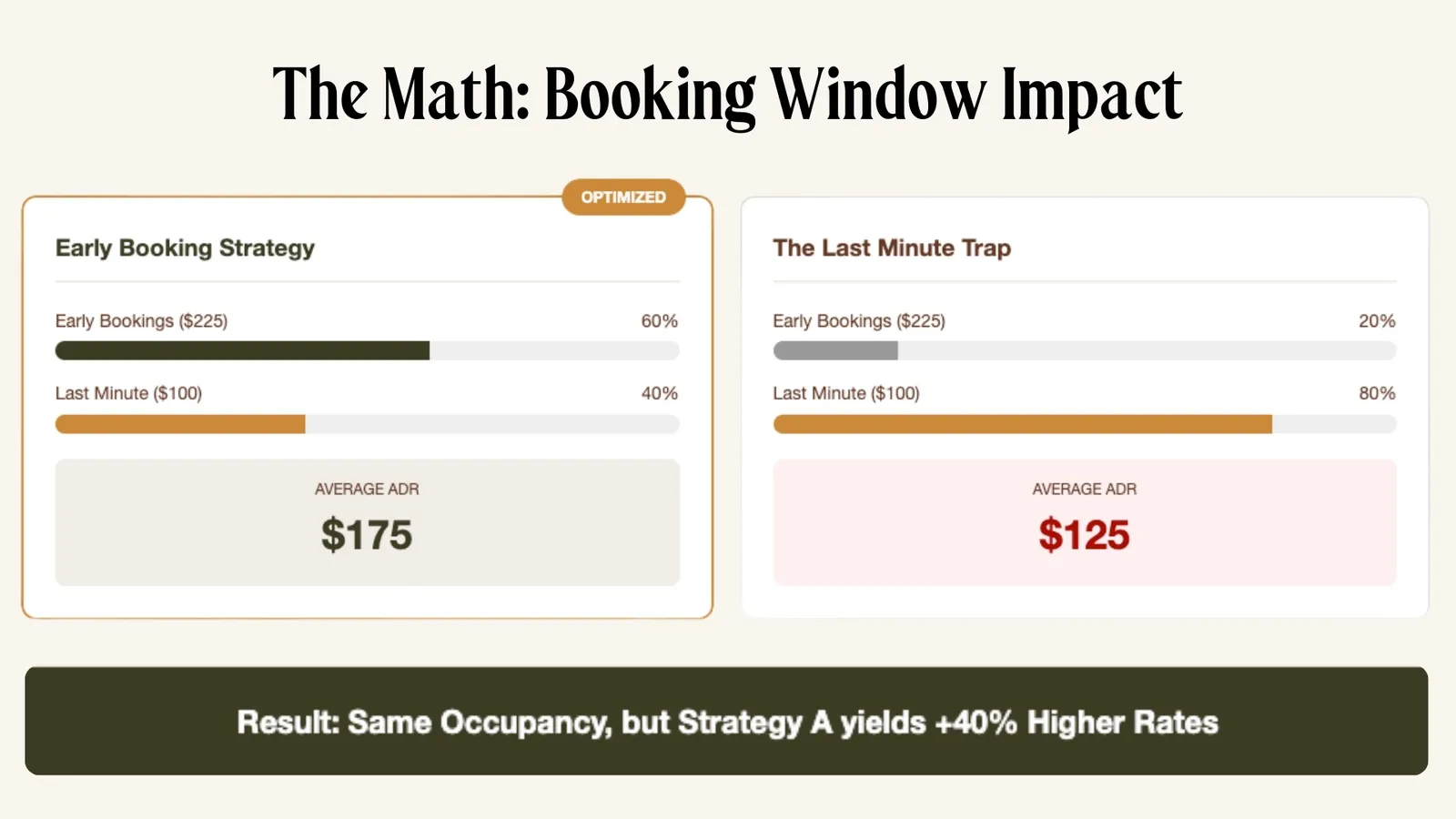
Scenario 1: Early Booking Strategy
- 60% of bookings at $225 = $135
- 40% of bookings at $100 = $40
- Average ADR: $175
Scenario 2: Last Minute Trap
- 20% of bookings at $225 = $45
- 80% of bookings at $100 = $80
- Average ADR: $125
Result: $50 more per night. That’s 40% higher ADR.
Same occupancy percentage. Different revenue outcome.
When you get 60% of your bookings early at higher rates and only 40% last minute at discounted rates, your average ADR destroys getting 20% early and 80% last minute.
The math is simple. It stays invisible if you only track occupancy and not booking window behavior.
Why Operators Fall Into the Last Minute Trap
False Sense of Success
Many operators compare themselves to market averages and think they’re doing great.
“I’m at 80% occupancy and the market is at 70%. I must be maximizing revenue.”
The average is pretty bad. There are tons of hobby hosts, part-time operators, and people running Airbnbs as side gigs who aren’t focused on revenue optimization at all. Some operators don’t even use pricing tools and run nearly flat pricing year-round.
Beating the average doesn’t mean you’re capturing your full potential.
Occupancy Obsession
Revenue equals occupancy times ADR.
Most operators obsess over the first variable and ignore the second.
If you price your units at $1 per night, you’ll hit 100% occupancy. You won’t make any money.
The point? Occupancy alone tells you nothing about revenue performance.
The last minute trap is just one of several revenue management mistakes that drain portfolio performance.
Not Tracking Booking Window
The booking window for your summer inventory didn’t start last week. It started six months ago.
If you weren’t participating early because your prices were too high, you missed the entire premium booking phase. Now you’re stuck competing in the last-minute discount war where margins disappear.
Few operators track when their bookings come in. They just know their calendar fills up eventually.
That “eventually” is costing them 30-40% of their potential revenue.
When to Start Dropping Your Prices
The timing of your price drops depends entirely on three factors:
- Your market’s booking window
- The season you’re pricing for
- Your property’s final occupancy expectations
Understanding when and why to drop prices last minute requires analyzing three key factors.
Let’s break down each one.
Understanding Booking Windows by Market
Booking windows vary widely by market.
Miami has a very short booking window. Most bookings come in 2-3 weeks before arrival. People don’t generally plan Miami beach trips six months out.
So in Miami, if you start dropping prices a month ahead, you’re turning your entire booking window into a last-minute pricing strategy. You’re giving away premium pricing during the peak demand window.
In contrast, ski markets, lakefront destinations, and family vacation markets often have booking windows that start 6-9 months out. Summer family trips get booked in January and February. Holiday weeks get reserved almost a year in advance.
In those markets, if you’re not offering competitive pricing six months out, you’re missing the boat entirely.
Booking Windows Are Seasonal
Your booking window isn’t static throughout the year.
High season typically has a much longer booking window. For most markets where summer is peak season, guests are already booking summer stays in January and February.
But your off-season? The booking window might only be a couple of weeks.
You need different pricing strategies for different seasons.
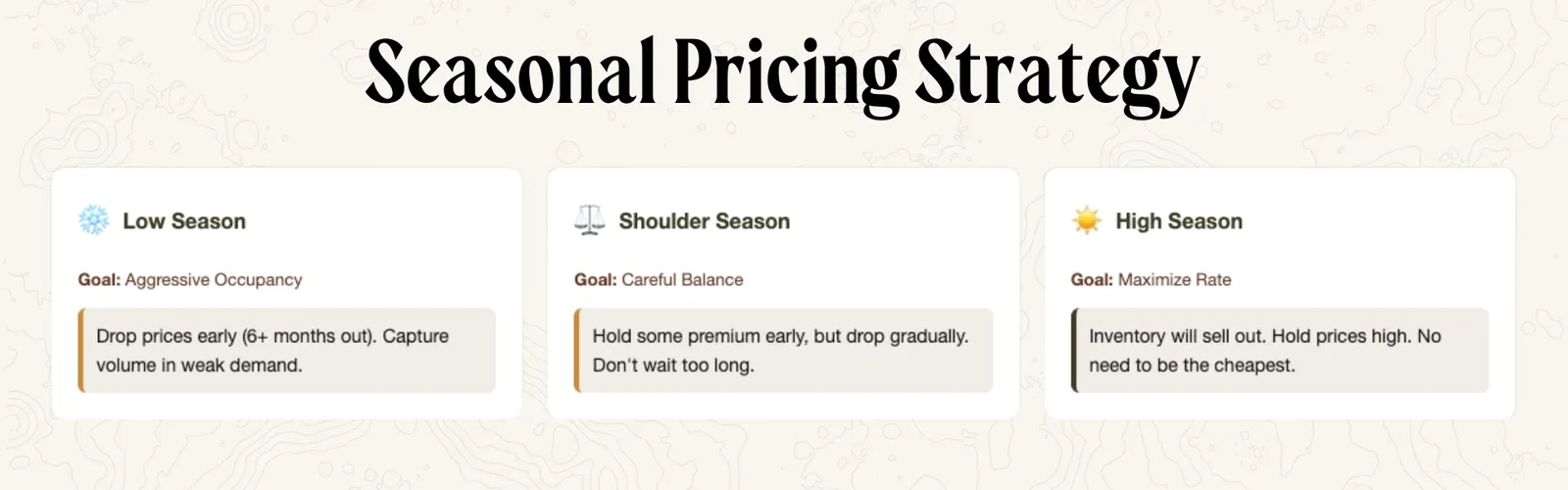
Last Minute Pricing Strategy by Season
Low Season (Under 30% Final Occupancy)
If your low season is dead (under 30% market occupancy), you want to start with your last minute pricing a year out.
This isn’t a “last minute strategy” anymore. It’s an aggressive occupancy play.
You want to offer your most competitive rates early because you’re trying to capture as many bookings as possible in a very weak demand environment.
If the market is running 25% occupancy and you want to hit 60%, you need to capture more than twice your fair share of bookings. That requires pricing aggressively from the start.
Some markets drop below 20% occupancy in the dead of winter. In those situations, any booking you can get is better than nothing. It’s purely an occupancy game.
Shoulder Season (30-50% Final Occupancy)
This is where most operators’ low seasons fall.
In this range, you still want to be very aggressive with pricing, but you don’t need to go to absolute minimum rates six months out.
You still want to pace ahead of the market (aiming for 150-200% of market pace), which means you need to start lowering prices fairly early, but you can hold some premium pricing in the beginning.
You might start with rates 20-30% below your high season pricing and gradually drop toward your minimum as you get closer to check-in.
The key is you still need to drop prices pretty far last minute to get booked, because there’s enough inventory that doesn’t fill where operators are getting desperate and slashing rates.
Shoulder Season (50-70% Final Occupancy)
This is the interesting middle ground.
You don’t want to drop prices too much far in advance because you do want to capture some premium bookings early. But you also can’t afford to hold rates too long because you still need to drive occupancy well above market to hit your targets.
This requires careful balance. You’re trying to capture the best of both worlds: some early premium bookings while also ensuring you don’t end up with too many gaps that force you into last-minute fire sales.
High Season (80-100% Final Occupancy)
High season is a different animal.
When final occupancy is going to be 80-100%, you can hold rates much longer because inventory is going to run out.
Here’s what typically happens in high season:
The cheap, underpriced units get booked first. These are properties from operators who price too flat year-round or don’t have pricing tools. They’re underpriced for high season, so early bookers snap them up.
Then the premium properties start getting booked. Quality listings with good reviews and attractive pricing get reserved as availability tightens.
What’s left at the end? Usually low-quality listings, properties with bad reviews, or overpriced inventory that never adjusted.
If you have a decent product with good reviews and quality photos, you’re probably going to get close to 100% occupancy in high season. You don’t need to drop your prices nearly as aggressively last minute because there isn’t that much inventory available.
In fact, in high season last minute, you don’t need to be the cheapest option to get booked. You just need to be available and reasonably priced.
Setting Up Your Last Minute Pricing in PriceLabs
Most dynamic pricing tools, including PriceLabs, offer multiple ways to configure last-minute pricing.
Avoid Fixed Last Minute Discounts
Some operators set up a fixed price drop at a certain point. For example, their rate might hover around $200-$300, then suddenly drop to $100 exactly 30 days out and stay there.
This isn’t optimal.
Use Gradual Discounts Instead
Gradual discounts work better for two reasons:
- Algorithm Advantage: Every time your price drops slightly, the OTA algorithms notice and give you a small visibility boost. They show your listing to more potential guests because the platform wants to reward competitive pricing. If your price drops a little bit every day, you get that visibility boost daily.
- Market Responsiveness: Gradual discounts allow you to adjust to market conditions as they develop rather than committing to a single price point weeks in advance.
PriceLabs Settings: Balanced, Conservative, Aggressive
PriceLabs offers pre-configured settings that automatically adjust based on market data:
- Market-Driven Balanced: This is the default recommendation
- Conservative: Smaller discounts (around 21% same-day)
- Aggressive: Larger discounts (around 40% same-day)
For example, looking at one of our Idlewild properties, the balanced approach drops prices by 31% for same-day bookings, gradually reducing to 0% discount after 16 days.
That 16-day window makes sense for this market because the booking window is relatively short.
If you don’t have a strong reason to deviate from the default balanced setting, stick with it. The tool is analyzing market data and making informed recommendations.
If your pricing tool still isn’t delivering the results you expect, these 5 common pricing mistakes might be the real issue.
Manual Overrides for Special Circumstances
You can and should make manual adjustments based on factors the algorithm can’t see:
Weather: In shoulder and low seasons, weather matters enormously. If you’re in a beach market and the forecast shows rain and wind for an upcoming weekend, drop prices to minimum. You’d rather get something than nothing. If it’s sunny, you might hold rates because demand will spike.
Local Events: Major concerts, festivals, sporting events, or conferences can change demand patterns. Sometimes you want to hold or even increase rates last minute.
Market Pickup: Look at how many bookings are flowing into the market in the last 7-10 days. If pickup is strong, you might not need to drop as aggressively. If it’s weak, get more aggressive faster.
Building a consistent revenue management routine helps you catch these opportunities before they turn into problems.
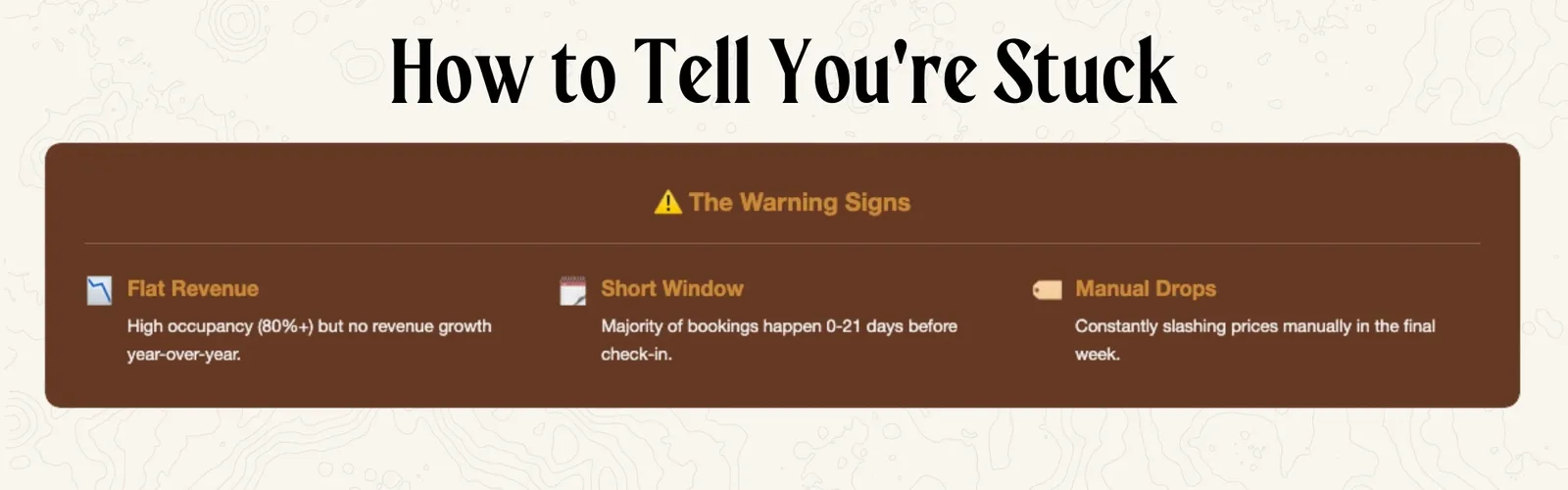
How to Tell If You’re Stuck in the Last Minute Trap
Here are the warning signs:
High Occupancy, Flat Revenue
You’re running 75-85% occupancy but your year-over-year revenue growth is minimal or negative (adjusted for market conditions).
Short Booking Window
When you look at your reservation data, most bookings are coming in within 14-21 days of check-in. Very few are coming in 60+ days out.
Low ADR Relative to Market Positioning
Your property quality, reviews, and photos suggest you should be in the top tier of your market, but your ADR is middle-of-the-pack or worse.
Consistently Dropping Prices Late
You find yourself manually lowering prices in the final week before check-in more often than not, trying to fill those last few gaps.
Revenue Reports Show the Pattern
If you run a revenue report comparing your performance to market benchmarks, you’ll likely see that your occupancy index is strong but your ADR index is weak.
Once you’ve identified the problem, learning how to manage pacing effectively becomes critical to fixing your booking window.
The Indirect Benefits of Early Bookings
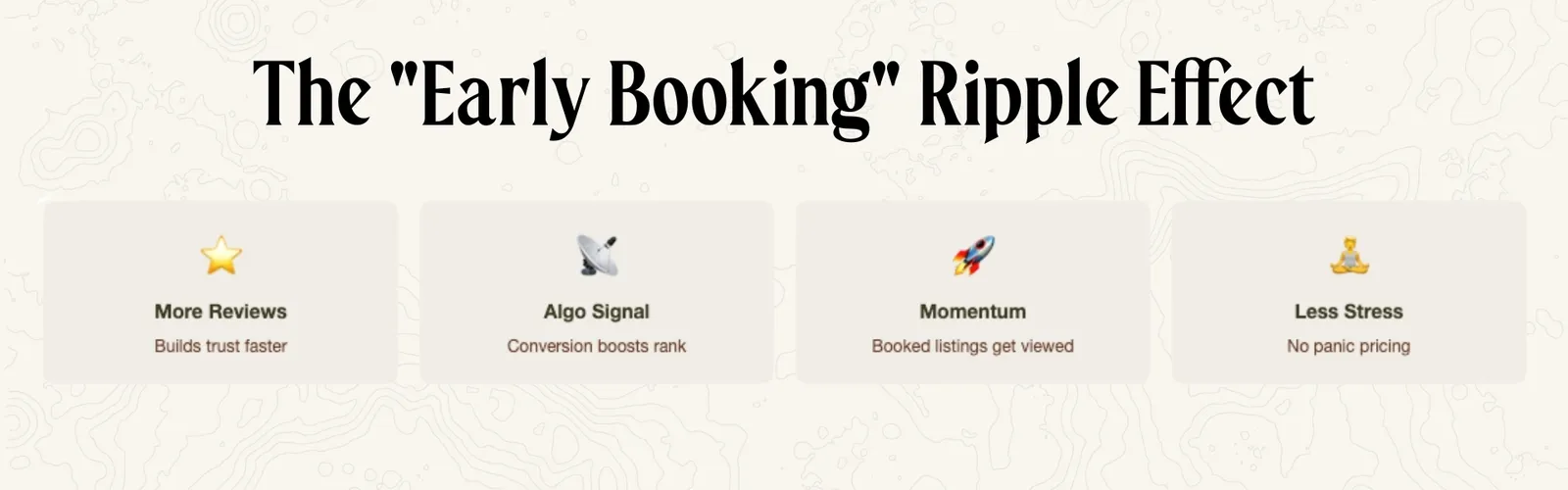
Beyond just higher ADR, early bookings provide several indirect advantages:
Review Generation
More bookings mean more reviews, which improves your listing’s visibility and conversion rate over time.
Algorithm Signals
When guests book your property, the OTA algorithms notice your listing is converting. This can trigger increased visibility, leading to more bookings in a positive feedback loop.
Momentum Protection
Once a listing starts booking, it tends to keep booking. The algorithm interprets the activity as a signal that the listing is attractive. Conversely, listings that sit empty for weeks can lose momentum and visibility.
Referrals and Repeat Guests
Guests who stay at your property can become repeat customers or refer friends and family. The more guests you host, the more opportunities you create for this organic growth.
Reduced Last-Minute Stress
When your calendar fills early, you’re not constantly scrambling to fill gaps. You can focus on operations, guest experience, and strategic planning instead of reactive pricing adjustments.
Summary & Key Takeaways
- High occupancy doesn’t equal high revenue. You can run 80% occupancy and still leave 35% of potential revenue on the table by getting most bookings last minute.
- The last minute trap destroys ADR. When 80% of bookings come in the final 2-3 weeks, you’re competing in the discount window where everyone drops prices.
- Booking window timing matters more than most operators realize. Getting 60% of bookings at $225 and 40% at $100 beats getting 20% at $225 and 80% at $100.
- Lower far-out prices can increase average ADR. Counter-intuitive but true: dropping early prices shifts bookings away from the last-minute discount window.
- Seasonal strategy is critical. Low season requires aggressive early pricing. High season allows you to hold rates longer. Shoulder season requires careful balance.
- Use gradual discounts, not fixed drops. Gradual price reductions trigger daily algorithm visibility boosts and respond better to market conditions.
Next Steps: Take Action Now
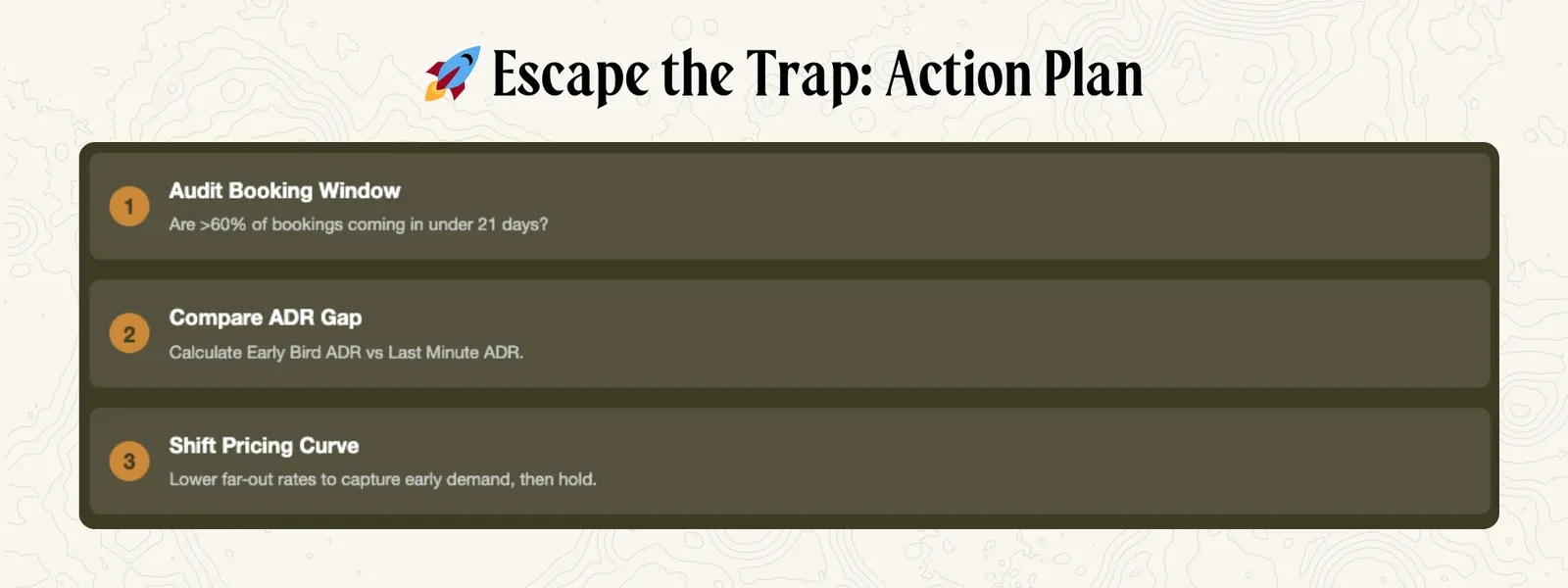
If you’re managing 15+ properties and suspect you might be stuck in the last minute trap, here’s what to do:
Audit your booking window. Pull your reservation data for the past 12 months. Calculate what percentage of bookings came in 0-14 days out, 15-30 days out, 31-60 days out, and 60+ days out. If more than 60% are coming in the first two windows, you’re in the trap.
Compare your ADR to booking window. Look at the actual ADR you captured for early bookings versus late bookings. Calculate the gap. This shows you exactly how much the trap is costing you.
Apply for a free Revenue Report. We analyze your portfolio’s pricing strategy, booking window behavior, and revenue performance against market benchmarks. You’ll see exactly where you’re leaving money on the table and get specific recommendations for your market and season.
Questions for Discussion:
How does your booking window look right now? Are most of your reservations coming in early or late?
Have you ever experimented with lowering far-out prices and seen your average ADR increase as a result?