Most STR investors obsess over revenue per night. RevPAR, ADR, occupancy, the numbers we stare at every week. And that is right. That is where the big gains come from.
But there is another category of optimization most investors ignore: what happens to the money you send out the door every month. Specifically, your mortgage payments.
If you own multiple short-term rental properties, you are probably sending somewhere between $10,000 and $50,000 per month in mortgage payments to your lenders. And until very recently, every dollar of that left your account and earned you nothing.
A company called BILT changed that in February 2026. And for STR investors who understand how travel points work, the numbers are compelling enough to act on immediately.
Key Takeaways
- BILT is not a credit card. It is an ACH pass-through that routes your mortgage payments and earns points without the 3% processing fee that credit cards charge.
- BILT launched mortgage points earning on February 7th, 2026. Previously, it was only available for rent payments.
- At $22,000 in monthly mortgage spend plus $18,000 in monthly credit card spend through BILT, an investor generates roughly 739,000 BILT points per year.
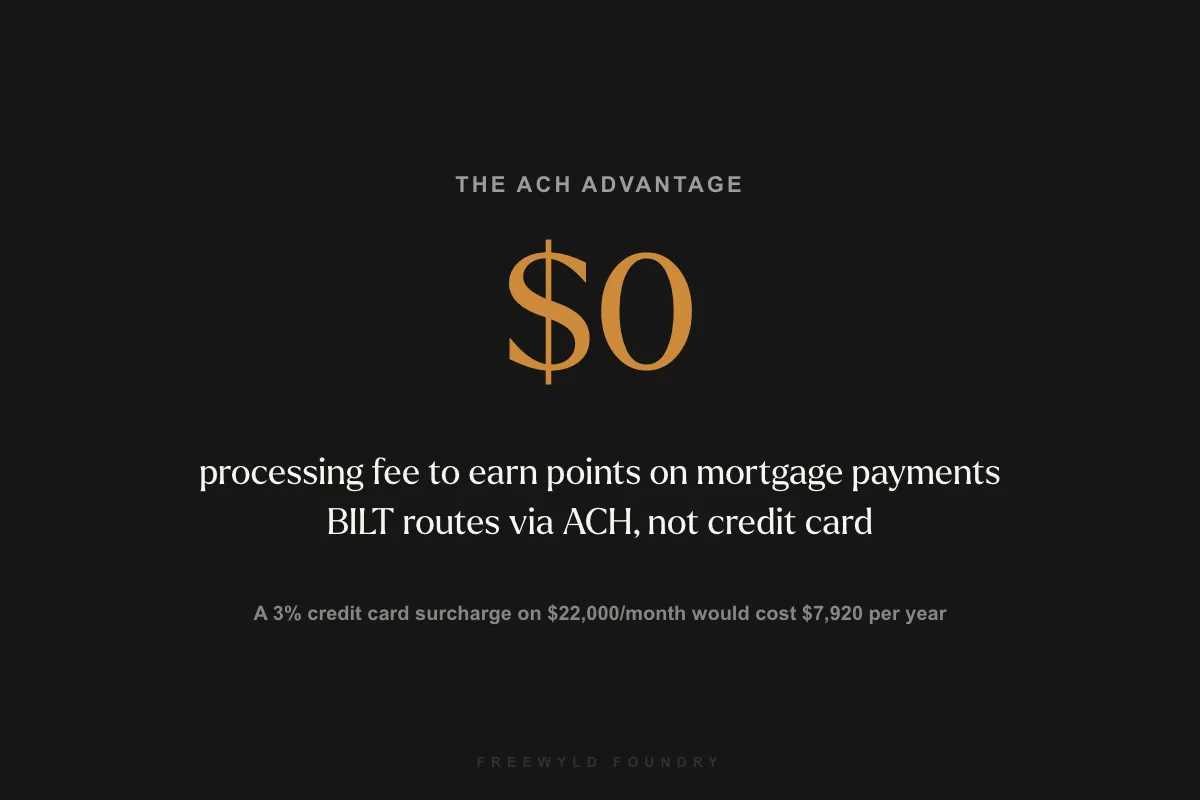
- On BILT’s monthly “rent day,” transfer partners offer double the transfer rate. That 739,000 becomes 1.4 million travel points.
- Those 1.4 million points can be redeemed for $11,000 toward a down payment, 37 one-way economy seats, or 16 international business class seats.
- The bigger your mortgage portfolio, the more compelling the math gets.
What BILT Is (and What Changed in February 2026)
BILT has been around for a few years as a way for renters to earn travel points on monthly rent payments. The concept: instead of paying rent directly from your checking account, you route it through BILT, which earns points on the transaction and then pays your landlord. No credit card swipe. No processing fee.
That alone made it popular with renters in high-cost cities. But the product had an obvious ceiling. Once someone bought a home, they stopped paying rent and stopped earning.
On February 7th, 2026, BILT opened up the same model for mortgage payments. The mechanics are the same: your mortgage servicer draws from BILT, and BILT draws from your checking account via ACH. No card swipe. No surcharge. Just points on a payment that was always going to leave your account anyway.
For renters, BILT was a nice perk. For real estate investors with multiple mortgages, it is a different conversation entirely.
The Math: How 1.4 Million Points Per Year Works
BILT’s earning structure rewards you for total spend across both mortgage payments and BILT credit card activity. The more you run through the system, the higher your earn rate on mortgage payments, either 1x or 1.25x per dollar depending on your activity tier.
An STR investor in Lincoln City, Oregon ran his own numbers through a calculator he built in Claude. His stack:
- $22,000 to $23,000 per month in mortgage payments across his portfolio
- Just over $18,000 per month in credit card spend through BILT (personal spend plus property utilities)
On those numbers, the calculator generates approximately 739,000 BILT points per year. That is already meaningful. But the real multiplier happens once a month on what BILT calls “rent day.”
On rent day, BILT’s transfer partners allow double the standard transfer rate. Instead of transferring 739,000 points to an airline or hotel partner at 1:1, you get 2:1. The 739,000 becomes 1.4 million travel points.
| Input | Monthly | Annual BILT Points |
|---|---|---|
| Mortgage payments | $22,000 | ~260,000 |
| Credit card spend (BILT card) | $18,000+ | ~479,000 |
| Total before rent day | 739,000 points | |
| After rent day 2x transfer | 1.4 million points |
For a family of four that travels during school breaks, 16 business class seats internationally is more than they can use in a year. The surplus goes to bringing more people along.
Why There Is No Processing Fee
The first question everyone asks when they hear about paying their mortgage with a points system: “What is the fee?”
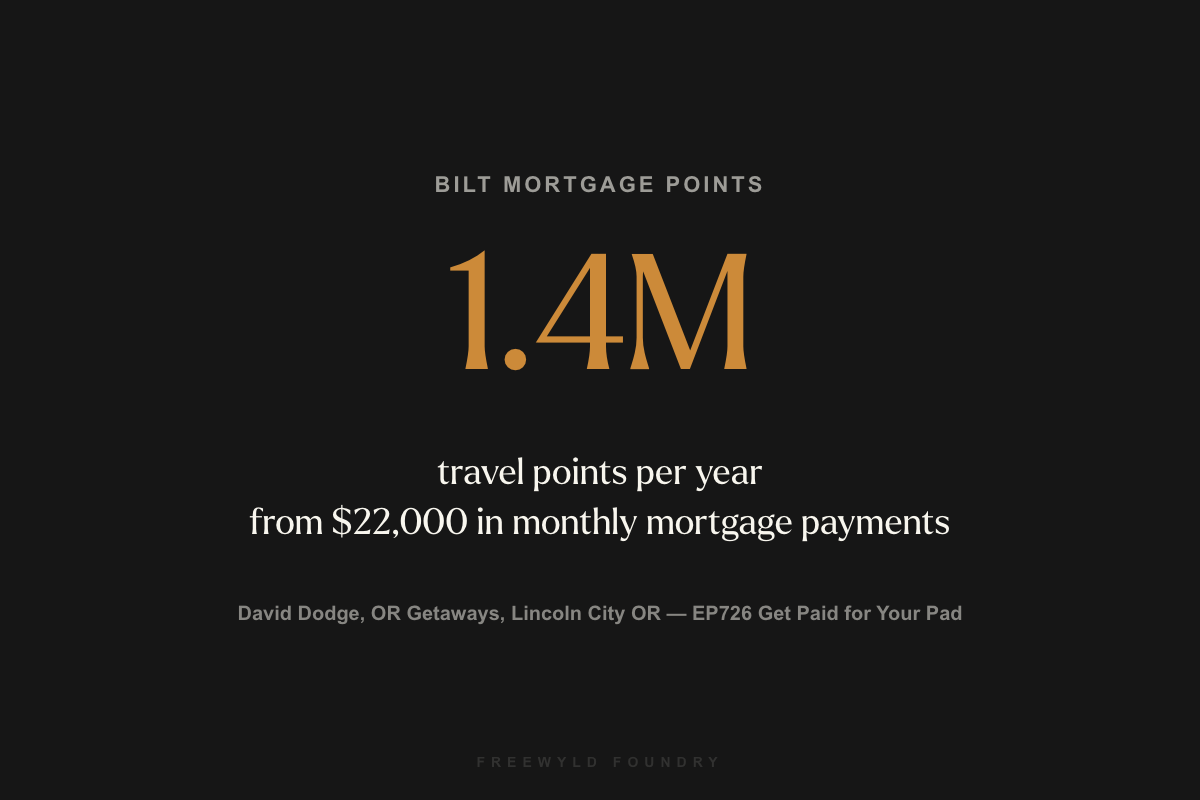
With credit cards, it is a fair question. Most mortgage servicers do not accept credit card payments directly. And if a third party processes a credit card payment on your behalf, they typically charge 2 to 3 percent of the transaction. On a $22,000 monthly mortgage, a 3% fee costs $660 per month, or nearly $8,000 per year. That wipes out most of the points value immediately.
BILT avoids this entirely because it is not a credit card transaction. When you route your mortgage through BILT, your servicer pulls from BILT via ACH, and BILT pulls from your checking account via ACH. No card network is involved. No interchange fees. No surcharge.
The mechanics of how BILT funds this come down to network building: BILT earns interchange fees on the credit card side and is building out networks of apartment buildings, gyms, restaurants, and other services around where people live. The mortgage earn appears to be subsidized by credit card revenue and the longer-term value of those networks. For the investor, the result is that the ACH routing earns points for free.
What 1.4 Million Points Gets You
Travel points are not all created equal. The value depends entirely on how you redeem them.
Most people undervalue points because they look at the face rate: a business class seat “costs” 150,000 points, and 150,000 points can also be cashed out for $1,500, so the seat is “worth” $1,500. But airlines price their award inventory separately from their cash inventory, and the two pricing curves diverge sharply at the premium end.
The reason points are so powerful is flexibility. Award seats are often priced at a fraction of the cash equivalent when you are flexible on dates and comfortable with the booking process. A business class seat on a transatlantic route, for example, can sometimes cost only twice as many points as economy, even though the cash price is four or five times higher. That is where you get asymmetric value.
At 1.4 million points per year, the investor above has enough to fly a family of four internationally in business class multiple times over, with points left to spare. Alternatively, $11,000 per year in down payment credits compounds meaningfully across a multi-property portfolio over a five-year hold.
| Redemption Option | Value (1.4M points/year) | Best for |
|---|---|---|
| Cash toward down payment | ~$11,000/year | Investors reinvesting into portfolio |
| Economy flights | 37 one-way seats | Frequent domestic travel |
| International business class | 16 seats | Best asymmetric value vs. cash price |
The BILT transfer partners include major airline and hotel programs, giving you flexibility to direct points wherever the redemption rate is highest.
Why STR Investors Are Positioned Better Than Anyone Else
BILT’s product is interesting for a homeowner with a $3,000 monthly mortgage. It is compelling for an investor with $22,000 in monthly mortgage payments. The math scales linearly.
Most STR investors also have higher-than-average credit card spend: property supplies, utilities, maintenance, furnishings, insurance, and subscriptions all run through their accounts. Routing that spend through the BILT card rather than another travel card stacks onto the mortgage earn.
The profile that gets maximum value from BILT: multiple properties with total mortgage payments above $10,000 per month, meaningful monthly business credit card spend, and interest in travel, whether for personal trips or for portfolio-related travel to conferences and markets. That describes a large percentage of serious STR operators.
The Portfolio Behind the Numbers
The Lincoln City investor who ran these calculations did not stumble into this by accident. He built his way to $22,000 in monthly mortgages by scaling deliberately starting from one five-bedroom in 2021, with a deliberate focus on larger properties where the ROI gap versus smaller bedrooms is widest.
His flagship property, the Ebb and Flow (OR Getaways), is a custom-built duplex designed specifically for short-term rental performance: common areas with ocean views instead of the master bedroom, AC in a market where almost no other properties have it, and a duplex structure that allows occupancy up to 20 guests in a market capped at 16 per property permit. Two permits and two water meters under one roof, unlocking occupancy that single-permit competitors cannot legally match.
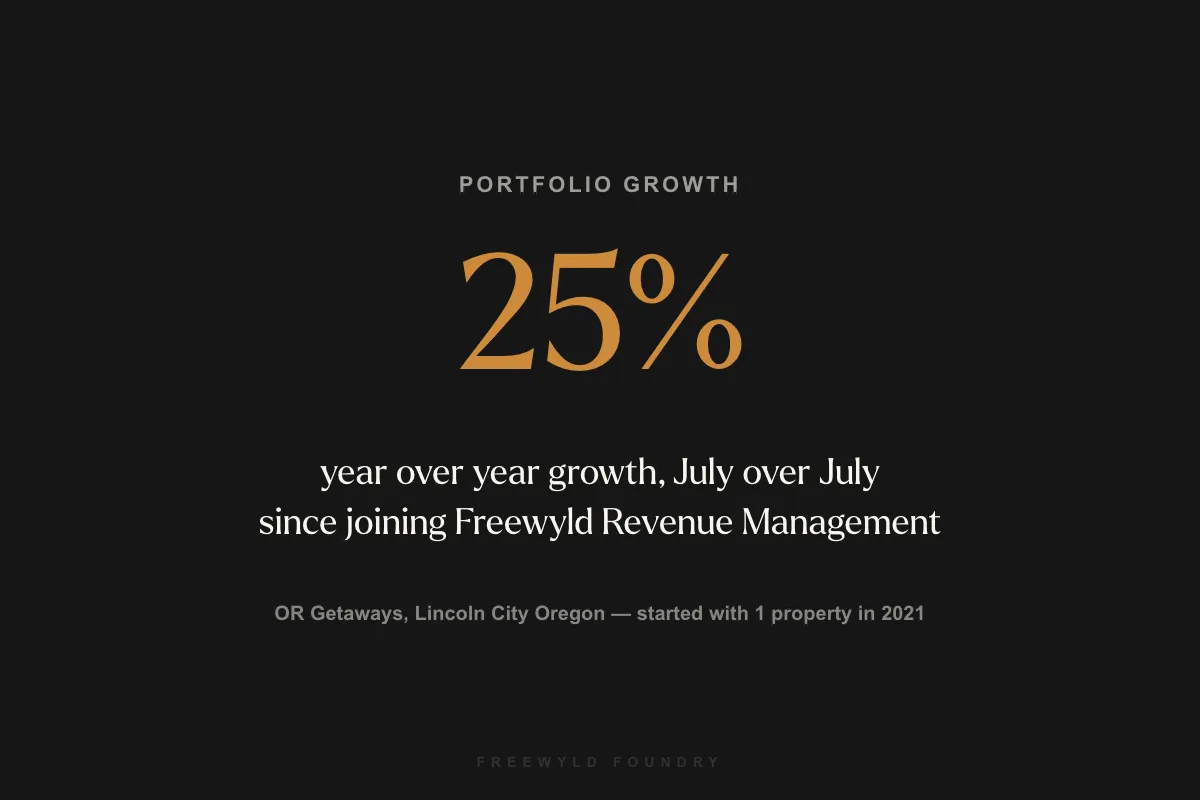
His portfolio has grown 25% year over year, July over July, since bringing on professional revenue management through Freewyld. He started self-managing, running two pricing sessions per week as a trained actuary who understood the numbers well. The gap between where he was and where he is now came down to one thing: risk tolerance. Specifically, the willingness to hold higher prices for longer into the booking window instead of locking in certainty at a discount.
He puts it this way: the key difference between self-managing and working with Freewyld is not analytical ability, it is risk appetite. When a summer weekend is open a month out, the instinct is to lock it down. The methodology says to wait, because the demand signals are there. Following that methodology rather than that instinct has been the ingredient.
The BILT decision follows the same logic: find the yield opportunities most investors are ignoring and capture them systematically.
How to Get Started With BILT
If you want to route your mortgage payments through BILT and start earning points, the process is straightforward.
Step 1: Check that your mortgage servicer is compatible. BILT works with a growing list of servicers. Log into biltrewards.com and verify your lender is on the list before doing anything else.
Step 2: Open a BILT account and connect your checking account. This is where your mortgage payments will originate. BILT draws from here via ACH and forwards to your servicer.
Step 3: Apply for the BILT credit card if you want to maximize your earn rate. The card is not strictly required, but your earn rate on mortgage payments scales with your BILT card spend. Running business expenses through the BILT card pushes your effective mortgage earn rate from 1x toward 1.25x.
Step 4: Model your numbers. Before fully committing, run a quick estimate: total monthly mortgage x 12 x earn rate x 2 (for the rent day transfer bonus) = annual travel points. Then look up redemption rates for your target airline or hotel partner to see what that translates to in real-world value.
Step 5: Set a rent day reminder. The 2x transfer bonus only applies on BILT’s designated rent day, typically the first of each month. Points do not automatically double; you have to initiate the transfer on rent day. A calendar reminder costs nothing. Missing the transfer costs you half your points value for the month.
One note: BILT is currently US only for mortgage points earning. If you are managing properties outside the US, this does not apply yet.
The Broader Point
The STR operators who build durable wealth are rarely doing one thing better than everyone else. They are doing a dozen things a little better: larger properties in undersupplied niches, professional revenue management instead of instinct-based pricing, a BILT account instead of routing mortgages directly.
None of these is a silver bullet. Together, they compound.
If you are running a portfolio with meaningful monthly mortgage payments and you are not currently earning points on them, you are leaving money on the table for a problem that takes about 30 minutes to fix.
Want to see where your revenue stands?
Get your free revenue report and we will show you where your pricing strategy can improve. We manage over $170M in bookings across 70+ client companies, and we will show you exactly what professional revenue management can do for your numbers.
Listen to the Full Conversation
This article draws on a conversation with David Dodge, founder of OR Getaways, on the Get Paid for Your Pad podcast.
Listen on Acast | Watch on YouTube
Related Articles
- Short-Term Rental Revenue Management Services: what a dedicated revenue manager does for a portfolio, and how to get a free audit
- STR Market Update June 2026 - how Freewyld portfolios outperformed the market by 13 points last month
- Why STR Hosts Drop Prices Last Minute - the pacing strategy that explains the 25% YoY growth above
- OR Getaways Case Study - the full numbers behind David Dodge’s Lincoln City portfolio