How to Launch New Listings (Most Operators Get This Wrong)

Want to outperform the market? Freewyld Foundry’s Revenue & Pricing Management service is driving an 18% performance lift for $1M+ STR operators, even in down markets. If you’re managing 10+ listings and want a free pricing audit, apply here
Most STR operators lose thousands of dollars when they launch new units. They obsess over ADR, chase premium rates from day one, and treat the first 60 days like any other operating period. This single mistake can permanently tank a listing’s momentum before it ever gets started.
In this episode, Jasper Ribbers breaks down the exact launch strategy Freewyld Foundry uses after overseeing 500+ new unit launches across 80+ clients in just two years. He reveals why review velocity matters infinitely more than early revenue, how four-star reviews can kill a new listing, and the step-by-step process to avoid the mistakes that cost operators $10,000+ per property.
If you’re adding units to your portfolio or managing new properties for clients, this episode will save you more money than any other content you consume this year.
You’ll learn:
- Why your only goal for the first 60 days should be accumulating five-star reviews, not maximizing ADR or revenue
- How to price new listings competitively while protecting high-value dates 60+ days out
- The exact minimum and maximum night stay settings that accelerate review accumulation
- Why you need to set your base price HIGH before connecting your pricing tool (and what happens if you don’t)
- How to get owner buy-in when they expect premium rates from day one on their beautiful new property
We also talk about:
- Why calendar availability needs to be open 12 months but your pricing strategy should focus on 30-60 days
- The pre-launch checklist that prevents expensive sync errors between your PMS and pricing tools
- How to use flexible cancellation policies during launch without exposing yourself to bad guests
- Why response time matters more in the first 60 days than any other operating period
- The ROI math on spending $200-500 solving guest problems during launch (hint: it’s 10-20X returns)
Mentioned in the Episode:
- Freewyld Foundry Revenue Report (Free pricing audit for $1M+ operators)
- Free STR Revenue Resources (Free revenue management workshops and guides)
- How to Launch Short Term Rental Units for Maximum Revenue
- New Listing Launch Strategy: How to Get Your First 25 Five-Star Reviews on Airbnb
- The STR Pacing Playbook
Subscribe for more episodes every Monday and Friday on YouTube, Spotify, and Apple Podcasts.

The STR Pacing Playbook
A step-by-step guide to tracking and using pacing data to optimize your short-term rental pricing strategy.
Download Free GuideContinue Listening

September RM Update: Best Month in Company History, GuestyVal Takeaways, and an Airbnb Story
Jasper covers September 2026 portfolio performance: Freewyld Foundry up 37% year over year with 27% measurable impact above market, the highest in company history. Plus GuestyVal takeaways on AI in revenue management, the Vrbo commission change, and a personal Airbnb story.
The Javier Effect: A Custom PriceLabs Strategy for Unique STR Inventory
Javier Vasquez, a Freewyld Foundry revenue manager and former PriceLabs employee, walks through the custom Portfolio Occupancy-Based Adjustment strategy he built for a glamping dome portfolio with 97-98% occupancy year-round and 212-day booking windows.
Midterm Rentals with Frank Bosie: The Revenue Strategy Already Happening in Your Portfolio
Frank Bosie of Hostfully joins Jasper to break down the data behind midterm rentals, including why 39% of STR operators already have 30+ night bookings, how the occupancy math works, and when the hybrid approach beats a hard minimum-stay strategy.
The Hidden Costs of Launch Day
If you launch an STR unit the wrong way, it can cost you thousands and thousands of dollars. And most operators get this completely wrong.
Welcome back to Get Paid For Your Pad. Today I'm going to talk about how to launch new STR units. This is really, really important because if you don't have the right strategy when you launch a STR unit, especially in today's competitive climate, you might be losing out on thousands of dollars in the long term. And I've seen this happen over and over again. So I really want you not to make this mistake. And so in this episode, I'm going to walk you through step by step the best way to launch a new STR unit.
Why I'm Qualified to Talk About This
Obviously I have launched a lot of Airbnb listings or STR units in the last 15 years that I've been involved in the Airbnb game. But I'm not just talking from my own experience of launching my own listings. We as Freewyld Foundry manage now over 3,000 listings, over 3,000 short-term rental units across around 70 portfolios.
Now our clients, one of the reasons that they work with us to do the revenue management is because it frees them up to go focus on business acquisition. So a lot of our clients are adding a lot of listings. And so I quickly had a look at our database of clients and how many listings they had when they started with us, and how many listings they have now. And on average, our clients have grown by 20% since they started working with us.
So we currently manage over 3,000 listings. But if you look at the amount of units that our clients started with, it's actually around 2,500. So our clients have added 500 listings in the last two years that we've been doing this revenue management service. And so I've pretty much been a part of all of that. Not directly, of course, but I've been overseeing all of our clients' portfolios.
The Mistakes That Kill New Listings
So I'm involved and aware of how we launch these listings, what mistakes were made by our clients, because they don't always follow our advice, fortunately. But for the most part, they do. But it's also easy to make a mistake, because you have to be very, very careful with how you launch a new listing.
There's a lot that can go wrong. If you sync it at the wrong moment, maybe you got bad prices, and people start booking. We've seen that. Maybe you activate your Airbnb listing before you're ready to go live, and your calendar is still blocked. And now you're missing out on the early momentum, that early couple weeks where Airbnb gives you a little bit more visibility as a new listing. You're losing out.
Maybe your minimum night stay settings were incorrect. Maybe you forgot to put a markup on a festival or a concert that's in town that's attracting a lot of demand. There's a lot of mistakes that you can make. And that can be very costly, because the last thing you want to do is launch a listing and not get any bookings. And then your listing is going to go in the dead zone, it's not going to be visible, it doesn't have any reviews, it's just going to sit there for months, and you're not going to get any bookings.
Or you might get a booking at a wrong price, and now you might want to cancel it. Obviously, canceling a booking is the last thing you want to do as well when you're launching a new listing. So there's a lot that can go wrong, and you have to have the right strategy, but you also have to have the right process to make sure that you're not making any mistakes.
So in this episode, I'm going to walk you through all the details. So by the end of this, if you just take the transcript of this podcast episode, put it in ChatGPT and tell ChatGPT to create a SOP for you and send that to your team, you'd be good to go.
The Launch Strategy Most Operators Get Wrong
First, let's talk about high level strategy. And this is where a lot of operators go wrong, is that they don't have a strategy at all. They just put the listings together and they just sync it up to the pricing tool, and they just hit go. And they don't really think about like, hey, what's the best strategy? How should I be priced? What should our minimum stays be? What kind of promotions are we using? They don't really think about that. They just kind of go live and see what happens.
So number one is have a strategy. And number two is, of course, have a good strategy. Have my strategy. Because I have a very strong opinion on this. And that's just because I have so much experience. I've done this so many times now that I've seen over and over what works and I've seen over and over what doesn't work. So that's why I have a very clear understanding of the best way to launch these listings.
Forget About ADR and Revenue for 60 Days
So strategy wise, your goal when you launch a new STR unit, your goal is not to get the highest ADR in the beginning. It's not to get the maximum amount of revenue in the first month or the second month. None of that is your goal. Forget about it. Forget about the ADR. The ADR doesn't matter. Your revenue doesn't matter in the first two months, unless you're only planning to have this unit live for two months. But I'm assuming that you're launching this listing for a long time. Because our strategy is focused on long term revenue generation.
So the first couple months, the only thing that matters, there's only one thing that matters really. That is get people in the doors, get five star reviews, get as many five star reviews as possible. I'm talking about Airbnb right now, but it's the same for Booking.com. Same is true for VRBO. It doesn't matter how much you make in the first couple months. All that matters is you want to build your review base and you want to make sure you get five star reviews or you get a nine or a 10 on Booking.com. Whatever the rating system is that the OTA that you're targeting, you want to get high ratings.
But specifically on Airbnb, you cannot get anything below a five star because even four star reviews are bad for your visibility.
Why You're Starting at a Disadvantage
And the problem is when you launch a new unit, you're at a competitive disadvantage because other units that you're competing with, they already have a bunch of reviews. They already have great ratings. The hosts are already really dialed in with the experience of the guests. There's no, you know, they've already solved all the little problems that could show up.
So you're at a disadvantage because you have zero credibility. You don't have any reviews. You don't have any ratings. And also you're at risk. Your guest experience might not be dialed in completely. If you have a new house, there might be little details that you oversaw. There might be some things that are not working perfectly yet. There might be some design issues or whatever it is.
Typically, I always recommend if you have an opportunity to stay in the home before you launch it, do that because then that way you can experience it as a guest. And there's always going to be little things that you're going to notice as a guest versus as the operator.
The Real Goal for Your First 60 Days
So the goal for the first couple months is to get as many reviews as possible, get five-star reviews, get high ratings and learn, get feedback from your guests and solve any issues that come up. And what you're going to have to do is you're going to have to sacrifice some money probably. If your first guests are experiencing any problems, you're going to have to be very, very generous with how you solve those problems. You're going to have to buy them lunch, buy them something. Make sure you get that five-star or the higher rating.
It's really, really important because if you get those reviews, if you don't get those high ratings, your listing is going to be hard to find and the momentum is going to die. And when the momentum dies, it's very difficult to get it back up. You're going to have to essentially relaunch it, but now you don't get the benefit of the additional visibility that a lot of the OTAs give you. You don't get the benefit of the new listing promotion that Booking.com has, that Airbnb has.
It's going to be very difficult to relaunch it. You're going to have to drop the prices significantly more than when you launched the new listing. So that's the situation that we want to try and avoid.
Do Whatever It Takes for Five-Star Reviews
So focus on getting those five-star reviews, do whatever you need to do, make your guests happy. Don't be stingy or I don't know how to say that. Don't be worried to spend a little bit of money. These reviews are worth thousands and thousands of dollars for you in the long term. If you have to buy a bottle of champagne, if you have to buy some other welcome package or a gift for the guests when they leave, or maybe you have to show up in person, whatever you need to do, you need to get five-star reviews.
I've seen this now so many times where one of our clients has launched the listing. There's something wrong with the property. The guest shows up. They don't have a great experience. They leave a three-star review. They leave a two-star review or even like a couple of guests leaving a four-star review. Now your rating on Airbnb is like a 4.4, a 4.6 and you have like three or four reviews and you're done. You're pretty much done.
Why High Expectations Kill New Listings
So we can't let that happen. So don't worry about ADR. Way too many of my clients when they launch a new home, they're excited. It's a beautiful property. They've done a great job at taking the photos. They did everything really well and they have high expectations and they're so excited to see like how much are people paying for my new amazing unit. Or the owner of the property, if a client is managing, they have all these expectations. And they are excited to see the first couple of bookings coming in and what price are we getting and all of that.
And so oftentimes we get pressured by either the owners or our clients like, Hey, you know, we want to get at the minimum, we want to get this price. And so we have to battle them and tell them like, Hey, you don't look at the price for the first couple of months. You don't look at the revenue for the first couple of months. We're looking at reviews and five-star ratings. Don't worry about the price. Don't worry about revenue. You focus on making sure that these guests are getting a five-star experience. That's what you as an operator need to focus on.
Maximize Guest Turnover, Not Revenue
Also, we want to get as many people through the doors as possible. I'm not saying that you want to offer one-night stays necessarily because one-night stays can be risky and definitely don't want to have a problem. You don't want to have the neighborhood being mad at you when you first launch it, of course. So you do have to be cautious of who you're letting into the doors and maybe you don't want to do one-night stays. But you definitely don't want somebody to book it for a month because now there's one person staying in there or one group of people staying there. And now your listing is going to be unavailable for the next 30 days. And so you're not able to get momentum.
So I would say set a maximum amount of nights, maybe set it at three or four, maybe set it at seven, whatever you want to do. But you want to focus on shorter bookings because every booking is a new person that can give you feedback on the experience and that can give you a five-star review.
How to Communicate With Early Guests
And you want to make sure that all your guests leave you a review and you want to communicate around this. Tell them like, Hey, this unit is new. I'm learning. If there's anything wrong, I apologize. It's the startup phase of this unit. We'll make it right to you, but please give us a five-star review. Because we need that in order to be successful with this unit. So really communicate to your guests like, Hey, a four-star is going to crush, it's going to crush my business when it comes to this house.
So make it up. If something goes wrong, make it up to your guests, explain them that the unit is new, that there might be some, a couple of things that you still need to dial in. And 99% of the time, your guests will be sympathetic. As long as you communicate friendly and nicely, give your guests a little present, buy them lunch, whatever you want to do. If anything is wrong, give them a refund. The couple hundred dollars that you're losing now, that's going to come back to you tenfold, 10X, 20X. So don't worry about giving a little refund at the start.
Seven Critical Launch Mistakes to Avoid
So that's high level strategy is just all you need to worry about is get bookings and get five-star reviews, get high ratings and get a lot of them. Now I'm going to go through a number of mistakes that I've seen hosts make.
Mistake 1 - Launching With Bad Photos
So number one is don't launch a mediocre listing. Don't launch a listing with low quality photos. And what I've seen a few times is you're planning a photo shoot and the photo shoot is in three days and you're like, I want to launch now. So I'm going to take some pictures from my iPhone and then I'm going to put that up and then I can get bookings in the next couple of days. No, don't do that.
Make sure that when you onboard the listing, you plan appropriately. So your photo shoot should be done before you go live. Don't go live with iPhone photos. The listing has to be completely optimized. You only have one chance of getting momentum and that's the moment that you open your doors to your guests. That's your only chance to get momentum. And if you don't have everything dialed in when it comes to your listing quality, when it comes to your guest communication, when it comes to your photos, everything needs to be dialed in before you receive your first guests.
So make sure your listings are fully, fully optimized. And we've done a lot of content on this podcast about how to optimize Airbnb listings, how to optimize any listings. Booking.com makes it very easy. It gives you a property score. If that property score is not 100%, get it up to 100% before you launch.
Mistake 2 - Pricing Too High
Next mistake is pricing too high. Again, it's not about the ADR. It's not even about the revenue that you're making the first couple months. Price competitively. Use the Airbnb new listing promotion, use the new listing promotion on Booking.com. Don't worry about the ADR. Obviously you don't want to rent it out for 10 bucks, so there's a limit of course, but just be competitive, just be in the lower end of the market.
Depending on what quality of your product is, but just sell it cheaper than, give people a deal because you get a lot of bookings quickly.
How to Protect High-Value Future Dates
Now you do want to protect your higher value dates. So I don't recommend putting your base price too low because then somebody might book next year for Christmas or 4th of July at a really low rate. You don't want to do that. So you either set your base price high, just lower the price for the first 30 or the first 60 days.
You can also close your calendar, only open it up for the next 90 days, but that's not the best strategy though. I think because a calendar that's not open for 12 months hurts your visibility. So I'd much rather have your calendar open for 12 months, but just make sure you protect your high value dates. Either put a far out premium on your pricing, or you can pick specific dates and just jack up the price or just add a more restrictive minimum night stay setting.
But just make sure that people are not going to be able to book high value dates far in the future at a lower price. The price that they book at in the next 30 or 60 days, don't worry about it. Unless you launch a listing six weeks before Thanksgiving and Thanksgiving is the highest value date in your market. Obviously you don't want to lower the prices too much for Thanksgiving in that case, but just make the prices around, make all the other prices competitive and then charge still a premium for Thanksgiving.
The whole point is like the first couple months people are going to get a deal and that's fine. You just want to focus on occupancy, get as many people through the doors as possible and get feedback.
Mistake 3 - Letting Ego Drive Decisions
Leave your ego and your owner's ego, leave that out. You're all about getting feedback. What can I improve? How is your experience? Is there anything I could do better? Ask as many questions as possible from your guests. When you communicate that to your clients, they're also going to be sympathetic also. They're not going to leave you a four-star review because you're clearly showing like, Hey, I'm trying to do my best here. I'm trying to create the best experience for you. And I'm not charging super high rates. I'm letting you stay for a deal because I need to learn. I need to improve. I need to get feedback. I need to get a five-star review. People will be sympathetic to that.
Mistake 4 - Creating Booking Friction
Next up, make it as easy as possible for people to book. So use instant book, allow same night bookings if you can. Don't be too restrictive with your minimum day settings, cancellation policy. I would say set your cancellation policy to flexible. And again, if you have like these high value dates in the future, either block them out so people can't book those under the flexible cancellation policy or just make it really expensive that people are just not going to book it.
But the whole goal is you want to make it as easy as possible for people to book while protecting your higher value dates and future dates. Because you don't know how much this unit is going to do. A lot of owners and our clients, they have an idea of like, Hey, this unit should be doing X or should be doing Y. Well, in the short-term rental industry, you never know because it all depends on how much the guest values the experience.
Why You Can't Predict New Listing Performance
And you'll be surprised sometimes. I mean, out of the hundreds of listings that I've launched, I would say probably in half of the cases, I'm either surprised positively that the unit is doing much better than I thought it would, or it's not doing as good as I thought it would. It's hard to predict these things, unless you have a super cookie-cutter apartment, like downtown Miami one bedroom apartment, there's thousands of them. You can pretty much predict what it's going to do.
But a lot of times you'd be surprised. So because you don't really know what the ultimate ADR is that you can get booked at, you need to learn that. And so the first couple months is really for you also to learn like, Hey, how much money are people willing to pay for this property? Because that gives you an idea of eventually, once you get that 25 reviews or 25 ratings or whatever it is, then you can start operating it as a normal unit with your normal revenue management strategy, where you look at pacing and all this stuff that we talked about in this podcast. And then you're going to find out what the actual potential of the unit is. You don't really know until you have 25 reviews up.
Additional Launch Best Practices
So yeah, make it as easy as possible for people to book, be flexible. If you have any friends or guests that are repeat guests that live nearby, tell them. Tell them like, Hey, I've got a new unit. I'll let you stay for half of the price if you can give me some feedback and leave me a five-star review. You can come and stay at a 50% discount, whatever it is. Because friends, family, and repeat guests, those are very powerful people to leverage to get those five-star reviews going.
Again, over-deliver. So really over-deliver. So if there's new guests, over-deliver so that you get the best reviews. I mentioned the new listing promotions. I always recommend using those. Also, respond fast to any concerns. Again, new homes are at a higher risk of issues, and you want to make sure you solve those issues fast. Response time is huge when it comes to guest experience.
If there's a bunch of stuff that doesn't work or something goes wrong or whatever it is, if you respond fast and you immediately solve the problem for your guests and you offer them some sort of refund or you offer them something for free or whatever it is, it's not going to hurt your ratings for the most part.
You also want to pay attention to hygiene. The home has to be absolutely spotless. Pay your cleaners an extra 50 bucks and tell them, hey, do almost like a deep clean in the beginning. Make sure everything is spotless. You don't want to have one hair in the bed that ruins the experience for the guests and then get a four-star review. So really over-invest and don't worry about how much money you're making in those first couple months because it's all about the long-term.
The Critical Timing of Syncing Your Systems
The last thing I want to talk about is the timing when it comes to syncing. So you have your OTAs, you have your PMS and you have your pricing tool. You got to make sure that everything syncs correctly when you launch a new listing. What you don't want to do is when you create the Airbnb listing, maybe there's some random price in there. Maybe there's a random price in your PMS that's way too low. Now you're going live. You turn on your pricing tool. You open up your calendar and boom, you start getting bookings at a bad price because your prices from your pricing tool haven't synced yet.
Oftentimes it can get a little tricky because you have to open the calendar. Most PMSs, you have to open the calendar in the PMS in order for the prices to sync. So depending on your PMS, this might work a little bit different, but my point is just put really high prices on the OTAs or in your PMS before you connect the pricing tool. Because then when you go live, let's say it takes 10 minutes or 50 minutes or an hour for your pricing tool to sync the prices. Now you're protected because your prices are very high.
So that's the last thing I wanted to mention.
Why This Strategy Works Long-Term
So with that said, I hope this is helpful. If you follow this strategy, I can guarantee you that your listing is going to take off and it's going to generate so much more money in month three, four, five, next year, the year after, than if you're trying to get the highest ADR possible and you're not focused on making sure that all your guests have a world-class experience.
Maybe you have a guest that comes in and complains about something and you're upset about it. You're like, this is my best unit that I ever launched. And this guest doesn't appreciate it. I'm not going to give them a refund. And now you're gaining $200 and you're losing 10,000. That's what the English call penny wise, pound stupid. So you don't want to do that.
Don't Forget to Educate Your Owners
Also last thing, I keep thinking of last things to say, obviously you understand this, but your owner is probably not going to understand this. Your owner, they have one home that they rent out. It's their vacation home that they spend two years or three years finding and building and renovating all this stuff. And they have such high expectations. And then you book it at $150 where they think it's worth $500. They're going to be mad.
So you got to educate them first. You got to walk them through this whole process. Because if you don't get the buy-in from the owner, you're going to be in trouble. So you got to make sure you educate them. You got to tell them like, Hey, listen, we're going to be offering competitive rates. It's not because your house isn't worth more. It's not because we want bad quality guests. No, it's because we want to get momentum so you can make more money in the long term. So you want to explain that to them, send them this podcast. That will probably help.
How We Can Help You Launch Successfully
All right. That's it for now. Hope this is helpful guys. If you want us to do this, obviously this can be a little bit tricky sometimes. But obviously if you work with us, we help you through this process. So if you're scaling fast, the more benefit of working with us is that we can help you really launch these listings correctly, maximize the revenue from the get go.
So if you're interested, freewyldfoundry.com/report, you can get a free report. We're going to be looking at your revenue, your pricing strategy. We're going to tell you where the leaks are, where the holes are. If we think it's a good fit, because we don't work with everybody, we have a very specific type of company that we go after. But if we don't work together, we have resources for you to help you.
If we do want to work together, we'll send you a proposal. And then if it's a win-win, then we can work together. But either way, your revenue report is free. So it's just free value for you. And we do a lot of these reports. We do a lot of them. I think we do probably at least 10 or 15 every single week.
All right. So we've done so many of them at this point that we have a pretty clear understanding of how much upside there is. We know what to look for. We know how much revenue we can squeeze out of different changes in the strategy. So we're using AI now to help us with that as well. So yeah, we're getting pretty good at this stuff.
Who We Work With
So go ahead, submit an application for your free revenue report at freewyldfoundry.com/report. We do only work with operators that do a million dollars of top line net rental revenue, excluding fees. If you're scaling fast, we may consider a little bit lower than that, like 700K, 800K, if you're looking to scale, if you seem like a cool person. And if you have, if you're in one market and your portfolio is not too complicated, then we'll consider also smaller hosts.
But as a general rule, we're looking for operators that are doing a million or more. But if you're close, feel free to send in your application as well. And if you're smaller, but you do want to learn revenue management, you could still put in your application for the report. We'll still do the report. Or if you're very small, what we'll do is we'll give you other resources. We have a course, we have lots of free trainings. We have a lot of resources that we can give you to help you. And then you can become an expert revenue manager. So that's another option.
All right, that's it for today. Thank you for listening. We'll see you next time.
Related Articles
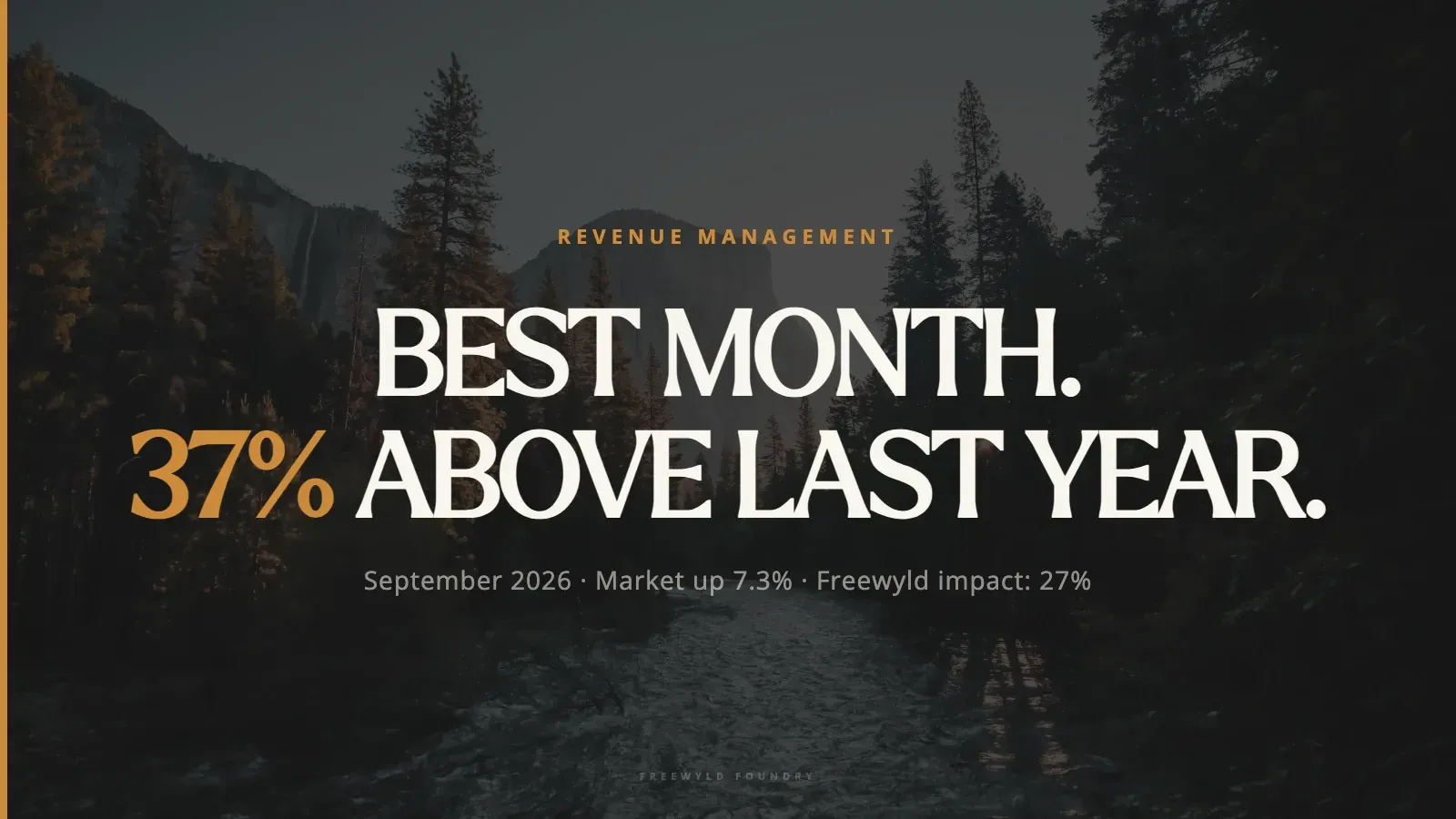
STR Market Update September 2026: Record Month, Vrbo's Commission Shift, and What AI Means for Revenue Management
September 2026 was the best month in Freewyld Foundry's history. Comparable units finished 37% above last September while the broader market grew 7.3%, producing a 27% measurable impact, the highest we have ever recorded. Here is what drove that gap, which markets led and which lagged, what Vrbo just changed about commissions, and what the industry learned about AI in revenue management at GuestyVal in Madrid.
PriceLabs Portfolio Occupancy-Based Adjustment: A Strategy for Unique STR Inventory
When your STR inventory runs at 97% occupancy year-round with a 212-day booking window, standard PriceLabs market factors actively work against you. Here is how to build a custom Portfolio Occupancy-Based Adjustment strategy for destination and unique inventory.
Midterm Rentals for STR Operators: The Data, the Math, and How to Start
Midterm rentals are already happening in most STR portfolios. 39% of short-term rental operators have received at least one 30+ night booking. Here is the data, the occupancy math, and how to be intentional about it without abandoning your short-term rental business.