How to Launch Short Term Rental Units: The Complete Strategy for Maximum Revenue
Launching short-term rental units is a make-or-break moment that can cost you $10,000 or more in lost revenue if done incorrectly. Most STR operators make critical mistakes in the first 60 days that permanently damage their listing’s visibility and revenue potential.
After overseeing the launch of 500+ short-term rental units across 70+ clients (3,500+ listings under management), I’ve identified the exact mistakes that kill new listings and the proven strategy that generates 10-20X returns on your launch investment. The biggest mistake? Focusing on ADR (average daily rate) and revenue in months 1-2 instead of review velocity and five-star ratings.
How to launch short term rental units successfully requires prioritizing guest reviews over immediate revenue. When you optimize for the wrong metrics during launch, you waste your one chance at momentum and spend the next 6-12 months fighting for visibility you could have locked in during week one.
This guide walks you through the complete strategy for launching short-term rental units, from pre-launch setup to the first 60 days of operations. Whether you manage 5 units or 500, this process protects your long-term revenue potential.
What Is the Biggest Mistake When Launching Short Term Rental Units?
The biggest mistake STR operators make is pricing new listings too high and optimizing for revenue in the first 60 days. Your goal during launch should be accumulating 25+ five-star reviews as quickly as possible, not maximizing ADR or monthly revenue.
Here’s why this matters: When you launch a new listing on Airbnb, Booking.com, or VRBO, you’re competing against established properties with dozens or hundreds of reviews. You have zero credibility, no ratings, and higher risk of operational issues since the property is untested.
The OTAs give new listings temporary visibility boosts and promotional placements. This is your ONE chance to build momentum. If you price too high, get slow bookings, receive a few four-star reviews, or encounter guest issues you handle poorly, your listing drops into obscurity.
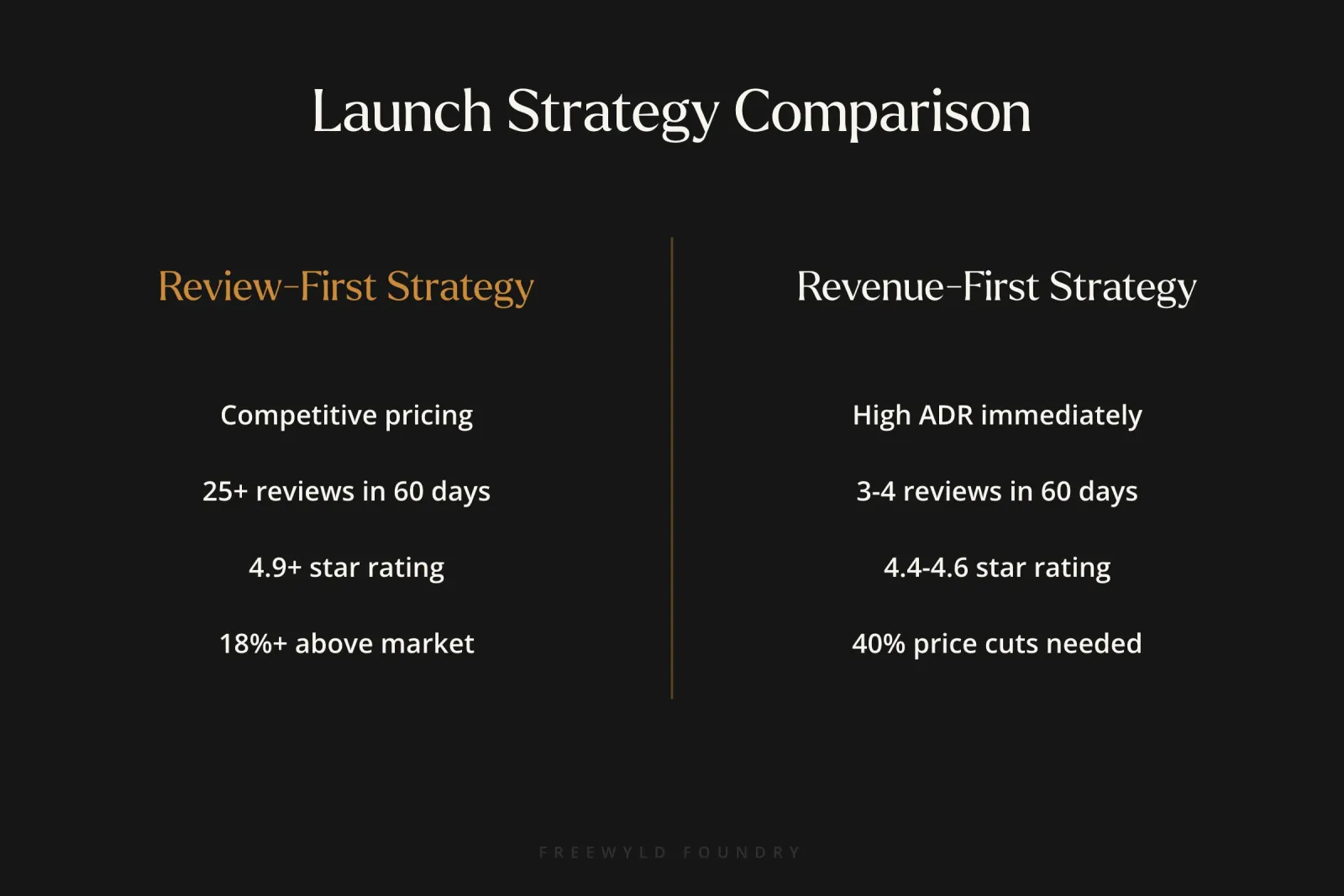
According to data from managing 3,500+ short-term rental listings, a new property that launches with 3-4 reviews averaging 4.4-4.6 stars is “pretty much done.” The listing struggles to gain visibility, bookings slow to a trickle, and operators are forced to slash prices 40%+ just to generate occupancy.
The alternative? Price competitively in the first 30-60 days, focus exclusively on guest experience and five-star reviews, and accept lower revenue temporarily. Once you reach 25 reviews with a 4.9+ average rating, you can shift to normal revenue management and the listing performs 18% or more above market.
The difference in first-year revenue between these approaches: $15,000-30,000+ for a typical property.
Why Do Four-Star Reviews Kill New Short Term Rental Listings on Airbnb?
Four-star reviews are not “good” reviews on Airbnb. They severely damage your visibility and search ranking, especially when you only have 3-4 total reviews.
Here’s the math: If your first four guests leave ratings of 5, 5, 4, and 4 stars, your average is 4.5. Airbnb’s algorithm treats anything below 4.8 as underperforming. Your listing gets pushed down in search results, loses new listing promotional visibility, and becomes nearly invisible to potential guests.
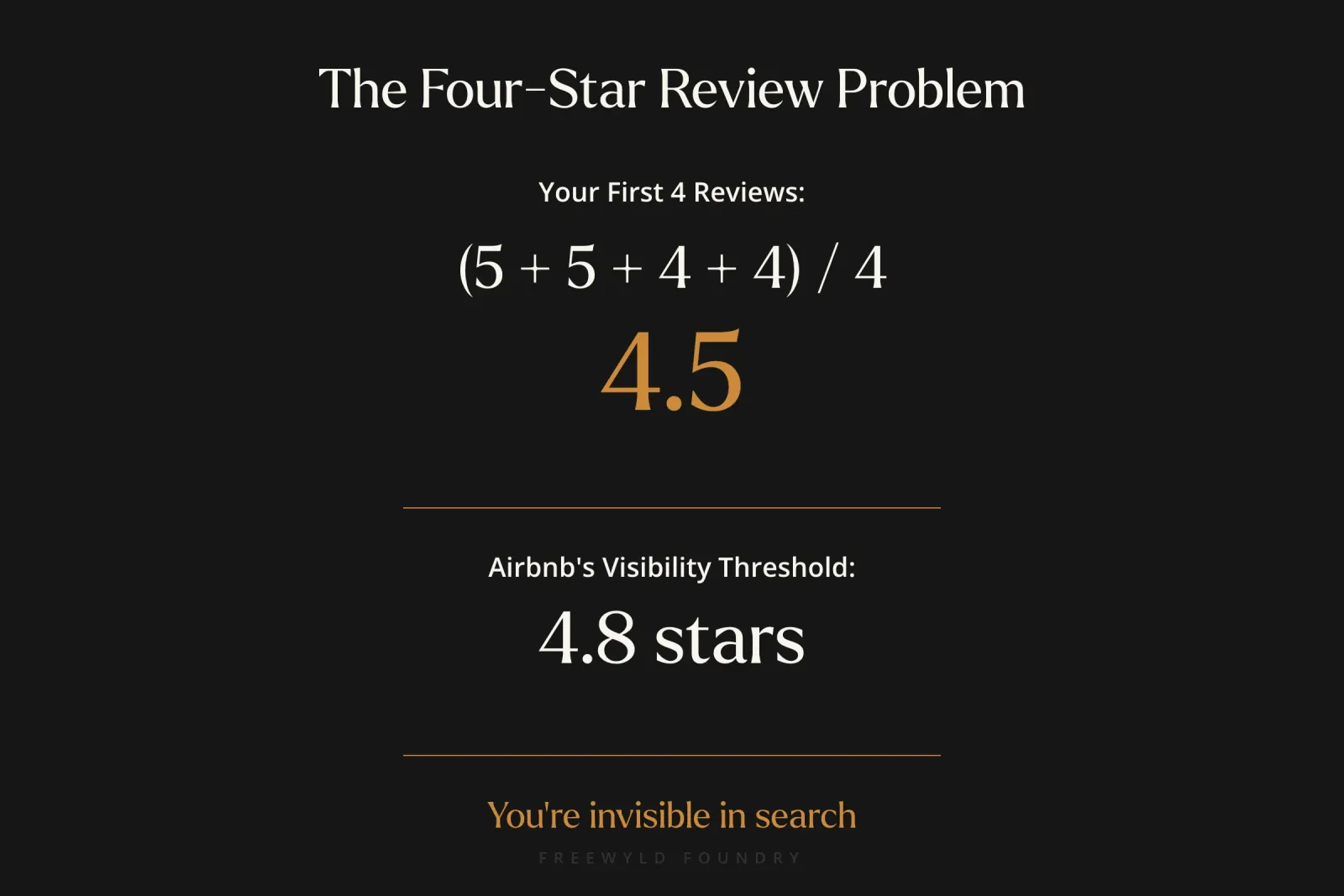
The problem compounds because guests see your 4.5-star rating and assume something is wrong with the property. Bookings slow down. You’re stuck in a cycle where you can’t get enough bookings to accumulate new reviews that would improve your average.
Restarting momentum at this point requires:
- Dropping prices 30-50% below market rates
- Waiting months for enough bookings to dilute the low rating
- Losing the new listing promotional benefits permanently
- Competing without the credibility advantage of an established property
This is why the launch strategy must focus on ONLY five-star reviews. Every booking in the first 30-60 days should prioritize guest experience over profit. If a guest encounters any issue, solve it immediately and generously. Buy them lunch, send a gift, offer a partial refund, whatever it takes to ensure a five-star review.
The $200 you spend solving a problem now returns as $2,000-4,000+ in future bookings once you have visibility and credibility.
How Do You Accelerate Review Velocity When Launching STR Units?
Review velocity (the rate at which you accumulate reviews) determines how quickly your listing gains traction. More reviews faster means reaching the 25-review credibility threshold sooner, which unlocks full revenue potential months earlier.
The key is maximizing the number of bookings in your first 60 days, not maximizing revenue per booking. Here’s how:
Set maximum night stay limits at 3-7 nights. Most operators only think about minimum stays. During launch, you need to CAP bookings at shorter durations. A 30-day booking locks your calendar and generates only one review. Ten 3-night bookings generate ten reviews and ten opportunities to refine your guest experience.
Price in the lower range of your market. Not the lowest, but competitive enough that guests see clear value compared to similar properties. Use new listing promotions from Airbnb (20% discount for first 3 guests) and Booking.com. These promotional tools accelerate bookings without requiring you to manually discount.
Remove all booking friction. Enable instant book, allow same-day reservations if possible, set cancellation policy to flexible (protect specific high-value dates separately), and keep minimum night requirements low (2-3 nights maximum during launch).
Leverage your network. Reach out to friends, family, and repeat guests from other properties. Offer them 50% discounts in exchange for honest five-star reviews. These trusted guests are less risky than unknown travelers and help you identify operational issues before paying guests encounter them.
Communicate your newness transparently. Tell guests in pre-arrival messages that the unit is new, you’re learning and refining the experience, and you value their feedback. This creates sympathy and understanding if minor issues arise. Guests are far more forgiving when you’re upfront about being in launch phase.
By following this approach, you can accumulate 10-15 five-star reviews in the first 30 days instead of 2-3 reviews in 60 days. The faster you reach 25 reviews, the sooner you can shift to optimizing for revenue instead of visibility.
What Is the Correct Pricing Strategy for New Short Term Rental Launches?
The correct pricing strategy for launching short-term rental units uses high base prices to protect future dates while offering competitive near-term rates to accelerate bookings.
Here’s the specific approach:
Step 1: Set your base price HIGH. Your base price should be at or above your target long-term ADR. This protects you from guests booking high-value dates 6-12 months in the future at launch promotional rates.
Step 2: Open your calendar for 12 months. Contrary to common advice, do not limit your booking window to 30-90 days. OTA algorithms penalize listings with limited availability. A fully open calendar signals to Airbnb and Booking.com that you’re serious about hosting.
Step 3: Manually protect high-value dates. Identify holidays, local events, festivals, and peak season dates in the next 12 months. Either:
- Price these dates at premium rates (50-100%+ above base)
- Set more restrictive minimum night requirements (5-7 nights)
- Add far-out booking premiums in your pricing tool
Step 4: Lower ONLY near-term prices (next 30-60 days). Manually reduce rates or use dynamic pricing rules that offer 15-25% discounts on dates within your launch window. This creates the competitive pricing that accelerates bookings without sacrificing future revenue.
Step 5: Use platform-specific new listing promotions. Airbnb offers 20% off for your first three guests. Booking.com has similar programs. These promotions stack with your competitive pricing to make your listing attractive to early bookers.
| Pricing Element | Setting | Reason |
|---|---|---|
| Base Price | High (at target ADR) | Protects far-future dates |
| Near-term (0-60 days) | 15-25% below market | Accelerates launch bookings |
| High-value dates | +50-100% premium | Captures peak demand value |
| New listing promos | Enabled | Platform visibility boost |
This strategy ensures you get the booking velocity needed for review accumulation while protecting your ability to charge premium rates once the property is established.
Common Mistakes to Avoid When Launching Short Term Rental Units
1. Going live before listing optimization is complete. Some operators activate their listing with iPhone photos because the professional photo shoot is scheduled for three days later. They think they can get a few quick bookings before the photos are ready.
This is catastrophic. You only get one launch window with promotional visibility from OTAs. If your listing goes live with poor photos, incomplete descriptions, or missing amenities, you waste that window. Complete your photo shoot, write compelling copy, optimize your listing to 100% on platform scoring tools, and THEN activate.
2. Letting owners pressure you into high ADR. Property owners who are not STR professionals see their beautiful new vacation home and expect premium pricing immediately. They compare their property to established listings with 100+ reviews and demand similar rates.
Your job is to educate them: “The $2,000-3,000 we might forgo in months 1-2 returns as $20,000-30,000+ in additional revenue once we have visibility and credibility.” Frame the launch phase as paid market research and reputation building, not revenue generation. Get owner buy-in on the review-first strategy before launching.
3. Incorrect PMS and pricing tool sync timing. You create the listing in Airbnb with a random $100/night price. You connect your PMS, which has a different price. You activate your pricing tool, which needs 30-60 minutes to sync. During that gap, a guest books at the wrong rate.
The solution: Set temporary prices at 2-3X your target rate in both the OTA and PMS BEFORE connecting your pricing tool. This way, if sync delays occur, you’re protected by artificially high prices. Once pricing syncs correctly, then open your calendar fully.
4. Being stingy with guest issue resolution. A guest arrives and discovers the coffee maker doesn’t work. Instead of immediately ordering a replacement and offering a $50 credit, you tell them to use instant coffee and offer nothing. You “save” $75. The guest leaves a four-star review. You lose $4,000+ in future bookings due to reduced visibility.
Every problem in the first 60 days should be met with excessive generosity. Refunds, gifts, free meals, whatever it takes to guarantee a five-star review. The ROI on this spending is 10-20X minimum.
5. Allowing long bookings during launch. A guest wants to book your new property for 45 days. The revenue looks attractive. You accept. Now your calendar is blocked for 6+ weeks, you generate only one review, and your momentum dies.
Set maximum stay limits of 3-7 nights during launch. You can remove these limits once you reach 25 reviews. Prioritize review accumulation over per-booking revenue.
How to Implement the Short Term Rental Launch Strategy (Step-by-Step)
Step 1: Complete pre-launch optimization (week before go-live). Schedule and complete professional photography. Write optimized listing copy using target keywords. Set up all amenities, create welcome books, test all systems (wifi, locks, appliances). If possible, stay in the property yourself for 1-2 nights to experience it as a guest would.
Step 2: Configure pricing and availability settings. Set high base prices in your PMS and OTA accounts (2-3X target rate as a safeguard). Connect your pricing tool but keep calendars blocked. Program your pricing strategy with far-out premiums and event-based pricing. Identify and protect high-value dates in the next 12 months.
Step 3: Sync and verify before going live. Open your pricing tool, verify rates sync correctly to OTAs. Check that calendars are open for 12 months. Confirm minimum/maximum stay rules are correct. Enable instant book and flexible cancellation. Test the entire booking flow from guest perspective.
Step 4: Launch with promotional pricing. Lower only near-term rates (next 30-60 days) to competitive levels. Activate Airbnb and Booking.com new listing promotions. Notify your network (friends, family, past guests) of the launch with special rates.
Step 5: Focus obsessively on first 10 guest experiences. Respond to every message within 5-10 minutes maximum. Pay cleaners an extra $50 for deep cleaning before first guests. Over-deliver on amenities (welcome basket, local recommendations, small gifts). Proactively ask for feedback during stays.
Step 6: Solve problems with extreme generosity. Any issue, regardless of size, should be met with immediate resolution plus compensation. Order replacement items same-day. Offer partial refunds for any inconvenience. Send gifts or meals. Your goal is to turn any negative experience into a story the guest tells about amazing host service.
Step 7: Explicitly request five-star reviews. In your post-stay message, mention that the property is new and building credibility. Explain that reviews matter tremendously for visibility. Ask directly for a five-star review if their experience was excellent. Most guests are happy to help when you explain why it matters.
Step 8: Track review velocity and ratings. Monitor how many reviews you’re accumulating per week. If you’re not getting 2-3 reviews minimum per week, increase discounts or reduce minimum stays to accelerate bookings. If any guest leaves less than five stars, analyze what went wrong and fix it immediately.
Step 9: Transition to normal revenue management at 25 reviews. Once you reach 25 reviews with a 4.9+ average rating, shift your focus from review accumulation to revenue optimization. Remove maximum stay limits, adjust pricing to market rates, implement dynamic pricing based on demand, and begin normal operations.
Real-World Example: Launching a 3-Bedroom Vacation Home
A client managing a portfolio of mountain vacation rentals added a newly renovated 3-bedroom property. The property was stunning, 2,000+ square feet, with mountain views and hot tub. Comparable properties in the area were booking at $350-450/night with 50+ reviews.
The owner expected to immediately command $400+/night and was frustrated when I recommended launching at $250/night for the first 30 days.
Here’s what happened:
Weeks 1-2: Priced at $250/night with new listing promotion (20% off), the property booked 8 nights at an average of $200/night. Total revenue: $1,600. The owner was disappointed. But we collected four 5-star reviews with detailed positive feedback.
Weeks 3-4: With 4 reviews and 4.98 rating, visibility improved. Bookings accelerated to 12 nights at $275/night average. Revenue: $3,300. Now at 8 five-star reviews.
Weeks 5-8: Raised rates to $300-325/night. Booked 20 nights across four weeks. Revenue: $6,200. Reached 15 five-star reviews with 4.97 average rating.
Months 3-4: Transitioned to dynamic pricing between $325-425/night based on demand. Occupancy stabilized at 70% with $350 ADR. Monthly revenue: $7,350.
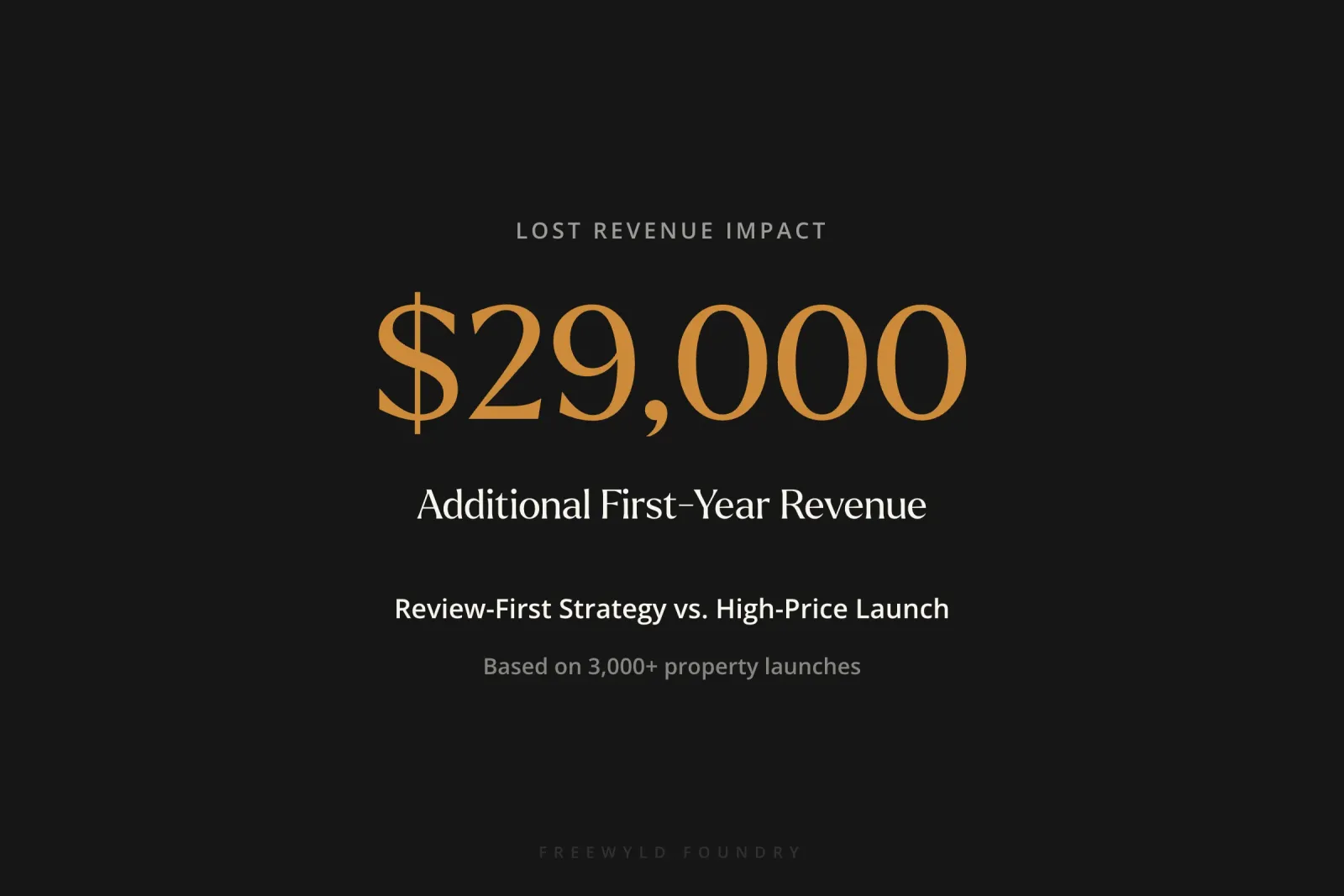
Total first-year performance: 68% occupancy, $365 ADR, $90,000+ annual revenue. Comparable properties that launched at higher prices and received mixed reviews in the first 60 days averaged 52% occupancy, $320 ADR, and $61,000 annual revenue.
The strategy generated an additional $29,000 in first-year revenue by focusing on reviews instead of immediate ADR.
Frequently Asked Questions
How long should the launch phase last for a new STR unit?
The launch phase should last until you accumulate 25 five-star reviews with a 4.9+ average rating. For most properties, this takes 30-60 days if you follow the review-velocity strategy outlined above. Once you reach this threshold, you can transition to normal revenue management and pricing optimization focused on maximizing ADR and occupancy.
Should I use instant book when launching a new short term rental?
Yes, enable instant book during launch. Instant book properties receive visibility boosts from OTAs and remove friction that slows bookings. You need maximum booking velocity during launch to accumulate reviews quickly. The algorithmic advantages and reduced guest hesitation outweigh the minor risks of problematic bookings. You can adjust instant book settings after reaching 25 reviews if needed.
What minimum stay setting should I use for new STR launches?
Keep minimum stays at 2-3 nights during launch phase. More importantly, set MAXIMUM stays at 3-7 nights to accelerate review accumulation. Longer bookings generate fewer reviews and slow your momentum significantly. This approach prioritizes building credibility over individual booking revenue. Remove maximum stay limits once you reach 25 reviews and can focus on revenue optimization.
How do I protect high-value dates when pricing competitively at launch?
Set your base price high (at target long-term ADR) and only discount near-term dates (next 30-60 days). For specific high-value dates like holidays or local events, add premiums of 50-100%+ or set restrictive minimum stays of 5-7 nights. This protects future revenue while allowing competitive launch pricing that accelerates bookings and reviews.
What should I do if I receive a four-star review during launch?
Immediately analyze what went wrong and fix the underlying issue. Double down on guest experience for the next 5-10 bookings by offering even more value and generous problem resolution. You need multiple five-star reviews quickly to dilute the four-star rating and recover your average above the critical 4.8 threshold. Consider offering deeper discounts temporarily to accelerate bookings and review accumulation.
How does launching short term rental units differ from scaling an existing portfolio?
Launching new units requires prioritizing reviews and credibility over immediate revenue, while scaling established portfolios focuses on operational efficiency and maintaining quality standards. New launches get one-time visibility boosts from OTAs that you must capitalize on, whereas existing properties compete on established reputation and can optimize purely for revenue metrics.
Should I launch on Airbnb or Booking.com first?
Launch on both platforms simultaneously to maximize visibility and booking velocity during the critical first 60 days. Each platform offers new listing promotions and algorithmic boosts that compound when you launch across channels. The review accumulation strategy works best when you’re generating bookings from multiple sources rather than relying on a single OTA.
Conclusion
Understanding how to launch short term rental units successfully requires abandoning the instinct to maximize immediate revenue. The operators who generate the most long-term revenue are those who invest the first 60 days in building credibility through five-star reviews and optimized guest experiences.
The strategy is counterintuitive: price competitively, limit booking lengths, over-deliver on service, solve problems generously, and explicitly ask for reviews. But the data across 500+ property launches proves it works. Properties launched with a review-first strategy consistently outperform those that chase early ADR by $15,000-30,000+ in first-year revenue.
Your one chance at launch momentum happens the moment you activate your listing. The OTA visibility boosts, the new listing promotions, the opportunity to build credibility before competitors notice you, these advantages disappear if you mismanage the launch.
Want expert help launching your short-term rental portfolio? Freewyld Foundry manages revenue and pricing for 3,500+ STR units across 70+ client portfolios. We’ve overseen 500+ successful property launches in the past two years and know exactly how to maximize your long-term revenue from day one. Get your free revenue report to see how we can help you launch profitably.
Related Resources:
- 5 Revenue Management Strategies to Crush Your Short-Term Rental Goals
- How to Maintain 4.9 Star Airbnb Reviews Across Large Portfolios
- How to Choose the Right Revenue Manager for Your Short-Term Rental Business
Listen to the full conversation: Get Paid for Your Pad, Episode 708: How to Launch Short Term Rental Units
About Jasper Ribbers: Jasper Ribbers is Co-founder of Freewyld Foundry and has 15 years of experience in short-term rental operations and revenue management. He oversees pricing strategy for a portfolio of 3,500+ properties generating $170M+ in annual bookings.