Introduction
If you own short-term rentals in Seattle, Philadelphia, Los Angeles, Dallas, Houston, Kansas City, or New York, you probably expected the 2026 World Cup to be your biggest revenue month of the year. You might have already set your prices at 3x, 4x, or even 5x your normal rates, confident that international soccer fans would fill every available bed.
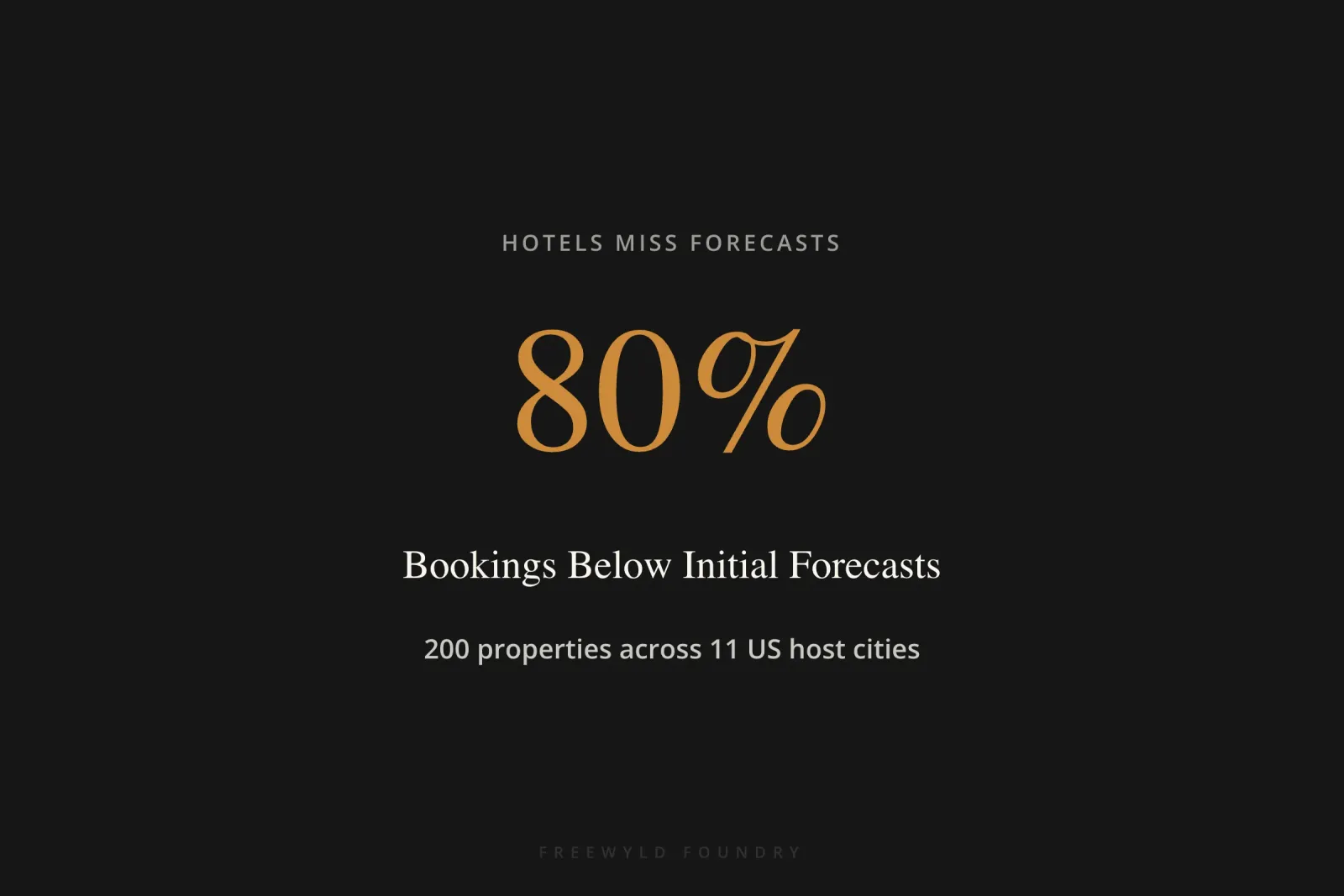
Nearly 80% of hotels across 200 properties in the 11 US host cities are reporting bookings tracking below their initial forecasts. Some dates are seeing LESS demand than the same period last year. World Cup 2026 STR pricing expectations have collapsed, and despite hosting the world’s largest sporting event, some cities are experiencing lower occupancy than a normal summer week.
In this article, you’ll learn why World Cup demand has collapsed, what the real booking data shows across host cities, and the exact two-phase pricing strategy that’s helping sophisticated operators still capture 50% to 200% premiums while less informed hosts watch their calendars stay empty. This analysis comes directly from the May 25, 2026 episode of the Get Paid for Your Pad podcast, where Jasper Ribbers, co-founder of Freewyld Foundry (managing over $170 million in annual STR bookings), breaks down the surprising reality of World Cup pricing.
Want a free personalized pricing audit for your properties? Our team analyzes your market, competition, and revenue potential at Get your free revenue report
What Is Causing the World Cup 2026 Demand Collapse?
The World Cup 2026 demand is significantly lower than expected due to four primary factors: visa processing uncertainty deterring international travelers, elevated travel costs including 7x price increases for transportation, hosts maintaining prices that are 2x to 5x normal rates which displaces regular summer travelers, and general economic uncertainty reducing discretionary travel spending.
According to Jasper Ribbers of Freewyld Foundry, “Bookings are falling way short of expectations. In fact, some cities are seeing less demand than same time last year, which I think nobody was really expecting that.” This revelation comes from Fortune magazine’s report that 80% of surveyed hotels across 11 US host cities are tracking below their initial booking forecasts.
The Visa and Entry Uncertainty Factor
International travelers are expressing significant concerns about visa processing and treatment at US airports. This uncertainty alone is preventing many soccer fans from booking trips to see their national teams play. For travelers from countries where the US visa process is complex or unpredictable, the risk of planning a $5,000 to $10,000 trip only to face visa denial is too high.
The perception of how international visitors will be treated at airports and within host cities is creating additional hesitation. These concerns, whether warranted or not, are having a measurable impact on booking velocity from key international markets.
Transportation Costs Have Skyrocketed
Oil prices have risen in recent months, driving up flight costs across the board. But it’s not just airfare. Local transportation costs within host cities have increased exponentially for World Cup dates.
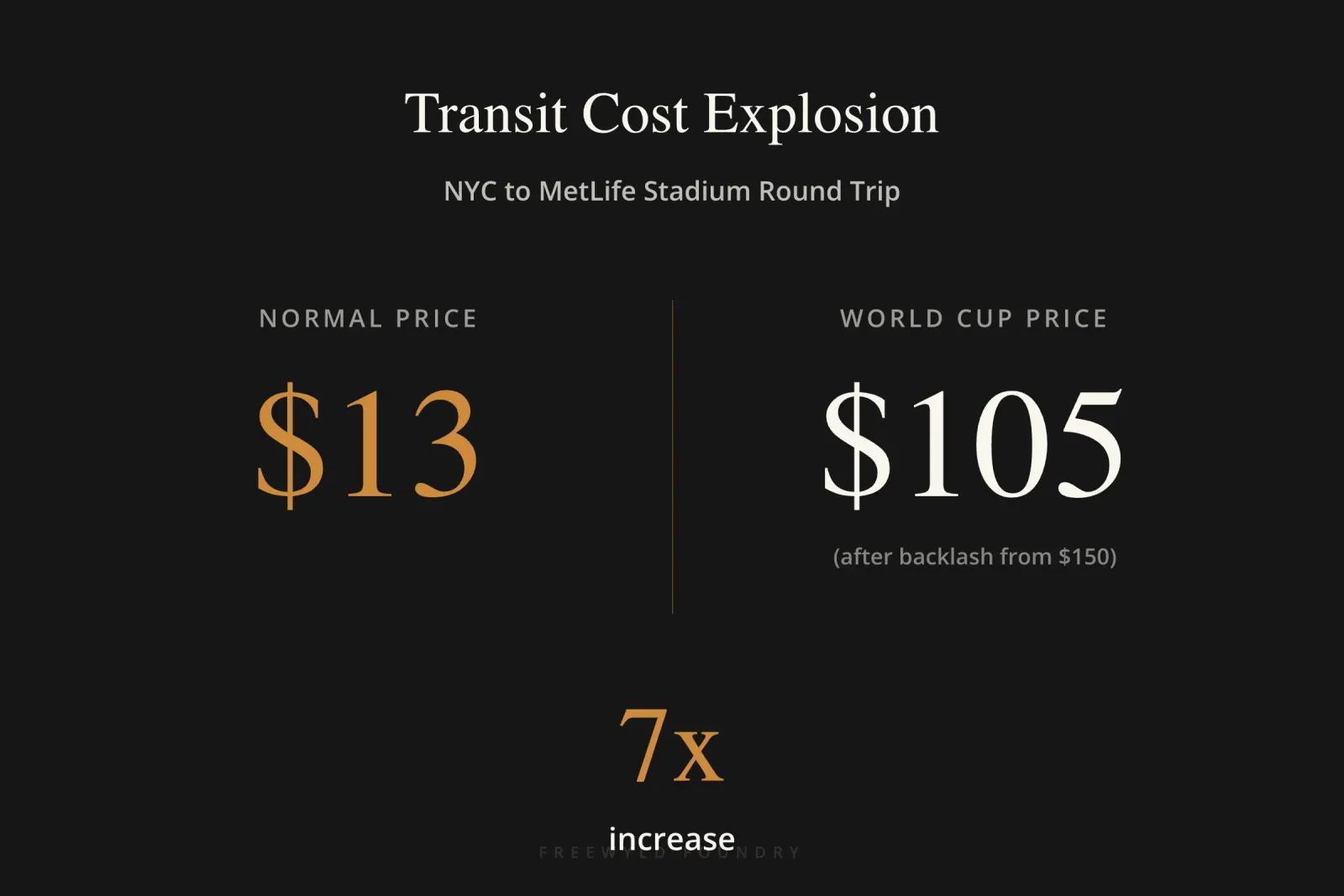
As an example, the New Jersey Transit Authority raised the price of a round-trip ticket from New York City to MetLife Stadium (where several matches will be held) from its normal $13 to an initial $150. After backlash, they lowered it to $105, which is still more than 7x the typical cost. This pattern is repeating across every service connected to World Cup dates, from rideshare surge pricing to parking fees to restaurant reservations.
For an international traveler, these compounding costs transform what might have seemed like an achievable dream trip into a financial burden. “You have to consider that a lot of countries where people are going to be traveling from, the income are lower than in the States,” explains Ribbers. “So like, yeah, $5,000, $10,000 is a lot of money. But for people living in other countries where incomes are lower, that’s even more costly relatively.”
The Pricing Paradox Displacing Regular Travelers
Here’s the insight most STR hosts are missing: your elevated World Cup 2026 STR pricing isn’t just failing to attract international soccer fans, it’s actively driving away your regular summer guests.
Think about a business traveler who normally visits Houston in July for client meetings. They check Airbnb expecting to pay $150 to $200 for a one-bedroom near downtown. Instead, they see prices starting at $400, $500, or $600. “If you’re not coming for the World Cup, then why would you be paying these super high prices?” asks Ribbers. “If you don’t absolutely have to be traveling to the World Cup cities in the summer, you’re probably going to travel somewhere else.”
This displacement effect means host cities are experiencing a double demand problem:
- Lower-than-expected international World Cup travel
- Loss of regular domestic travel that would normally occur in summer
Interestingly, some non-host cities across the US are reporting INCREASED demand for summer 2026, likely from travelers who shifted their trips away from overpriced World Cup cities.
How Much Revenue Are STR Hosts Losing?
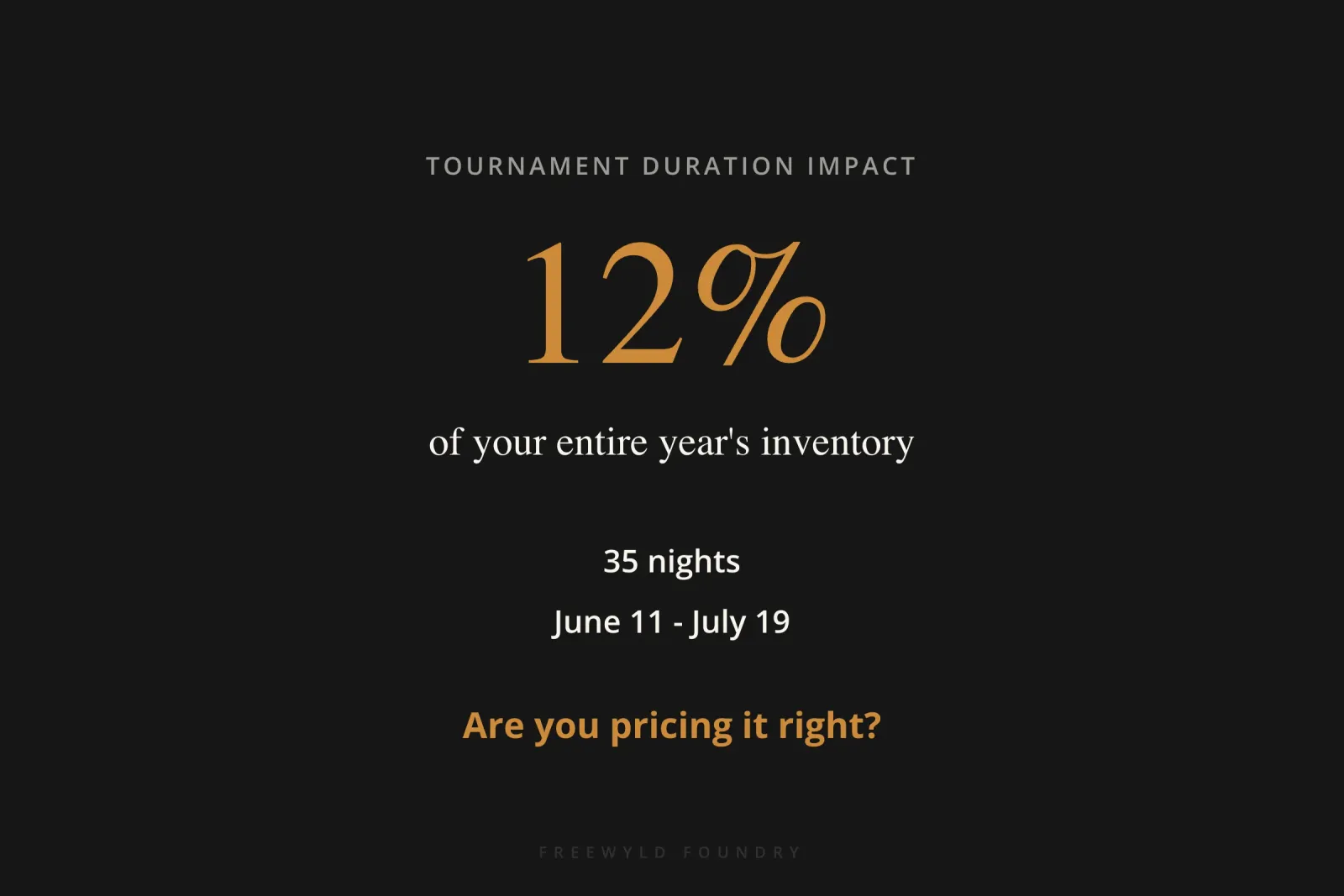
STR hosts maintaining 3x to 5x pricing premiums for World Cup dates are losing potential revenue in two ways: missed bookings during the five-week tournament period (June 11 to July 19) which represents 12% of annual nights, and displacement of regular summer travelers who would have booked at standard rates. Properties that adjust to market reality can still achieve 50% to 200% premiums above normal rates.
The World Cup spans from June 11 (opening match) through July 19 (final), covering five full weeks during peak summer travel season. For most STR operators, this represents approximately 35 nights or about 12% of the nights in an entire year.
Real Performance Data from Adjusted Pricing
Freewyld Foundry manages pricing for over 3,500 listings across World Cup host cities. When they began aggressively adjusting prices downward in recent months, here’s what happened:
“The bookings are still coming in at good prices. It’s not that you’re going to have to lower the price all the way to what a regular price would be. We’re still getting like 50%, 100%, 150%, 200% premiums in some cases,” reports Ribbers.
These results demonstrate that significant revenue premiums are still achievable, they just require abandoning the fantasy of 400% to 500% multipliers that many hosts are still targeting. Understanding these revenue management strategies is essential for capturing available demand.
| Strategy | Expected Premium | Booking Success | Risk Level |
|---|---|---|---|
| Hold 4x-5x prices until last minute | 400%-500% | Very Low | High (empty inventory) |
| Aggressive pricing now (Freewyld approach) | 50%-200% | High | Low (confirmed bookings) |
| Match previous year rates | 0% | High | Medium (missed opportunity) |
| Wait until 1 week out then panic drop | Variable | Medium | High (compressed booking window) |
The Cancellation Risk You’re Not Tracking
If you received bookings in early December 2025 (when the match schedule was first released), you may be sitting on a time bomb. Many hosts saw an initial wave of bookings at extremely elevated rates. Ribbers mentions seeing properties booked at $1,700 for two-bedroom units during this period.
The problem: many of these bookings were made under flexible or moderate cancellation policies. With World Cup dates now just weeks away and current market rates significantly lower, those early bookers are likely reconsidering. They can cancel penalty-free, rebook the same property type at a 30% to 50% discount, and pocket the savings.
“If those people are going to check out the current rates and they’re probably following the news reports as well… A lot of people are probably going to think like, hey, maybe we can get a better deal. Let’s cancel the one that we have,” warns Ribbers.
Every cancelled booking this close to the event is difficult to replace, especially at the original rate. Hosts need to audit their existing World Cup bookings immediately and identify which ones have flexible cancellation terms.
What Is the Difference Between Group Stage and Knockout Stage Pricing?
The World Cup consists of two distinct phases requiring different pricing strategies. The group stage (June 11 to approximately July 2) features known schedules where all 48 teams already know exactly when and where they play, making aggressive pricing essential now. The knockout stage (starting approximately July 3) features matchups that won’t be determined until days before each match, justifying elevated pricing due to legitimate last-minute travel.
Understanding this tournament structure is critical to maximizing World Cup revenue. According to Ribbers, “It’s split into two phases. There’s the group stage where all 48 countries that are participating already know exactly when and where they’re going to play… And then [after that] we don’t know yet who’s going to play who, because that depends on how the rankings are going to pan out in the individual groups.”
Why Group Stage Pricing Requires Immediate Action
During the group stage, each of the 48 participating countries plays three matches. The schedule for these matches was released in December 2025, and the final qualifying matches determining which countries would participate were completed in April 2026.
This means international travelers have known for MONTHS exactly when and where their team plays. If they were going to book travel to see their team’s group stage matches, most would have already done so. “I don’t see travel for the group stage games taking a huge flight. I just can’t imagine that people who travel from across the world are going to make these last minute decisions to fly out to the States,” explains Ribbers.
There will be some last-minute bookings, particularly from travelers in nearby countries like Mexico or Canada, or from domestic US travelers who decide on short notice to catch a match. But the massive international travel wave that hosts were expecting is not materializing.
For group stage dates, Ribbers recommends: “I would be very aggressive for the group stage. I mean, at this point, we’re like three or four weeks out. I just don’t see the last minute demand being enough to really book up all these cities for the group stages.” This approach aligns with broader STR revenue management principles of capturing available demand rather than speculating on future surges.
Why Knockout Stage Pricing Should Stay Protected
The knockout stage operates under different dynamics. Out of 48 teams in the group stage, 32 will advance to single-elimination rounds. These 32 teams include the top two finishers from each group plus the best-performing third-place teams.
The critical factor: until the group stage concludes, no one knows which teams will play which opponents, or in which cities these matches will occur. This creates legitimate reasons for last-minute travel that don’t exist during the group stage.
Imagine you’re a fan of the Netherlands national team. During the group stage, you know exactly which three cities they’ll play in. But for knockout rounds, you don’t know if they’ll even advance, and if they do, you don’t know their opponent or location until just days before the match.
“There’s no point for me booking that travel already because I don’t even know where they’re going to be playing. So that travel, there might be more or less minutes or there probably will be or most certainly will be more last minute travel for the knockout stage games,” notes Ribbers.
This uncertainty justifies maintaining elevated pricing for knockout stage dates, but requires active management once the tournament begins and matchups start becoming predictable.
How to Predict Knockout Stage Demand While Group Stage Is Still Playing
Smart operators won’t wait until knockout matchups are officially confirmed. By following group stage results closely, you can make educated predictions about which teams will advance and where they’ll play.
The strategy: “If let’s say take Spain, which is the number one favorite to win the tournament, they win their first two games. There’s a pretty good chance they’re going to be number one in the group. If they’re going to be number one in the group, then you already know where they’re going to be playing,” explains Ribbers.
The tournament structure predetermines that first-place finishers in certain groups will play their first knockout match in specific cities. Once you can reasonably predict which teams will finish first or second in their groups, you can anticipate demand for your market before those predictions become obvious to other hosts.
This is where following soccer closely during the three-week group stage pays dividends. Pay attention to:
- Which teams win their first two matches (likely group winners)
- Which heavily-supported teams (Brazil, Argentina, Germany, Spain, England, France, Mexico) are likely to advance to your city
- Which groups remain competitive until the final match day (creating uncertainty that keeps pricing elevated)
Common Mistakes STR Hosts Are Making with World Cup Pricing
The most common World Cup 2026 STR pricing mistakes include playing “last man standing” by holding inflated rates hoping for desperate last-minute bookers, treating all five weeks as equally valuable despite group stage versus knockout stage dynamics, ignoring competitor pricing and neighborhood booking data showing how low the market is transacting, and failing to audit cancellation policies on existing bookings leaving revenue vulnerable to penalty-free cancellations.
Mistake 1: The “Last Man Standing” Gamble
Many hosts are maintaining 4x or 5x pricing premiums with the strategy of being the last property available when supposedly desperate travelers arrive. This strategy assumes:
- A surge of last-minute bookings will materialize
- Travelers will have no choice but to pay premium rates
- Other hosts will panic and drop prices first
The reality: “Don’t gamble everything on last minute. I don’t think the mark’s going to book up completely. So there will probably be inventory that’s left empty,” warns Ribbers.
What happens is most inventory remains unbooked at inflated rates, and by the time hosts recognize the problem and drop prices, the booking window has compressed so severely that even reduced rates can’t generate sufficient bookings. This trap is similar to the last-minute pricing mistakes that cost hosts thousands throughout the year.
Mistake 2: Ignoring Market Booking Data
Most hosts set their World Cup prices based on what they HOPE the market will bear, not on what it is BOOKING at. This is a critical error that leaves money on the table in two directions: pricing too high and getting no bookings, or eventually pricing too low in a panic.
PriceLabs offers a neighborhood data feature that shows the median booked price in your market. This reveals what rates are converting browsers into bookers. “You can kind of see what people are booking at, what kind of prices are people booking at. And so I try to lower your prices to be in that region because that’s where you’re going to have the best chance of getting booked,” advises Ribbers.
Checking this data weekly and adjusting accordingly is the difference between confirmed revenue and empty calendars. Learning to use Price Labs features effectively can significantly improve your World Cup 2026 STR pricing performance.
Mistake 3: Uniform Pricing Across All Five Weeks
Treating June 11 through July 19 as a homogeneous “World Cup period” ignores the fundamental differences between:
- Group stage dates where travel is predictable and should be booked by now
- Early knockout round dates (Round of 32, Round of 16) where matchups determine demand
- Later knockout rounds (quarterfinals, semifinals, final) where demand is highest and most last-minute
Properties using a flat premium multiplier across all dates are overpricing group stage dates (losing bookings) while potentially underpricing later knockout rounds (leaving money on the table).
Mistake 4: Not Protecting Against Cancellations
Hosts who received bookings during the December 2025 rush often aren’t monitoring whether those bookings have flexible cancellation terms. As market rates decline, those early bookers are rethinking their reservations.
The fix: “Make sure you look at those cancellation policies that those bookings came in under and see where people can book, can cancel for free and pay attention on those dates because you might see some cancellations,” recommends Ribbers.
When a high-rate booking cancels, your pricing software may automatically drop the newly-available date to your minimum price or apply aggressive last-minute discounts. To prevent this, set elevated minimum price floors specifically for World Cup dates so cancelled dates don’t fall below profitable rates.
How to Implement a Two-Phase World Cup Pricing Strategy
Implementing a successful World Cup pricing strategy requires immediate aggressive pricing for group stage dates (targeting 50% to 150% premiums above normal rates), elevated minimum price floors to protect against cancellation-reopened dates, close monitoring of knockout stage matchup probabilities as the group stage plays out, and price adjustments within 5 to 7 days of knockout matches once teams and locations are confirmed.
Step 1: Audit Your Current Group Stage Pricing (Do This Today)
Pull up your calendar for June 11 through approximately July 2 (the group stage period). Compare your current rates to your typical June/July rates. If you’re charging more than 200% of your normal rate, you’re likely overpriced based on current market conditions.
Check your neighborhood’s median booked price in PriceLabs. If your prices are significantly above this level, you’re competing for a small pool of bookings while the majority of demand transacts below your threshold.
Step 2: Lower Group Stage Prices to Market-Clearing Levels
Based on Freewyld’s experience managing thousands of listings, target premiums of 50% to 150% above your normal rates for group stage dates. This means:
- If you normally charge $100/night, price between $150 and $250
- If you normally charge $200/night, price between $300 and $500
- If you normally charge $300/night, price between $450 and $750
Yes, this feels like leaving money on the table compared to the $400 or $600 or $800 you HOPED to charge. But confirmed bookings at 100% premiums generate far more revenue than empty calendars priced at 400% premiums.
“We’re still getting really good bookings, right? So you could still do well during the World Cup. You could still get higher prices, higher ADRs than what you’re used to,” confirms Ribbers. This approach follows proven Airbnb pricing strategy principles that prioritize occupancy and total revenue over rate alone.
Step 3: Set Elevated Minimum Prices for All World Cup Dates
If you’re using dynamic pricing software (PriceLabs, Wheelhouse, Beyond, etc.), that software may have aggressive last-minute discounts or minimum price floors that are too low for World Cup dates.
Create a custom minimum price rule specifically for June 11 through July 19. This prevents your software from dropping prices too low if:
- A booking cancels close to check-in
- Your last-minute discount rules activate
- The software’s algorithm overreacts to low occupancy
Even in a soft World Cup market, your minimum should still be 30% to 50% above your normal rates. You’re not trying to match non-event pricing, you’re trying to capture opportunistic demand at rational premiums. Understanding when your pricing tool isn’t enough helps you implement these protective measures.
Step 4: Monitor Your Existing Bookings for Cancellation Risk
Export all your current World Cup bookings into a spreadsheet. For each booking, note:
- Check-in date
- Booking date (when it was made)
- Total rate
- Cancellation policy (flexible, moderate, firm, strict, or non-refundable)
- Deadline for penalty-free cancellation
Bookings made in December 2025 under flexible or moderate policies are highest risk. These are the ones where guests are most likely to cancel and rebook at lower current market rates.
For high-risk bookings, consider proactively reaching out to guests with a small added value (late checkout, parking, welcome gift) to reduce cancellation incentive. The cost of a $20 to $30 gesture is far less than losing a $1,000+ booking.
Step 5: Create a Knockout Stage Monitoring System
Starting when the World Cup begins on June 11, track:
- Group stage results for all 12 groups
- Which teams are likely to finish first, second, or third in their group
- Which cities will host matches for these group winners/runners-up
- The probable matchups for Round of 32 and Round of 16
Set up Google Alerts for “World Cup 2026 [your city]” so news about upcoming matches in your market reaches you immediately.
The goal is to predict 7 to 10 days before each knockout match which teams will play in your city, giving you a head start on adjusting prices before it becomes obvious to every other host.
Step 6: Adjust Knockout Stage Prices Based on Confirmed Matchups
Once matchups are officially confirmed (typically 3 to 5 days before knockout matches), adjust your prices based on the draw:
- Two major soccer nations (Spain vs Germany, Brazil vs Argentina, etc.): Maintain or increase to 200% to 300% premiums
- One major nation vs smaller nation: Maintain 150% to 200% premiums
- Two smaller nations: Consider 75% to 150% premiums
- US national team playing in your city: Highest premiums (300%+) as domestic demand will be strong
Remember that knockout stage travel IS legitimately last-minute because fans couldn’t have booked earlier without knowing the matchup. This is where maintaining elevated pricing is justified.
Step 7: Track Neighborhood Pickup Weekly
In PriceLabs or your booking data, compare your market’s current booking pace (how many bookings are coming in per week) to the same period last year. Ribbers reports: “Right now I’m seeing a lot of markets where pickup is lower than same time last year.”
If pickup is declining week-over-week, this signals you need to be more aggressive with pricing. If pickup is accelerating, you have more room to maintain current rates.
This weekly tracking prevents you from holding prices too long based on outdated assumptions about what demand “should” be. Establishing a consistent revenue management routine ensures you catch these trends early.
Real-World Example: How Freewyld Adjusted Strategy Across 3,500+ Listings
When Freewyld Foundry began tracking World Cup booking patterns across their portfolio of 3,500+ listings in early April 2026, they noticed something alarming: occupancy on the books for World Cup dates was tracking BEHIND the same period in 2025 despite having the world’s largest sporting event in their markets.
According to Jasper Ribbers, co-founder of Freewyld Foundry, the company made a strategic decision: “We have been getting more aggressive with our pricing in the last couple months, just to get ahead of the curve a little bit, because we don’t want to gamble on the last couple of weeks.”
The Results of Aggressive Price Adjustments
Rather than holding out for 400% or 500% premiums, Freewyld began reducing prices to the 50% to 200% premium range. The impact was immediate: “The bookings are still coming in at good prices. It’s not that you’re going to have to lower the price all the way to what a regular price would be. We’re still getting like 50%, 100%, 150%, 200% premiums in some cases.”
These bookings represent confirmed revenue. Properties that held higher prices during this same period remained empty, hoping for a last-minute surge that hasn’t materialized.
The key insight: by acting early while other hosts waited, Freewyld captured demand before travelers either canceled their trips entirely or selected lower-priced alternatives in neighboring non-host cities. This proactive approach is central to their revenue management philosophy that emphasizes confirmed bookings over speculative maximum returns.
The Risk They Avoided
“We don’t want to gamble on international travel really increasing in the last couple of weeks and just keeping the prices these really high levels in the hope that the demand is still coming, because in my opinion, that’s taking a big risk,” explains Ribbers.
This philosophy, managing $170 million in annual STR bookings, values confirmed revenue over speculative maximum revenue. For operators with bills to pay and mortgages to cover, a 100% premium that books today is superior to a 300% premium that never books at all.
Frequently Asked Questions
Should I still expect any premium pricing for World Cup dates at this point?
Yes, premiums of 50% to 200% above normal rates are still achievable, even close to the event. Freewyld Foundry’s portfolio of 3,500+ listings is currently booking at these premium levels after adjusting from initially higher expectations. The key is pricing competitively within current market rates rather than holding out for 300% to 500% premiums that are no longer realistic given lower-than-expected international travel and displacement of regular summer visitors.
What should I do if I have a December booking at a very high rate?
Immediately check the cancellation policy for that booking. If it’s flexible or moderate, the guest can cancel penalty-free and is likely comparing your rate to current market rates that may be 30% to 50% lower. Consider proactively adding value to reduce cancellation incentive, such as offering late checkout, parking, or a welcome basket. The cost of a small gesture is far less than losing a high-value booking and having to rebook the same dates at lower current rates. Also ensure your pricing software won’t drop that date to minimum prices if the booking cancels.
How much are hotels and STRs booked for World Cup dates right now?
Nearly 80% of hotels across 200 properties in 11 US host cities report bookings tracking below initial forecasts, with some dates showing LESS occupancy than the same period last year. This data comes from industry reports cited by Jasper Ribbers on the Get Paid for Your Pad podcast. The booking shortfall is significant enough that Fortune magazine published an article calling the World Cup a “non-event” from a hospitality perspective. STR occupancy patterns are following similar trends, with pickup rates in many markets lagging previous years.
Which World Cup dates should I keep prices highest?
Maintain elevated pricing (200% to 300% premiums or higher) for knockout stage dates, particularly quarterfinals, semifinals, and the final on July 19. Also protect pricing for any matches featuring the US national team or matchups between two major soccer nations (Brazil, Argentina, Spain, Germany, England, France). For group stage dates through early July, be more aggressive with pricing now as the predictable schedule means most travel should already be booked. The exception is if your city hosts a particularly high-profile group stage match.
Is there any chance demand surges in the final weeks before the World Cup starts?
While some last-minute booking activity is likely, Jasper Ribbers warns against counting on it: “Don’t gamble everything on last minute. I don’t think the mark’s going to book up completely.” The factors suppressing demand (visa uncertainty, high travel costs, economic concerns) won’t resolve in the final weeks. Some opportunistic domestic travelers may book if prices come down significantly, but the hoped-for surge of international travelers making last-minute decisions to fly across the world is unlikely. The safer strategy is securing confirmed bookings now at realistic premiums rather than gambling on a surge that may never come.
How does World Cup pricing compare to hotel revenue management approaches?
World Cup 2026 STR pricing requires different strategies than traditional hotel revenue management due to the displacement effect on regular travelers and the longer booking windows for short-term rentals. While hotels typically adjust prices based on demand curves they’ve seen in past events, the unique combination of visa uncertainty, elevated costs, and displaced summer demand makes this event unlike typical major sporting events. Understanding the differences between hotel and STR revenue management helps operators avoid applying inappropriate strategies from the traditional hospitality industry.
Conclusion
The 2026 World Cup represents a harsh lesson in the difference between expected demand and actual booking behavior. With 80% of hotels across host cities tracking below forecasts and some dates showing lower occupancy than normal summer weeks, STR operators must abandon the fantasy of guaranteed 400% or 500% premiums.
But here’s the critical point: significant revenue premiums are STILL achievable for operators who adjust strategy now. Freewyld Foundry’s portfolio of 3,500+ listings is capturing 50% to 200% premiums by pricing aggressively for group stage dates while protecting knockout stage pricing for later adjustment. These confirmed bookings represent real revenue rather than speculative maximum returns.
The two-phase approach is essential. Group stage dates (June 11 through early July) require immediate price adjustments to capture demand before travelers cancel their trips entirely or select alternative destinations. Knockout stage dates (starting approximately July 3) justify elevated pricing due to legitimate last-minute travel driven by unknown matchups until days before each match.
The biggest risk isn’t pricing too low, it’s holding inflated rates so long that your calendars remain empty while other hosts capture the available demand. Missing out on 100% premiums while hoping for 400% premiums is a costly mistake that will impact your annual revenue far beyond just these five weeks. Avoiding these revenue management mistakes requires accepting market reality and adjusting quickly.
Want expert World Cup pricing management for your properties? Our team actively manages 3,500+ listings across World Cup host cities and would welcome the opportunity to help you maximize this event at Get your free revenue report
Related Resources:
- FIFA World Cup 2026 STR Pricing Strategy
- How to Track STR KPIs
- Revenue Management Strategies to Crush Your Goals
Listen to the full conversation on the Get Paid for Your Pad podcast
About Jasper Ribbers: Jasper Ribbers is co-founder of Freewyld Foundry, which provides Revenue & Pricing Management for over 3,500 short-term rental listings representing $170M+ in annual bookings. He co-hosts the Get Paid for Your Pad podcast, which has released over 700 episodes on STR revenue optimization.