STR Revenue Management: How One Operator Left $20K on the Table (And How to Avoid It)
Introduction
You’re finally getting bookings. Your occupancy looks decent. Your guests seem happy.
But here’s the uncomfortable truth: You’re probably leaving thousands of dollars on the table every month.
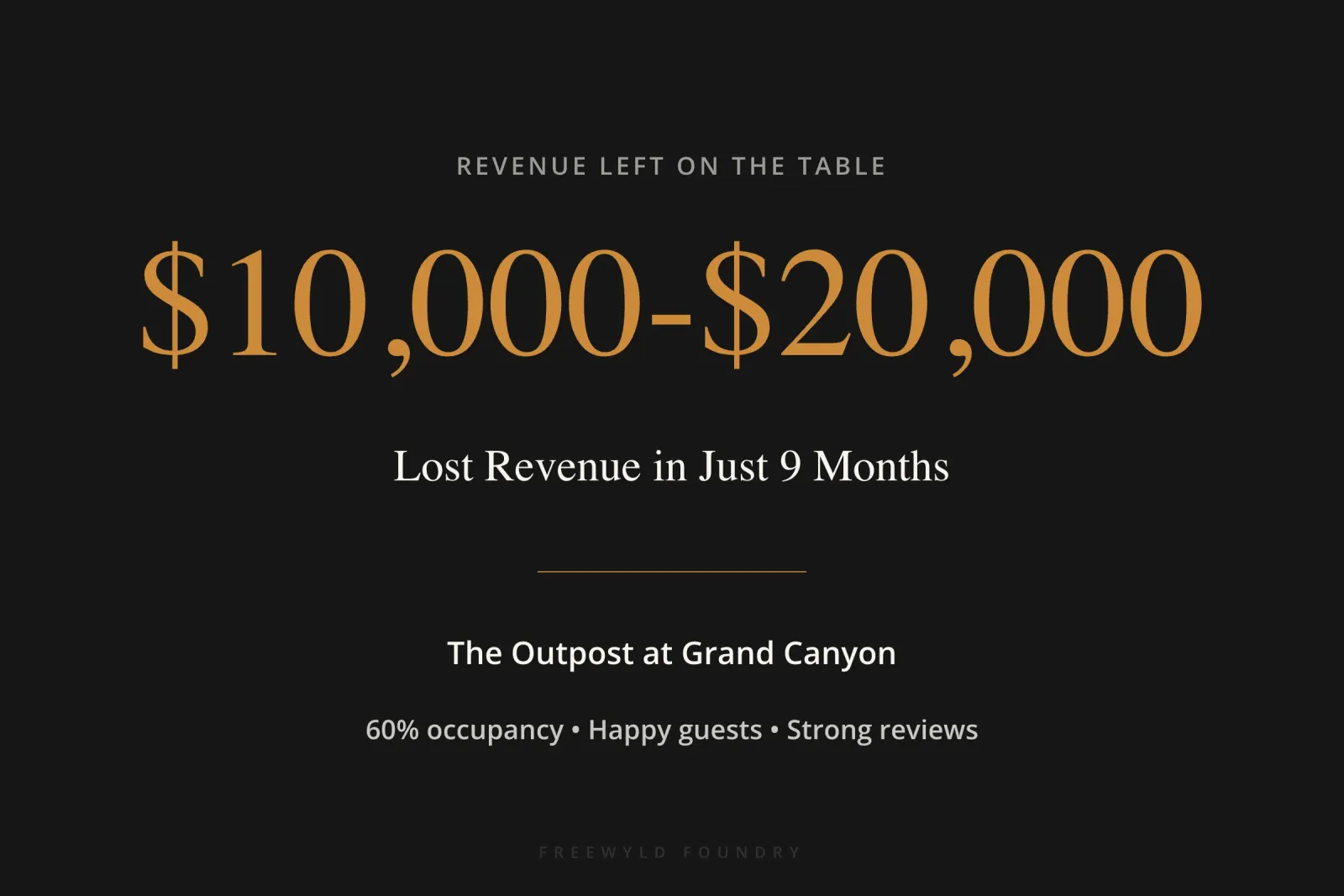
That’s exactly what happened to Conor Schwab, operator of The Outpost at the Grand Canyon. His 12-Airstream property hit 60% occupancy in the low season, filled up completely during holidays, and guests loved the experience. Everything looked great on the surface.
Except he was undercharging by $10,000 to $20,000 over just nine months.
The problem wasn’t bad properties or poor service. It was something most short-term rental operators don’t take seriously enough: STR revenue management.
In this deep dive with Jasper Ribbers, head of revenue management at Freewyld Foundry (managing $150 million across 3,000+ listings), you’ll learn why treating pricing as a side task is costing you serious money, what STR revenue management actually means (hint: it’s not just a pricing tool), and the exact strategy professional revenue managers use to optimize STR income.
What Is Revenue Management for Short-Term Rentals?
Most STR operators think revenue management means setting prices in their property management system. Maybe using a tool like PriceLabs or Wheelhouse. That’s only part of the picture.
STR revenue management is whatever you do in your business that directly affects the chance that somebody will book and the price that somebody will book at. It’s a strategic business function, not a task you do when you have time between emergencies.
The obvious part is setting prices dynamically. But revenue management also includes:
- Cancellation policies: Put a strict policy on Airbnb and your listings won’t be seen, regardless of your prices
- Minimum night stays: Too high and you miss bookings, too low and you waste resources on turnover
- Calendar availability: Open 12 months or 9 months? This affects your booking window strategy
- Same-day bookings: Accept them or not? The choice impacts your last-minute fill rate
- OTA promotions: Which discounts actually drive bookings versus just cutting your profit?
- Booking settings: Every switch you flip either helps or hurts your chances of getting booked
“You can have very attractive prices, but if you put a strict cancellation policy on Airbnb, your listings are just not going to be seen,” Jasper notes. “Then it doesn’t really matter what your pricing strategy is.”
There’s a gray area where STR revenue management overlaps with distribution and operations. Listing optimization technically falls under marketing, but it directly impacts your revenue. Professional revenue managers give advice on photos and descriptions even if they don’t personally optimize listings.
How Much Can Revenue Management Increase Your STR Income?
Let’s look at real numbers.
Conor’s Grand Canyon property was doing well by most standards. They hit 60% occupancy in Q2 (their low season) and projected 85% for Q4. But by underpricing holidays and busy weekends, they lost $10,000-$20,000 in just nine months.
That’s with a relatively new property that was already performing above projections.
Freewyld Foundry manages over $150 million in annual bookings across 3,000+ listings for 70+ clients. They charge 1-3% of rental revenue (depending on portfolio size). They still have their first clients from over two years ago. Why? Because the service pays for itself through increased revenue.
Here’s the math: If you pay 3% to a revenue management service and they increase your revenue by more than 3%, you’re making money while doing less work. Most operators see bigger gains than 3%.
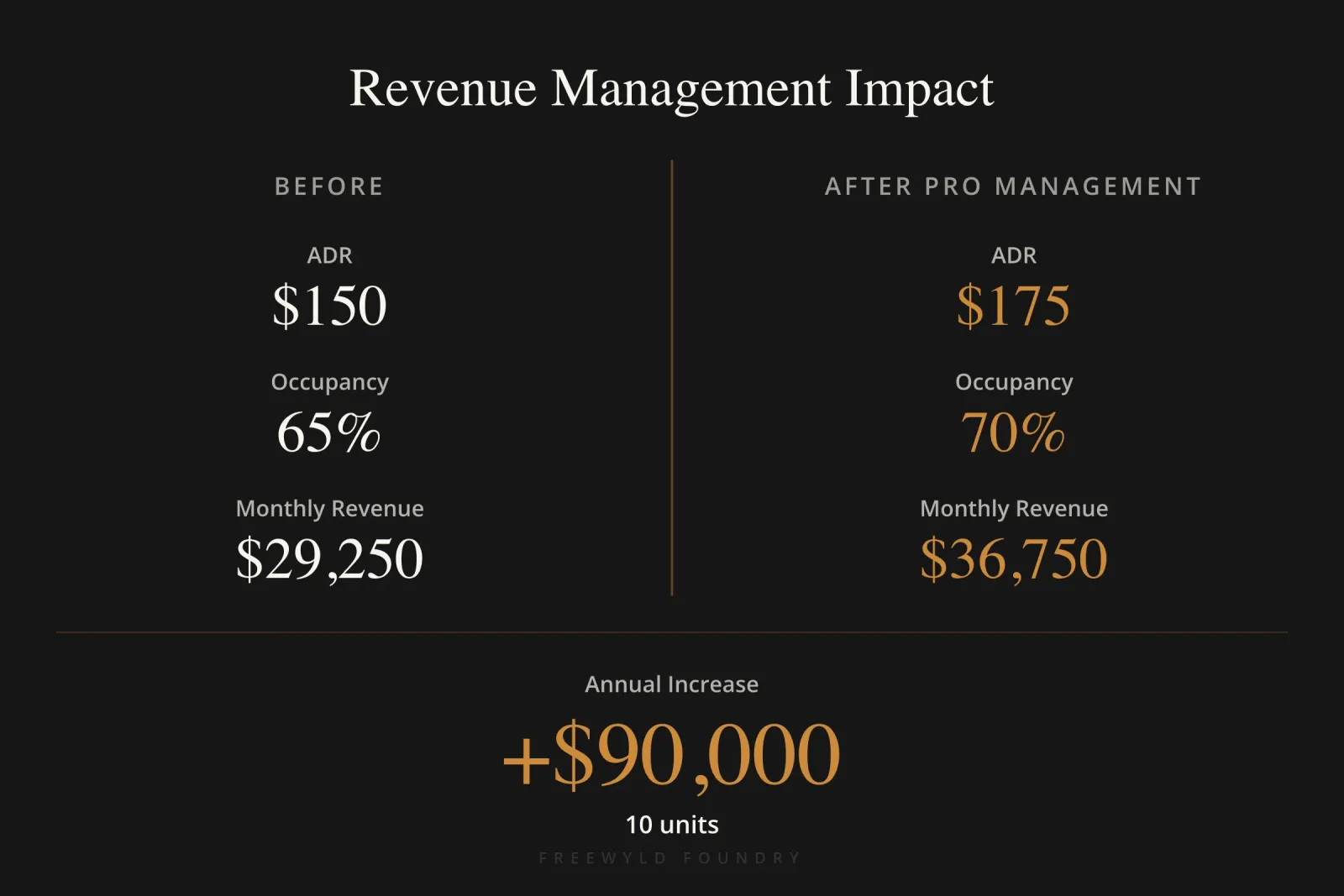
| Metric | Before Pro Management | After Pro Management | Change |
|---|---|---|---|
| ADR (Average Daily Rate) | $150 | $175 | +16.7% |
| Occupancy | 65% | 70% | +7.7% |
| Monthly Revenue (10 units) | $29,250 | $36,750 | +25.6% |
| Annual Revenue (10 units) | $351,000 | $441,000 | +$90,000 |
Even conservative improvements compound significantly. A $10 increase in ADR on a unit that books 180 nights per year equals $1,800 in additional revenue. Multiply that across a portfolio and the numbers get serious fast.
“In the end of the day, it all comes down to: can we increase your revenue or not? That’s why when a company applies for our service and we look at the pricing strategy and we see that they’re doing really good and we don’t think there’s significant upside, we just tell them that. We want to work with clients where we can increase their revenue.”
- Jasper Ribbers, Freewyld Foundry
The impact goes beyond just dollars. Professional STR revenue management gives you back time and mental energy. Instead of obsessing over prices across six different OTA platforms, you focus on operations, guest experience, and business growth.
Common Revenue Management Mistakes STR Operators Make
Mistake 1: Treating Revenue Management as a Side Task
The biggest killer of STR revenue is treating pricing as something the GM or CEO does “when there’s time.”
“There’s always fires. There’s always something urgent to work on,” Jasper explains. “Typically, the revenue management side is not something that people consider to be extremely urgent. So it’s done when there’s time.”
The problem? There’s never time. Urgent operations always win over important strategy.
This leads to:
- Prices set once and forgotten for weeks
- Holiday pricing figured out last minute (when it’s too late)
- No response to competitor price changes
- Missing booking pace trends until inventory sits empty
- Panic discounting when occupancy looks low
Mistake 2: Thinking a Pricing Tool Equals Revenue Management
Operators buy PriceLabs or Wheelhouse, connect their listings, and think they’re done. This is like buying a gym membership and expecting to get fit without working out.
“That’s a big misconception,” Jasper says. “People think that a pricing tool, that’s revenue management. But it’s really not. The price is purely defined by the parameters that you put in. If you put in the wrong base price, you’re going to get horrible prices.”
Pricing tools are useful. They can:
- Adjust prices based on occupancy
- Set dynamic minimum night stays
- Update across multiple OTAs automatically
- Factor in seasonal patterns
But tools don’t think strategically. They don’t know:
- When your local market starts booking
- How your property compares to competition
- Whether to prioritize early bookings or wait for higher prices
- If a local event will drive demand next month
You have to review your pricing daily (or at minimum weekly) and adjust the tool’s parameters based on what’s actually happening in your market.
Mistake 3: Judging Your Own Product’s Worth
Operators often resist charging high prices because they think “my unit isn’t worth that much.”
But who decides what something is worth?
“Is it the person that owns the product or is it the person that’s paying for it?” Jasper asks. “I would argue it’s the person that’s paying for it. In Holland, we have an expression: something is worth what the craziest person will pay for it.”
Think about airline tickets. How much is a flight from New York to Los Angeles worth? On Thanksgiving, you’ll pay $2,000. On a Tuesday in February, maybe $150. You’re getting the exact same five hours in a cramped seat.
If someone books your unit for $600, they judged it worth $600 to them. Your personal opinion about your bathroom size doesn’t matter.
The guest made the purchase. They decided the value. Trust their judgment.
How to Implement a Revenue Management Strategy
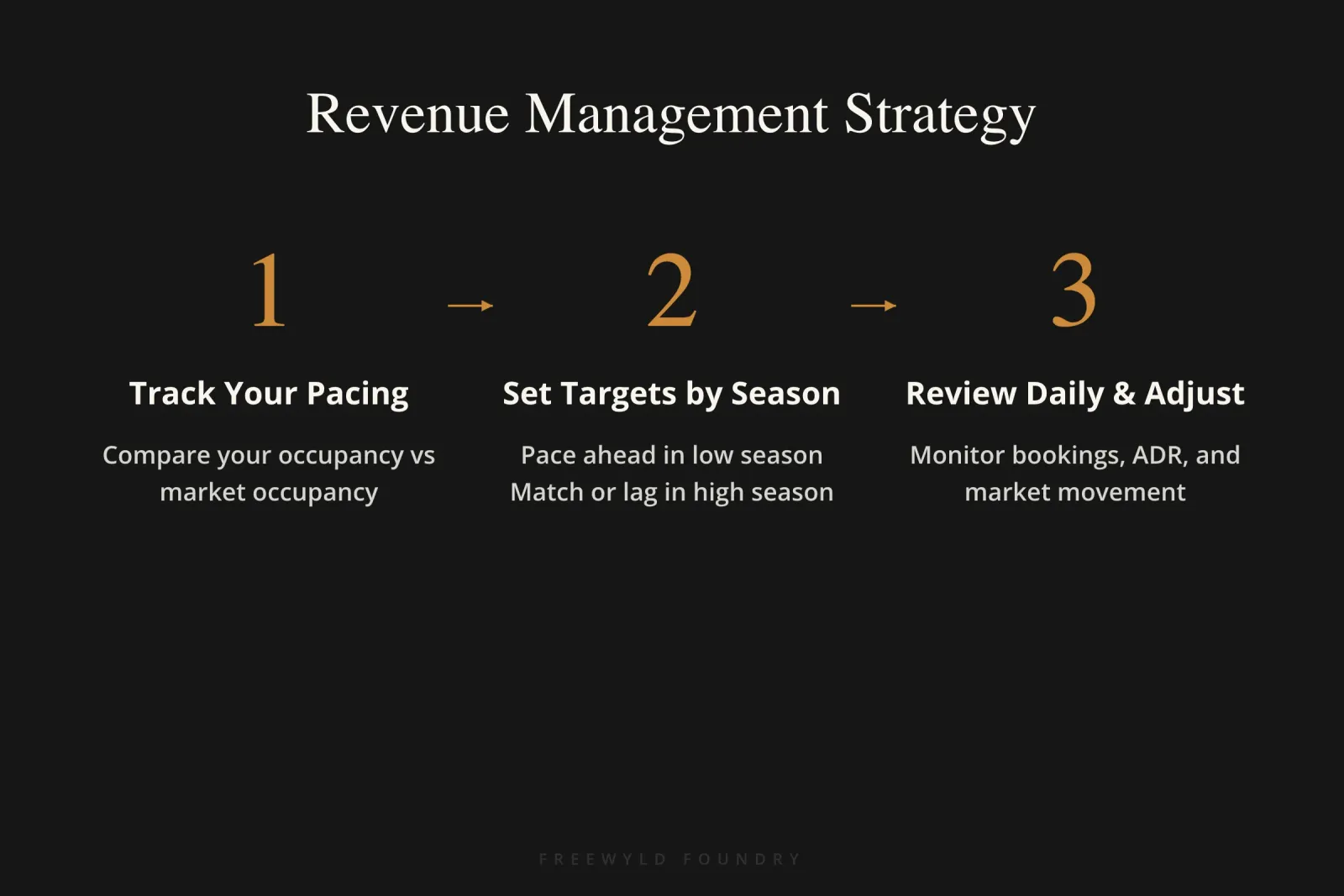
STR revenue management works through a simple but powerful concept: pacing analysis.
Step 1: Track Your Occupancy vs. Market Occupancy
Look at future months. Compare your portfolio’s occupancy to similar properties in your market.
Let’s say it’s March and you’re looking at May bookings:
- Your properties: 10% occupied for May
- Market average: 30% occupied for May
You’re pacing behind. Your prices are likely too high, or your listings aren’t visible enough.
Flip scenario:
- Your properties: 40% occupied for May
- Market average: 10% occupied for May
You’re pacing ahead. Your prices might be too low. People are choosing your units over competitors, which could mean you’re leaving money on the table.
Step 2: Set Pacing Targets Based on Season
Here’s where strategy comes in. You don’t just want to match the market. You want to pace based on season and what you expect final occupancy to be.
High season example: If you expect the market to book out almost completely (90%+ occupancy), you can pace with the market or even slightly behind. You know last-minute bookings will still happen at decent prices because inventory will be tight.
Low season example: If you expect the market to end at 30-40% occupancy, you need to capture MORE than your fair share of early bookings. If you wait, you’ll be competing for scraps at terrible prices.
Step 3: Review Daily and Adjust
Every day, check:
- How many new bookings came in?
- How does this affect your pacing compared to yesterday?
- Are you getting lots of bookings quickly? (Might be underpriced)
- Are bookings drying up? (Might be overpriced or visibility issue)
Look at your booking window strategy. When are people actually booking?
If your average booking window is 30 days out, that’s when mainstream bookers start shopping. Early bookers come 60-90 days out. Last-minute bookers come within 14 days.
You want to capture bookings BEFORE your competitors panic and slash prices at 2-3 weeks out.
Step 4: Use Data Tables to Compare Periods
Track your performance week over week:
| Week | Occupancy | ADR | RevPAR | Bookings | Market Pace |
|---|---|---|---|---|---|
| Week 1 | 25% | $180 | $45 | 8 | +5% |
| Week 2 | 32% | $185 | $59 | 12 | +8% |
| Week 3 | 45% | $175 | $79 | 15 | +12% |
| Week 4 | 58% | $190 | $110 | 10 | +15% |
This shows you’re pacing well ahead of market (+15% by week 4), ADR is holding strong, and bookings are steady. This property is optimized.
Step 5: Adjust Booking Settings for Maximum Revenue
Beyond pricing, optimize these settings:
- Minimum night stays: Lower in shoulder season to capture shorter stays, higher during peak to avoid turnover costs
- Cancellation policy: Moderate on Airbnb (strict kills visibility), slightly stricter on Booking.com
- Calendar length: Keep it open 12 months if you target early planners, 9 months if you want flexibility
- Last-minute booking window: Test 1-day vs. 3-day vs. 7-day minimums and measure impact
- Check-in days: Allow mid-week check-ins during slow periods, restrict to weekends during peak
Real-World Case Study: The Grand Canyon Property
Conor’s property outside the Grand Canyon provides a perfect case study in STR revenue management challenges.
The Property:
- 12 Airstream units with private hot tubs
- Located near an international tourist destination
- Listed on 6 OTAs: Airbnb, Booking.com, Expedia, Agoda, Hipcamp, and direct bookings
- Uses Newbook PMS with PriceLabs integration
The Problem: 80% of bookings came from OTAs in the first six months. Each OTA has different algorithms, fee structures, pet policies, and communication systems. Learning to optimize across platforms while managing operations overwhelmed the team.
“I simply didn’t have the time to sit down and learn how to do the programming in Newbook or how to do it in PriceLabs,” Conor explains. “And I left so much money on the table in our first nine months when I was just trying to make sure we had cleaners and make sure we had all the faucets on for the winter.”
Specific mistakes:
- Holiday weekends: 100% occupancy at prices $20-30 below market rate
- Busy weekends: Booked out weeks in advance, indicating underpricing
- Event dates: Missed opportunities because they didn’t know events were happening
- OTA optimization: Left default settings across platforms instead of customizing
The Solution: After five weeks with Freewyld’s revenue management service:
- Weekly calls with dedicated revenue manager
- Platform-specific optimization across all 6 OTAs
- Market pacing analysis showing when to raise/lower prices
- Projected Q4 occupancy: 85% (up from 60% in Q2)
- Time saved: 10-15 hours per week not learning/managing six platforms
- Peace of mind: Expert monitoring prices while Conor focuses on operations
According to Conor: “If I can bring up my ADR by $10, then not only have I not had to do anything, but I also just made 7%. If I paid 3% to Freewyld, I just made seven extra dollars per month for doing less.”
Frequently Asked Questions
Does raising prices hurt my reviews?
No. The data shows higher prices don’t create worse reviews. If guests book at $400, they already judged it worth $400. They won’t suddenly demand perfection they wouldn’t expect at $200. What matters is meeting guest expectations set in your listing and having attentive staff. Price shoppers who book cheap often expect more and complain more than guests who book premium experiences.
Should I use PriceLabs, Wheelhouse, or another pricing tool?
Any major pricing tool (PriceLabs, Wheelhouse, Beyond Pricing, etc.) has the data you need. The tool matters less than your strategy and daily oversight. PriceLabs tends to offer the widest range of functionality and listens to user feedback. But the biggest gain isn’t switching tools but educating yourself and implementing daily review processes. Most operators see 10x more impact from better strategy than from changing tools.
How many OTA platforms should I list on?
Start simple. For most STR properties, Airbnb, Booking.com, and VRBO capture 90%+ of realistic bookings. Add complexity only if it significantly impacts revenue. Each platform adds management overhead. Conor’s Grand Canyon property benefits from six platforms because of international demand and unique property type. A standard vacation home in a domestic market probably doesn’t need more than three plus direct bookings.
How do I know if my revenue management is working?
Track these metrics monthly:
- RevPAR (Revenue Per Available Room): Your ADR times occupancy percentage
- Pacing vs. market: Are you ahead or behind similar properties?
- Booking window: When are guests booking? Is it getting earlier or later?
- Cancellation rate: High cancellations indicate possible pricing or policy issues
Compare your numbers to your market and to your own history. You should see year-over-year RevPAR growth of 5-15% in stable markets by tracking your KPIs.
Can AI replace human revenue managers?
Not yet. AI helps revenue managers work faster by scanning data and highlighting what needs attention. At Freewyld, they built tools that create revenue projections in one minute instead of one hour. But AI can’t make strategic judgment calls about when to prioritize early bookings versus waiting for higher prices, or how to interpret unusual market behavior. Think of AI as an assistant that makes humans more effective, not a replacement.
What’s the difference between a revenue manager and a pricing tool?
A pricing tool automates price changes based on rules you set. A revenue manager thinks strategically about your entire booking ecosystem: cancellation policies, minimum stays, OTA visibility, market pacing, competitive positioning, and seasonal patterns. The tool is one component in a complete STR revenue management strategy.
How often should I review my pricing strategy?
Professional revenue managers review pricing daily for active properties. At minimum, you should review weekly and make adjustments based on booking pace versus market trends. Major strategy reviews (adjusting base prices, seasonal patterns, minimum stays) should happen monthly or when launching new units.
Should I focus on occupancy or ADR?
Both matter, but RevPAR (occupancy times ADR) is the ultimate metric. A property at 90% occupancy and $100 ADR generates $90 RevPAR. A property at 70% occupancy and $150 ADR generates $105 RevPAR. The second property makes more money with lower occupancy. Focus on maximizing total revenue, not just filling beds.
Conclusion
STR revenue management isn’t sexy. It won’t wow your guests or win design awards. But it might be the highest-ROI activity in your entire STR business.
The operators who treat it seriously, whether they do it themselves, hire in-house, or outsource to specialists, consistently outperform operators who treat it as a side task. The difference isn’t small. We’re talking 20-30% revenue swings.
You have three paths forward:
- Learn it yourself if you love numbers and have bandwidth
- Hire dedicated in-house talent (hard to find, but gives you control)
- Outsource to specialists who do this all day for dozens of properties
Don’t choose the invisible fourth option: treating pricing as something you’ll “get to when there’s time.” That’s how you leave five figures on the table every year.
The good news? You don’t need perfection. You need consistency and the willingness to make small adjustments based on what the data tells you. Review your numbers weekly. Compare your pacing to the market. Trust that guests determine value through their purchase decisions.
That’s STR revenue management. And it works.
Want expert revenue management without the learning curve?
Get a free revenue audit for your STR property at /get-started/
See exactly where you’re leaving money on the table and what changes would make the biggest impact. No obligation, just actionable insights from revenue managers who optimize $150M+ in bookings.
Listen to the full conversation: Get Paid for Your Pad Podcast - Episode 715
About Jasper Ribbers: Jasper is co-founder of Freewyld Foundry and host of the Get Paid for Your Pad podcast (700+ episodes). He started his first Airbnb in 2012 in Amsterdam and now leads revenue management for $150M+ in annual STR bookings across 3,000+ listings. His background in econometrics and trading informs his data-driven approach to pricing strategy.