If you’re managing short-term rentals and not maximizing revenue on your peak demand dates, you’re leaving serious money on the table. When Freewyld Foundry onboards new clients, 90% of portfolios already have bookings on their highest-value dates at rates that are far too low. This happens because most operators focus on pricing a few months ahead, while peak demand dates require a different strategy starting 12 months in advance.
In this guide, you’ll learn exactly how to identify your peak demand dates, set pricing that captures maximum revenue without leaving units empty, and implement safeguards that protect you from the pricing mistakes that cost most operators thousands of dollars per property every year. These strategies come from managing 70+ client portfolios with over $170 million in annual bookings, where getting peak dates right often makes the difference between a good year and a great one.
The operators who master peak demand pricing consistently outperform their markets on the dates that matter most. The ones who don’t are handing that revenue to whoever happens to be priced right when eager travelers arrive at the calendar.
What Are Peak Demand Dates for Short-Term Rentals?
Peak demand dates are the highest-value booking periods in your market when travelers are willing to pay significantly more than usual for accommodations. These dates require special pricing attention because they have longer booking windows (often 12 months in advance), attract less price-sensitive guests, and represent outsized revenue opportunities compared to regular dates throughout the year.
Peak demand dates typically include:
- Major holidays like Christmas, Thanksgiving, New Year’s Eve, and Valentine’s Day
- Recurring events such as music festivals, sporting events (college football games, marathons), and annual conferences
- One-off special events like concerts, championship games, or the FIFA World Cup
- Long holiday weekends including Memorial Day, Labor Day, and Fourth of July
- Local event calendars specific to your market (air shows, food festivals, seasonal celebrations)
The key characteristic of peak demand dates is that booking windows extend much further than normal dates. For a random Tuesday in February, guests typically book only a few weeks or months in advance. For a major music festival or college football game, guests often book 6-12 months ahead. Some passionate travelers book accommodations the moment they leave an annual event, securing their spot for the following year before they even drive home.
This extended booking window creates both opportunity and risk. The opportunity comes from capturing bookings from highly motivated guests who will pay premium rates to secure their preferred accommodation. The risk comes from having your pricing wrong when those eager bookers arrive at your calendar. If your rates are too low when the booking window opens, you’ll lock in disappointing revenue for the entire year.
According to Jasper Ribbers, co-founder of Freewyld Foundry: “The people that book a year in advance, those are people that generally will be willing to pay a high price. They just want to lock something in.”
How Much Revenue Are STR Operators Losing on Peak Dates?
The revenue gap on peak demand dates is substantial and often shocking. When Freewyld Foundry analyzes new client portfolios, they consistently find money already lost to bookings made too far in advance at inadequate rates. The pattern repeats across markets and property types.
“90% of the portfolios that we onboard, we look at pricing in the next 12 months, and there’s usually a few dates where we already have some bookings at a way too low ADR,” explains Jasper Ribbers. With 70+ clients currently under management, this represents a significant data set confirming that underpricing peak dates is nearly universal among operators who haven’t implemented year-ahead pricing strategies.

The actual dollar amounts vary by property size and event type, but the losses add up quickly:
- Large homes during major events: $5,000-$10,000 additional revenue possible per property with detailed pricing monitoring (Coachella, for example)
- Two-bedroom apartments: Bookings captured at $1,700 per night a year in advance for World Cup dates versus much lower rates as events approached
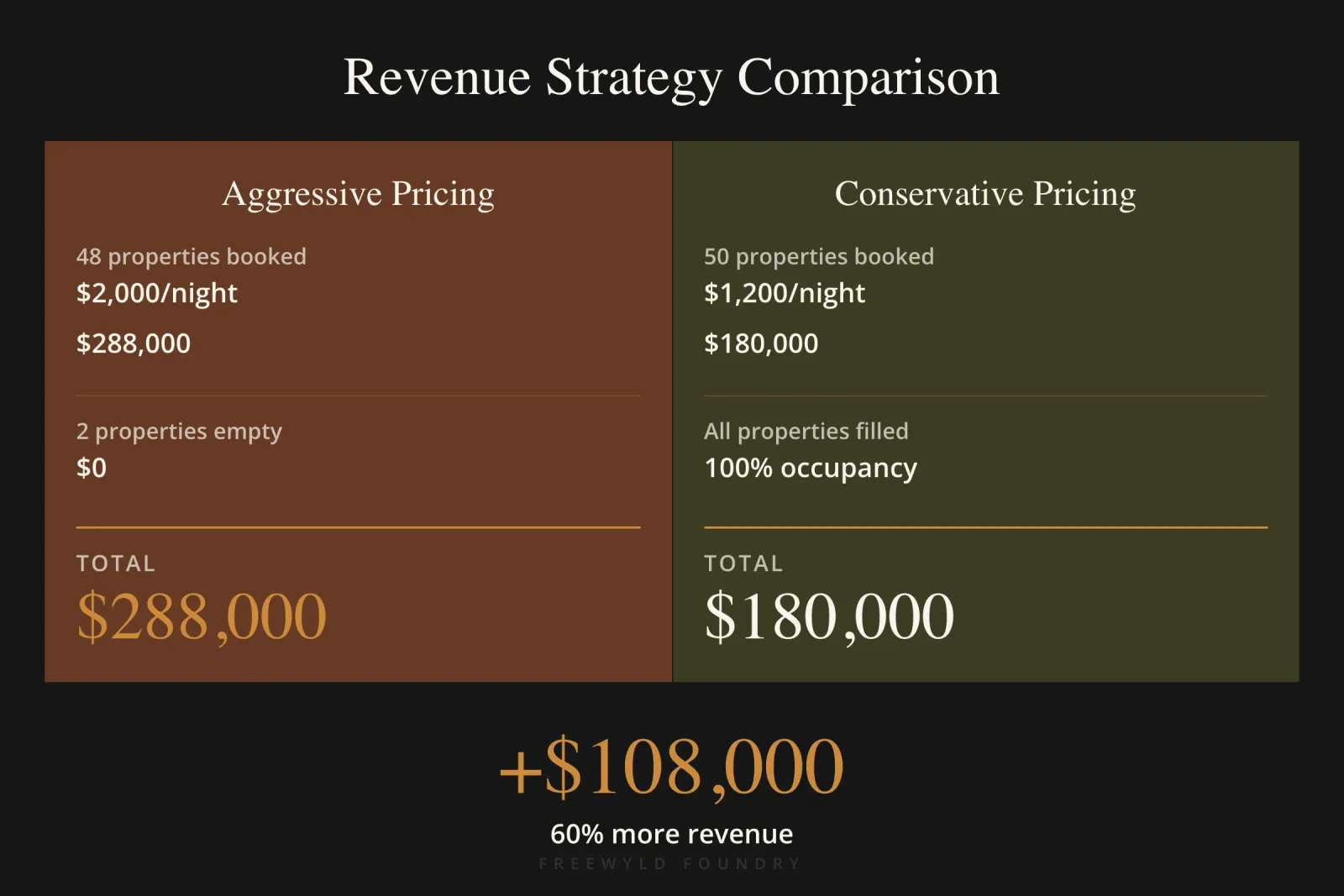
- Portfolio-wide impact: Additional revenue from 48 properties booking at premium rates typically outweighs having 2 properties remain empty with an aggressive pricing strategy
| Strategy | Risk Level | Potential Upside | Potential Downside |
|---|---|---|---|
| Aggressive year-ahead pricing | Medium-High | $5K-$10K per property | 5-10% of units may book last-minute or stay empty |
| Conservative guaranteed booking | Low | Modest premium (20-30% above normal) | Missing potential 2x-5x premium rates |
| Moderate pricing with monitoring | Medium | $2K-$5K per property | Requires ongoing attention and adjustments |
The revenue range depends on whether your market books out or reaches only 85-95% occupancy. In markets that book to 100% capacity, even last-minute bookings command premium rates. In markets reaching 85-95%, some inventory will remain available, creating downward price pressure in the final days before the event.
The challenge is that dynamic pricing tools struggle with peak demand dates because the range of what guests will pay is much wider than normal. A passionate college football fan or festival attendee traveling with a group of friends has very different price sensitivity than a family booking a random weekend getaway.
Why Traditional Revenue Management Fails on Peak Demand Dates
Most revenue management approaches that work well for regular dates actively cost you money on peak demand dates. The problem starts with the fundamental difference in booking windows and continues through how pricing tools make decisions.
The Booking Window Mismatch
Regular dates throughout the year have booking windows of 2-3 months in most markets. This means operators can set their prices a few months in advance and make adjustments as the date approaches based on how bookings are pacing. Peak demand dates have booking windows of 6-12 months, requiring pricing decisions to be made much further in advance when there’s little market data to guide those decisions.
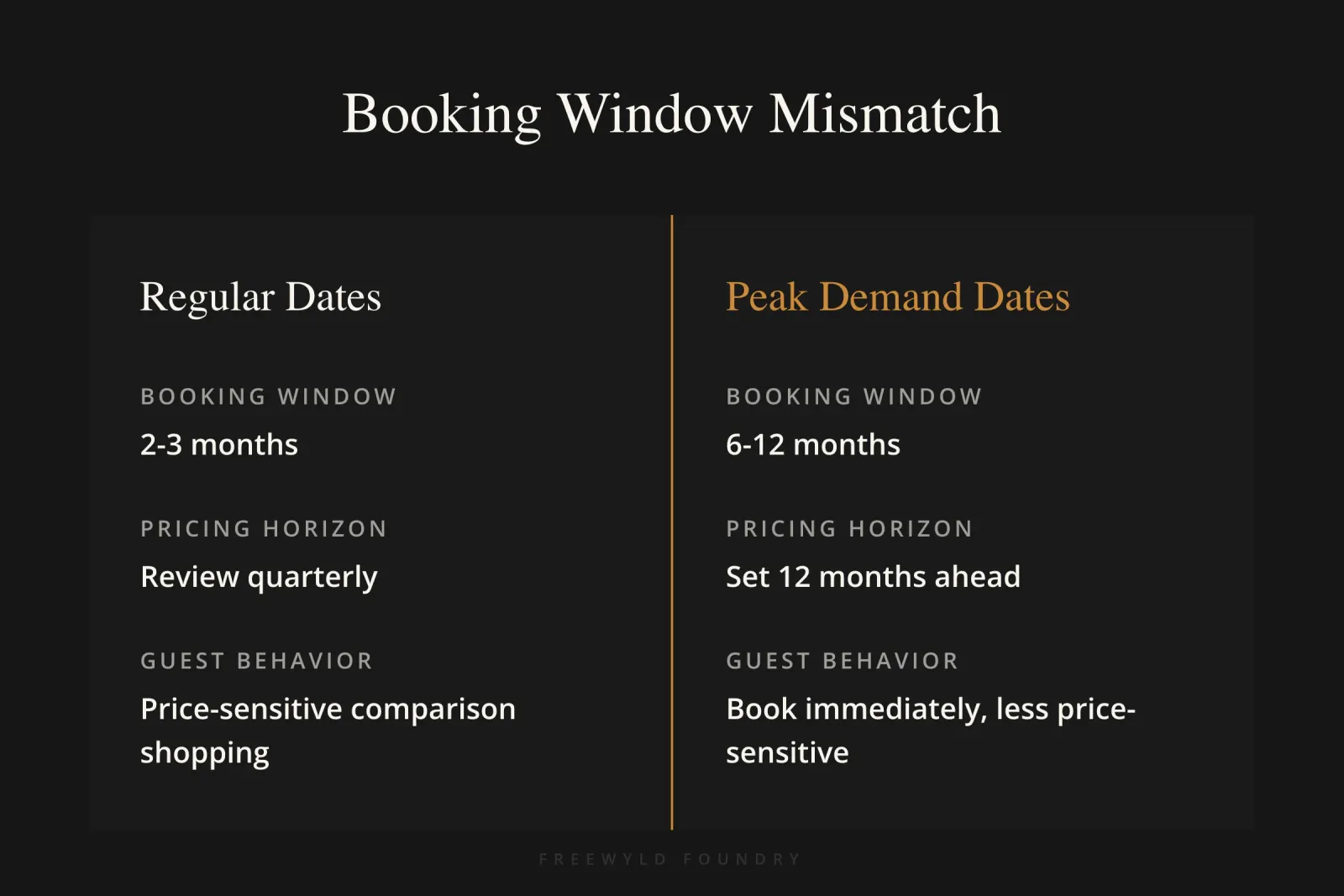
Most operators look at their calendar a couple months out, maybe three months if they’re particularly proactive. This works fine for 90% of your calendar but fails for peak demand dates. By the time you’re monitoring dates 2-3 months away, the first wave of bookings for peak events has already happened.
Pricing Tool Limitations
Pricing tools use demand factors and market signals to adjust rates up or down. On regular dates, they can see booking velocity in your market and adjust accordingly. A year in advance on a peak demand date, there isn’t meaningful booking velocity yet. The pricing tool has limited data to work with, so it often sets rates based on historical patterns that may not reflect current demand dynamics.
Additionally, pricing tools struggle with the price insensitivity that characterizes peak demand bookings. For a major festival or sporting event, passionate fans just want to secure something close to the venue. They’re traveling with friends, splitting costs, and treating it as a special occasion. The price range they’ll accept is much wider, and pricing tools can’t reliably identify the upper bounds of that range.
The Pacing Trap
In shoulder season and low season, the standard advice is to pace with or slightly ahead of the market. If your market is 20% booked for dates 60 days out, you want your portfolio to be around 20% booked as well. This ensures you’re capturing your fair share of bookings as they come in.
Peak demand dates require the opposite approach. You typically want to pace behind the market, not with it or ahead of it. In every market, 10-20% of units are underpriced because they’re managed by unprofessional hosts using fixed pricing or outdated rates. Those underpriced units get picked off first by deal-seeking guests. You don’t need to participate in that phase of the booking curve.
“People know that they’re typically going to be paying a much higher ADR, and so they’re always looking to pick off the underpriced units,” notes Jasper Ribbers. By pacing behind the market on peak dates, you let the bargain hunters exhaust the underpriced inventory first.
Last-Minute Discount Algorithms
The most destructive pricing mistake on peak demand dates comes from last-minute discount settings. Most pricing tools and strategies include rules that lower prices as you get close to a date with availability. This makes perfect sense on regular dates. On peak demand dates when markets book out those same discount rules destroy revenue.
If your market reaches 100% occupancy, last-minute availability becomes extremely valuable. Guests who make late decisions to attend an event will pay premium rates, not discounted rates, because there are no other options. But if your minimum price settings allow last-minute discounts to kick in, you’ll book that last-minute availability at rates lower than what you could have achieved weeks earlier.
This is why minimum price safeguards are critical on peak demand dates, not just your live pricing.
How to Identify Your Peak Demand Dates 12 Months in Advance
Finding your peak demand dates requires looking at three sources: historical performance data, local event calendars, and market intelligence about upcoming events.
Step 1: Analyze Historical ADR by Date
Pull your booking data for the past 2-3 years and sort by ADR (average daily rate) from highest to lowest. The dates that consistently show up at the top of your ADR rankings are your peak demand dates. Look for patterns:
- Which specific holidays drove the highest rates?
- Were there events (concerts, sporting events, festivals) that created ADR spikes?
- Did certain long holiday weekends perform better than others?
- Were there any one-off events that might recur?
If you manage a portfolio with multiple properties, this analysis is even more valuable because you have more data points. Look at the highest ADR achieved for each property on each date. That becomes your baseline for setting rates 12 months in advance for the same date next year.
Step 2: Build a Local Event Calendar
Don’t rely on your memory or casual awareness of what’s happening in your market. Create a systematic event tracking process:
- Subscribe to local tourism board calendars and newsletters
- Follow venue calendars for stadiums, arenas, and concert halls
- Track annual festivals and recurring events with confirmed dates
- Monitor announcement dates for concerts and events that book venues 6-12 months in advance
- Set up Google Alerts for “[your city] events” and “[your city] concerts”
- Join local STR operator groups where members share event intelligence
For recurring annual events, note the exact dates they occur each year. Most events stay on roughly the same dates or shift by just one day when holidays move. Once you know the pattern, you can set pricing for the next occurrence as soon as the current year’s event ends.
Step 3: Identify Event Booking Windows
Not all peak demand dates have the same booking window. Understanding when guests start booking for different event types helps you know when to have your pricing ready:
- Major festivals (Coachella, Burning Man, Stagecoach): 9-12 months in advance
- College football games: 6-12 months, especially rivalry games
- Holiday weeks (Christmas, Thanksgiving): 6-9 months
- Concerts at major venues: 3-6 months (right after tickets go on sale)
- Conferences: 4-8 months (business travelers book after registration opens)
- One-off special events: Varies widely, requires close monitoring
The key insight is that passionate, group-traveling guests book at the very beginning of these windows. They’re not comparison shopping or waiting for deals. They know they want to attend, they know they need accommodation, and they book as soon as they have their event tickets confirmed.
Step 4: Monitor Competitor Pricing
For your highest-value dates, create a competitive tracking spreadsheet. List every comparable property in your market and track:
- When do they first update pricing for the peak date?
- What rates do they set 12 months out vs 6 months out vs 3 months out?
- At what occupancy level do they start raising prices aggressively?
- Which properties get booked first (these are likely underpriced)?
- What rates did the last units to book command?
This competitor intelligence helps you understand both the floor (what underpriced units are taking) and the ceiling (what the market will bear when inventory is scarce).
The Year-Ahead Pricing Strategy for Peak Demand Dates
Setting the right price 12 months in advance for peak demand dates requires balancing two goals: capturing that first wave of highly motivated bookings while leaving room to test whether the market will pay even more.
Start with Your Historical High
Look at the highest ADR you’ve ever achieved for this specific peak date across your portfolio. That’s your baseline. If you had a 4-bedroom house book at $2,800 per night for last year’s music festival, that’s your starting point for this year’s festival.
Once you know your historical high, add 10-15% to that rate and set that as your initial price when the date opens on your calendar (typically 12 months in advance). This accomplishes several things:
- Tests whether demand has increased year-over-year
- Captures motivated early bookers who want certainty and aren’t price shopping
- Leaves room to adjust down if you overshot
- Prevents the “already booked too low” problem that affects 90% of portfolios
Set Minimum Price Floors
This is the step most operators skip, and it costs them significantly. Your minimum night stay settings and minimum price floors should be set at 2-5 times your normal rate depending on how you expect the market to book out:
- 2x minimum: Markets that reach 85-90% occupancy, some last-minute availability expected
- 3x minimum: Markets that reach 90-95% occupancy, limited last-minute availability
- 4-5x minimum: Markets that book to 100% capacity, extreme scarcity for last-minute bookings
The minimum price prevents your last-minute discount algorithms from destroying value when you most need to maintain high rates.
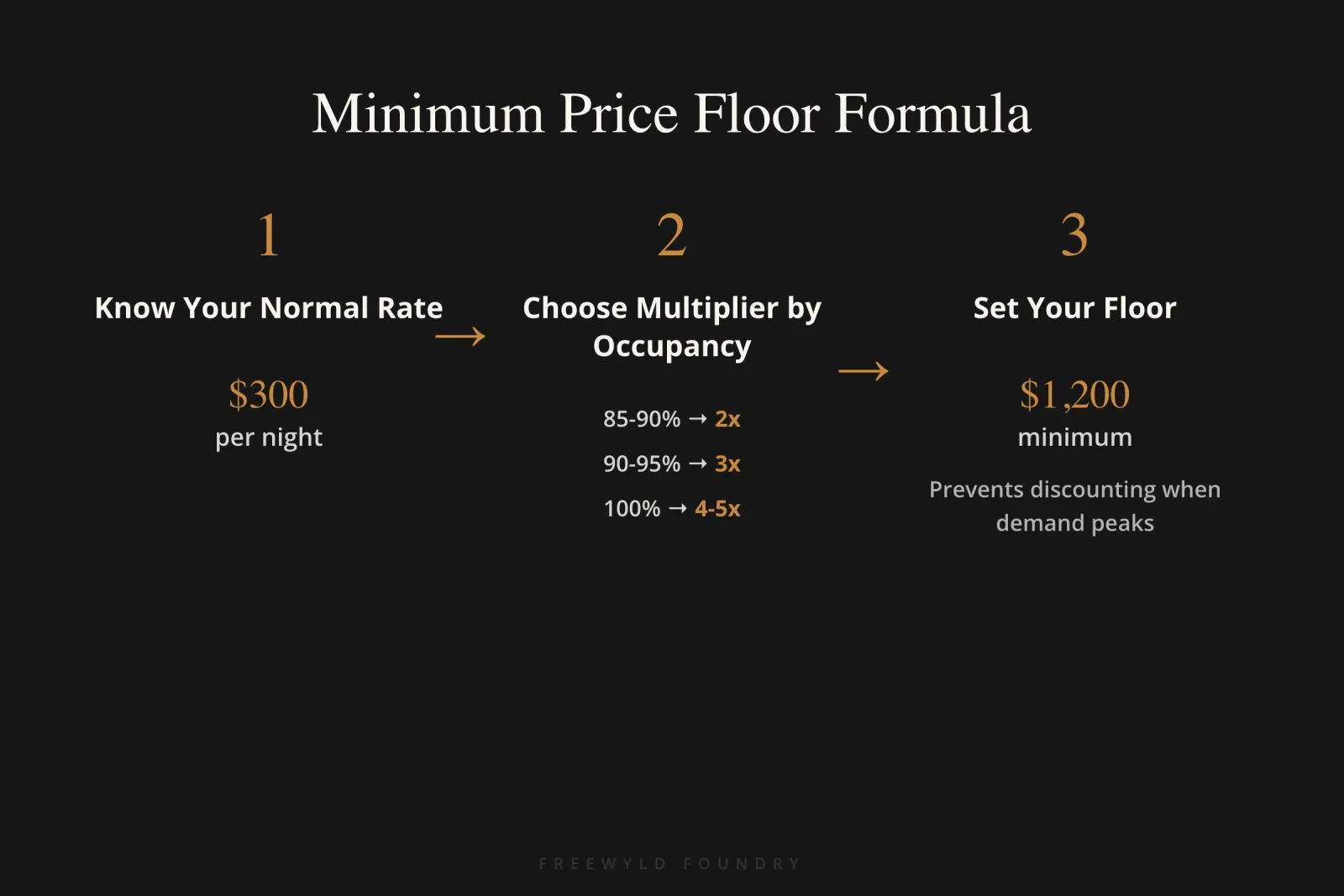 If your normal rate is $300/night and you expect the market to book out for a festival, set your minimum at $1,200-$1,500 for those dates.
According to Jasper Ribbers: “There’s always going to be people looking. There’s always going to be people that make a last minute decision that they want to go.” Those last-minute bookings in a sold-out market should pay premium rates, not discounted rates.
Use Seasonal Profiles, Not Calendar Overrides
If you’re using PriceLabs, set up these rates using seasonal profiles rather than manual calendar overrides. The PriceLabs features for seasonal profiles let you configure all your settings (minimum nights, minimum prices, base price adjustments, check-in/checkout pricing) in one place. After the event ends, you can shift the profile dates forward one year and have next year’s pricing already configured.
This saves enormous time compared to manually overriding dates on your calendar every year. More importantly, it ensures you don’t forget to update pricing for the next occurrence.
Review and Adjust Quarterly
Your initial pricing set 12 months in advance should not be “set and forget.” Review peak demand dates quarterly as you get closer to the event:
- 9 months out: Are you seeing any bookings? If yes, consider testing slightly higher rates on similar units.
- 6 months out: How is the market pacing? Are comparable units booking? Adjust your pricing to ensure you capture bookings in the middle phase of the booking window.
- 3 months out: The picture becomes much clearer. You can see occupancy levels and understand whether the market will book out or not.
- 1 month out: Final adjustments based on actual occupancy. If the market is 95%+ booked, hold firm on high rates. If it’s 70-80%, you may need to discount remaining inventory.
Building this into your revenue management routine is what separates operators who consistently capture peak demand premiums from those who react too late.
Common Mistakes to Avoid When Pricing Peak Demand Dates
Even experienced operators make critical errors when pricing peak demand dates. These revenue management mistakes can add up to thousands of dollars in lost revenue per property on your highest-value dates.
1. Opening Your Calendar More Than 12 Months in Advance
Some operators pride themselves on having 18-month or even 24-month booking windows. For peak demand dates, this creates more problems than it solves. The further out you open your calendar, the more price points you need to manage and monitor.
“I wouldn’t have my calendar open for 18 months or even longer if you’re in a market that has a lot of high value events,” advises Jasper Ribbers. “It’s just harder to manage and you just don’t really know what the world is going to look like in a year.”
Stick to a 12-month rolling calendar for peak demand dates.
2. Not Adjusting Minimum Night Stays for Peak Dates
Your normal minimum night stay settings don’t work for peak demand dates. If you typically require 2-night minimums, you might need 3-4 night minimums for major holidays or event weekends. A 4-night minimum at $1,500/night generates $6,000 versus a 2-night booking at $1,800/night generating only $3,600, despite the shorter booking commanding a higher nightly rate.
3. Competing with Underpriced Inventory Too Early
In any market, 10-20% of units are underpriced because they’re managed by unprofessional hosts using fixed pricing. These units get booked first by deal-seeking guests. If you aggressively chase occupancy pacing on peak demand dates, you end up competing with underpriced inventory rather than waiting for rational market pricing to emerge.
“You don’t necessarily have to participate in that part of the booking window, right? Because you don’t want to underprice your units,” explains Jasper Ribbers.
4. Using Portfolio-Level Strategy Without Owner Communication
If you manage properties for individual owners, applying portfolio-level pricing strategy without communication creates relationship problems. Aligning owners on your peak demand strategy before the event matters as much as the pricing strategy itself.
On a portfolio of 50 properties, holding out for premium rates might mean 48 units book at $2,000/night while 2 units remain empty. Financially, this works. But those 2 owners whose properties stayed empty will be furious.
The solution is transparent communication and guaranteed minimums. Tell owners in advance: “We’re going to hold out for premium rates on this date. If your property doesn’t book, we’ll pay you as if it booked at $X rate.” This protects your portfolio-level strategy while managing owner expectations.
How to Implement the Last Man Standing Strategy
The last man standing strategy means holding rates very high even as the event date approaches, betting that the market will book out and last-minute bookings will pay premium rates. When this works, it produces spectacular results.
When to Use This Strategy
The last man standing approach works best when you have strong evidence the market will reach 95-100% occupancy:
- Historical data showing the market has booked out for this event in past years
- Drive-to markets near major cities where guests can make last-minute decisions
- Events with passionate fan bases (college football, major music festivals)
- Small markets with limited inventory and high demand
- Markets where you’ve monitored competitor booking patterns and seen inventory disappear quickly in past years
Implementation Steps
Step 1: Set your initial prices based on historical high plus 10-15%.
Step 2: Monitor market occupancy weekly starting 6 months before the event. Track what percentage of comparable units are booked.
Step 3: When the market reaches 50% occupancy, evaluate your own portfolio’s occupancy. If you’re at 30-40% booked, you’re successfully executing the strategy. If you’re at 10-15% booked, you may be overpriced relative to the market and need to make adjustments.
Step 4: At 70-80% market occupancy, make your final strategy decision. If comparable units are booking rapidly and inventory is disappearing, hold your rates firm. If booking velocity is slowing and you still have significant availability, consider modest rate adjustments (10-15% reduction, not panic pricing).
Step 5: In the final 2 weeks before the event, if the market reaches 90%+ occupancy and you still have availability, maintain firm pricing. This is when the strategy pays off. Guests who must attend the event will book whatever is available at whatever price you’re asking.
The Risk Management Piece
Even with perfect execution, the last man standing strategy sometimes fails. When you commit to this strategy, calculate the math:
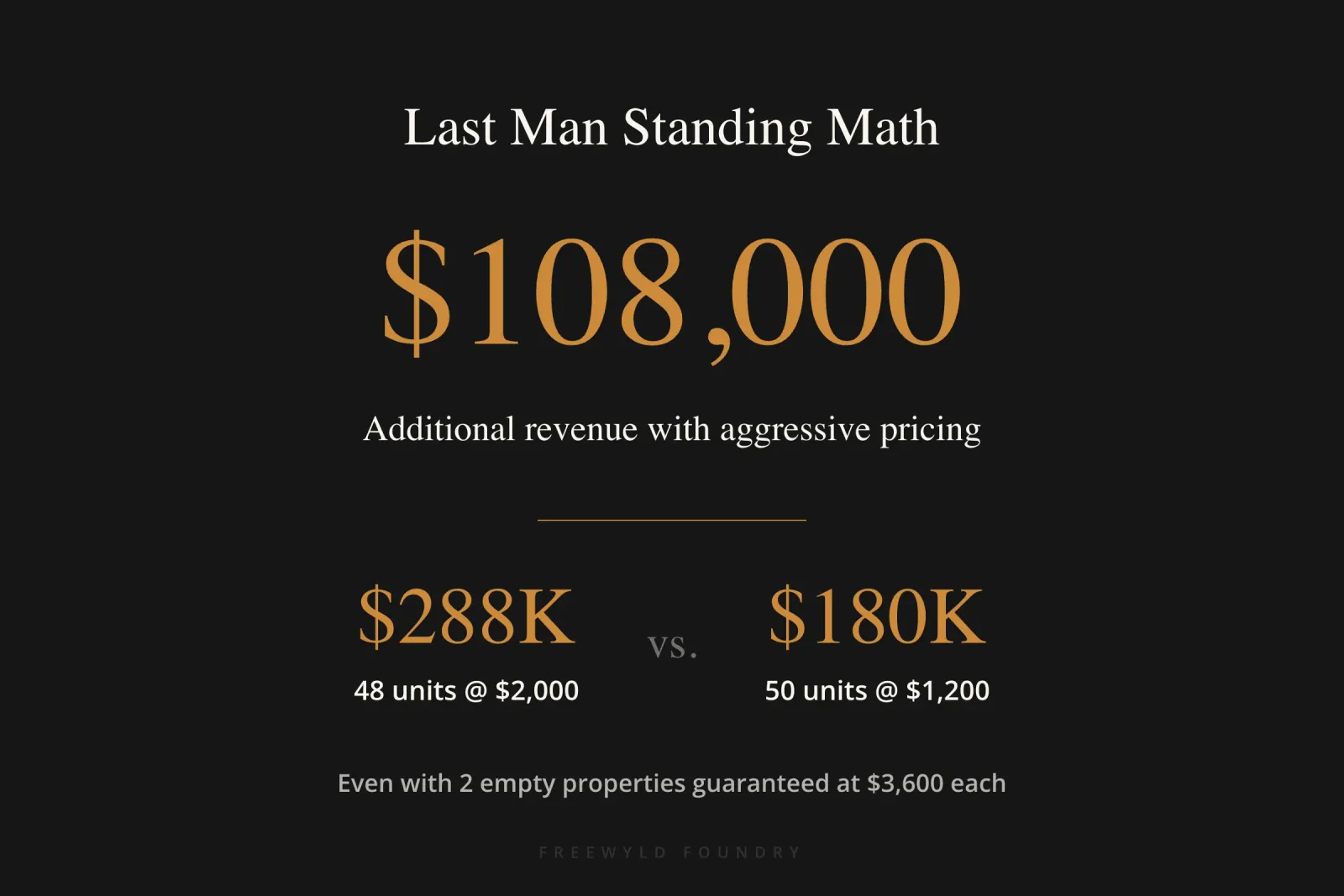
- Revenue from units that book at premium rates (48 properties x $2,000/night x 3 nights = $288,000)
- Lost revenue from units that don’t book (2 properties x $0/night x 3 nights = $0)
- What you would have earned with conservative pricing (50 properties x $1,200/night x 3 nights = $180,000)
In this example, even with 2 empty units, you earned $288,000 versus $180,000 with conservative pricing. For the 2 owners with empty units, guarantee them payment equivalent to conservative pricing ($1,200/night x 3 nights = $3,600 per property = $7,200 total). You still net $100,800 additional revenue.
“When it works, it’s fantastic,” explains Jasper Ribbers. “Not only are you making a lot of money, but also your owners are going to be impressed because you’re going to be booking a lot higher than the market.”
Real-World Example: Managing World Cup Demand
The 2026 FIFA World Cup provides a real-time case study in peak demand pricing challenges. Freewyld Foundry manages properties for 15-20 clients in World Cup cities, and the experience illustrates both the opportunities and difficulties of pricing one-off major events.
Initial Pricing (12 Months Out)
When the World Cup schedule was announced, there was immediate booking activity. Well-priced units captured that first wave of bookings at premium rates. One two-bedroom apartment booked at $1,700 per night a year in advance. These bookings came from international travelers who needed to secure accommodation before finalizing their travel plans.
The challenge was setting the right price without market precedent. Unlike recurring festivals or annual sporting events, one-off events like the World Cup have no historical data.
Mid-Cycle Adjustments (6-9 Months Out)
As time passed, market dynamics became clearer. Initial expectations of extreme demand softened. Market occupancy paced lower than anticipated. This required difficult decisions: hold firm on initial pricing and risk missing the booking window, or adjust down and potentially underprice if demand surged later. Different clients chose different strategies based on their risk tolerance.
The Lesson
One-off events are inherently unpredictable. Even with extensive data and experience, pricing these events involves more guesswork than recurring annual events. The operators who succeeded started with aggressive pricing to capture price-insensitive early bookers, then adjusted based on market signals rather than holding firm on initial assumptions.
Frequently Asked Questions
How far in advance should I set pricing for peak demand dates?
Set pricing 12 months in advance for peak demand dates with recurring events. When a holiday or annual festival ends, immediately update pricing for the same date next year. This ensures your calendar is ready when eager early bookers arrive. For one-off events, set pricing as soon as dates are announced, but be prepared to adjust as market intelligence develops.
What if my pricing tool already handles peak dates automatically?
Pricing tools use algorithms that struggle with the extreme price ranges and unique booking patterns of peak demand dates. According to analysis of 70+ client portfolios, 90% had underpriced peak bookings when onboarded despite using pricing tools. Always manually review and adjust pricing tool recommendations for your highest-value dates, particularly focusing on minimum price settings that prevent last-minute discounting.
Should I pace ahead or behind the market on peak demand dates?
Pace behind the market on peak dates, the opposite of normal revenue management strategy. In any market, 10-20% of units are underpriced by unprofessional hosts. Let those units get booked first by deal-seekers. As underpriced inventory disappears, well-priced units start booking at rates reflecting true demand. You might see 30% market occupancy while your portfolio sits at 15%, and that’s exactly where you want to be for peak dates.
How do I know if the market will book out?
Review historical occupancy data for past years of the same event. Markets that reached 95%+ occupancy in the past typically book out again unless significant new supply enters the market or demand drivers change. Drive-to destinations with limited inventory almost always book out for major events. Track competitor booking velocity 6-8 weeks before the event to confirm your expectations.
What’s the biggest mistake operators make with peak demand pricing?
Forgetting to update pricing 12 months in advance is the costliest error. Operators focus on dates 2-3 months out, but peak demand dates have booking windows of 6-12 months. By the time you’re looking at peak dates a few months away, eager early bookers have already filled underpriced inventory. The second biggest mistake is not setting minimum price floors to prevent last-minute discount algorithms from cratering rates when the market is sold out.
Want expert help maximizing revenue on your peak demand dates?
Freewyld Foundry’s revenue management team specializes in pricing strategy for high-performing STR operators. Get a free revenue report showing exactly where your pricing strategy is leaving money on the table: freewyldfoundry.com/get-started
Listen to the Full Conversation
This article was informed by Episode 718 of the Get Paid for Your Pad podcast. Listen here.
Related Articles
- Why STR Hosts Drop Prices Last Minute: Market Pacing Guide - How pacing strategy works on normal dates vs. peak demand dates
- The Last Minute Pricing Trap - Why 80% occupancy doesn’t mean you’re winning on your most valuable dates
- PriceLabs Features Guide: 7 Tools You’re Not Using - How to set up seasonal profiles for recurring event pricing
- Hidden Holidays: How to Maximize Revenue on Long Weekends - The same principles applied to long holiday weekends