You manage 15 vacation rental properties. You have business insurance. You feel protected. But right now, sitting in your desk drawer, is a policy that provides zero coverage for the exact scenarios you think you’re protected against.
STR business insurance protects property managers and co-hosts from liability claims arising from their management operations, including property damage, bodily injury, and professional errors. Unlike homeowner’s insurance, which covers physical property, business insurance covers your management company’s liability exposure when operating properties owned by others.
This is the reality facing thousands of short-term rental managers and co-hosts across the United States. According to Darren Pettyjohn, founder of Wister Insurance and former founder of Proper Insurance (sold to Hub International after growing to 160 employees and 150,000+ policies), most property managers have massive coverage gaps they don’t know exist.
The problem is simple but severe. Standard business insurance policies contain exclusions that remove property damage liability at the properties you manage. When your cleaner pops an ice maker line causing $100,000 in water damage, when your handyman’s electrical work leads to a fire, when a guest drowns in a pool and files a wrongful death lawsuit, your policy won’t respond. You’re personally exposed.
This guide breaks down everything property managers and co-hosts need to know about STR business insurance, the specific coverage gaps killing businesses, and how to protect yourself before catastrophe strikes.
What Is Business Insurance for Short-Term Rental Managers?
Business insurance for STR managers is different from homeowner’s insurance. When you manage properties owned by other people, you need coverage for your management business, not just the physical property.
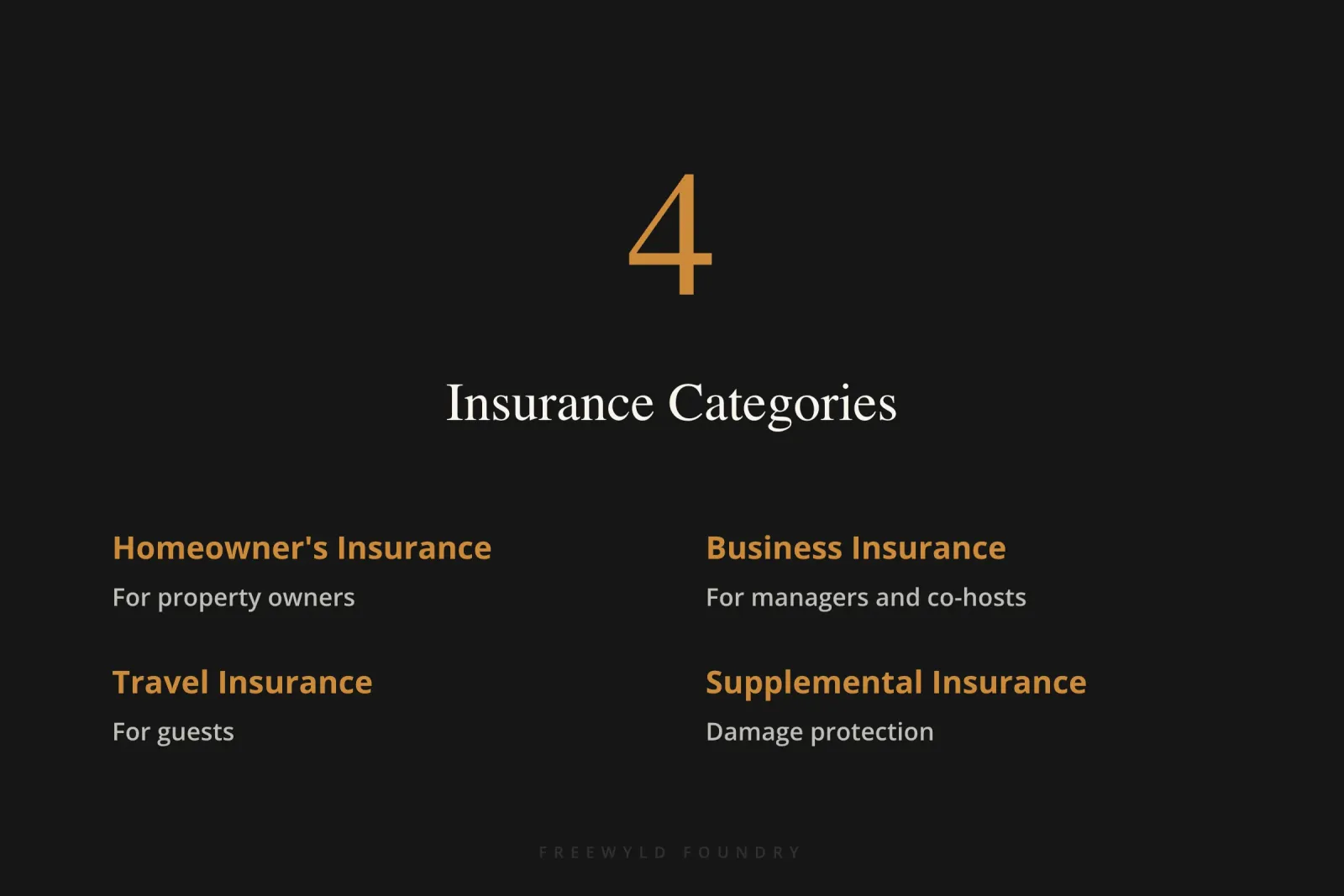
According to Darren Pettyjohn, founder of Wister Insurance, there are four categories of insurance in the vacation rental industry:
- Homeowner’s insurance for the property owner (companies like Proper Insurance, State Farm, Allstate)
- Business insurance for the vacation rental management company or co-host (what Wister provides)
- Travel insurance for guests
- Supplemental insurance including nightly damage protection and Airbnb Air Cover
Most managers focus on category one and assume they’re covered. They’re not.
“Right now, you’re a manager. Oh, I got insurance. I feel good. It’s in my desk drawer. And you have no idea that you have no coverage for property damage liability at any of the properties you manage,” says Pettyjohn.
Business insurance for STR managers requires two core coverage types:
Commercial General Liability (CGL) protects against bodily injury or property damage your business could be liable for. This covers slip and falls, injuries at properties, and property damage caused by your operations.
Errors and Omissions (E&O), also called professional liability, protects against financial losses resulting from your professional services. This covers mistakes in hiring vendors, oversight failures, and professional judgment errors.
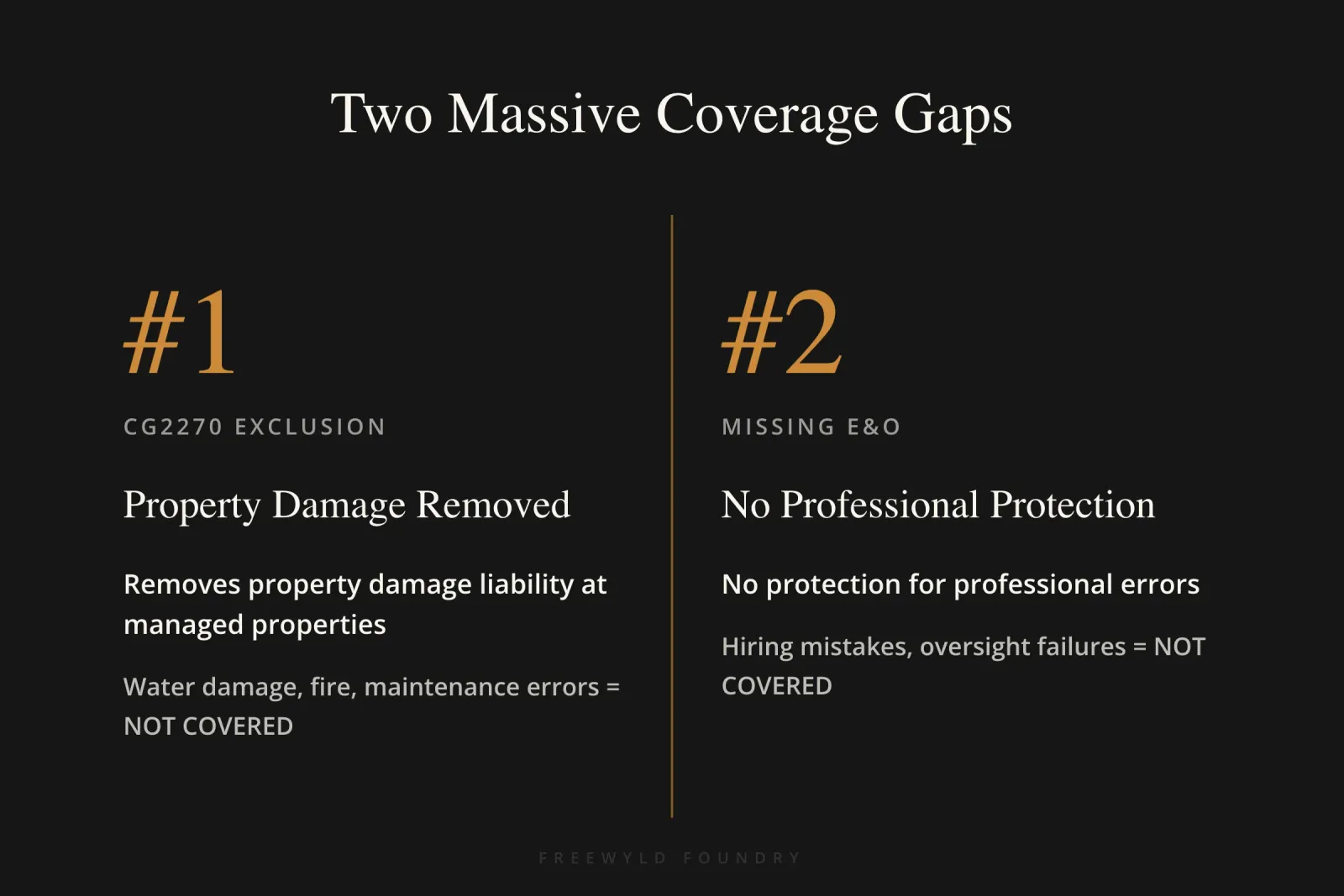
Most managers have CGL. Almost nobody has E&O. And the CGL most managers carry contains exclusions that make it worthless for their actual business operations.
How Much Does STR Business Insurance Cost?
Wister Insurance charges $125 to $300 annually per property for co-hosts and small managers. This covers both CGL and E&O with no exclusions for managed properties.

For larger operations, pricing varies based on:
- Number of properties managed
- Total annual bookings
- Number of W-2 employees
- Whether you need workers compensation
- Commercial auto coverage needs
- Employment practices liability
- Excess umbrella coverage
The cost is minimal compared to the exposure. A single wrongful death lawsuit can reach seven figures. A $100,000 water damage claim can bankrupt a small operation.
“When you onboard a new owner, you bake in a couple hundred bucks for insurance and you move on with life,” says Pettyjohn. “This is not something that’s going to set you back.”
What Are the Biggest Coverage Gaps in Standard Business Insurance Policies?
Standard business insurance policies sold to property managers contain exclusions that create massive liability exposure. The two biggest are CG2270 and lack of E&O coverage.
The CG2270 Exclusion: No Property Damage Coverage
CG2270 is an endorsement that removes property damage liability coverage at the properties you manage. This exclusion appears in virtually every competitor’s policy.
Here’s how it plays out in real life:
You send your cleaner to do a deep clean of a managed property. Part of the process involves pulling the refrigerator out to clean behind it. The cleaner doesn’t notice they popped the ice maker line. Water leaks for four days. You return to discover $100,000 in water damage.
What happens next? Two scenarios:
Scenario 1: The property owner files a claim with their homeowner’s insurance (Proper, State Farm, whoever). The insurance company pays for the damage, then subrogates the claim back against you. They determine the damage resulted from your business operation. You’re liable. Your business insurance should cover it. But it doesn’t because of CG2270.
Scenario 2: The owner doesn’t want to file with their homeowner’s insurance because their rates will increase. They demand you pay the $100,000 directly. When you refuse, they sue you. Your business insurance should defend you. But it doesn’t because of CG2270.
“You have no idea that you have no coverage for property damage liability at any of the properties you manage. That’s insane,” says Pettyjohn.
According to Pettyjohn, who has seen thousands of claims through Proper Insurance, property damage claims happen more frequently than bodily injury claims. Water damage from ice makers, washing machines, and plumbing issues. Fire damage from electrical work. Structural damage from maintenance errors. All excluded under CG2270.
Missing E&O Coverage for Professional Errors
The second massive gap is E&O coverage. Most small managers and co-hosts operate as “air traffic controllers.” They don’t have in-house cleaning staff or W-2 maintenance employees. They subcontract everything.
This creates enormous professional liability exposure.
When you hire a handyman who does faulty electrical work that causes a fire, you made a professional error in hiring or oversight. When your cleaning vendor misses a critical maintenance issue, you made a professional error in vendor management. When you fail to properly maintain a pool and someone gets sick, you made a professional error in property oversight.
None of these scenarios are covered by CGL. They require E&O coverage. And virtually no co-host or small manager carries E&O.
“What happens when one of your subcontractors does something stupid? That’s an error. You’re providing professional services as a manager. That’s all you’re doing,” says Pettyjohn.
The problem compounds because managers operating within the Airbnb ecosystem believe Air Cover protects them. It doesn’t.
Does Airbnb Air Cover Provide Business Insurance for Property Managers?
No. Airbnb Air Cover is not business insurance for property managers and co-hosts.
As of March 2025, Airbnb updated their host liability insurance policy with critical language. Co-hosts or hosts with six or more properties “may be required at the time of loss” to file claims with their own insurance provider, not Air Cover.
This policy change reveals Airbnb’s position. Air Cover was never designed to be business insurance for professional managers. It’s supplemental coverage for individual hosts.
Air Cover provides no E&O coverage at all. It only covers CGL, and even that CGL may not respond for managers with six or more properties.
“They just use the word may,” says Pettyjohn. “I can’t tell you right now if you have 10 on there and someone drowns in a swimming pool tomorrow and you get hit with a wrongful death suit, that Airbnb won’t respond. I don’t know. They may respond.”
The reality is managers and co-hosts cannot rely on Air Cover. Any operation managing six or more properties needs dedicated business insurance with both CGL and E&O coverage.
What Types of Lawsuits Do STR Managers Face?
STR managers face two primary lawsuit categories: bodily injury and property damage.
Bodily Injury Lawsuits
According to Pettyjohn, who settled multiple million-dollar claims at Proper Insurance, bodily injury lawsuits include:
- Wrongful death from drowning
- Slip and fall injuries
- Swing or rope equipment failures
- Hot tub rash (similar to Legionnaire’s disease)
- Falls from decks or railings
- Injuries from inadequate lighting
The wrongful death lawsuits reach seven figures. Multiple drowning cases in Florida settled for over $1 million each.
“We have settled multiple wrongful death, million-dollar drowning lawsuits in Florida. We’ve written those checks,” says Pettyjohn.
The statute of limitations varies by state. California allows three years. Florida allows four years. This means a guest who breaks their nose at your property today can file a lawsuit three years from now. Stories change. Memories fade. Small incidents become major lawsuits.
Property Damage Lawsuits
Property damage claims happen more frequently than bodily injury but receive less attention because they typically involve lower dollar amounts (though $100,000+ water damage claims are common).
Property damage lawsuits include:
- Water damage from plumbing, ice makers, washing machines
- Fire damage from electrical work or maintenance errors
- Structural damage from improper repairs
- Mold damage from undetected leaks
- Equipment damage from vendor negligence
The challenge is managers assume these are homeowner’s insurance claims. They are, until the homeowner’s insurance company subrogates against the manager for causing the damage through business operations.
How Do I Know If My Current Insurance Policy Has Coverage Gaps?
Pull your current business insurance policy from your desk drawer. Look for these red flags:
Check for CG2270 endorsement. This exclusion removes property damage liability at managed properties. If you see CG2270 or similar language excluding “property damage to property you own, rent, or occupy,” you have a massive gap.
Check for E&O coverage. Look for “professional liability” or “errors and omissions” in your policy. If it’s not explicitly listed, you don’t have it. CGL alone is not enough.
Check coverage limits. $1 million in coverage sounds like a lot until you face a wrongful death lawsuit. Many policies carry $1 million per occurrence with $2 million aggregate. Consider whether this is adequate for your operation size.
Check for employment practices liability. If you have W-2 employees, you need protection against wrongful termination lawsuits. This is separate from CGL and E&O.
Check for commercial auto coverage. If any vehicles are titled in your company name (cleaning vans, maintenance trucks), you need commercial auto insurance. Personal auto policies won’t cover business use.
“Insurance is a product you don’t use. You go to Google, you get online, you fill out something, you get a policy, you throw it in your desk drawer, and you don’t use it once every nine years. But when that day comes, you pull it out, you dust it off and go, God, I hope I have the right insurance,” says Pettyjohn.
Don’t wait until you need it to discover the gaps.
What Should I Do Immediately After an Incident at My Property?
Contact your insurance company immediately. Do not wait. Do not try to handle it yourself.
This advice contradicts common belief. Most people avoid calling insurance because they fear rate increases. But liability claims have no deductible for a reason. Insurance companies want to know immediately so they can gather evidence while memories are fresh.
“There’s a reason there’s no deductible on a liability insurance claim,” says Pettyjohn. “We want you to contact us immediately so we can get a written statement. So we can reach out to people and find out what’s going on.”
Step-by-Step Incident Response Process
Step 1: Secure the scene and ensure everyone’s safety. Call 911 if needed.
Step 2: Create an incident report immediately. Document who, what, where, when, why. Get the guest’s statement in writing if possible. Take photos. Gather contact information.
Step 3: Call your insurance company the same day. This is an incident report, not a formal claim. No demand has been filed against you yet. You’re simply documenting what happened.
Step 4: Preserve all evidence. Don’t repair or alter anything until the insurance company investigates.
Step 5: Follow your insurance company’s instructions for vendor contact, repairs, and guest communication.
The key insight is early contact enables early settlement. Insurance companies may settle a broken nose incident for $10,000 immediately rather than face a $500,000 lawsuit three years later when the guest’s acting career failed because of facial disfigurement.
“I’d much rather settle for $10,000,” says Pettyjohn. “We may want to get him 10 grand and go, hey buddy, can you sign this? Because I don’t want you coming back in two years when you’re no longer an actor and you can’t get any movie deals because your nose is crooked.”
How Can I Prevent Liability Claims at My Properties?
Apply the “reasonable person test” to every property decision. If you think “I should probably…” just do it immediately.
“What would a reasonable person do? If you’re leaning against a railing on a deck and you’re like, damn, this thing’s getting a little wobbly, it should be shored up. You need to do it immediately,” says Pettyjohn.
Critical Safety Checklist
Install adequate lighting. Walk your property at midnight. If you can’t see clearly, your guests can’t either. Install lights anywhere it’s “pitch black.” Falls in darkness create easy liability wins for plaintiffs.
Shore up railings immediately. Test every railing at every property. Any wobble requires immediate repair. Deck collapses and railing failures result in catastrophic injuries.
Document hot tub maintenance. Clean and test hot tubs monthly at minimum. Document every cleaning. Hot tub rash lawsuits are common and winnable if you can’t prove proper maintenance.
Address tripping hazards. Uneven pavement, loose carpeting, clutter in walkways. Fix them immediately. Document the repairs.
Maintain pool safety equipment. Pool safety requires life rings, rescue hooks, clear depth markings, and functioning pool covers. Missing equipment creates liability when drownings occur.
Inspect vendor work. When handymen or contractors complete work, inspect it before they leave. Faulty electrical work, plumbing leaks, and structural issues become your liability if you fail to catch them.
Create maintenance schedules. Don’t rely on reactive maintenance. Schedule quarterly property inspections and document findings.
The documentation matters as much as the repairs. Under hospitality law, you have a legal duty to provide safe premises. When something goes wrong, the question becomes “what would a reasonable person do?” Documentation proves you acted reasonably.
How Much Business Insurance Do STR Managers Need?
The amount of STR business insurance depends on your operation size, but here’s the baseline for different manager types:
| Operation Type | Properties | Minimum Coverage Needed |
|---|---|---|
| Co-host | 1-5 | CGL + E&O ($1M/$2M limits) |
| Small Manager | 6-25 | CGL + E&O + consider umbrella |
| Medium Manager | 26-100 | CGL + E&O + Workers Comp + Umbrella |
| Large Manager | 100+ | Full suite including Employment Practices |
CGL and E&O are non-negotiable for anyone managing properties owned by others. This is your foundation.
Workers compensation becomes required when you hire W-2 employees. Most states mandate workers comp coverage. Penalties for non-compliance are severe.
Commercial auto insurance is required when vehicles are titled in your company name. This includes cleaning vans, maintenance trucks, or company cars.
Employment practices liability protects against wrongful termination lawsuits. If you have employees, you face exposure when firing someone. They may claim discrimination based on gender, age, race, or other protected classes.
Excess umbrella coverage sits on top of everything else. This provides additional limits after your primary policies exhaust. A $2 million umbrella policy is common for mid-size operations.
The threshold where most managers have some insurance in place is 20-25 properties. Below that, many operate with inadequate coverage or none at all.
Frequently Asked Questions About STR Business Insurance
Do I need business insurance if I only manage 3 properties as a co-host?
Yes, you need STR business insurance even managing just 3 properties. The moment you manage properties owned by someone else, you need business insurance with both CGL and E&O coverage. The number of properties doesn’t change the liability exposure. A wrongful death lawsuit at one property costs the same as a wrongful death lawsuit at 100 properties. Wister Insurance covers co-hosts starting with a single managed property for $125-300 annually per property.
What happens if I don’t have E&O coverage and make a professional error?
You’re personally liable for the financial damages without E&O coverage. If you hire a handyman who causes a fire, the property owner (or their insurance company) will sue you for the damages. Without E&O coverage, you pay out of pocket. This can reach six or seven figures for major incidents. Most managers don’t have E&O because they don’t understand they provide “professional services” subject to professional liability.
Will calling my insurance company about an incident raise my rates?
Not for incident reports with STR business insurance. Liability insurance has no deductible specifically so you’ll report incidents immediately. An incident report is not the same as a filed claim. No demand has been made against you yet. Your insurance company wants to investigate, gather evidence, and potentially settle early before it becomes a lawsuit. Small early settlements prevent large late lawsuits.
Does my business insurance cover my personal properties that I also rent out?
No, STR business insurance for your management company is separate from homeowner’s insurance for properties you own. If you own and manage properties, you need both homeowner’s insurance for the properties (Proper Insurance or similar) AND business insurance for your management operations (Wister Insurance). These are different exposures requiring different coverage.
How long do I have before someone can sue me for an incident at my property?
The statute of limitations for bodily injury varies by state but typically runs 2-4 years. California allows 3 years. Florida allows 4 years. This means a guest can file a lawsuit years after the incident occurred. This is why immediate incident reports and documentation matter with your STR business insurance. Memories fade, stories change, and evidence disappears. Getting written statements immediately protects you if a lawsuit arrives three years later.
What’s the difference between CGL and E&O coverage in STR business insurance?
Commercial General Liability (CGL) covers bodily injury and property damage from your operations, like a guest slipping on your property. Errors and Omissions (E&O) covers financial losses from your professional services, like hiring a vendor who causes damage. Most managers have CGL but lack E&O, creating massive gaps when vendor mistakes or oversight failures cause claims.
Can I rely on Airbnb Air Cover instead of getting dedicated STR business insurance?
No, you cannot rely on Airbnb Air Cover as your primary STR business insurance. As of March 2025, Airbnb’s policy states co-hosts or hosts with six or more properties “may be required” to file claims with their own insurance at the time of loss. Air Cover provides no E&O coverage and may not respond for professional property managers. Dedicated business insurance is essential.
How does the CG2270 exclusion affect my property damage coverage?
The CG2270 exclusion removes property damage liability coverage at properties you manage, leaving you personally exposed. When your cleaner causes water damage or your contractor’s work leads to a fire, your insurance won’t respond because of CG2270. Most standard policies contain this exclusion, creating massive coverage gaps for property managers.
Conclusion
Business insurance for STR managers is not homeowner’s insurance. It’s not Airbnb Air Cover. It’s dedicated coverage for your management business with both CGL and E&O protection.
Most managers carry policies with exclusions like CG2270 that eliminate coverage for the exact scenarios they face daily. Water damage from maintenance errors. Fires from vendor negligence. Wrongful death from safety failures. All excluded under standard policies.
The cost to fix this is minimal. $125-300 per property annually for small operations. The cost of not fixing it is catastrophic. Million-dollar wrongful death lawsuits. Six-figure property damage claims. Personal bankruptcy when your policy won’t respond.
Pull your policy from your desk drawer today. Look for CG2270. Check for E&O coverage. If you see gaps, fix them before something happens. It’s not a matter of if. It’s a matter of when.
Want expert help reviewing your current insurance coverage? Wister Insurance provides free consultations for property managers and co-hosts. Even if you don’t switch policies, you’ll understand exactly what gaps exist in your current coverage. Visit Wister Insurance to schedule a consultation or get a quote.
Related Resources:
- Episode 713: Full Interview with Darren Pettyjohn
- How to Build Systems That Scale Your STR Business
- STR Revenue Management Guide for Property Managers
- How to Maintain 4.9 Star Airbnb Reviews Across Large Portfolios
Listen to the full conversation: Get Paid for Your Pad Podcast Episode 713
About Darren Pettyjohn: Darren Pettyjohn is the founder of Wister Insurance, the only insurance company focused exclusively on business insurance for vacation rental managers and co-hosts. He previously founded Proper Insurance, which grew to 160 employees and 150,000+ policies before being acquired by Hub International (the world’s largest private insurance group). Connect with Darren at LinkedIn or visit Wister Insurance.