Scale Your STR Business Right: The 7 Strata Method
Want to outperform the market? Freewyld Foundry’s Revenue & Pricing Management service is driving an 18% performance lift for $1M+ STR operators, even in down markets. If you’re managing 10+ listings and want a free pricing audit, apply here.
In this episode of Get Paid For Your Pad, Eric Moeller (CEO of Freewyld and Freewyld Foundry) shares the strategic planning framework that transformed his business and helped define Freewyld Foundry’s ambitious $1.2 billion revenue-under-management goal. If you’re an STR operator running 20, 50, or 400 listings but struggling to make real profit, operating without clear direction, or chasing every opportunity that comes your way, this episode will change how you think about building your business.
Eric breaks down the 7 Strata framework from Verne Harnish’s book “Scaling Up,” a system that forces operators to think long-term first, then work backwards. This is the exact process Eric and his team used to get crystal clear on who Freewyld Foundry serves, why they exist, and how they plan to dominate their market. Whether you’re a solo operator with two listings or running a multi-million dollar portfolio, this framework will help you stop driving blind and start building with intention.
If you’ve ever felt like you’re working harder but not getting ahead, saying yes to properties that don’t fit your model, or watching competitors with fewer listings make more profit, this episode reveals why strategy always beats hustle and how answering seven critical questions can unlock the path to sustainable growth.
You will hear:
- Why most STR operators are driving blind and how that leads to burnout
- The story of an operator doing $20M in revenue with 400 listings but making zero profit
- Why having properties in multiple markets and serving everyone means serving no one
- How the 7 Strata framework changed Freewyld’s business in one year
- What Elon Musk’s approach to thinking through major problems teaches STR operators
- Why shiny object syndrome kills growth and how 7 Strata keeps teams focused
- How Freewyld used 7 Strata to make the hard decision at VRMA 2025
- Why saying no to 99% of a conference room led to better business alignment
We also talk about:
- The seven strategic questions: core values, brand promise, ideal client, ten-year BHAG, key differences, profit per X, and this year’s actions
- Why Airbnb reviews below 4.8 reveal a lack of core values
- How to create a brand promise that separates you from every competitor
- Why one operator charges zero commission if he gets less than five stars
- What a Michelin-starred restaurant teaches about team alignment and excellence
- How to define your ideal guest avatar and stop trying to serve everyone
- Why most property managers partner with any homeowner instead of interviewing for fit
- How Freewyld Foundry’s ideal client is defined: $1M+ revenue, 4.7+ reviews, top 1% operators
- What a BHAG (Big Hairy Audacious Goal) is and why Elon Musk’s Mars vision is the perfect example
- How Freewyld’s $1.2 billion in ten years goal guides every decision the team makes
- Why “every listing, every day” is Freewyld Foundry’s key differentiator in revenue management
- How becoming PriceLabs experts separates Freewyld from set it and forget it revenue managers
- Why operators serving operators creates trust that consultants can’t replicate
- How profit per listing reveals which properties are actually worth keeping
- Why revenue doesn’t matter if you’re not making profit
- How Freewyld measures success through profit per revenue manager
- Why most operators would make more money with fewer listings
- The difference between planning and execution (and why execution is everything)
- How to narrow your focus down to five main actions for the year
- Why Freewyld stopped chasing new properties and focused on hiring the best revenue managers
- How to use ChatGPT to implement 7 Strata in your own business
🎯 Mentioned in the Episode:
- “Scaling Up” by Verne Harnish
- 7 Strata framework
- “Traction” by Gino Wickman
- Elon Musk’s BHAG: colonizing Mars
- Tesla, SpaceX, The Boring Company
- VRMA conference and booth strategy
- Freewyld core values: unreasonable hospitality, always be growing, extreme ownership
- Freewyld Foundry brand promise: grow your revenue or you don’t pay us
- PriceLabs revenue management tool
- Freewyld Cabins guest avatar
- Michelin star restaurant experience
- ChatGPT for business planning
- Freewyld Foundry Revenue & Pricing Management
🔥 Favorite Takeaway: “You’re driving down the highway in a really fast car, blindfolded, and that is not going to work out. You might have some fun, but we want you to get to your destination and be excited about that and excited about the journey that you’re on.”
📍 Want us to audit your pricing strategy? Get your free personalized revenue report at FreewyldFoundry.com/report
The STR Operator's Scaling Checklist
A tactical checklist for scaling your short-term rental business from 15 to 100+ listings. Covers team, systems, revenue management, guest experience, owner relations, and financial controls.
Download Free GuideContinue Listening
The One-Goal Method: How to Win 2026 by Doing Less
In this episode of Get Paid For Your Pad, Eric Moeller, CEO of Freewyld and Freewyld Foundry, takes the mic for his first solo podcast to dive deep into a practice he has been fine-tuning for over a decade: the art of goal setting and, most importantly, goal achievement. If you are an STR operator or entrepreneur who feels overwhelmed by a long list of New Year’s resolutions, or if you find yourself quitting your goals by mid-January, this episode is a must-listen. Eric breaks down why 80% of people quit their resolutions by January 10th and shares his 'Single Focus' strategy. This framework is designed to help you win your year by doing less, better. He explains how to transition from setting 'massive goals' that drain your energy to selecting the high-leverage targets that create true momentum in both business and life. Get your free, personalized revenue report at freewyldfoundry.com/report .
From Busy to Strategic: The Real Job of an STR CEO
In this episode of Get Paid For Your Pad, Kaye Putnam (Head of Marketing at Freewyld and Freewyld Foundry) sits down with Eric Moeller, CEO of Freewyld and Freewyld Foundry, to unpack one of the most overlooked challenges in scaling a short-term rental business: where the CEO should actually spend their time as the company grows. According to Harvard Business Review, CEOs waste 30 to 50 percent of their time on low-value activities. Eric explains why this problem becomes more severe as STR businesses scale, how decision fatigue quietly pushes leaders toward reactive work, and why being busy is often a signal that focus is broken. This conversation breaks down the mindset shift required to move from task-driven action to strategic momentum. If you’re an STR operator who feels pulled into emails, customer service, small fires, or constant decisions that don’t seem to move the business forward, this episode will help you rethink priorities, recognize patterns inside your operation, and identify the highest-leverage problems only a CEO can solve.
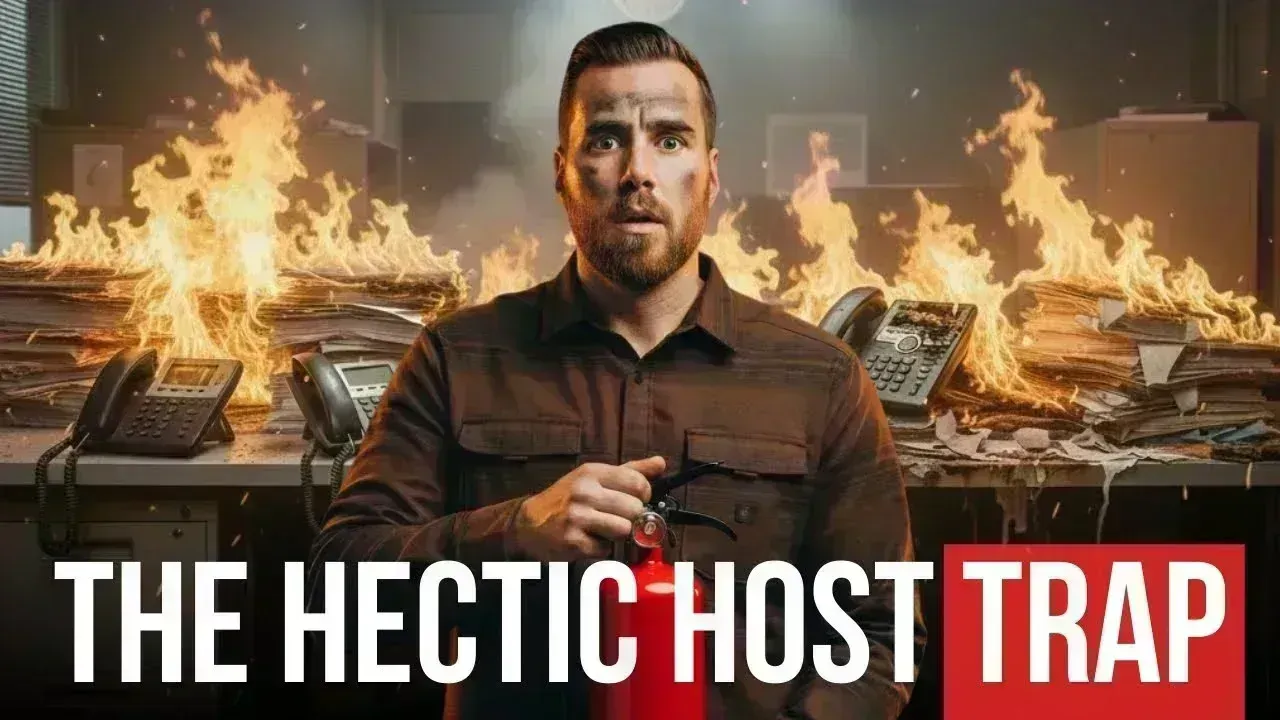
Hectic Host: The CEO Playbook for Ending STR Overwhelm
In this episode of Get Paid For Your Pad, Kaye Putnam (Head of Marketing at Freewyld and Freewyld Foundry) sits down with Eric Moeller to break down one of the most common and costly phases STR operators get stuck in: the hectic host stage. This is the mode where everything feels urgent, every day is firefighting, and growth never seems to unlock the freedom operators expect. If you’re an STR operator who feels overwhelmed by constant operational tasks, unclear priorities, stalled growth, or systems that never seem to catch up with your business, this episode is essential. Kaye and Eric share the behind-the-scenes of a recent Freewyld offsite, the operational shifts they implemented, and the mental models that finally stop operators from trying to “catch squirrels” instead of closing the hole in the roof.
Eric Moeller
I talk to a lot of short-term rental operators of all different sizes, from 20 listings to 400 listings, and I start to see some patterns. They come to us to help them with their revenue, to grow their revenue. But when I look under the hood of their business, I realize that most operators (and really this is most short-term rental or most businesses out there in the world) is that they're kind of driving blind.
They know that they're in the short-term rental industry. They know that they turn over properties and they have customer service, and they have bookings and bookkeeping, and they make a ton of money and all these other things. But when you ask them who they are as a company, why do they exist, who are their competitors, who's their freaking guest avatar, who's their ideal client... when you ask these identifying questions, most operators can't really answer that question. And I'm starting to recognize it over and over.
It's not just the beginners. It's also the individuals. I just got off the phone with an operator who reached out to us for revenue management services. He's running over 400 listings and he's been doing it for about five years. He's growing super, super fast. He's clearly a very talented and smart entrepreneur. He understands business to a certain degree of marketing and sales. But then I started recognizing, I'm like, hey man, why aren't you making money? You're dominating your marketplace numbers-wise. What is going on here?
And I start looking at his listings. Most of his listings are hovering about a four-star, 3.8 to a four-star. And I'm like, okay, something is radically breaking down here. And he has cleaning in-house and maintenance in-house, and he's got a ton of employees and they're doing like $20 million in revenue. And I'm like, what is going on?
You start just scraping away at his listings. And I'm asking these certain questions of, okay, well, who's your ideal guest avatar? Who are you actually serving? "Well, I don't know, the traveler." What do you mean? Well, what listings, what's your ideal listing that you're going after? What kind of properties do you specialize in? "Oh, we'll host anything."
Okay, well, what markets do you specialize in? What markets do you dominate? "Well, we'll host anywhere we get it. We have properties from Italy to Spain and everywhere in between."
I'm like, okay, we need to start from basics. No matter what we do on the revenue side, we're never going to be able to maximize true performance in a portfolio that's just all over the place and not executing.
The System That Changed Everything
So this inspired me to share with you guys a document, a process that I've implemented into my business that has completely changed the game. And it's something I want to inspire everyone who's listening to this to take the time. If you're just getting started and you're a solopreneur, if you're a seasoned entrepreneur and you've been in the short-term rental space for ten-plus years, take the time with your team and implement this in your business.
This one exercise completely changed our business last year. And it's funny because I've done it before, but I wasn't very specific and clear with the outcome. And once we started implementing this into Freewyld and we got super clear on this, it helped us change our business and we had an incredible amount of growth last year. And if everything goes to plan and we're blessed enough to experience this this year, 2026, we're going to see an incredible amount of growth in the Freewyld business.
So I want to share with you guys this book called "Scaling Up" by Verne Harnish. I was introduced to this book over ten years ago, and I've read it a lot. I've highlighted sections everywhere. I've implemented a lot of this stuff, and it's changed quite a bit in my business. But this one exercise changed everything for us at Freewyld.
If you have a short-term rental company at scale, I highly recommend buying this book. Me and my team are going through this now, and we're implementing many different systems and processes into our business right now, and we plan on scaling quite a bit. And this book is going to help us.
If you guys are a solopreneur or you're a host that has 1 or 2 listings, this book might be way too complex for the type of business that you have. Another book I would recommend is "Traction." That's good for startups and companies that are trying to achieve their first million in revenue.
But regardless, I want everybody to implement this one system into their business because it changed everything for us. And it's going to help you resolve those questions or those challenges.
Why Most Operators Struggle
So I just shared about this operator who's running 400 listings, doing about $20 million in revenue. He's got a ton of team members, all this stuff, but he's struggling to make real money. I mean, he's making revenue, but at the end of the day, spending all that money and investing it back into his business, and he's just losing a ton of money.
And you might be listening to this and be like, dude, I'm a short-term rental operator. What are you talking about? I run Airbnbs, we turn over properties, and you know, our client is anyone who books our property. And most operators think that way.
That is the fastest way to failure in business. And it may take a year, could take five years or ten years, but eventually that's going to burn out. We as entrepreneurs, we have to get super clear on who we are as a company and develop a company, a brand, a product, a culture that is unique, that's different from competition.
Introducing the 7 Strata Framework
So this is what I found to be one of the most powerful things in my business. This system is called 7 Strata. It is something that we spent about two days... myself and Jasper and our team rented a house and got everybody together. We broke out the whiteboards and we just spent hours, hours, hours, hours just drilling down one after another these questions and trying to get as clear as possible to just understand who we are and how are we going to succeed in what we're doing.
So 7 Strata. These are the seven main questions that are in 7 Strata. I highly recommend that you guys take a day or two in a place where you're not doing business. You don't have distractions, you shut off your phones, and you're either by yourself if you're a solo entrepreneur or you're with your key team members that can help you make decisions.
The 7 Questions
All right. So number one is core values and purpose. Number two is what you want to be known for (so essentially your brand promise). Number three is ideal client. Number four is your ten-year target. This book calls that your BHAG (Big Hairy Audacious Goal), and I'll touch on that here in a second. Number five is your key differences between you and your competition. Number six is profit per X, which I'll break down what that means to us. And then number seven is actions this year.
Okay. So what's really good about this is when you take the time to carve out with your team and map out these questions and not just filling it out quick. You're sitting there and you're putting a lot of brainpower into solving these problems.
I just listened to an interview with Elon Musk and someone was asking him, you know, how do you do what you do? And how can somebody learn from you and create businesses like you? And he essentially was saying, like, you have to study, you have to read, and you got to think of major, major problems and think through the major solutions to those problems. And he said, if your brain doesn't hurt from thinking, you're not trying hard enough.
And I want to take that energy and bring that to you guys for this strategy, because, you know, the way I view this is like when you're in the room and you're thinking through this with your team, take your time. Go through this. Dial in. Ask the question why. Why is that important to us? Why do we want to achieve that? Why is this a core value? What does this mean to us? And get really clear on that.
Because again, we don't want to be these entrepreneurs that are driving blind. We want to be these entrepreneurs that are driving towards the destination that we're excited about, that we know where we're going. We may not know all the turns to get there, but we know the ultimate destination and where we're going and why we're on this destination, right?
So when crazy new turns and roadblocks come up, you have the ability to push through those things because you understand who you are and where you're going with your company.
Why This Framework Works
Okay. So what works really well with this and why this works: it forces you to think long-term first and then work backwards from that long-term goal.
Okay, this also helps... one thing that I learned with this 7 Strata is it helped me narrow down my team's focus, right. So one big challenge... and if you've been an entrepreneur for some time now, you know that shiny object syndrome is a real thing, right? Like, you start dominating one market or start building your business in one market. And then somebody here, your cousin's sister's brother, heard that you now manage Airbnbs and you're in Chicago and they're down in Miami, and they want you to run their Miami property. And you say yes. And now you have one property in Miami, but you're up in Chicago. Now you're running two different markets, serving two different type of clientele, and now you're completely disconnected from the product that you're running.
Right. As a leader, as a CEO, the number one thing that I'm constantly doing is making sure that my team is rowing in the same direction, and I have to hold the line to make sure that we are not chasing shiny objects. At the end of the day, we pull out that 7 Strata. We look at that and ask, is it on track to accomplish what we're trying to accomplish? And the answer is no...
A Real Example: VRMA Booth Decision
One example of this is last year, 2025. Freewyld for the first time sponsored a booth. So we rented a booth at VRMA and Jasper and I spoke at VRMA. We did a whole workshop on revenue management and it was a big, amazing experience and milestone for both Jasper and I, because we both have been going to VRMA for 8 or 9, ten years now, and we of course interact with all the businesses there. But I've never sponsored or rented a booth there before, so it was a big deal. We had our team there. It was a great experience.
But leading up to the booth, you got to start asking your questions of like, how are we going to present ourselves? How do we explain to our ideal client who we are, what we do, and why we're different from the other revenue managers in the room?
And then through that, we start recognizing, it's like, hey, our ideal client, probably only 1% of that room. There's a whole 99% of that room that doesn't qualify for RPM. So we need to sell them something, right? We got to justify the expense of why we're here. If someone comes to our booth and we can't... you know, they're looking for revenue management support. We should have something to sell to them.
And then we start getting lost down that rabbit hole, and I start recognizing that we are off our path. We are trying to service a different client that, frankly, at the end of the day, we won't be able to bring the same amount of detail and excitement and outcome and impact to that client because they're not our ideal client.
We focus on the top 1% of short-term rental operators from around the world, helping them scale their revenue. You have to do $1 million or more to qualify for our revenue management service. Everyone below that we want to support and we do that through this podcast. We do that through our email and the content that we create, and we try to do our best. We have Cash Flow Mastery for anybody who doesn't qualify for RPM. They can buy that and learn our actual strategies and implement it into their business themselves.
Right. Then I had to make the decision. I went back to the 7 Strata and I read it, and I realized that we are trying to solve a problem for a client that is not our ideal client.
So I made the decision to say, hey, we are not trying to sell Cash Flow Mastery. We are not trying to service... we're going to give free value to them. Anyone who comes to the booth, we're going to try to educate as best as possible, but we're not going to chase them or consider them as a potential client.
And I use that, for example, because I feel like the 7 Strata is something that will help you and your team make strategic decisions. Again, going back (don't mean to beat up this big operator), but as I'm looking at his 400 listings, it's everything from one single room in a house to condos to houses to buildings to hotels, every single type of market you can think of. And I was just confused on who he was and what his brand stood for.
And I get short-term rentals, but short-term rentals is too broad. Right. You don't want to go to a restaurant that's just serving food. "Well, what kind of food are you serving?" "Well, we serve food. That's what a restaurant does." And it's like, well, I want to go either to an Italian restaurant or Thai restaurant. I want to understand what the experience is and what you guys specialize in. I'm not just going to show up because you guys are a restaurant.
So we want to make these decisions to understand who we are and that is going to keep our company on path. Right.
Breaking Down the 7 Strata
1. Core Values and Purpose
So the first place to start with all of this is values and brand promise. Values is one of the most important things for a company to focus on, especially in the beginning stages of your business. And then it's something that you have to check in frequently and then revisit.
So when I'm looking at a portfolio that is getting on Airbnb three-star reviews, one after another, one-star review, one-star review and their Airbnb profile is anything less than a 4.6 (even though like our new baseline is 4.8), I know that operational excellence or unreasonable hospitality is not their core values, right?
Because if those were your core values, it is truly who you are as a person, as a company. You're going to show up completely different to your guest regardless of the situation, regardless if you're a property manager that you can't control the details of the property as best as you want to, or you constantly love hearing this is like, "I always rent to just the worst tenants or the worst guests."
And it's like, okay, if you had the values of unreasonable hospitality, operational excellence, no matter what the situation is, if those are who you are and how you operate, you're going to show up completely different and in a mindset to solve problems for those guests. And those guests are going to recognize that. They're going to feel that, and they'll make different decisions when they leave those reviews.
So I can tell right away your values by looking at your Airbnb reviews, your property reviews. Right.
2. Brand Promise
And then your brand promise. Okay, so we spent a lot of time on this. I won't get into too much detail on how we do it. We share a lot of this on our website. We're very transparent. So if you go to Freewyld.com you can see our core values, our brand promise, the whole thing.
Right. So we got really clear on our values. Unreasonable hospitality is one of our core values. Always be growing. Extreme ownership is one of our core values. And we show up and hire and do our business based off of that. And if we recognize that we're operating outside of those values, we're going to correct course and approach it a little bit differently.
And then brand promise. So back in the day when we were training companies on a scale, I used to teach this of, like, you have to create a brand promise that completely separates you from your competition. That solves one of the biggest objections that your ideal client is coming to you with, and then also hold your entire team accountable to showing up to a world-class operational business.
Right. So we had one client who set for his property owners that if he got anything less than a five-star on their property, he wouldn't charge them a commission for that stay. Freaking bold. Scary. Challenging, but not impossible. And it completely changed his business.
He went from being a standard operator to being one of the best operators in his marketplace. Scaling like crazy, added a lot of properties, and now he has an incredible amount of demand from property owners coming to him because he has this standard and he lives up to that standard. If he gets anything less than five stars, he doesn't charge his commission.
So what happens is with that brand promise, it aligns the entire company to make decisions. You gotta believe... like if you have that brand promise in your business, your cleaners are showing up differently. Your maintenance team is showing up differently. Your customer service team has shown up differently. You as a business owner is showing up differently because that's money out of your pocket.
And what happens is you start hiring people around you that get excited about this, that get excited about being the best in the world.
I don't know if you guys have ever been to like a Michelin star restaurant. If you haven't done it, save up your pennies. Go to a Michelin star restaurant in your marketplace. Invest into the experience. It's silly. I remember I brought my dad, who's a truck driver from New Jersey to a two-star Michelin restaurant here in San Diego. The first meal they bring out is like this huge, beautiful plate, and it's just like a drop of food. And he sits back and he's like, "Where's the rest of it? What's going on here? It was $300. Where's the rest of my food?"
So he doesn't understand. You know, that was his first experience and it was incredible to go through that. But my whole point of bringing this up is go invest into one of those experiences and see how the team operates. It's freaking magical.
We're hiring a ton of people for Freewyld right now, and one of the first things we do is we send them our core values and brand promise and who we are, our principles, all of that. And right away you start to see the A players that get excited about getting involved in a results-driven revenue management company. And it's amazing.
So I'll wrap this up. My whole point here: focus on your values. Get a brand promise. Our brand promise is we'll grow your revenue or you don't pay us.
Question one and two: values and brand promise.
3. Ideal Client
Question number three is ideal client. Okay. This is insanely important for our industry. I can't tell you how many portfolios I look at that just have any type of property in multiple different markets.
I talked to someone in Canada who's like, "Hey, I got properties that are 400 miles away from where I am now." That's by themselves, and it's really hard for me to get cleaners there, and I can't hold the standard. I'm like, of course, don't do that. Get rid of that property. Sell the contract to a local company. Why do you have this on? How much money is it making versus how much of a headache it costs you to run this place? And how does that serve your clients, where 90% of your properties are in this one market? Why do you have that property that's 400 miles away? That doesn't make any sense unless you are expanding into these markets.
So you're doing this exact type of structure and you're hiring and you're focused, your marketing and your clientele, everything in one market, in a new marketplace. Stick to the basics. Stick to the markets that you know, like the back of your hand.
Choose your ideal client. Your ideal client is your guest avatar. So who are you serving as a guest? You can't serve everybody. You're serving everybody, you're serving nobody.
And then as property managers, who is your ideal client when it comes to bringing on properties into your business? What homeowners do you actually want to work with?
Right. So like for example, in Freewyld Cabins we service young couples that are traveling from San Diego, Orange County, or LA. It's very, very clear. We of course get families that come out. But if you go to our Instagram page, Stay Freewyld, you'll see all of our marketing is targeted towards young, you know, like Gen Z to, you know, whatever's above millennials, that region of people that are in the city that want to escape. And it's all focused around couples, right?
So that shapes everything we do. We offer different experiences for them. Our marketing is tailored towards them. The properties that we're going to be... the cabins that we're developing are tailored towards them. So we want to focus on them. We want to get really clear, who are you guys serving? Because then that avatar, that guest avatar will seek you out because you're solving a problem that's unique to them and they can identify with you and your brand.
It's totally okay to have multiple ideal clients if you have multiple different products, but you want to specialize in those products and you want to be known for those products.
And then same thing with the homeowner side. If you want to focus on... this is the biggest thing that I see too. It's like people just partner with anybody who brings a property to them. Don't do that. Interview these owners. Make sure that they align with your values. Make sure that they're going to trust you as the expert to make decisions.
The amount of people that we work with that have to go back to their owners and ask them, is it okay for us to implement a change in their revenue strategy for people that have no idea what they're doing around revenue, that are fully disconnected from the day to day of the business, that's just kind of a stranglehold on what you can do in your business, right?
So, for example, when it comes to Freewyld Foundry and our revenue management service, our number one ideal client is a short-term rental professional who has a portfolio that's doing about $1 million or more in top-line revenue. Okay. Now we break it down even more. To qualify for our service, your profile has to do at least 4.7 in reviews. You have to be narrowed down into certain markets and you have to be growing. But the number one thing that we share all over the place, it's on all of our marketing. Our team understands it. Our clients understand it. To qualify, our ideal client is $1 million or more in top-line revenue, and that's really the top 1% of short-term rental companies from around the world.
4. Ten-Year BHAG
So number four is your ten-year BHAG. Now the BHAG (Big Hairy Audacious Goal). But what this does, the BHAG, it paints a North Star for you and your team to go after. Right. It gives you purpose. So why you guys exist when you're dealing with all of the issues that you deal with, with building a short-term rental business or any business, any entrepreneur, that BHAG, that North Star should be the thing that is pulling you towards it, right? It's pulling you towards that North Star and out of the challenges.
So regardless of what's happening in your business, you don't get lost in the BS because you know that you're solving problems to achieve this one thing.
The best way I like to explain this is Elon Musk. Elon Musk has a very simply stated, but insanely difficult to accomplish BHAG. His number one thing... when you look at Tesla, you look at SpaceX, you look at The Boring Company. You look at all everything else, the satellite company. When you look at all of that, it all supports his one thing, his BHAG of colonizing Mars.
Okay. Very simple. You can put it on the wall. You could read it. You understand exactly what he's trying to do. Obviously very insanely difficult to accomplish, but all of his businesses are strategically designed to accomplish that one goal.
We got to do the same thing. We don't got to colonize Mars. And by the way, when you relate your business to that goal, you start to realize that becoming the best short-term rental company in your marketplace becomes insanely achievable compared to colonizing Mars, right?
So what I want to challenge you guys to do is kind of think through: Why are you here? What is possible in ten years? Where are you going? What is the thing by the end of the day when you accomplish it, you can sit back and feel fulfilled?
But now be also... just like any other goal, they have to be measurable at the end of the day. So for example, our BHAG... and by the way, once you get clear on this, then you can start answering all the other questions and solving all the problems that go into accomplishing that goal.
So our BHAG for Freewyld's Foundry is to in ten years have $1.2 billion in revenue under management. Okay, so that's a very simply stated goal of ours. Our entire team is surrounding that and is motivated by that. And then all the decisions that we're making is to accomplish that one goal. How do we get $1.2 billion of revenue under management in Freewyld Foundry? Very, very large goal, very challenging, but completely possible.
So when you're going through this, these goals should scare the hell out of you, right? Like, they should be something that feels like it's impossible for you to accomplish. I shouldn't say impossible. It should scare you. It should challenge you. It should put you and your team in a place of like, how the hell are we going to accomplish that? But you got to keep asking yourself, is it possible? Is it possible? Is it possible? And then why? Why do we want to accomplish this?
We have a lot of why behind that number. So when we look at it, our whole team understands what we're trying to accomplish and it's not coming from anywhere.
5. Key Differences
So number five is key differences in your business. What's the one thing that separates you from everything else in your business?
Right. So for us, we started recognizing that in the revenue management side, there's a lot of revenue management services and companies and individuals out there that offer revenue management services. But they're really doing set it and forget it. They set up their strategy, they run their portfolios, and then they disconnect and they'll jump in there every once in a while and make some changes.
Now for us, we realize that to get the results that we are getting for our clients, we have to be in the portfolios every day. We got to be obsessed with details, and we have to manage every listing, every day to get the results. And we realize that most short-term rental revenue management companies don't want to do that because it's the hard work to do. But we know at the end of doing that hard work, we're going to get the result.
Right. For us, one of our key... what makes us different as a revenue management company is that we have a principal now in our company that is simply stated: every listing, every day. Right. So what that does is that shows us in our team that we have to stay active in our clients' portfolios every day to drive the results that we're looking for.
Another separation for Freewyld Foundry in our RPM service that makes us different from everybody else is that we realize that there's a lot of pricing tools that are out there, and they're all great for what they do. But we fell in love with PriceLabs because we just feel like they're the best of the best at what they do. There's a difference between them and everybody else, and it's very clear from a revenue management standpoint. When you're in there, you notice that difference.
So we became experts of that tool and everyone who works for us, every revenue manager becomes an expert of that tool. Right. So that's the one thing that separates us. That's another thing that separates us from the pack.
Another thing that separates us is that we're operators serving operators. And we understand the pain that you're going through. Because frankly, I've gone through it many, many times. I've grown a couple of short-term rental businesses already at scale from arbitrage, property management, and now we're building cabins and running our own hospitality brand under the Freewyld flag. And then, you know, so that really helps us to connect, right?
So how you can use that in your business is, you know, we just interviewed somebody on the podcast who is an expert in his market, in their market in Cleveland, Ohio. Says no to everything else except for Cleveland. So that separates him between everybody, all the other operators that are in this marketplace.
So my whole point of this is you want to go through this factor that's going to separate you guys. You want to have 3 to 5 differences between you and the competition, but it's going to be truly as unique as your core values. This is like your fingerprints, right? This is what makes you different. My fingerprints make me different from you.
6. Profit Per X
This next one, profit per X. This is a game changer. The question here is at the end of the day, even though we run a revenue company, when it comes to you as a business owner, revenue doesn't actually matter, right? Because you could... again, that company that's running 400 listings, they're doing $20 million in revenue. He makes no profit and like very little profit, probably as much profit as some of our clients that run 20 to 30 listings.
So you need to ask yourself, why take that on? Why take that burden on? And, you know, unless there's a bigger destination that you're getting to ultimately, or you're completely obsessed with offering service without profit, then you're a nonprofit. You got to start figuring out how to make profit.
So you want to develop out a metric in your business that you're measuring to know if you are successful in what you're doing. So, for example, profit per X can be that every single listing that you take into your business, after all your expenses, profits you X amount of dollars. Then you can start working backwards. The number your BHAG.
Right. So we know our profit per X comes down to our revenue managers. Essentially we have it worded differently. But essentially, how many portfolios can they truly manage and drive the results that we expect without any disruption to the results or to the client's experience. Right. So essentially it's profit per revenue manager. That's the way that we manage that and measure it.
For you as an operator, it's going to be something in the realm of profit per listing. If every short-term rental operator out there figured out their profit per listing, I guarantee that you guys would say no to a majority of these properties that are giving you guys problems. You would focus on properties that actually drive profit. Your business would be easier for you to run. You would have less listings, but make more money and you'd probably enjoy the process even better.
So highly, highly recommend that you guys narrow this down. Of course, revenue is important to track, but at the end of the day, you got to make sure that you guys are driving profit in your business.
7. This Year's Actions
Okay. Now the last question here is this year's actions, right? The goal is you can plan as much as you want. You can plan to go to the gym January 1st. But unless you go, what's the point in planning, right. It's not about the planning. It's about the execution of the plan that matters.
So all of this is... now you're boiling down to what are the top five things that we as a company need to accomplish, need to take action on right away this year.
And that might be determining your profit per listing. That might be going through that and firing your homeowners that don't meet your values or align with your BHAG, or your profit per listing, or your profit per X. Right? You want to take massive action on things that will actually get you results. Right.
So what we go through is we then take our 7 Strata and we map out everything we feel that we need to take action on. And then we just keep asking the question, why do we want to do this? What will that actually deliver us? And we get all the way down to the five main actions that you're going to take this year.
We're still narrowing this down for 2026, but last year it was putting the blinders on. We didn't pursue any new properties, a couple of new properties that popped up, but we didn't actively pursue them. We didn't actively pursue developing our properties. We actively pursued hiring and training the best revenue managers in the short-term rental space. We actively pursued building the best Freewyld Foundry brand that we can build. And by the way, if you haven't seen the website, go to the website. Freaking awesome. Kaye, our head of marketing just freaking crushed it.
We pursued these things that have a ROI, a compounding effect to them. So you want to go through this with your team, but ultimately, at the end of the day, it's not about the planning. It's all about the execution, continued execution every single day.
Wrapping Up
So I'm going to leave it there. I've been talking my butt off. Appreciate everyone who's been following along with me through this journey. Again, shout out to Verne Harnish and the book "Scaling Up." The exercise or the system that we're talking about is called 7 Strata.
Go through this. Upload this podcast and ChatGPT along with the transcript of "Scaling Up" and tell ChatGPT, "Hey man, first time doing a 7 Strata. Teach me how to implement this. Everything you know about my business and everything you know about me. How do I start planning this?" Take it section by section and just start implementing. Implement, implement, implement.
Get your team aligned with it. Make strong decisions in your business. Say no to the shiny objects. Cut the properties that are not profitable. Cut the owners that are not aligned with your values. Start getting obsessed with operational excellence and unreasonable hospitality. Build this into your business and if you're doing this, you're going to be successful.
And at the end of the day, we want you to be successful. We want more hosts to drive incredible experiences for guests. And if you align that with the right revenue management strategy, either with us or you build it in-house, you guys are going to freaking crush it.
But without this, you're driving down the highway in a really fast car, blindfolded, and that is not going to work out. You might have some fun, but you know, we want you to get to your destination and be excited about that and excited about the journey that you're on. So check it out.
Thanks for listening, guys. Thanks for sticking around. If you guys want to reach out to me, I'm really only active on LinkedIn. It's Eric D. Moeller on LinkedIn. If you need support, if you're doing $1 million or more in revenue on booking revenue, you need our support with revenue management, we're happy to do a revenue pricing audit with your pricing tool. So just go to FreewyldfFoundry.com and submit an application. And we'll go through and do an audit.
For everybody else, just keep showing up. Listening to this podcast, myself, Kaye and Jasper are committed to pumping out as many podcasts as possible. As you guys can tell, we're experimenting with a handful of different formats here. Give us feedback, leave us a review. Let us know what you guys like, what you dislike. Share this with a friend. Do all the things. Okay?
Love you guys. Bye. See ya. Adios.
Related Articles
7 Strata Framework: Strategic Planning Questions Every STR Operator Needs to Answer
Most short-term rental operators stay busy, but lack real strategic clarity. In this article, we break down the 7 Strata framework and how it helped Freewyld Foundry define a $1.2B goal, and make better decisions at every level.
STR CEO Time Management: Stop Wasting 50% of Your Day on Low-Value Tasks
If you're a CEO or business owner, there's a good chance you're spending almost half your workday on tasks that don't move your business forward. According to research from Harvard Business Review, 30 to 50% of a CEO's time is spent on low-value activities.

Single Focus Goal Setting: How to Actually Achieve Your Business Goals in 2026
Learn a proven framework for single focus goal setting that replaces the scattered "do everything" approach with strategic simplicity. You'll discover the four essential elements that turn ambitious visions into accomplished realities, complete with real examples from scaling a revenue management company from the ground up.