Why Airbnb Suspends Listings (And How to Avoid It)

Want to outperform the market? Freewyld Foundry’s Revenue & Pricing Management service is driving an 18% performance lift for $1M+ STR operators, even in down markets.
If you’re managing 10+ listings and want a free pricing audit, apply here.
In this episode of Get Paid For Your Pad, Jasper Ribbers breaks down one of the most expensive risks facing STR operators in 2026: Airbnb listing suspensions. With Airbnb removing over 100,000 listings in recent months and tightening quality standards across the platform, a single bad review or guest complaint can now cost operators thousands of dollars in lost revenue and temporary or permanent removal from the platform.
If you are an STR operator who wants to protect your listings, maintain high review scores at scale, and understand exactly what to do when something goes wrong, this episode is essential. Jasper walks through the prevention systems that elite operators use to consistently maintain 4.9+ ratings across 100+ listings, the mindset required to turn guest problems into five-star outcomes, and the exact steps to take if you receive a bad review or suspension warning.
You will hear:
- Why Airbnb is prioritizing quality over quantity and removing low-performing listings
- How the suspension process works and what triggers warnings, temporary removals, and permanent bans
- Why it is possible to maintain 4.9+ ratings across large portfolios (and how top operators do it)
- The cleaner communication system that prevents bad reviews before guests arrive
- How to own mistakes, make guests feel heard, and recover from service failures
- Why some guests leave three or four-star reviews without realizing the damage it causes
- How to educate guests on Airbnb’s rating system using magnets and messaging
- What to do immediately after receiving a bad review to minimize conversion damage
- How to request review removal through Airbnb’s official process
- Why contacting the guest directly (after the 14-day window) can still get reviews removed
- How to push bad reviews off the front page using relevant, long-form guest feedback
- Why diversifying to Booking.com and direct bookings protects revenue when suspensions happen
We also talk about:
- Why “Unreasonable Hospitality” should be required reading for every STR team
- How cleaner reporting systems catch broken amenities before guests discover them
- Why refunds cost less than suspensions (and when to offer them proactively)
- How responding professionally to bad reviews speaks to future guests, not past ones
- Why new Airbnb users often misunderstand the rating system and leave unintentional damage
- How Booking.com is becoming a viable Airbnb replacement in many markets
- Why prevention through systems and mindset beats mitigation every time
- How taking ownership and removing ego from guest issues protects your business
🎯 Mentioned in the Episode:
- Airbnb listing suspensions and removals
- Airbnb’s quality standards and review policies
- “Unreasonable Hospitality” by Will Guidara
- Cleaner training and issue reporting systems
- Airbnb review removal process
- Guest education on rating systems
- Review response strategies
- Booking.com as a distribution channel
- Direct booking diversification
- Freewyld Foundry Revenue & Pricing Management
- New Listing Launch Strategy: How to Get Your First 25 Five-Star Reviews on Airbnb
- How to Price Your Airbnb: The Pricing Triangle Framework
- The STR Pacing Playbook
🔥 Favorite Takeaway: “It doesn’t matter what happens. What matters most is how you respond to it. Take your ego out, stick to the facts, and ask yourself: what’s the best way to respond?”
📍 Want us to audit your pricing strategy? Get your free, personalized revenue report at FreewyldFoundry.com/report.
The Direct Booking Playbook
The complete system for growing direct bookings from 20% to 50%. Covers brand strategy, website conversion, email marketing, creator partnerships, Meta Ads, and the 5 biggest mistakes to avoid.
Download Free GuideContinue Listening

September RM Update: Best Month in Company History, GuestyVal Takeaways, and an Airbnb Story
Jasper covers September 2026 portfolio performance: Freewyld Foundry up 37% year over year with 27% measurable impact above market, the highest in company history. Plus GuestyVal takeaways on AI in revenue management, the Vrbo commission change, and a personal Airbnb story.

The Javier Effect: A Custom PriceLabs Strategy for Unique STR Inventory
Javier Vasquez, a Freewyld Foundry revenue manager and former PriceLabs employee, walks through the custom Portfolio Occupancy-Based Adjustment strategy he built for a glamping dome portfolio with 97-98% occupancy year-round and 212-day booking windows.
Midterm Rentals with Frank Bosie: The Revenue Strategy Already Happening in Your Portfolio
Frank Bosie of Hostfully joins Jasper to break down the data behind midterm rentals, including why 39% of STR operators already have 30+ night bookings, how the occupancy math works, and when the hybrid approach beats a hard minimum-stay strategy.
Jasper Ribbers:
If your Airbnb listing gets suspended, that could cost you thousands and thousands of dollars. So if you want to prevent that, keep listening, because I'm going to share lots of tips on how to prevent your Airbnb listings from getting suspended.
Welcome back to Get Paid for Your Pad. Today, I'm going to cover Airbnb listing suspensions, removals, and warnings.
I'm sure you've noticed that Airbnb is getting very, very strict when it comes to bad feedback from guests, bad ratings, and low review scores. If you get a couple four-star reviews, you immediately get a warning that you have to address the issues. And if it persists, then Airbnb will even temporarily suspend or even permanently suspend your Airbnb listing.
And this can cost you a lot, a lot of money. We've seen listings and units that are almost the same where one unit had the listing suspended for like one or two weeks and it ended up costing our clients upwards of $5,000. So it's really, really expensive when your listings get suspended on Airbnb, especially if Airbnb is one of your major booking channels. And for most hosts, that is the case.
So it's extremely important to prevent Airbnb suspensions and listing suspensions. It's extremely important nowadays to drive high review scores, to drive high ratings, and to deliver a world-class guest experience. Because if you don't, you're going to feel it in your wallet. That's the reality that we have to live with right now. You can like it or you don't like it. It doesn't matter. This is what it is, right?
And so today in this podcast, I am going to share tips on how to prevent Airbnb listing suspensions, and also what you can do if it does happen. What are your options? What's the best route? So let's dive into it.
What's Happening with Airbnb Right Now
So again, what is happening? Eric, my business partner, he was at the Airbnb HQ Summit earlier, well, not earlier this year. It's 2026 now, but late 2025.
Freewyld was invited along with, I think, another 50 operators or so to join the Airbnb leadership at Airbnb HQ. The biggest message that they relayed to the group was that they don't want bad guest experiences. I think it's because it's very costly to them. Airbnb wants to grow. They want to get more users. Especially when new users have a bad experience, they will most likely never use Airbnb again.
And Airbnb wants to prevent that. So they are really, really focused on quality. They're not focused on the quantity of listings. They've removed a lot of listings in the last year or so. I think they removed upwards of 100,000 listings. If you look at the PriceLabs market dashboards or other market data, you'll see that in a lot of cities, the Airbnb inventory has been slightly declining in a lot of places.
And I think that's not necessarily because hosts are throwing in the towel. I think a lot of it is because Airbnb is simply removing the listings that have the lowest ratings. So Airbnb is not focused on getting more listings. They're focused on getting higher quality listings. That's their strategy. You can agree with it or you don't agree with it. It doesn't matter. That's what they're doing.
How the Suspension Process Works
So what's happening right now is if you get bad feedback from your Airbnb guests, that could be in the review, but it could also be direct feedback to Airbnb, Airbnb is going to flag your listing in your account, and it's going to have you read some articles, go through some articles on how to improve your hosting experience or the guest experience.
If you continue to get bad feedback or low ratings, Airbnb will then temporarily suspend your listing. And the next step is they could permanently remove your listing. And if you do a really bad job, then it could even delete your account.
And we've seen this happen in our community. We've seen several operators have their entire Airbnb account removed. Sometimes it was because of bad ratings, but it's also happened a couple of times where the reason was not completely clear, because Airbnb does not have to let you know why they close down your account.
Of course, that's the worst case scenario, that they close your account. That doesn't happen very often. But what does happen very often is the first stage of the process where Airbnb gives you a warning and says, "Hey, there are some listing issues. You have to address these." There's maybe like a three-star review, maybe a couple four-star reviews, or maybe some complaints from the Airbnb guest directly to Airbnb.
How to Prevent Suspensions: It Starts with Mindset
So how do we prevent this? Well, first of all, I talk to hosts sometimes who are in the mindset that it's not possible to have high review scores at scale. So the first thing I want to do is I want to kind of disprove that myth, because it is totally possible to drive high review scores and high ratings across large portfolios.
And the reason I know that is because we have clients who are doing that. We have clients who have upwards of 100 listings who have more than a 4.9 rating. And it's not because they don't deal with annoying guests. It's not because nothing goes wrong. The reason that these operators are able to drive these really high review scores is because they're in the mindset of: How do we deliver the best guest experience possible? How do we make the guest feel special if something goes wrong? How do we own up to it? How do we fix it? How do we prevent it in the future?
That's the mindset that they're in. That's why they're getting these high review scores.
The people that are in the mindset of "Airbnb's unfair, you can't make all guests happy, this wasn't my fault, yadda yadda yadda", excuses, blaming, focusing on things that you can't control and complaining about it, is not going to get you higher ratings. That's just not going to work. Trust me, I've seen it.
Recommended Reading: Unreasonable Hospitality
So what do we need to do? We need to focus on driving a better guest experience. One book that I highly recommend that everybody read, and every single team member on the Freewyld team reads this book, it's called Unreasonable Hospitality. This is a story about the author who basically created a restaurant and turned it into the number one restaurant in the world.
And obviously, restaurants are different from short-term rentals. But the concepts are the same. It's hospitality, right? So how do you deliver an incredible experience for your guests, your customers? How do you make them feel special? How do you blow them away by what you're offering them, how you're treating them, how you're communicating with them?
That's what this book is all about. And I highly recommend you read it if you want to really take your hosting game to the next level.
Systems and People: The Foundation of Great Reviews
Now, a couple other tips on how to prevent bad ratings. Obviously, it's all about systems and people, essentially. Well, every business is about systems and people, right?
So obviously, you want to train your cleaners. You want to make sure that your cleaners report any issues while they're cleaning. This is a big reason that we see some of our clients get bad reviews sometimes, because there's something wrong in the unit. Maybe the dryer is not working. Let's say it's broken and the cleaners don't communicate that to leadership. And so no one's aware that this is happening. And then you get a bad review because it's not working. And that's how you find out that something is broken.
So you've got to train your cleaners to make sure that they check everything. If you have quality inspectors, you can have your quality inspectors do this. But you have to be aware if something is not working, if something is broken, if there's an issue. You gotta find out before the guest arrives, because once the guest arrives and they're experiencing that issue, there's a good chance that they're not gonna be happy, right?
Doesn't mean they're gonna give you a bad review, because there's still some things that you can do to prevent that. But the baseline is just having a rock-solid system in place where if there's something broken, it will get fixed. And where the turnovers are being managed correctly and there is nothing overseen. That's really the basics of getting great ratings.
When Things Go Wrong: Ownership and Making It Right
Now, obviously, something will always go wrong. There are things that are outside of our control. We're human beings. Everyone makes a mistake sometimes. So if you do run into an issue, you have to own up to it. You can't blame it on somebody else. You can't blame it on circumstances whatsoever. You've got to take ownership. And you've got to make it right to the guest, whether that's giving them a refund or giving them something extra, buying them lunch, or whatever it is. You've got to make it right to the guest.
At the end of the day, it's your responsibility that a guest has a great experience. If that's not the case, you got to make it right. That's not only the right thing to do, but it's also the best business decision. Because I can guarantee you, having your listing removed or suspended is going to cost you more than the refund that you're going to be paying to your guests.
And yes, I know that some guests take advantage of this and that they run into a small issue and they ask for an unreasonable refund amount. But I would recommend erring on the side of paying a higher refund than what you think is fair, because it's just, again, it's just a better business decision. It's just too costly to get these really bad reviews, right?
Educating Guests About the Rating System
Now, another thing that you wanna do is some Airbnb guests, especially the ones that are new, they're not necessarily aware of how the rating system works on Airbnb. So oftentimes we'll see a review come through and the guest seems really happy. They only have positive things to say. But they still leave you a four-star review or a three-star review.
And then when you communicate with them afterwards and ask them, "Hey, why did you leave that three-star review?" it turns out that in their minds, a three-star or a four-star is not a bad review. These are people that have stayed in hotels, but they've maybe never used Airbnb. And they think, "Well, this was like a three-star hotel experience. So I'm going to give it three stars." They don't know that this is going to essentially put you at risk for getting your listing suspended.
So it's important to communicate that to the guests to make sure that they're aware of that, right? So depending on your markets, because some markets, guests are more educated around Airbnb, for example. Our market in Idyllwild, our guests are mostly from LA and San Diego. Our guests typically have used Airbnb in the past. They're usually pretty educated around how Airbnb works. So they understand that a three or four star is a bad review.
But if you're in a market where you're hosting a lot of guests that don't have that awareness, then you want to make sure you educate them through communication. There's magnets that you can download on Amazon and on other websites that explain the rating system. Some of them are pretty funny. So just putting that on your fridge or somewhere else in your unit to educate the guests can really help.
What to Do If You Get a Bad Review
Another thing is, if you do get a bad review, what can you do? What are your options, right?
Well, your first option is, of course, to look at if there were any issues. If there were issues, you've got to fix it. You've got to create a system, make sure it doesn't happen again in the future. And you've got to respond to this review. And don't be defensive. Respond in a professional way and address the issue and communicate what you're doing about the issue.
In a review response, you're always communicating to your future guests. You're not communicating to the guest that has left a review, because that guest is already gone. What's done is done. But you can communicate to your future guests. And that will help mitigate the damage of a bad review.
Requesting Review Removal from Airbnb
Now, you can also contact Airbnb. Actually, there's an online process for this now. If you just Google "how to request Airbnb review removals," you'll find the website where you can request the review to be removed.
Now, that's only going to happen if the review is against Airbnb's terms of service. So another thing you can Google, I highly recommend everybody do that, just Google the terms of service, and you'll understand what's allowed in the review or what's not allowed.
The review has to be relevant. It has to be related to the guest stay. They can't be giving you a bad review out of retaliation. They can't be giving you a bad review because they don't like you or whatever. It has to be related to the actual stay. And sometimes the guest will say something that's factually incorrect. And if you can prove that that's the case, then you can get this Airbnb review potentially removed.
Also, I think it's not allowed to use certain words, swear words, or accuse or attack you personally as a host. So there's a number of things that an Airbnb guest can do in the review that will help you get it removed.
Contacting the Guest Directly
Now, if Airbnb does not want to remove it, then your only option is to contact the guest. Explain the situation. So you can contact the guest and say, "Hey, I'm really sorry about this experience. We're going to do our best to fix it in the future. If you want to come back, we'd love to offer you a free night or whatever it is."
"But the review that you left us, it's really, really hurting our business. We have our team members that we have to pay. This is going to cost us a lot of money because Airbnb these days, if you get a bad review, the bookings just completely dry out." You can explain that to your guests and you can ask them, "Hey, would you be willing to contact Airbnb and remove the review?"
So after the 14-day review window is over, the guests cannot change the review anymore. But they can contact Airbnb and ask Airbnb to remove it. They can say to Airbnb, "Hey, listen, looking back, I don't think I left a great review. Looking back, I would have done it differently. Could you please remove it? Because it's not really accurate to the experience that I had at this unit, or maybe I didn't understand the rating system well."
If they say that to Airbnb, then Airbnb can remove the review if the request comes from the guests. If the request comes from you, you have much less of a chance that they will do it. But when the guest requests it, usually Airbnb will remove it.
So that's another option that you have. You can obviously offer the guests some type of incentive to help you with this. You could say, "Hey, listen, I reviewed the situation. I want to offer you an additional refund. But I would really appreciate it if you could contact Airbnb and ask them to remove the review, because this is really hurting my business."
And so typically, we've seen some of our clients have really good success with that.
Pushing Bad Reviews Off the Front Page
Now, next step is if you cannot get the review removed, the review is already done. You respond to it, but it's going to be there. And now it's going to take a while before that review is going to drop out of the first six that are visible on the front page.
Airbnb is displaying, in most cases, depending on how many reviews you have, if you have a lot of reviews, Airbnb typically shows the six most relevant reviews on the front page of your listing. So even if you get a few good reviews after the bad one, it doesn't mean that it's automatically going to be pushed down. Because Airbnb has some algorithm that determines which reviews are most relevant, right?
So one thing that you can do is, obviously, once you have that bad review, you want to get as many good reviews as possible to get your rating back up, but also to push that review down so it's no longer visible on the front page.
And in order to do that, you want to get a lot of reviews. So you want to make sure that every single person that's staying with you through Airbnb, treat that person like a king or a queen. And really do everything that's in your power to get a five-star review from this person.
And also, I would recommend asking this person if they can write a long review. So put a lot of content in the review. Because from what I can tell, that's one of the factors that Airbnb uses to determine if the review is relevant or not.
So if your guest just leaves you a review saying, "Great stay, right?" there's a smaller chance that Airbnb is going to consider that a most relevant review than if your guest writes like three paragraphs with details about the stay. That has a higher chance of being relevant. And so that has a higher chance of replacing that bad review that is showing on your listing.
Because as long as that bad review is showing, there is some conversion damage, right? People generally look at those six reviews that are showing on the front page of the Airbnb listings. Some people go dig deeper and they look at more reviews. I would say, and we don't really have data on this, but from what I've seen, most people look at the six reviews that are showing.
So the more reviews that you get and the more relevant they are, the better the chance that this review is going to be pushed down and will no longer be visible on the front page. So that's your best approach once you do get a review.
Avoiding Multiple Bad Reviews
Obviously, your listing is under the threat of suspensions and removals if you get multiple bad reviews, multiple bad guest experiences. Airbnb is not just going to suspend your listing if you get one bad review. You need to get several bad reviews in order for that to happen.
So if you have one, then you got to do whatever is in your power to not get another one, right? Because if you get multiple, that's when really things can go sideways. And we have some of our clients have listings that have been completely removed. And so we can't use Airbnb anymore.
Sometimes you can create a second account and start over with the listing. We do have some clients that do that and where they get away with it. But Airbnb is getting better at finding duplicate listings. And so it's becoming harder and harder to create a duplicate listing, essentially. Even if you create it in a different account with a different phone number, different email, et cetera, there's still a chance that Airbnb will flag it and see that it's a duplicate listing, and then they'll just remove it again.
So obviously, that is last resort. Worst case scenario is trying to create a new listing. Ideally, like I started with in this podcast, ideally you just focus on prevention. Prevention is always better than mitigation or fixing the issue. It's always better to prevent.
The Biggest Message: Prevention First
So that's the biggest message that I want to share in this podcast: prevent. Do whatever you can to prevent these bad reviews. If something goes wrong, own it, communicate with the clients. Call the clients. Don't just send them a message, right? Really get personal with the client so that the client knows that there's somebody on the other side that's a human being, that has a family, that has team members that need to be paid, right?
You want to make sure that the guest has some type, feels some type of connection to you or can relate to you as an operator, you're a small business owner. A lot of guests have small businesses too. So they can relate to this stuff. But if you're not making it personal, if you don't build a bit of a relationship with the guest, it's much easier for the guest to just be annoyed and give you a bad review, right?
Most people are pretty reasonable. Most people understand that something can go wrong, right? So if you communicate with the client, with the guest, and you show the guest like, "I'm doing everything that's in my power to make this right," you apologize for what happened, you take ownership, nine out of 10 times, you can still prevent a bad review.
Because we have, on our Freewyld cabins, we have like a 4.9 average or so on our reviews. I think all of our listings are around 4.9 or higher. But we get problems. We have problems. Things go wrong. In Idyllwild, it's in the mountains. There's storms. There's fires. Electricity goes out. There's snow. I mean, there's all sorts of stuff that affects the guest experience. And sometimes our team makes a mistake, too. That happens as well.
So again, everyone's experiencing these problems. Everyone's experiencing these challenges. But it's the mindset and the way that we respond to these challenges that's going to determine how much of a negative effect it's going to have on our business.
How You Respond Matters Most
I don't know who said this, but one thing that I hear and read over and over in books and podcasts that I listen to is the idea that it doesn't matter what happens. It doesn't necessarily matter so much. What matters most is how do you respond to it?
So that's something that I want to also put out there as a message for everybody: when a challenge happens, when you run into an issue, take a moment and think to yourself, what is the best way to respond to this? Don't react out of emotion. Don't react immediately. Just take a little bit of time. Assess the situation. Take your ego out of the situation. Put your ego in the wardrobe or outside or whatever it is. And just take a high level view and observe what happens. Just stick to the facts.
And don't let your emotions or your stories or whatever it is, don't let that get in the way. And just think to yourself, "Hey, what's the best way to respond? What's the best way to respond?" And if you do that every single time, then I can guarantee you that's going to really help your business.
And this is not just for when you get a bad review, but in general. Whenever something happens in your business that you don't like, it's always better to take a little time and respond to it versus just immediately react and do the first thing that comes to your mind.
Diversification: The Booking.com Strategy
So I think that's it for this podcast. I guess one last thing is now that Airbnb is getting stricter with the ratings, reviews, et cetera, and your listings are at risk of being removed if things go sideways, it's another argument to diversify.
I think at Freewyld, I think we had close to 50% of our bookings this month were direct bookings. And obviously, if you get direct bookings, you're not dependent so much on Airbnb. We have some clients who have listings where the Airbnb listing was suspended, but we're still almost driving the same amount of revenue as in the previous years. And that's because we're filling up the gap that Airbnb leaves with Booking.com, or VRBO, and direct bookings. Maybe there's some other platforms out there, but those are the main channels typically that we see.
And Booking.com is becoming a really strong channel. I think I'm going to talk more about Booking.com in the future, because I've noticed that Booking.com is a very different beast. I think I've done a couple of podcasts already on the topic of Booking.com, but Booking.com can be a very strong channel. And in some markets, it could potentially even completely replace Airbnb.
So if you're not on Booking.com, I highly suggest take a look at that channel. It's a little bit more complicated to use. It's more complicated to onboard. But if you set it up correctly and you push through the onboarding phase, which there's a little bit of a learning curve there, but if you do get everything set up, you can get pretty good traction on that channel.
So if you're not on Booking.com, I would highly suggest you consider it. And in the future, I'll be doing some more podcasts about Booking.com and how to get the most out of that platform.
Apply for a Free Revenue Report
So with that said, appreciate you listening. Of course, if you are interested in our revenue management service, then you are very welcome to apply for a free revenue report at freewyldfoundry.com/report. We exclusively work with operators that do at least a million dollars yearly in net rental revenue. So excluding cleaning fees, just the nightly rate that the guest pays needs to be at least a million dollars for us to work with you. That's our model.
There's other companies that can help you if you're smaller. And we also have a course, Cashflow Mastery course, that you can take if you want to learn it yourself, if you want to learn revenue management yourself.
Again, as I mentioned many times on this podcast, what's really clear to me is that somebody in your business needs to own revenue management, right? Whether that's you, whether that's an employee, or it's a service provider, those are the three options that you have, but somebody needs to own it.
So if you're interested in working with us, then feel free to apply for a free revenue report at freewyldfoundry.com/report. There's no cost to it, and we'll give you insights into your strategy, where you can improve. And if we think it's a good fit for us to work with you, which is not always the case because outside of the minimum threshold that we have for revenue, we also want to work with great operators.
Because what we've noticed is that operators who don't really drive great experiences for the guests, it's very hard to increase revenue. And that's related to what we're talking about today with Airbnb ratings and suspensions. Low ratings and bad guest feedback is going to depress your revenue more so now than in previous years. And so because our goal is to increase your revenue, if we see that you have an average of like 4.5 or 4.6 and you have multiple listings that have listing quality issues and bad ratings, then it's gonna be really hard for us to have a major impact. And we want to have a major impact.
So we focus on the great operators that do at least a million dollars in net rental revenue. So if you're interested, go to freewyldfoundry.com/report.
With that said, appreciate you. Thank you for listening. And we'll be back next Monday with another episode of Rev Up. Until then.
Related Articles
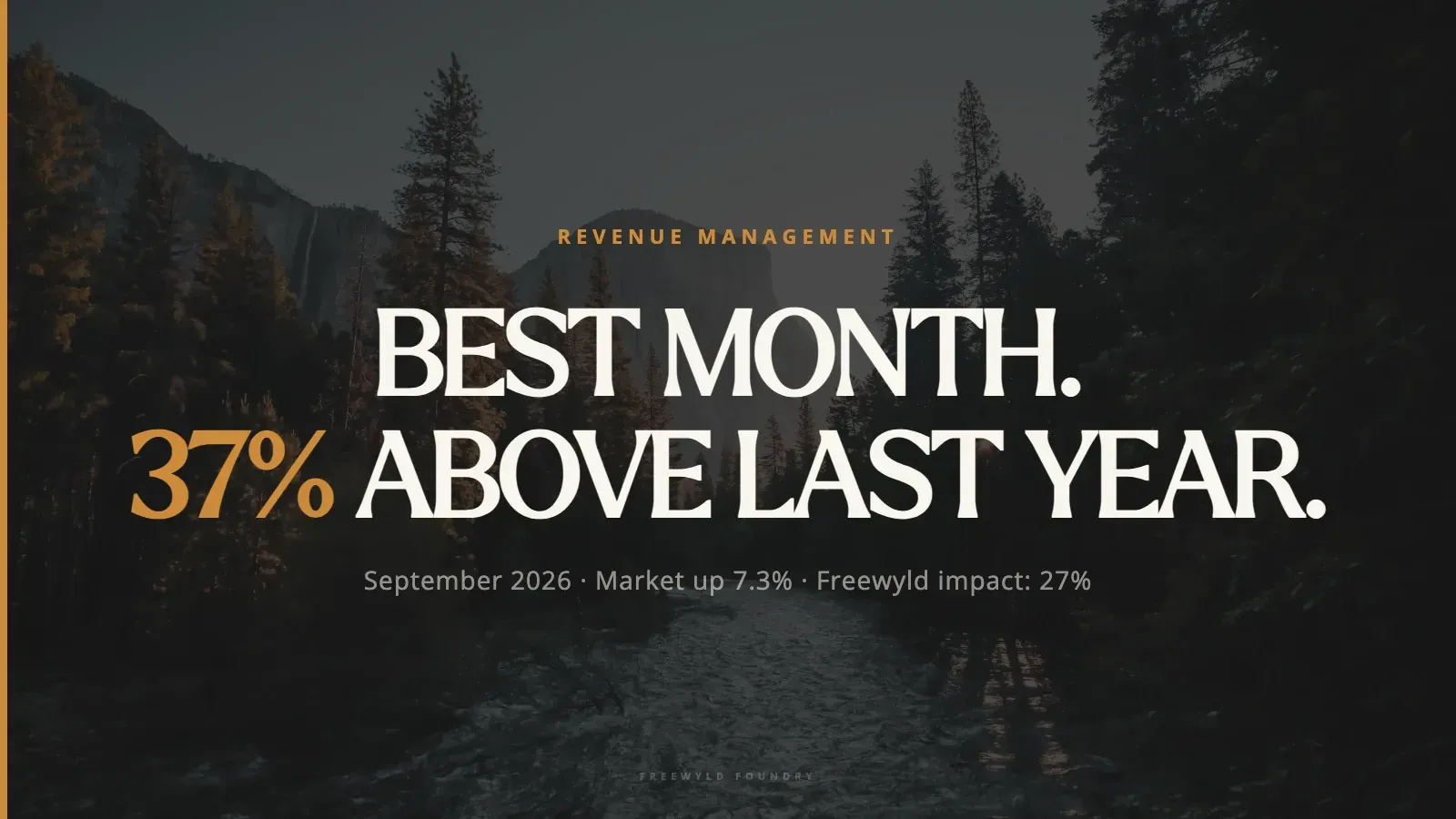
STR Market Update September 2026: Record Month, Vrbo's Commission Shift, and What AI Means for Revenue Management
September 2026 was the best month in Freewyld Foundry's history. Comparable units finished 37% above last September while the broader market grew 7.3%, producing a 27% measurable impact, the highest we have ever recorded. Here is what drove that gap, which markets led and which lagged, what Vrbo just changed about commissions, and what the industry learned about AI in revenue management at GuestyVal in Madrid.
PriceLabs Portfolio Occupancy-Based Adjustment: A Strategy for Unique STR Inventory
When your STR inventory runs at 97% occupancy year-round with a 212-day booking window, standard PriceLabs market factors actively work against you. Here is how to build a custom Portfolio Occupancy-Based Adjustment strategy for destination and unique inventory.
Midterm Rentals for STR Operators: The Data, the Math, and How to Start
Midterm rentals are already happening in most STR portfolios. 39% of short-term rental operators have received at least one 30+ night booking. Here is the data, the occupancy math, and how to be intentional about it without abandoning your short-term rental business.