How to Turn Your Team Into an Owner Acquisition Engine
Want to outperform the market? Freewyld Foundry’s Revenue & Pricing Management service is driving an 18% performance lift for $1M+ STR operators, even in down markets. If you’re managing 10+ listings and want a free pricing audit, apply here
Most property managers think owner acquisition is a price war. Lower your commission rate, undercut the competition, and the owners will come.
Annie Holcombe has seen this play out hundreds of times across her career as an operator, Marriott channel manager, and now consultant. The PMs who compete on price burn out fast. The ones who win play a completely different game.
In this episode, Annie reveals why your entire team (yes, even your housekeepers) are your best acquisition tool, why telling owners “you won’t make your mortgage” actually closes more deals than overpromising, and why rapid growth without systems destroys businesses through review damage that bleeds across your entire portfolio.
You’ll learn:
- Why price doesn’t matter when you have a strong brand and honest communication
- The one factor that keeps owners loyal (and the one that makes them leave)
- How to turn your maintenance and housekeeping teams into brand ambassadors
- Why telling hard truths upfront closes 9 out of 10 owner deals
- How negative reviews on one property damage visibility across your entire portfolio
We also talk about:
- Why your local competitors should be partners, not enemies
- How channel distribution creates owner pride beyond just bookings
- When rapid growth becomes dangerous for your business
- How to engage with destination marketing organizations effectively
- Why small operators are more local than any hotel chain
Mentioned in the Episode:
- Abode Luxury Rentals (Park City, Utah)
- Moving Mountains (Robin and Heather Cragen)
- Alex and Annie Podcast
- Annie & Co. Solutions
- VRMA (Vacation Rental Management Association)
- Host vs Brand: Which Airbnb Profile Strategy Drives More Short-Term Rental Bookings?
- How to Build a Content Army That 3X Your Direct Bookings (Without Paying $50K Per Post)
- The Direct Booking Playbook
Follow Annie Holcombe:
- LinkedIn: Annie Holcombe
- Website: anniecosolutions.com
Subscribe for more episodes every Monday and Friday on YouTube, Spotify, and Apple Podcasts.
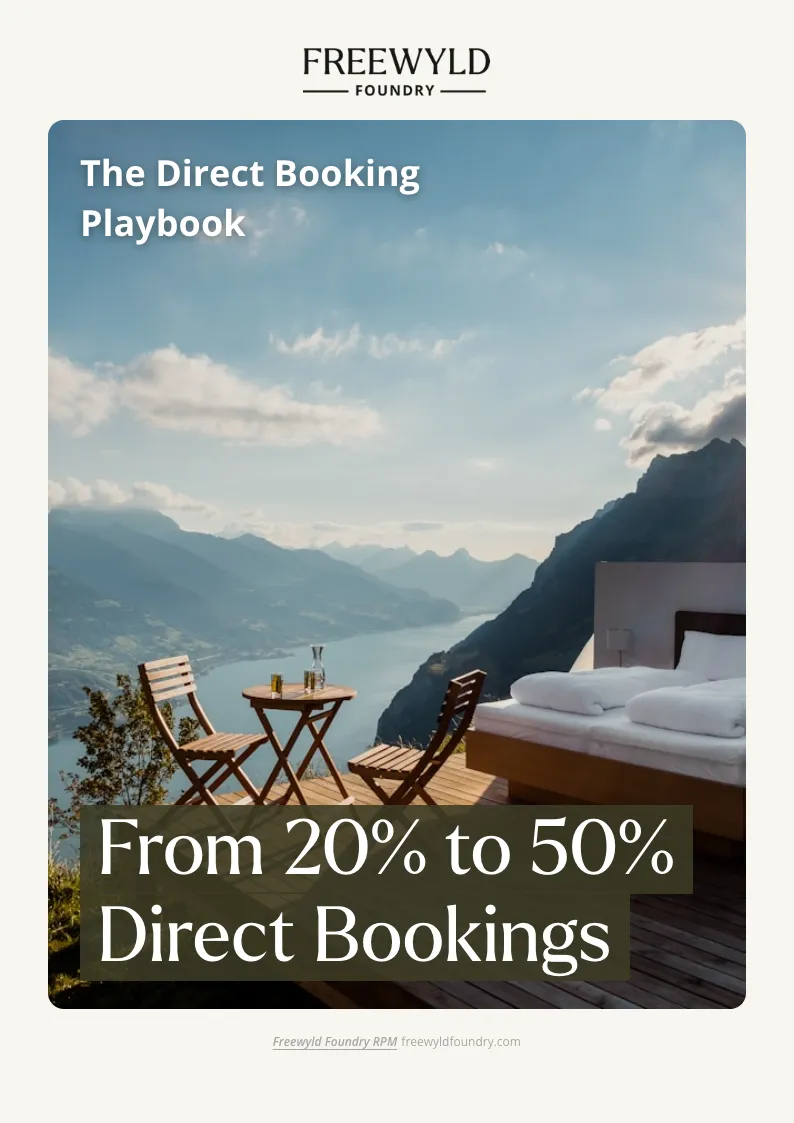
The Direct Booking Playbook
The complete system for growing direct bookings from 20% to 50%. Covers brand strategy, website conversion, email marketing, creator partnerships, Meta Ads, and the 5 biggest mistakes to avoid.
Download Free GuideContinue Listening
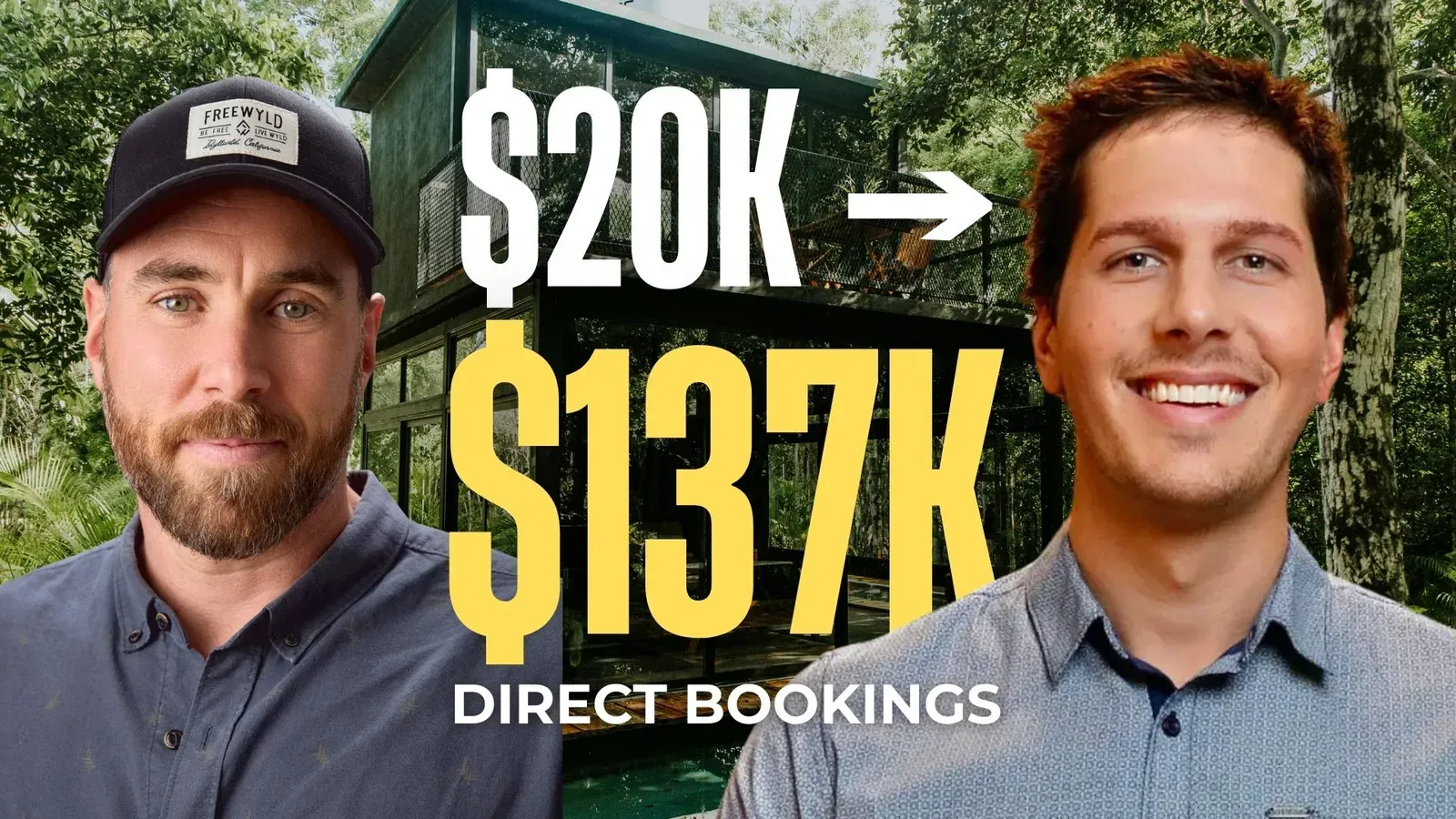
From $20K to $137K in Direct Bookings: The Meta Ads Playbook
Dustin Baker from HiddenGem Media breaks down the social media funnel strategy driving massive direct booking results for STR operators, including one client who went from $20K to $137K in a single month.
Building STR Sites That Convert: The Direct Booking Formula
In this episode of Get Paid For Your Pad, Kaye Putnam (Head of Marketing at Freewyld) sits down with Eli Pritykin, founder of Hudson Creative Studio and creator of HomeRunner, to break down what actually makes a direct booking website convert. Eli has built hundreds of STR websites and explains why trust, UX, data structure, and brand clarity matter far more than most operators realize. If you have ever wondered why guests abandon your booking flow, why your traffic is not turning into reservations, or how AI search will impact the future of discovery, this conversation gives you the clarity and frameworks to fix the problem. Explore Hudson Creative Studio and HomeRunner to upgrade your booking experience and increase your revenue.
STR Branding Battle: Human Face vs. Company Logo
In this episode of Get Paid For Your Pad, Eric Moeller and Kaye Putnam explore one of the most overlooked levers in short-term rentals: how you present yourself on your Airbnb profile. Should you lead with a polished brand identity or a personal host photo that builds trust instantly? You’ll discover: - The psychology behind guest trust on Airbnb profiles - Why logos can help you scale but sometimes hurt conversions - When showing your face creates a stronger booking connection - How big STR brands balance host identity with brand identity - The role of consistency in branding across multiple listings We also dive into: - Eric’s shift from “I’m Eric” to “We’re Freewyld” - The risk of blending in as a commodity vs. Subscribe to Get Paid For Your Pad and explore more resources at FreewyldFoundry.com.
The Price Myth
Kaye: What are the biggest mistakes that you see property managers make when they are trying to reach out to homeowners?
Annie: They think that it's all about price. And I think, yes, absolutely. But if you have a good brand and a good message and good service and you can back that up with a good team, the price really doesn't matter.
Kaye: We started a management company from zero. And within the first two years, we had about 800 properties. But onboarding, it's a nightmare. And it sets the team up for just friction and chaos and just frustration. And so I think it's just really make sure you have all the foundational pieces of like your PMS can handle it. Your accounting systems can handle it.
Annie: If you don't have the team to create a really great guest experience and you're starting to get a lot of negative reviews on your portfolio, that can not only affect that one listing. It bleeds into other listings as well in terms of visibility and conversion rates on the different OTAs.
Kaye: So what do you think is the number one thing that makes a homeowner stay with a property manager? And what's the number one thing that makes them leave?
Annie: Trust and erosion of trust.
Introduction
Kaye: Get paid for your pet. So here at Freewyld Foundry, we work with over 60 PMs, many of whom have over 20 listings, 50 listings. And one of the most common questions that we get is how do I acquire more listings and specifically more of the right listings? So I am so excited for today's episode with Annie Holcombe. We are going to be talking about that very subject. Welcome to Get Paid for Your Pad, Annie.
Annie: Thank you for having me. I'm excited. It feels like it's a long time coming. I've been following you guys for years and got the chance to meet you at VRMA. You were in the booth right next to me and Alex with our podcast. So that was a lot of fun. And so this kind of feels like a full circle moment for me. I'm so happy to have you here.
Kaye: Thank you for making the time and sharing your genius with us. So you know, I mean that sincerely. I know it sounds cheeky, but you've been like on literally every side of this industry from being an operator to channel manager with Marriott. Now you opened your own consulting company. What unique perspective does that give to you when you're working with PMs?
Annie's Multi-Sided Industry Perspective
Annie: You know, I don't want to sound trite about it, but I think it makes me really empathetic to what they're facing. So I've been there. I mean, I when I was in property management, I started out literally with zero knowledge, just like everybody else does. I don't think anybody gets into this business really by choice. I mean, there's there's a few people that you run into, but a lot of this is very happenstance. It just kind of occurs over time.
So I had to like figure it out. It was kind of like, you know, what's the right way to do it? There is no right way. There's no wrong way. I think that's the great the genius of this business is it's really just kind of what you make of it. But having been there, having had those hard conversations, you know, getting owners on that don't jive with like the kind of the ethos of the company or maybe they're too demanding and they're really hard on the staff. I mean, there's just so many ways that this this whole relationship could go.
So I don't think that there's any right or wrong way, but I do think that there's some like foundational things that that property managers need to think about. And having been kind of in the full circle of the conversation, I think I can lend a lens to their thought process that maybe they aren't seeing from their perspective as just a property manager.
Kaye: Yeah. The consultancy is relatively new. You started it in mid 2025. Is that correct?
Annie: Yeah. I actually, yeah. Well, yeah. Labor Day weekend was like my, I mean, it was like the oddest time in the world to launch. But it seemed like the good cutoff point of like end of summer and and starting. I had been thinking about it for several, several months. And I probably for about two years, people had been asking why I wasn't doing it. And it just never felt right. And so, yeah, so it's I'm still relatively new at this. I'm not even a year in. So, yeah.
Kaye: How has the experience been so far? It's like truly owning your own thing. It's it's a big thing.
Annie: Yeah. Yeah. It's it's great from the fact that there's nobody like telling me what I have to do from day to day. And I think like someone I feel like everybody in this business has some level of ADD. Like we just need all the things happening. And if you come from property management, for sure, you're used to doing wearing so many hats, doing so many things every day. So that's the nice part about it.
The other like part about it is like, oh, my God, I have to like make sure that I'm, you know, like I'm a squirrel getting my own nuts for a change. You know, I'm not like having anybody else show me where they are. So it's some of that. But it's allowed me a lot of freedoms and creativity that I kind of didn't hadn't tapped into in a really long time.
Kaye: I love that connection between being ADD and this industry. And maybe that's why I love it so much.
Annie: Yeah. It truly is like a different situation, a different challenge every single day. And it keeps it so interesting.
Turning Your Team Into an Acquisition Army
Kaye: All right. So let's dive into marketing to owners. You talk about turning property management teams into an acquisition army. What does that look like in practice? And how do you do that?
Annie: So for me, one of the things I try to talk to people about is like, what do you want to be when you grow up? So if you've got five units, a lot of times that people started out, they had five units. And then they had a friend that said, here, could you manage mine? And then another friend, another friend, another friend. And so they really it was kind of organic. It was really just other people were trying to do it. And they realized, oh, my God, it's not for me. And kind of dumped it on you.
Like some people have started out that way. And then other people were like, just took on anything because they wanted to have those numbers. They wanted to have the growth. They wanted to be like to establish themselves. So I think it goes back to the beginning of like, what do you really want? What does your brand say to a potential guest? What does it say to an owner? What do you want? Are you looking for to be in the luxury space? Are you looking to try to have inventory that fits all types of travel? Are you in a specific market? I mean, there's a lot of things that I think factor into it. But at the core of it, it's really having a brand that has a message and that you want your team to understand what that message is.
Now, that's not to say that you want someone who's working in your housekeeping or maintenance to like have a pitch deck. And, you know, they're going out and they're talking about it. But they need to be they're selling the company every day that they're servicing a property or every day that they're running into the hardware store to buy nails to fix something in a property. They're running into a potential customer, whether it be a traveler in the market or an owner.
So you want them to like buy into what the message of the company is. And so that's kind of what I mean is in turning them into the army is that make sure that everybody understands what the company is about, what differentiates them from their competitor, what the offerings are. And so people aren't working in silos. I think it's really important that everybody in the company is kind of swimming in the same direction.
And I reference a couple of companies that do, I think, do a really great job of this. Abode Luxury Rentals out in Park City, Utah. They have three different markets there. I think they're very good. Like their company culture is like everybody's part of, you know, where they're headed. And then Moving Mountains with Robin and Heather Cragen. They've sent and sold their company to another group, but they're still active in it. But their whole intent was like the team is part of everything that they do.
So just by having your team buy in and really understand that you're there to protect the investment of these owners that are giving you the honor of representing their property, but then also that you are given the honor for like guests that come to stay to help them create these memories. And so like just having the team buy into that is just so important.
Kaye: Yes. Mic drop. I came to the short-term rental industry by way of brand strategy, essentially. I started working with Freewyld to build their brand. Prior to this, I had worked with a lot of different industries, lots of different types of businesses, but have gone all in on the short-term rental industry. So you were speaking my language. The brand is so foundational and it makes everything else possible. So I'm really glad that you highlighted that selfishly.
Biggest Mistakes in Owner Outreach
Kaye: What are the biggest mistakes that you see property managers make when they are trying to reach out to homeowners?
Annie: I see it too often that putting down their competitors is the way they think that they need to go or they just they think that it's all about price. And I think, yes, absolutely. There are owners of properties that are very price sensitive. But if you have, again, a good brand and a good message and good service and you can back that up with a good team, the price really generally doesn't matter.
So never put your competitors down. Really try to find the things that differentiate you from your competitors, whether it be, you know, you offer a service that maybe somebody doesn't have. You know, what kind of like going in and custom shooting photos for properties. You know, a lot of luxury properties will do this. Go in and have photo shoots for these higher end properties and really customize what they're doing for that particular owner, making that owner feel seen and heard and make them understand that, you know, you know that this is their investment.
And a lot of times this investment is like maybe their future retirement home or it's something that they've been having their kids grow up in and they want their grandkids to. So there's a lot of emotion tied to it. So I think that understanding, one, the type of owner that you're dealing with. I mean, I think there's different owner avatars that you could take a look at that you're going to be working with. But don't put your competitors down. Just really, really try to find and hone in on the thing that makes you different from your competitors.
But also, like, know who your competitors are. A lot of people will say, oh, I know that guy. He has these properties, but I don't know anything about him. Make them your friend. I mean, I think that we, Alex and I joke about it on the podcast. It's like you have frenemies. You know, your competitors should be your coopetition. You know, you're competing with them, but you want to be cooperative with them and you want to have a relationship where, you know, you might have an owner that doesn't fit with you, but you could recommend them and you kind of have this like back and forth.
But I think that just partnering with your local competitors is important so that the owners see that you're like looking at the bigger picture of what the industry is in the market. And you're not a, I don't know, like a negative Nelly. I think people just don't like that.
Kaye: Yeah, yeah. It's easy to resort to because you look at your own business and you have so much pride in how you do things and how you build things. And you're like, I'm the best out there. And using that message feels obvious. But like you said, it actually can create kind of a negative connotation if you're constantly resorting to competitive language in your marketing. I think that's super smart.
What's Actually Working in Owner Acquisition
Kaye: I'd love to zoom in on the tactics for a moment. What's actually working in terms of like channels or strategies or just things that people are actually doing in their business that attracts the right owners to your property management business?
Annie: So I think it varies from market to market from what I can tell. Like there's, I think that there's, you know, there's a lot of tools out there that'll say, well, we can identify the owners, the second homeowners, and you can send them a mailer and here's the message you should send. So, you know, there's a lot of those and I don't put any of them down. I think they're great. They're great sources to get that information.
But it really is about establishing yourself in the market as a brand leader, being engaged with your market. There's a lot of conversation around what destination marketing organizations can do for your property management group. A lot of DMOs, CVBs, these marketing organizations kind of ignore the short-term vacation rental market. They're just, they're there. But, you know, in some markets, it's like they're there. They don't understand them. Or maybe they have a really large hotel group and the hotel group is the one that generates the most revenue so they get the attention.
So I think that it's like you have to be heard and seen in the market. And then just constantly engage. Again, you know, engage with your owners. Make sure that you're talking to your owners because they're going to be your best source of referrals. Because they're going to say like, oh, yeah, I am in a private Facebook group with other owners within this destination. And we're always sharing. And I think that's what people miss out on. It's just they don't think that these owners are talking.
But I think at the end of the day, we all know there's private user groups for about every possible thing that is going on. And so these owners are having conversations. They're meeting at the local restaurants when they come into town. They're talking to decorators. They're talking to realtors. So it's really about establishing a brand that people are going to recognize and know where to go look for a manager.
Kaye: Yep. I've had personal experience, my husband and I. We don't tell you more, but we owned a second home in the mountains of North Carolina. And we absolutely had a homeowners group of all of those local cabin owners. And the property management discussion came up often. It's like, man, are you using this property manager? Are they charging you this fee? Have your bookings slowed down? How are your bookings?
So understand that those conversations are happening. And I think the best thing that you can do, to your point, is to nurture and really love on those homeowners as much as possible so that those conversations are as positive as possible.
Annie: Yeah. Yeah. And also share, I think, you know, sometimes people get concerned about they don't have anything good to tell, so they're afraid to communicate. But the silence, I think the void is what causes, you know, the most thing. It's like when people don't know, there's a lot of assumptions that get made. So communicate, whether you have something good to say or something bad to say. It's like they would rather hear from you than hear a third party and have to come to you to address it. So make sure you're just communicating with them. And that's just, again, it just nurtures that relationship.
Channel Distribution Strategy
Annie: And then in terms of, like, what other things that you can be doing, this is another, like, piece of my consultancy and kind of where, like, my, I don't want to say, like, expertise lies. But, like, the distribution conversation, there are, you know, the owners want to see that you're marketing that their properties. They want to know that they can look on any channel and find their properties. And AI is really, really changing that. So people are going to have to stay on their A game for it.
But I look at, you know, a channel like Marriott Homes and Villas is a really great example. That's a channel that is a source of pride for owners when they get their properties listed on that channel because they don't take every property. So a lot of times, you know, you'll run into Tom has his property on it, but Bob doesn't. And Bob's really, really upset why he doesn't. And ultimately, you know, the manager could say, well, Bob, the reason yours isn't on there is because you need to upgrade and you need to do these things.
And so think about, like, your distribution mix. What does that mean in terms of, like, the pride factor for the owners? Because at the end of the day, the owners want to see their properties out there against, you know, they're competing with other owners in their neighborhood. I mean, it's definitely a competition. So think about those type of things.
And then also, like, with your guests, you know, take care of your guests so those reviews are positive because owners are going to, and I'm seeing it more and more with ChatGPT and Claude and all the different AI tools. People are plugging in, like, property manager in Destination. And it's sourcing reviews. It's sourcing distribution channels. It's sourcing all the areas that these property management groups are out in. I can find really, really quickly the ones that you'll be able to tell, like, that's not who I want to work with and this is absolutely who I want to work with. So you really have to work so many different angles at this point.
Kaye: Yeah, you really do. I can't remember where I read this of yours, but I think you mentioned something about not just paying attention to, like, your pricing yield or your listing yield, but thinking about channel yield. How do you recommend that property managers think about channel distribution? Is it just be everywhere that you can? Or what is your strategy behind that?
Annie: So I think it's be everywhere that makes sense. And, again, going back to your brand and what your goals are. If your goals are, you know, to book direct and, you know, attract owners, then you're going to want to be on the channels that your owners are telling you. And owners will tell you. And they're going to say they're going to want to be on Airbnb. They're going to want to be on VRBO.
If they have higher-end properties and they're a business traveler, they're going to want to be on any of the channels that are, like, kind of in that. So, like, American Express, Hyatt, Hilton, you know, the Marriott is, like, the easiest one that you could look to because, I mean, they've got, what, over 200 million Bonvoy members. So a channel like that has a lot of reach. If they're staying in Marriott's every week when they're traveling and they look on their app and, you know, they're looking in a market and vacation rentals are coming up, they want to see their property there. So that is a really great tool.
But I think that also not letting your mix get, I guess, too heavy on one channel, like, making sure that it's really spread out so that, again, you're getting more eyeballs. You're getting more diverse customers. But the owners are shopping the channels just as much as a guest is.
When and How to Grow
Kaye: How do you advise or consult with PMs or operators on when they should grow? Or, like, how do you think about the effort or time or investment mix between marketing towards guests and then marketing towards owners?
Annie: I think that's where I got, like, subjective because it's really, you know, I've talked to property managers that have 25 units and they want to just grow organically. They're not going to put any effort behind trying to find owners because they're just not looking for big growth. But then you have some groups that I want to take on 100 properties, you know, in the next year. So then there's, like, an aggressive, you know, program that has to be put together.
So it really just depends on what are you capable of handling. I mean, I think the biggest mistake, and I know when I was in property management, the market that I was in was very condo heavy. So it was very easy to pick up a building and you'd get 75 to 100 units. But the problem is having to onboard all of that very quickly heading into season.
I mean, we went, you know, my husband and I worked with a group. We started a management company from zero. And within the first two years, we had about 800 properties. But onboarding is just, like, it's a nightmare. And it sets the team up for just friction and chaos and just frustration.
And so I think it's just really make sure you have all the foundational pieces of, like, you know, your PMS can handle it. Your accounting systems can handle it. Do you have an onboarding workflow that you've put together to take on owners from contract to go live? You know, do you have the team that can talk with these owners as they're going through this process?
Because a lot of times, I mean, let's face it, you know, you'll hear time and time again from owners of they don't have the staff or property managers. They don't have the staff. And they're doing, you know, 10 different jobs wearing multiple hats. Well, if that's the way your business is operating, you're probably not going to be able to take on more than a couple units at a time.
So really be mindful of that. And, you know, if you need to partner with somebody, it's okay to, like, you know, create a partnership with another management company. I've seen that done where you can take on some things over time. Maybe there's a manager that's looking to get out of the business. Or maybe they're looking to off-board some properties. And maybe they only want homes and they want to get rid of their condos. Or they want to get rid of their homes and only do condos.
I mean, there's a lot of things if you work your market that you can do and you can kind of put into a strategy. But I would say really think about what you want to do. Don't go into it with, like, yeah, I want to take on 100, but I have no processes in place to do it. It's sage advice.
Kaye: Yeah. Because you're, I mean, you could be shooting yourself in the foot. Because if you don't have the team to create a really great guest experience and you're starting to get a lot of negative reviews on your portfolio, that can not only affect that one listing. It kind of, it, like, bleeds into other listings as well in terms of visibility and conversion rates on the different OTAs. So you have to be ready for that growth, for sure.
Trust: What Keeps and Loses Owners
Kaye: In your experience, what do you think is the number one thing that makes a homeowner stay with a property manager? And what's the number one thing that makes them leave?
Annie: Trust and erosion of trust. I think those things just go hand in hand. Because if you, if an owner doesn't feel that you are protecting their investment and being honest with them about their investment in terms of, like, what it can actually do. You know, I see that a lot where people will, and this, and I see this more so kind of in the real estate space where you have, like, maybe a real estate arm or somebody who's a realtor. And they're maybe not in the rental side of it. And they're looking to sell properties.
So they'll say, oh, you can absolutely take care of the mortgage and take care of your insurance and you'll make all the money that you need to do. And with given, like, the last couple of years with real estate prices, it's just not feasible. So by the time they get to a rental manager, the rental manager has to make the hard call of, like, do I try to do this? Or do I tell them up front that this is just not, you know, not sustainable? It's not going to work.
So, you know, it's just really about being honest. And I think a lot of times if someone bought a property, a realtor said, absolutely, they get to a manager and the manager says, look, there is no way that I'm going to do it, but I'll work really hard for you. You know, I would say nine out of ten times that that owner is going to say, I'm going to work with you. I'm going to give you a shot because you're being honest with me.
But if someone were to say on the account, you know, the flip side of it, oh, absolutely, we can do it. And six months into it, they're so far off the mark, there's no way they're going to be able to make half of what they anticipated. Then all of a sudden it becomes panic and it becomes they'll feel lied to. And so I just think it's absolutely about the trust. It's there's nothing more important for trust or no trust to keep and lose an owner.
Kaye: Yeah. I mean, we're a couple of years off of this now, but we experienced that with our cabin because when we started working with our property manager, they were quoting us like returns and results from 2020, 2021, when the short term rental market, particularly in that area, because it was a drive to destination, was just on fire. Wild, wild, crazy.
But there was no mention of like, by the way, the market is shifting. The demand has definitely shifted. It was all sunshine and roses. And it took us a little while to realize that as owners that, you know, what the actual expectation was going to be. And that absolutely does impact the trust in the relationship versus them being more upfront and forward looking, not just backwards looking.
Annie: I think that's also important. I was going to say, like, I think that's also like a factor of like when you're looking for a property manager or, you know, if you are a property manager, think about your longevity in the market and how you can talk about you've been through cycles. I mean, I think that people that came on post-COVID, they didn't know anything previous. So for them, the market being on fire didn't seem like it was really on fire like it was for all of us that have been doing it for a long time because we saw it and it was like we're like, this totally isn't sustainable.
But anybody that got into it was like, this market's just going. It's great. It's like the stock market is just going to keep going and I'm going to get rich. And, you know, but that wasn't the reality of it. So I think it's like if you've been in a market for a while, talk about your longevity in a market. Talk about how you've seen the ebb and flow of the industry and you know how to weather it with your marketing, with your support services, those type of things. That's another thing that I think managers don't play enough off of.
Kaye: Super smart.
How Messaging Shifts with Market Cycles
Kaye: Do you think the messaging to homeowners changes when the market is booming versus when it's more steady or on a decline?
Annie: Yeah, I do. I think that it could go two ways. I think that when the market is booming, you know, owners start to take notice and then they get a little more maybe aggressive about the things that they want. And they think we have to take advantage of it now. And then they might go shop around and think, well, that could make a little more money. I could cut a little bit on my commission here or there.
But I think that that's where it's important for you to say, like, this is great. And maybe we're reinvesting the money into like, you know, I've talked to owners all the time. You've got cabins in the mountains are a great example. Some of these cabins have been in existence for decades. And some of the decor in them has been in existence for decades. And these owners have just they're like very happy with it. They're not, you know, it's not they're not dirty. Like they're comfy cabins, but they just need some love.
You know, like they might need to get rid of that flowered couch that grandma had picked out in 1970. You know, so like, you know, talking to the owners about using that boom to reinvest and make better and preparing for when it eventually levels out. I think it's just really, really sharing data with owners. You don't have to share everything, but just share market intelligence with them so they can see six months down the road what's coming. They understand the trends.
I think that, you know, everybody right now is seeing like gas prices. We know that's going to affect summer because, you know, all these drive destinations. That's going to affect maybe how far people are going to actually go or how long they're going to go. Like they may have to cut back on that. So some of those things like you share it in advance so that the owners aren't blindsided. But I think that it's just it goes back to the constant communication and keeping that trust, that trust built.
Repeating Advice for Owners
Kaye: When you're talking to the owners that you work with, do you find yourself repeating pieces of advice again and again? If so, what is what are those?
Annie: Oh, for sure. Communication. I mean, because, again, people will say, oh, I send them a newsletter every month. OK, great. Are they reading that newsletter every month? Are you sharing the same same every month? Are you giving them something informational, interesting that, you know, and I think we live in a world now where news needs to be in these little sound bites. It needs to be very quick, concise, you know, like the, you know, TikTok and Instagram and Facebook and all the things. You just have to give them little bits of information. Don't write an article that they have to, you know, nobody has the time anymore. And I don't think people's attention spans aren't good for that.
So I have I tell people all the time, like, ask your owners what they want. You know, you're going to hear things you don't want, but you can filter through it and find the things that they really find relevant. And maybe, you know, there's Sarah Bradford. She used to have Steamboat Springs. I was a property management company in Steamboat Springs. I always get the name wrong, so I'm not going to try to remember it. But she sold her company a couple of years ago.
But one of the things that she said over and over again is, you know, make sure that you're actually physically talking to an owner, not just through an email, not through a newsletter, but picking up the phone and calling them. So randomly just call them, you know, monthly. Make sure you're touching every owner. Now, if you have hundreds, it's a little different. You've got to have a team of people to do that.
But to physically just call and say, hey, nothing's wrong. Just wanted to say hello. See how you were doing. I was thinking about you. Wanted to give you an update on X, Y, Z, you know, buy your property, the road being paved or whatever it is. That means you're intentional about your relationship with them. And I think that too many people get bogged down in, like, the operations and the guest facing. And guest facing is so important. I mean, you have to have the guest and you want to take care of that.
But that owner relationship, too, because you could very easily, you know, lose a property that you've had for 20 years just because you didn't call and say happy birthday or you had a granddaughter. You know, like something. I think it's just make, put that on your calendar every week to call an owner. You know, maybe it's just block an hour to call to owner or something like that. But I think that's something that I feel like I do repeat a lot.
Kaye: Yeah. And on the marketing side of things, I always tell people, like, when they're doing market research for a new business or a new idea or just adding something to your business, that your best source, market intelligence, is the actual words coming out of a human's mouth. Because we constantly filter ourselves if we're filling out a form or a survey or even posting things online. All of that is filtered. So the closer you can get to that actual human speaking to you, the better gold nuggets that you're going to find to help inform your marketing strategy and the things that you're doing.
Annie: Absolutely.
VRMA and Industry Changes
Kaye: So, Annie, you're on the VRMA board. Yeah. What changes do you want to see in this industry moving forward? And how is VRMA shifting and changing to meet this new future that hospitality is going into?
Annie: Yeah. Yeah. So I think the biggest opportunity that I, and it was part of the reason that I started Annie & Co. in the way I did was that, you know, 90, the number changes. But, like, say 90% of the business is small hosts. It's people that have less than 20, 25 properties. And the way that they've been educating themselves is going to YouTube or ChatGPT or, you know, Google. And they're not talking to other property managers because maybe they're in a market. You know, it's not a hotbed destination. So they don't have a destination marketing organization. There's maybe not a really large established property manager that's there.
So, you know, from the VRMA standpoint, we recognize that, like, those people, we need to bring them into the tent, so to speak. And so, like, trying to get in front of them to say, like, hey, let us help you get access to information, come to our conferences, participate in the webinars. I think that that's something that's really a big focal point for everybody within the organization. So I think it's an opportunity there to expand.
And then, you know, I mentioned to this earlier, just the conversation about destination organizations. So they are kind of the front line within a market. They're handling the market messaging that's out in, you know, in the marketplace to the consumer. But they're also very important in the messaging that gets to municipalities in terms of, like, you know, in terms of, like, regulation.
So really engaging with those entities to make sure that, one, the association can be in front of everybody that's in the market. But also, when there is stuff that comes up, like, they can come to the association as a resource for, like, hey, we think this regulation might be on the table soon. How can we address it? You know, we have a governmental affairs group that really, really works on that and working on the tonality of the way things are written and how to address them when they come up and how to be proactive about it and not have to be reactive.
So I think it's overall just, you know, making sure that people know that the association is there to support, regardless of what market you're in and no matter what size you are.
Building Relationships with DMOs
Kaye: Smart. I want to dig into that just briefly here. But if
Related Articles
The Complete Guide to Airbnb Discounts: How to Boost Your Short-Term Rental Revenue by 20-60%
In this comprehensive guide, you'll discover how to leverage Airbnb's merchandising tools to make your discounts visible, improve your booking conversion rates, and potentially boost your revenue by 20-60%.
Host vs Brand: Which Airbnb Profile Strategy Drives More Short-Term Rental Bookings?
You're staring at your Airbnb profile setup, cursor hovering over the profile photo upload button. Should you use a professional headshot or your carefully designed brand logo? This single decision could impact your booking conversion rates, guest relationships, and long-term business growth.
How to Build a Content Army That 3X Your Direct Bookings (Without Paying $50K Per Post)
Are you tired of paying astronomical fees to influencers who have zero connection to your brand? What if I told you there's a way to tap into an army of content creators who care about your business and can triple your direct booking rates?