
If you manage short-term rentals, you’ve probably faced this situation: a guest books your property and then messages to say they’re bringing a “service animal.” You’re not sure what you can legally ask. You don’t want to discriminate, but you also suspect the claim might not be legitimate.
You’re right to be concerned. According to John Bradford, founder of Pet Screening, 60% of people claiming emotional support animals in rental properties don’t actually meet federal standards. If you’re waiving pet fees without verification, you’re leaving significant revenue on the table while thinking you’re following the law.
At Freewyld Foundry, we’ve helped manage $190M+ in bookings across 4,000+ listings, and pet policy is one of those operational gaps that quietly costs operators money. The good news: there’s a structured way to handle this that protects you legally, captures legitimate pet revenue, and lets you be more pet-friendly without increasing risk.
Key Takeaways
- 60% of ESA claims in vacation rentals don’t meet federal standards, meaning you’re often entitled to collect pet fees you’re currently waiving
- For service animals, you cannot ask for documentation, but you CAN challenge whether the described task actually meets ADA standards
- For ESAs, you can request a healthcare provider letter and contact the provider directly to verify authenticity
- Service animals and ESAs still have to follow your property rules, including leashing requirements and waste cleanup
- Visiting pets (brought by guests’ friends) create liability even when the booking guest doesn’t own a pet
- Post-reservation pet screening takes minutes for guests and doesn’t slow your booking velocity
- Banning all pets is often the costliest policy: more pets exist in U.S. households than children under 18
What Is Pet Screening for Short-Term Rentals?
Pet screening is a software platform that helps property owners and managers enforce their pet policies while staying compliant with federal laws around service animals and emotional support animals (ESAs).
The platform operates post-reservation: after a guest books but before they check in. Guests receive a link to complete a pet profile that takes minutes to finish. They upload vaccination records, photos, and pet details. If they claim a service animal or ESA, trained specialists review the claim against federal standards.
The result: property managers can confidently allow pets (expanding their market), charge appropriate pet fees (capturing revenue they’re entitled to), and comply with disability laws (avoiding discrimination claims), all without becoming legal experts themselves.
This connects directly to a broader revenue management principle: operational gaps compound quietly. Pet fees are one of those revenue lines that looks small on any single booking but adds up fast across a portfolio.
How Much Revenue Are You Losing to Fraudulent ESA Claims?
The numbers are significant. Pet Screening’s team of Fair Housing and ADA specialists has reviewed millions of assistance animal claims over nine years. They’ve found that 60% of people who claim to have emotional support animals do not meet federal standards.
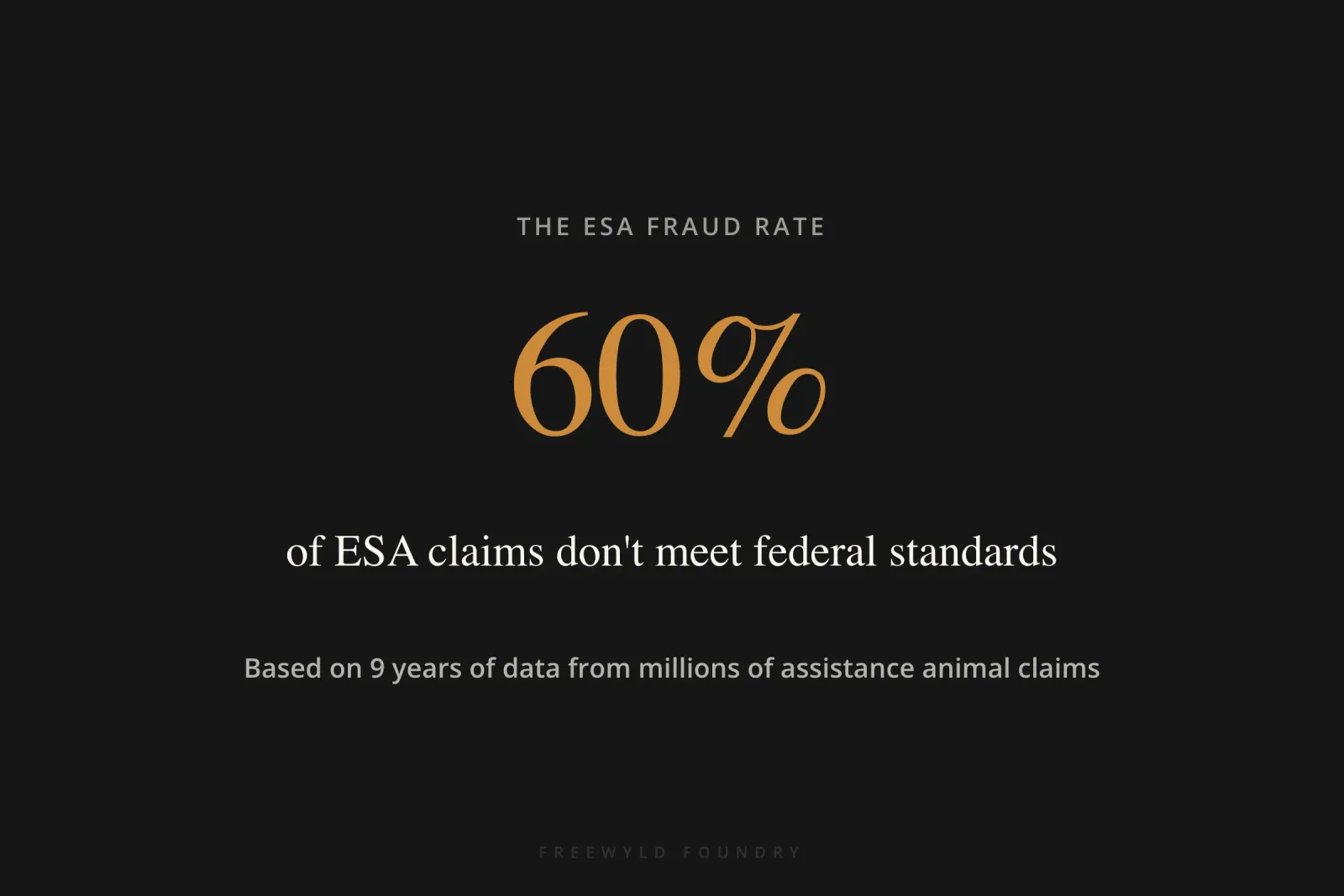
Think about what that means for your business. If you manage properties that trigger Fair Housing Act requirements (typically stays of 30 or more days), and you accept ESA claims without verification, you’re waiving pet fees more than half the time when you shouldn’t be.
Here’s how the math works:
| Scenario | Pet Fee Collected | Annual Impact (10 ESA Claims) |
|---|---|---|
| Accept all ESA claims without verification | $0 per claim | $0 |
| Verify ESA claims (60% fraud rate) | $200 for 6 fraudulent claims | $1,200 |
| Plus legitimate pet bookings from being pet-friendly | $200 per booking | Variable (often $2,000+) |
Bradford explains the dynamic: “If someone says they have an ESA and you’re just accepting it and not really doing any type of review, you’re missing out on some pet revenue because really it’s a pet. It may not be an ESA 60% of the time.”
Beyond the direct revenue loss, there’s an opportunity cost. Many vacation rental operators ban pets entirely because they don’t have tools to manage the risk. They’re leaving booking revenue on the table in a market where there are more pets in American households than children under the age of 18.
If you’re also losing money on guest screening more broadly, the AI guest screening guide covers how to verify guests and prevent fraud before it affects your listing.
What’s the Difference Between Service Animals and Emotional Support Animals?
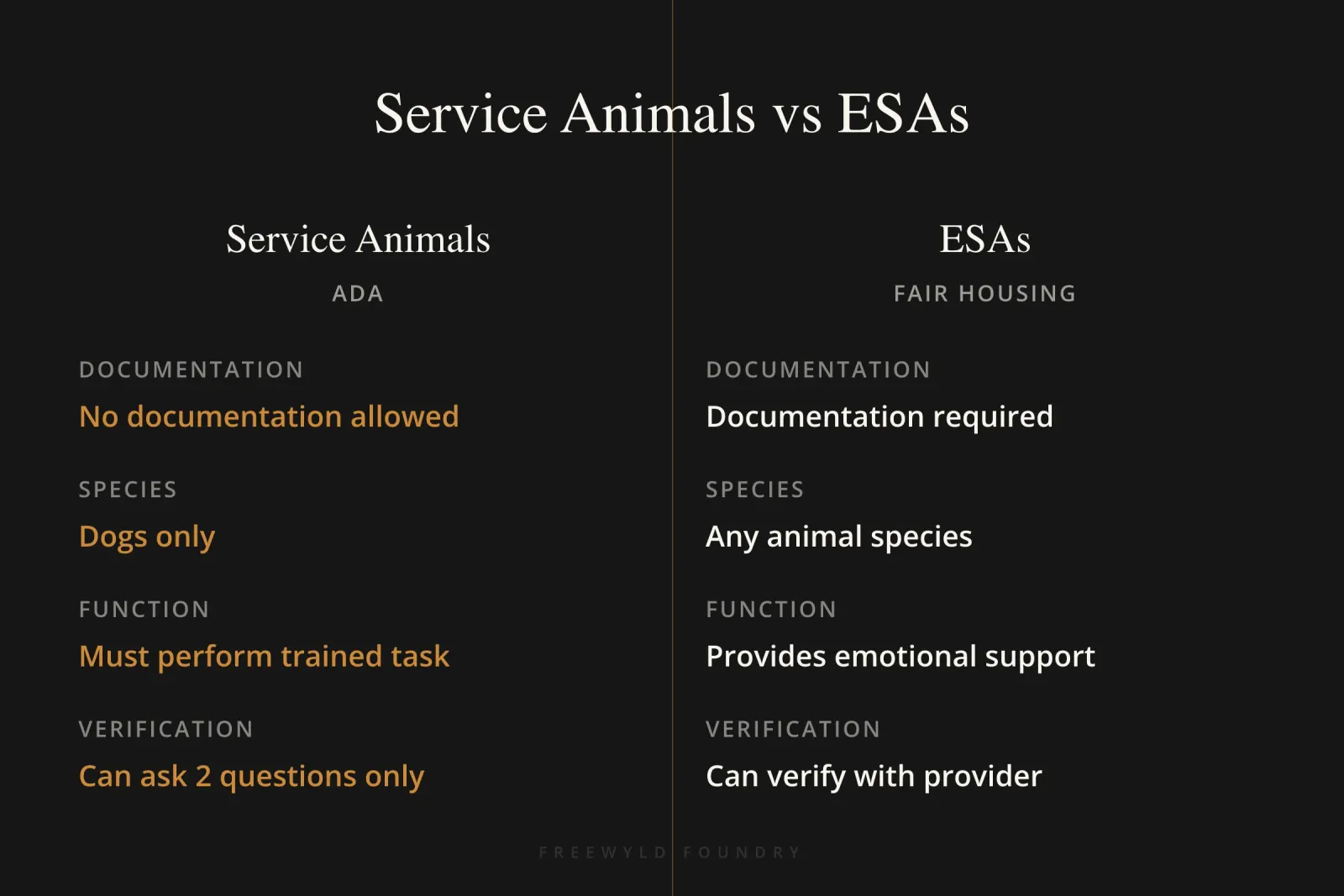
Understanding this distinction is critical because the laws governing each are completely different, and most hosts get them confused.
Service Animals (Governed by ADA)
A service animal under the Americans with Disabilities Act is a dog (or in rare cases, a miniature horse) that has been trained to perform a specific task for someone with a disability.
Key facts about service animals:
- No documentation required or allowed: Federal law prohibits you from asking for proof, certificates, or medical records
- Limited to dogs and miniature horses: Other animals don’t qualify under federal ADA (though some states like California relax this)
- Must perform trained tasks: Providing comfort or emotional support alone doesn’t meet the standard
- You CAN ask two questions: (1) Is this a service animal required because of a disability? (2) What work or task has the animal been trained to perform?
- You CAN challenge inadequate answers: If the task they describe doesn’t meet ADA standards, you can determine it’s actually a pet
Bradford clarifies a common misconception: “For service animals, no evidence or proof is needed or even allowed to be asked for. That’s not an Airbnb thing. That’s the law. That’s federal law.”
Emotional Support Animals (Governed by Fair Housing Act)
Emotional support animals are different. They don’t need to be trained for specific tasks, but they do require documentation from a healthcare provider.
Fair Housing Act typically applies to vacation rentals when:
- Length of stay is 30 or more days (varies by jurisdiction)
- The property is owner-occupied with rooms rented out
- Certain other housing scenarios apply
Key facts about ESAs:
- Documentation IS required: You can request a letter from a healthcare provider
- Not limited to dogs: Can be cats, birds, rabbits, or other animals
- Healthcare provider verification allowed: You can contact the provider to authenticate the letter
- No pet fees allowed for legitimate ESAs: If they meet the standard, Fair Housing protects them
- 60% don’t meet the standard: Most claims fail verification when properly reviewed
The confusion between these two categories is where most hosts get into trouble. They either accept everything (losing pet revenue) or question everything (risking discrimination claims).
What Questions Can You Legally Ask When Someone Claims a Service Animal?
When a guest tells you they’re bringing a service animal, federal law allows you to ask exactly two questions:
Question 1: “Is this service animal required because of a disability?”
Question 2: “What work or task has this dog been trained to perform?”
That’s it. You cannot ask about the person’s disability, request medical documentation, or demand to see certification.
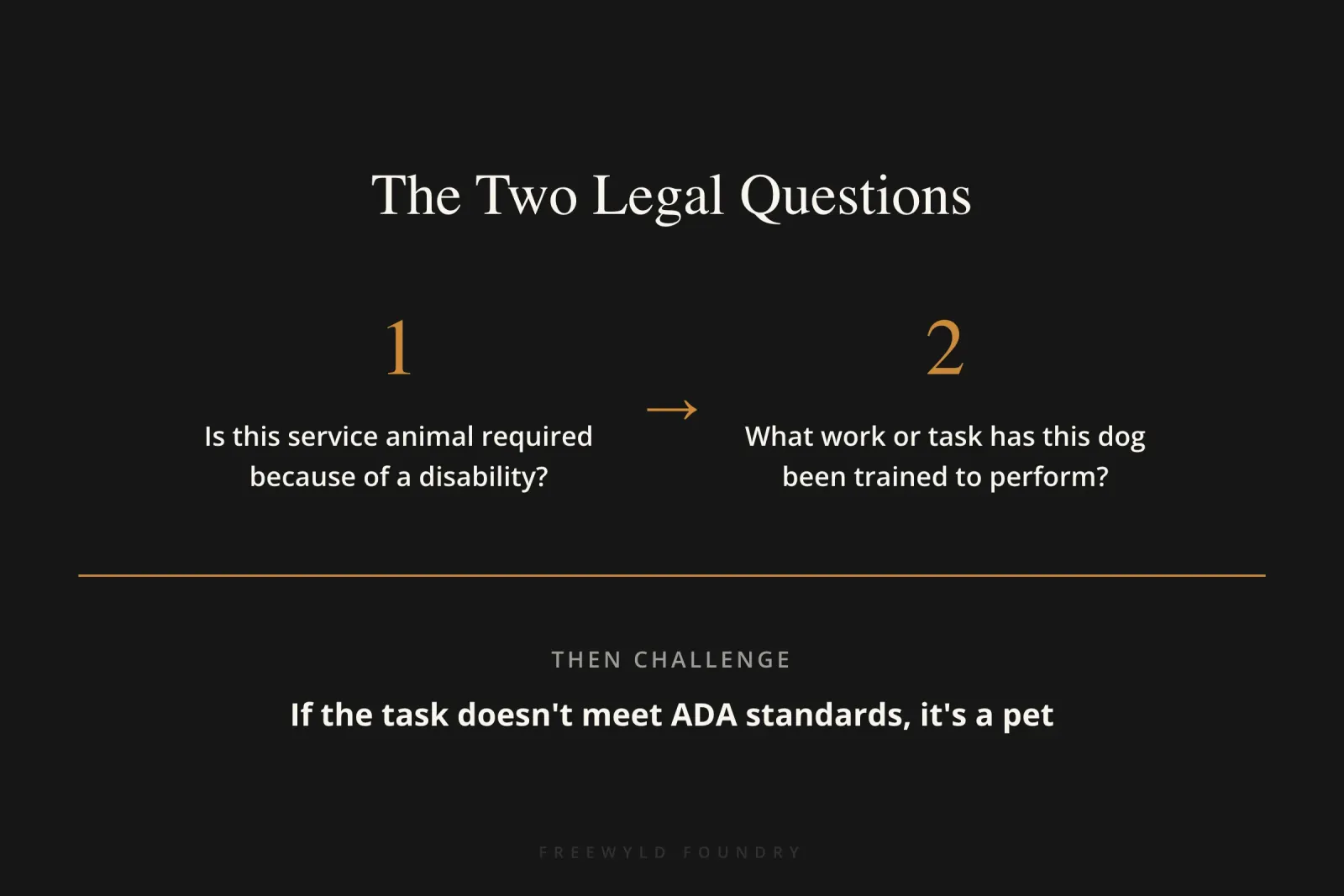
But here’s what most hosts miss: you can challenge the answer to question two.
Bradford explains: “The questions you ask and their answers are so meaningful. The task that they type, we get it in writing. You would be surprised how many types of tasks actually don’t meet the standard.”
Tasks That DON’T Meet ADA Standards
Common responses that indicate a pet, not a service animal:
- “My dog provides emotional support for my anxiety”
- “She helps me feel calm”
- “He keeps me company”
- “She makes me feel safe”
These describe emotional support functions, which are valuable but don’t meet the service animal standard under ADA.
Tasks That DO Meet ADA Standards
Examples of legitimate trained tasks:
- “Alerts me before my blood sugar drops” (diabetic alert)
- “Applies deep pressure during panic attacks” (psychiatric service)
- “Retrieves medication when I have a seizure” (seizure response)
- “Opens doors and picks up dropped items” (mobility assistance)
- “Guides me when I can’t see” (visual impairment)
The key difference: service animals must be trained to perform a specific, active task that mitigates a disability. Passive emotional comfort doesn’t qualify.
If a guest gives you an answer that clearly doesn’t meet the standard, you can politely inform them that their animal is actually a pet, and your pet policies (including fees) apply.
How to Verify Emotional Support Animal Claims
If you manage properties where Fair Housing Act applies (typically 30-day or longer stays), guests may present ESA documentation. Unlike service animals, you have significant verification rights here.
What You Can Request
For ESA claims, you’re allowed to ask for:
- A letter from a healthcare provider (doctor, therapist, psychiatrist, nurse, or other licensed professional)
- The provider’s contact information
- Confirmation that the letter is authentic
The Verification Process
Bradford’s team verifies thousands of ESA claims monthly. The process works like this:
Step 1: Collect the healthcare provider letter through your pet screening system.
Step 2: Review the letter for required elements: Is it from a licensed healthcare provider? Does it state the person has a disability? Does it explain how the animal provides support related to that disability? Is it dated within the last year?
Step 3: Contact the healthcare provider to authenticate. Call, email, or fax the provider’s office, confirm they issued the letter, and verify it hasn’t been altered.
Bradford notes: “Faxing, believe it or not, is still a big form of communication in healthcare. It’s not like the old thermal fax machine. It’s all much more sophisticated, but faxing is a HIPAA-compliant approved type of communication.”
Step 4: Make a determination based on the verification. If the letter is legitimate and meets Fair Housing standards, you cannot charge pet fees. If it’s fraudulent or doesn’t meet standards, standard pet policies apply.
Common Red Flags for Fraudulent ESA Claims
Pet Screening’s specialists have reviewed millions of these documents. Warning signs include:
- Online registry certificates: Legitimate ESAs don’t come from online registries, only from individual healthcare providers who have treated the person
- Altered documents: Forged signatures, photoshopped letterhead, or mismatched dates
- Provider can’t be reached: Phone numbers disconnected or provider denies issuing the letter
- Generic language: Letter uses template language without individualized assessment
- Recent relationship: Provider only met the person days before issuing the letter, rather than having an ongoing treatment relationship
Bradford shares: “We see documents for ESAs that are altered. Truly altered. We catch those because their healthcare professional tells us they’re altered. They’re like, ‘That’s not my signature.’”
The Most Common Mistakes Hosts Make with Pet Policies
After managing pet policies for 8 million rental units over nine years, Bradford has seen recurring mistakes that cost hosts money or create legal risk.
Mistake 1: Asking for Service Animal Documentation
Federal ADA law prohibits requesting proof, certificates, or medical records for service animals. Asking puts you at risk of discrimination claims. Instead, ask only the two permitted questions about whether it’s required for a disability and what task it performs, then challenge inadequate task descriptions.
Mistake 2: Accepting All ESA Claims Without Verification
60% of ESA claims don’t meet federal standards. You’re waiving pet fees when you’re legally entitled to collect them. Implement a verification process that contacts healthcare providers to authenticate ESA documentation for stays triggering Fair Housing Act.
Mistake 3: Having No Policy for Visiting Pets
Even if your guest doesn’t own a pet, their visitors might bring animals to your property, creating liability. Bradford explains: “Guests may not bring a pet with them, but while they’re staying there, they might have friends that live within an hour of the rental. Someone brings their dog. That dog now creates risk for that host, even though the guest doesn’t have a pet.”
Include visiting pet policies in your rental agreement, and make clear that guests are responsible for ensuring visitors don’t bring unauthorized animals.
Mistake 4: Thinking Assistance Animals Have No Rules
Service animals and ESAs still must follow property rules about leashing, waste cleanup, and behavior. Bradford clarifies: “Service animals and emotional support animals don’t get this all access pass without accountability. If they poop, someone’s got to pick it up. If you have a leashing requirement, these animals still have to follow rules.”
Establish clear policies that apply to all animals, assistance animals included.
Mistake 5: Banning Pets Entirely Out of Fear
You’re excluding a massive market segment and leaving revenue on the table. Use verification tools to confidently allow pets while managing risk. Collect deposits, require insurance, and screen for temperament issues.
This connects to a broader systems problem. If your pet policy is one of many operational gaps you’re managing manually, building scalable systems is what separates hosts who grow from hosts who stay stuck.
How to Implement a Pet Screening System
A proper pet screening system should be zero-friction for guests, protect you legally, and operate seamlessly with your existing booking flow.
Step 1: Choose a Post-Reservation Workflow
The system activates after booking but before check-in. This prevents slowing down your booking rate while ensuring compliance before guests arrive.
Bradford: “We’re post-reservation. We live after the reservation is made so we never slow anything down from a booking standpoint. But once the booking is made, we live between the time of booking and the actual time of check-in.”
Step 2: Integrate with Your Property Management System
Look for integrations with your PMS to automate the process. Pet Screening currently integrates with:
- Owner Rez
- Guesty
- Hospitable
- Hostfully
If you don’t use a PMS, you can manually send a custom link to guests via email or text.
Step 3: Set Your Pet Policies
Define your rules clearly: pet fees (one-time or per night), pet deposit amounts, size restrictions, number of pets allowed, breed restrictions (for pets only, not service animals), vaccination requirements, leashing and cleanup rules, and visiting pet policies.
Step 4: Require Completion Before Access
Make pet screening completion mandatory before providing door codes or check-in instructions. The process takes minutes for guests. They upload photos of their pet, vaccination records, pet details, an emergency contact for the pet, and, if applicable, a service animal task description or ESA healthcare provider letter.
Step 5: Review and Approve (or Challenge)
For standard pets, approval is automatic once vaccination and photo requirements are met.
For service animal or ESA claims, trained specialists review the submission against federal standards and return a determination:
- Approved as service animal or ESA: No pet fees can be charged
- Does not meet standard, classified as pet: Standard pet fees apply
- Fraudulent documentation detected: Guest cannot bring the animal or must pay pet fees
Step 6: Communicate Clearly with Guests
Use the platform to send automated messages: an initial link after booking, a reminder if not completed 48 hours before check-in, a confirmation once approved, and property-specific pet rules before arrival.
A Revenue Framework: What Pet-Friendly Properties Can Earn
Here’s an illustrative example of how the math works for a portfolio with 20 vacation rentals averaging $300 per night and 60% annual occupancy.
Without pet screening (no-pet policy):
- Turning away an estimated 30 bookings per year from pet owners
- Accepting all service animal or ESA claims without verification (around 10 per year)
- Lost booking revenue: 30 declined bookings x $300 x 3 nights average = $27,000
- Lost pet fees from unverified ESA claims: 6 fraudulent claims x $200 = $1,200
- Total opportunity cost: roughly $28,200 annually
After implementing pet screening:
- Opening 12 properties to pets based on flooring type and outdoor space
- Capturing the majority of previously declined pet bookings
- Verifying ESA claims and collecting pet fees on fraudulent claims
- New booking revenue: recovered bookings x $300 x 3 nights = significant upside
- Pet fees collected on both legitimate pets and rejected fraudulent ESA claims
The exact numbers vary by market and portfolio, but the pattern is consistent: the combination of recovered bookings, pet fees, and ESA fee recovery adds up to meaningful annual revenue. And that’s before accounting for the competitive advantage of appearing in pet-friendly search filters on OTAs.
As Bradford puts it: “We’re seeing people use our tool and be more welcoming and accepting to pets because they have a tool. They can tell their owners who hire them, ‘Hey, I think you should allow pets. You’ll make more money and we got a way to manage it.’”
For more on how pet revenue fits into your overall pricing approach, see the complete STR revenue management guide.
Frequently Asked Questions
Can I charge pet fees for service animals?
No. Under the Americans with Disabilities Act, you cannot charge pet fees, pet deposits, or any additional fees for legitimate service animals, even if you normally charge pet fees for regular pets.
What if a service animal causes damage to my property?
You can charge the guest for actual damages caused by a service animal, just as you would charge for damages caused by the guest themselves. Service animals don’t get immunity from damage liability, only from upfront pet fees.
Do I have to allow all breeds of dogs as service animals?
Generally yes, if they meet the service animal standard. While you can have breed restrictions for regular pets, service animals are protected under ADA regardless of breed. The only exception is if the specific animal poses a direct threat based on its actual behavior, not assumptions about the breed.
What states have laws against service animal fraud?
Many states including California, Florida, Colorado, and North Carolina have made service animal fraud a crime. Bradford notes these laws are rarely enforced: “Service animal fraud is a crime in a lot of states. Now I’m not saying these get enforced. They can be hard to enforce.”
Can I use AI to verify service animal or ESA claims?
No. Federal law requires individualized assessments for people with disabilities. You cannot use algorithmic or formulaic approaches to make these determinations. Bradford: “Under the law, people with disabilities are entitled to individual reviews. You can’t formulaically, algorithmically make these decisions.”
How does state law interact with federal law?
States cannot make rules more restrictive than federal law, but they can relax standards. California, for example, allows a broader definition of service animals than federal ADA. A good pet screening platform manages to state-level laws automatically, so you don’t have to track each state’s rules manually.
What about the risk of pet damage?
Pet damage can happen, but so can guest damage. Bradford’s take: “There’s a lot of myths around pet damage. Pet damage can happen, but so can people damage. Our whole thing is just holding everybody accountable.”
Proper deposits, documentation of the pet before arrival, and clear policies shift accountability where it belongs, to the guest.
Want to optimize your STR revenue beyond just pet fees?
Apply for a free revenue report — we’ll assess your portfolio and show you what’s possible with professional revenue management. Our clients average 18% above their market.
Related Articles
- AI Guest Screening for Short-Term Rentals — How to verify guests and prevent fraud before it affects your listing
- 5 Revenue Management Mistakes Costing STR Operators Money — Common pricing errors that quietly drain your portfolio
- How to Prevent Airbnb Listing Suspensions — The systems operators use to protect their listings at scale
Listen to the Full Conversation
This article was informed by a conversation with John Bradford on the Get Paid for Your Pad podcast.