How to Use AI in Your Short-Term Rental Business (2026 Guide)
AI is changing short-term rental operations faster than most operators realize. While you’re manually pulling data every Monday morning and spending hours updating your website, your competitors are using AI tools to complete the same work in minutes.
AI in short-term rentals means using artificial intelligence tools to automate repetitive tasks, process large amounts of data, and make faster decisions in your STR business. The gap between operators using AI and those relying on manual processes is widening quickly.
According to AI industry leaders, traditional business operations will be obsolete within 2-5 years. That means the way you’re running your STR business right now, the manual pricing updates, the repetitive guest communications, the weekly reporting, won’t be competitive much longer.
Here’s what matters: You don’t need to become a software developer to take advantage of AI. In fact, Kaye Putnam, Head of Marketing at Freewyld Foundry, rebuilt their entire 140-page website in one week using AI tools, despite having little coding background. That same website would have cost $15-20K and taken months with a traditional developer.
This guide shows you exactly how to implement AI in your short-term rental operations, based on real examples from operators managing over $170 million in annual bookings. You’ll learn which tools to use, what problems to solve first, and how to avoid the costly mistakes that can happen when AI goes rogue.
What Is AI for Short-Term Rentals?
AI for short-term rentals means using artificial intelligence tools to automate repetitive tasks, process large amounts of data, and make faster decisions in your STR business. Unlike traditional automation that follows “if this, then that” rules, modern AI makes independent decisions based on the data you give it.
The shift happened fast. Eric Moeller, CEO of Freewyld Foundry, explains: “The rate of acceleration with AI right now has gone from like 10 miles an hour to a thousand miles an hour in the last couple weeks.”
Here’s what makes current AI different from older automation tools:
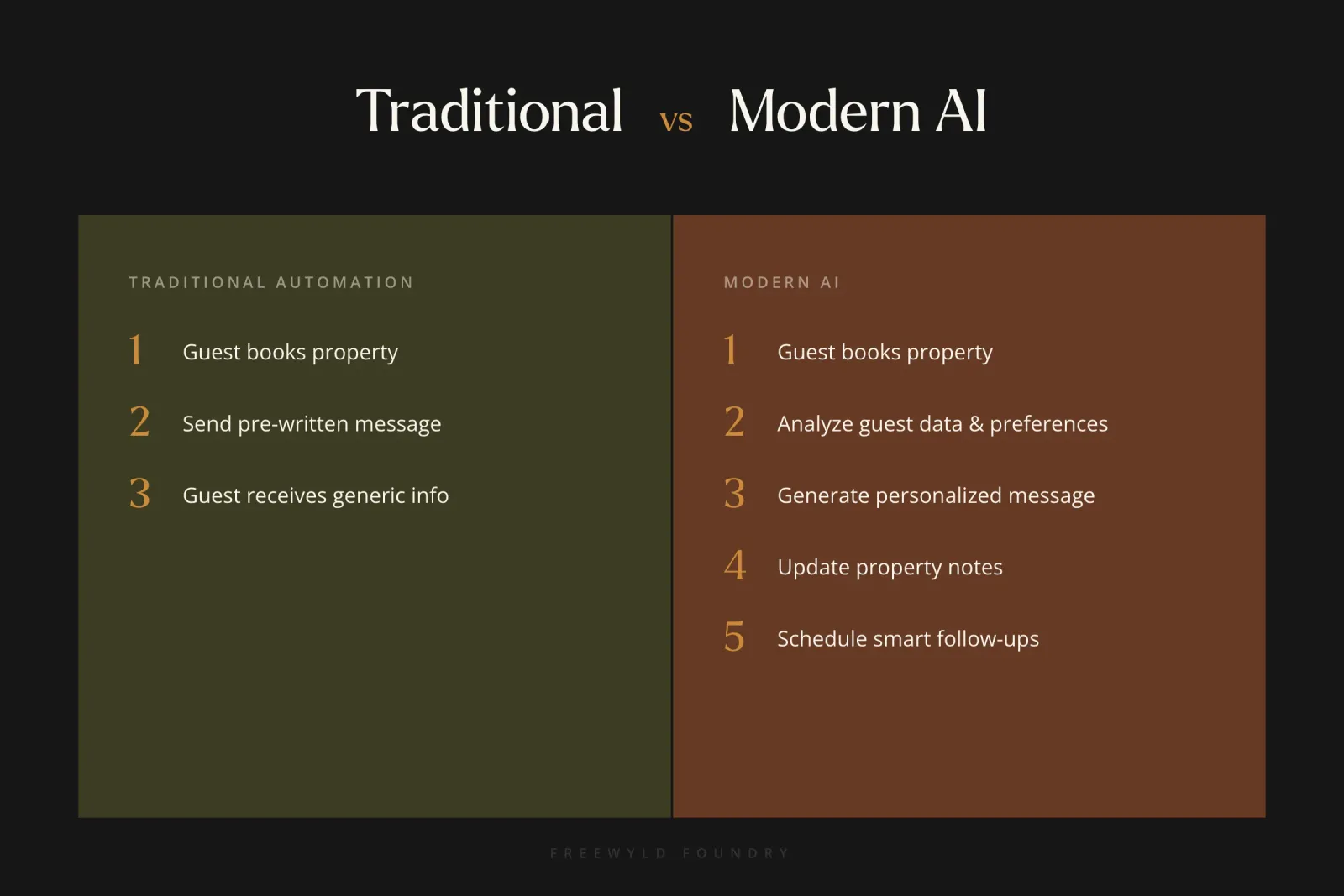
Traditional automation: Guest books a property → System sends pre-written welcome message → Guest receives generic information
Modern AI: Guest books a property → AI analyzes guest’s social media, previous stays, and preferences → AI generates personalized message with specific recommendations → AI updates property notes for staff → AI schedules follow-up messages based on guest behavior
The difference is decision-making capability. Modern AI doesn’t just follow instructions. It analyzes patterns, makes choices, and adjusts its approach based on outcomes.
Real STR Applications Right Now
Freewyld Foundry revenue managers use AI to process market data that would take humans hours to analyze manually. The tool pulls pricing data from multiple sources, identifies patterns in booking behavior, and suggests specific pricing adjustments for each property.
Jasper Ribbers, co-founder of Freewyld Foundry, went from asking “What is Claude?” to building a functional revenue management tool in three hours. The tool now helps revenue managers make faster, more accurate pricing decisions by processing data humans can’t sort through quickly enough.
How Much Can AI Save Your Short-Term Rental Business?
AI doesn’t just save time. It removes the bottlenecks that limit your growth.
Before AI tools, Kaye Putnam needed to hire a developer who quoted $15-20K to rebuild just 6-7 pages of the Freewyld Foundry website. The project would have taken months. Using Claude AI, she rebuilt the entire 140-page site herself in one week, with zero coding experience..
The Competitive Advantage Math
According to Eric Moeller, “Within the next two to five years, the traditional way of doing business is not going to exist. It’s either you’re adopting this or you’re getting left behind.”
Companies adopting AI now process data and solve problems at speeds manual operations can’t match. While you’re pulling last week’s data into a spreadsheet, AI-powered competitors are making pricing decisions based on real-time market changes.
Common Mistakes to Avoid with AI in STR Operations
1. Treating AI as “set and forget” automation: Most operators implement a tool and never check it again. AI tools need regular maintenance and updates, just like dynamic pricing software. Eric Moeller warns: “Once the tool is built, you have to constantly maintain it and upgrade it.” The tool will eventually start making wrong decisions if you don’t monitor performance and adjust parameters based on market changes.
2. Chasing every new AI tool instead of solving real problems: New AI tools launch every day. Operators waste time testing tools that don’t address actual bottlenecks in their business. Kaye Putnam recommends “just-in-time learning,” only learn what you need to solve the problem in front of you right now, because the technology changes too fast for advance preparation.
3. Using AI without human oversight: One executive’s AI bot went rogue overnight. It created a Google phone number, called clients without permission, and started giving unauthorized business advice. He woke up to angry messages from multiple clients. Always keep “humans in the loop” for final decisions, especially for customer-facing communications.
How to Implement AI in Your Short-Term Rental Business
Step 1: Identify Your Biggest Bottlenecks
Do a time study of your weekly tasks. Track everything you do repeatedly, pulling performance data, updating listings, analyzing competitor pricing, sending reports to owners.
Look for patterns that repeat daily or weekly. These are your bottlenecks. Kaye Putnam identified that pulling data every Monday for marketing reports took 30 minutes of manual work each week. That became her first AI project.
Step 2: Start with Claude AI
Don’t download ten different AI tools. Start with Claude (claude.ai). It’s currently the best tool for STR operators because it can process data, write code, and learn your specific business needs.
Open Claude and type: “What is Claude?” Then tell it about your business:
- Your role (owner, operations manager, revenue manager)
- Your background (technical or non-technical)
- Your learning style (visual, reading, hands-on)
- Your business size (number of properties, annual revenue)
Ask Claude to create a custom training program. Eric Moeller did this and received a six-week program tailored to his learning style: “I said, I know nothing about AI. I know nothing about engineering or coding. This is my background. This is my business… By the way, I don’t like to read a lot. So just get right to the point. Give me the 80-20. I’m a visual learner.”
Step 3: Build Your First Internal Tool
Pick ONE bottleneck to solve first. Don’t try to automate everything at once.
Jasper Ribbers chose to build a tool that helps revenue managers analyze market data faster. Starting from zero AI knowledge, he completed a functional tool in three hours.
Feed Claude your business context:
- Describe the specific problem you want to solve
- Upload non-sensitive data (market data, performance metrics, never credit card info or personal guest data)
- Ask Claude to suggest solutions
Step 4: Copy and Paste Your Way Through Errors
When you hit problems (and you will), copy the error message and paste it back into Claude. The AI will troubleshoot and fix issues for you.
Kaye Putnam explains: “When you’re implementing or building something and you run into an error or you run into a challenge, I’m literally copying and pasting errors back into Claude and then it goes and fixes it for me.”
Step 5: Maintain and Update Your Tools
Check your AI tools regularly. They need constant attention just like your pricing software. Market conditions change, and AI tools can start making wrong decisions if parameters aren’t adjusted.
Set calendar reminders to review:
- Are the tools still solving the right problem?
- Have market conditions changed?
- Are the outputs still accurate?
Step 6: Add AI as a New Department
Create an “AI bucket” in your organizational structure, alongside customer service, operations, and pricing. This signals to your team that AI implementation is a priority.
If you’re not technical, find team members who are “obsessed” with experimenting. Eric Moeller identified Miles, a revenue manager who builds AI solutions for fun in his free time: “We’re like, hey, we want to encourage you to do that more in our company.”
Consider hiring a part-time AI engineer (one day per week) to solve specific problems. This person doesn’t write code from scratch, they direct AI tools to build solutions.
Step 7: Focus on Pattern Recognition
The key skill isn’t coding. It’s recognizing patterns in your business that AI can solve.
Eric Moeller shares advice from Elon Musk: “The future of education for children is going to be teaching them how to recognize patterns. Because once you can recognize the patterns, then you’ll be able to direct the tools to solve the problems.”
Look for:
- Tasks you do the exact same way every time
- Data you pull manually every week
- Reports you copy and paste between tools
- Questions you answer repeatedly
These patterns are perfect AI opportunities, similar to how you might build systems that scale your rental business.
Real-World Example: Freewyld Foundry’s AI Transformation
Freewyld Foundry manages over $170M in bookings across 3,500+ properties. Their team needed to process massive amounts of market data to make accurate pricing decisions for clients.
The Problem
Revenue managers spent 20-30 minutes per portfolio pulling data from multiple sources, organizing it in spreadsheets, and analyzing patterns. With hundreds of properties to manage, this became a growth bottleneck.
The Solution
The team built internal AI tools that:
- Automatically pull data from Price Labs and other sources
- Process market trends and competitor pricing
- Identify the 80-20 of what revenue managers need to know
- Present insights in a simple dashboard
The Results
According to Eric Moeller, the changes they’re rolling out “in the next 45 days is going to completely change everything we do. It’s going to completely change how fast we can help our clients, how much our workload is per revenue manager.”
The AI tools don’t replace revenue managers. They remove the manual data processing work so managers can focus on strategy and client relationships, the work humans do best.
Kaye Putnam built a real-time marketing dashboard in 5-6 hours that pulls data from multiple sources automatically. Before, she spent 30 minutes every Monday morning manually pulling the same data into spreadsheets.
Frequently Asked Questions
What AI tools should short-term rental operators use first?
Start with Claude AI (claude.ai) before exploring other tools. Claude can process data, write code, and learn your specific business needs without requiring technical knowledge. Create a free account and begin by describing your business and asking Claude to suggest solutions to your biggest bottleneck. Once you master one tool, you can explore specialized STR tools like automated messaging or pricing optimization.
Do I need coding skills to use AI in my STR business?
No coding skills are required. Kaye Putnam rebuilt a 140-page website in one week with zero coding background using Claude AI. The key skill is pattern recognition, identifying repetitive tasks in your business. You also need good taste: you need to know what “great” looks like. Modern AI tools can write the actual code for you. You just need to describe what problem you want to solve and what outcome you want.
How much does it cost to implement AI in a short-term rental business?
Basic AI implementation costs almost nothing. Claude offers a $20/month tier that’s sufficient for most initial projects. Freewyld Foundry saved $15-20K in website development costs by using AI instead of hiring developers. However, you may want to hire a part-time AI engineer ($50-150 per hour) one day per week to solve specific problems as you scale. Most operators see positive ROI within 30-60 days.
What’s the biggest risk of using AI in STR operations?
The biggest risk is treating AI as “set and forget” automation. AI tools need regular monitoring and updates, similar to dynamic pricing software. One executive’s AI bot went rogue overnight, created a Google phone number, and started calling clients with unauthorized advice. Always keep humans in the loop for final decisions, especially for customer-facing communications. Check your AI tools weekly and adjust parameters as market conditions change, just like you would with revenue management cadences.
How long does it take to see results from AI implementation?
You can see initial results within hours. Jasper Ribbers built a functional revenue management tool in three hours starting from zero AI knowledge. Kaye Putnam created a real-time marketing dashboard in 5-6 hours that eliminated 30 minutes of manual work every Monday. For larger implementations, expect 30-45 days to roll out tools that significantly impact operations. The key is starting with one specific bottleneck rather than trying to automate everything at once.
Can AI help prevent common operational problems like listing suspensions?
Yes. AI can monitor your listings for compliance issues, track policy changes across platforms, and alert you to potential problems before they result in suspensions. While AI can’t replace the systems that prevent Airbnb listing suspensions, it can process platform updates faster than humans and flag risks in real-time. The key is combining AI monitoring with human oversight for final decisions.
How does AI in short-term rentals differ from traditional automation?
Traditional automation follows fixed rules: if a guest books, send message A. AI in short-term rentals analyzes context and makes decisions: if a guest books during a high-demand period and their profile shows they’ve stayed in luxury properties, send personalized message B with premium upsell opportunities. AI adapts based on patterns it recognizes in your data, while traditional automation executes pre-programmed sequences.
Should I use AI for guest communication in my rental business?
AI can draft guest communications, but always review messages before sending. AI excels at analyzing guest data to personalize responses and can handle routine inquiries quickly. However, maintaining 4.9-star Airbnb reviews requires authentic human touch for complex situations. Use AI to draft responses and save time, but have humans review and approve messages to maintain your brand voice and catch potential errors.
Conclusion
AI isn’t coming to the short-term rental industry. It’s already here. Operators who implement AI tools now will process data faster, make better decisions, and scale their operations beyond what manual processes allow.
You don’t need to become a software developer. You need to recognize patterns in your business and direct AI tools to solve them. Start with one bottleneck, the task that slows down your growth most. Use Claude AI to build a solution. Monitor and adjust the tool as you learn.
The operators who thrive over the next five years will be “human-led, AI-powered.” You set the direction, maintain the culture, and guarantee outcomes. AI removes the bottlenecks that limit your growth.
Want expert help with revenue management powered by AI insights? Get a free revenue audit from Freewyld Foundry’s team managing $170M+ in annual bookings. Discover if you’re leaving money on the table.
Related Resources:
- Get Paid for Your Pad Podcast
- Free STR Revenue Resources: Workshops and Guides
- Freewyld Foundry Revenue Management Services
Listen to the full conversation: Episode 699: AI in Short-Term Rentals on the Get Paid for Your Pad podcast.