Airbnb just told hosts they can no longer collect a guest’s email address or phone number, not even to send a door code. That single line in Airbnb’s latest update to house rules and guest data policy is going to break workflows that a lot of hosts have relied on for years.
This update does two things. It caps how many house rules you can set and draws a hard line around what counts as a reasonable request versus a required chore. And it restricts what personal data you’re allowed to collect from a guest before, during, and after their stay, including some of the most common data points hosts gather through check-in forms, guidebook apps, and Wi-Fi portals.
After managing $220M+ in bookings across 4,000+ listings, we’ve learned that platform policy changes like this one tend to separate operators into two groups fast: the ones who read the update and adjust their systems in a week, and the ones who find out they’re out of compliance months later when something breaks. Here’s exactly what changed, what it means for your listing and your tech stack, and how to get ahead of it.
Key Takeaways
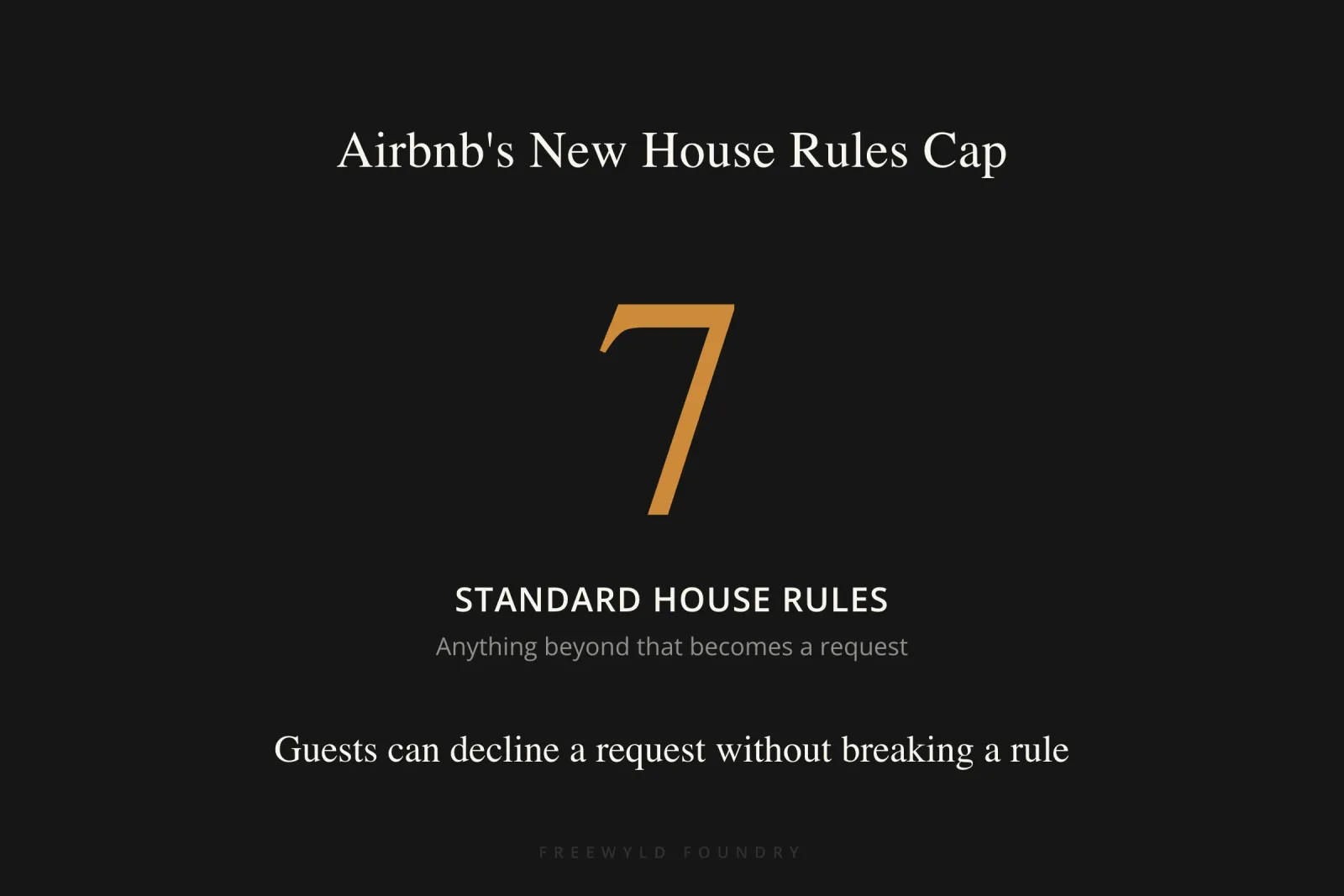
- Airbnb now caps hosts at seven standard house rules. Anything beyond that becomes a request guests can decline.
- Hosts can no longer require guests to strip beds, wash dishes, start laundry, or take out trash. Reasonable requests, like gathering towels or locking up, are still fine.
- Airbnb has banned collecting guest email, phone number, ID copies, card or bank details, background checks, and biometric data during booking or the stay, even to send a door code.
- Pre-arrival forms that ask for name, phone, email, license plate, or signature are no longer allowed, and neither are third-party apps required for entry.
- In-person ID checks and signed rental agreements are still allowed, as long as the ID check is disclosed in your listing and you don’t keep a copy.
- Local law and HOA requirements override the new restriction where they conflict with it.
What Changed: Airbnb’s New House Rules Cap
Airbnb used to let hosts set as many house rules as they wanted. Now you get seven standard rules, and anything you want to add beyond that gets reclassified as a request. Guests can see a request, but declining it doesn’t put them in violation of your listing’s terms the way breaking a house rule would.
If your current house rules list runs longer than seven items, Airbnb will flag that to your guests directly.
The Cleaning Rules Are the Biggest Shift
The clearest casualty of this update is anything that looks like outsourcing your cleaning crew’s job to your guest. You can no longer require guests to strip beds, wash or put away dishes, start laundry, or carry trash off site.
Airbnb made this change because guests have been complaining about it, and the complaint is a fair one: when a guest pays a cleaning fee, they don’t expect to also do the cleaning. If you’re charging for professional cleaning and still asking departing guests to strip the beds, you’re effectively charging twice for the same job.
What’s still a reasonable request: gathering used towels, putting dishes in the sink, sorting trash into the right bins, and locking up on the way out. Those are things most guests would do anyway without being asked, and Airbnb isn’t restricting common courtesy, just mandatory labor.
In practice, most professional operators already don’t require heavy cleaning tasks from guests. This part of the update mainly targets smaller, owner-operated listings that don’t run a dedicated cleaning crew and have historically leaned on guests to fill the gap.
Airbnb’s New Guest Data Restrictions
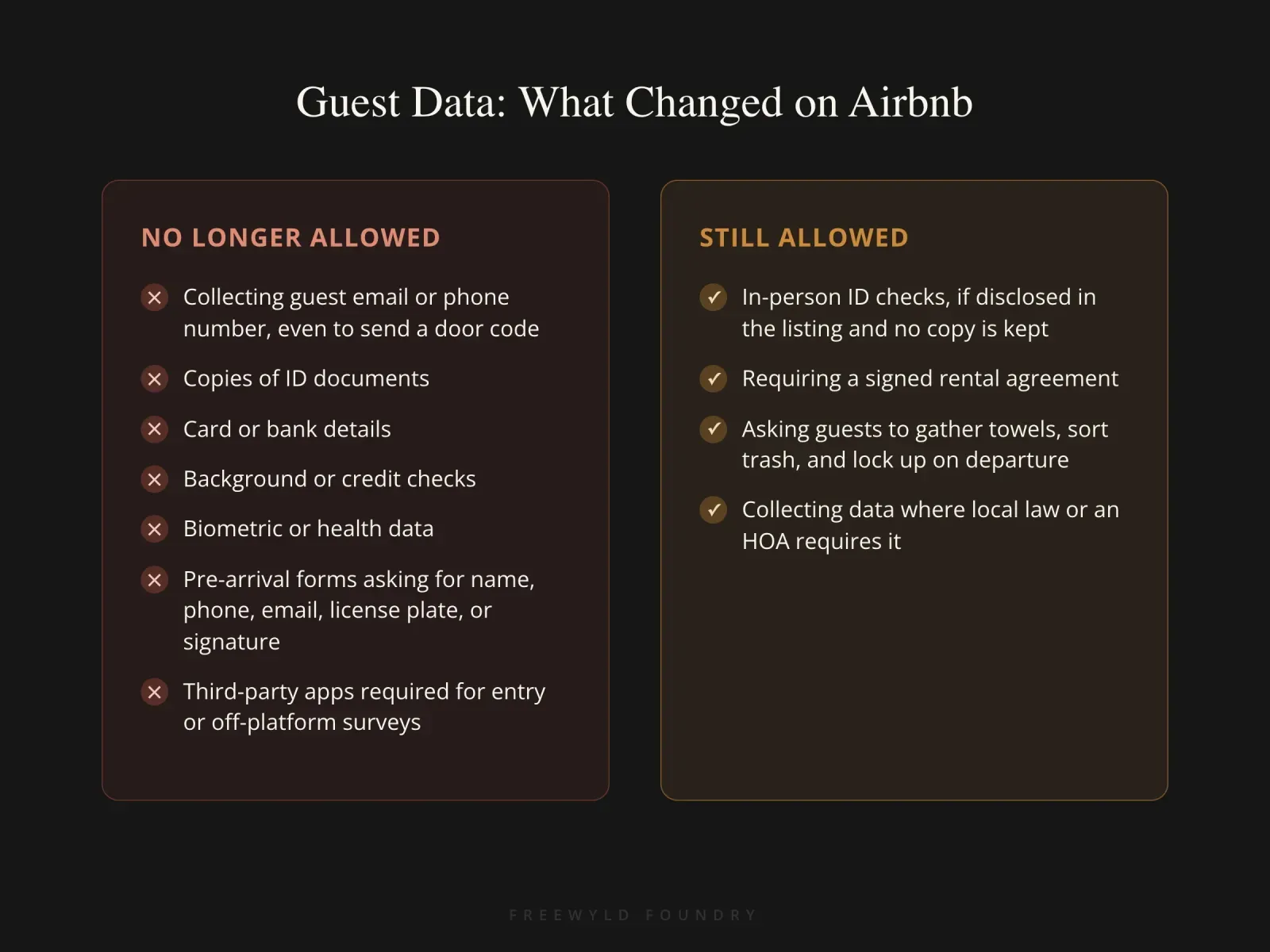
This is the part of the update with real operational teeth. Airbnb has banned hosts from collecting a long list of guest data during booking or the stay:
- Guest email address or phone number, even if it’s only to send a door code
- Copies of ID documents
- Card or bank details
- Background or credit checks
- Biometric or health data
Airbnb also closed off the workarounds. Pre-arrival forms asking for a guest’s name, phone, email, license plate, or signature are no longer allowed. Neither are third-party apps required for entry, or off-platform surveys sent to guests.
Some things are still fine. In-person ID checks are allowed, as long as it’s disclosed in your listing and you don’t keep a copy of the ID. A signed rental agreement is still allowed too. And if a local law or an HOA requires you to collect specific guest information, that requirement overrides Airbnb’s restriction.
As Jasper Ribbers, co-founder of Freewyld Foundry, put it on a recent episode of Get Paid for Your Pad: “I think these restrictions do have a pretty significant effect on how we do business, because a lot of us do collect email and phone numbers from our guests.”
Why This Could Break Your Check-In and Guidebook Apps
Here’s where this update gets expensive if you don’t catch it. A lot of third-party check-in tools and digital guidebooks gate access behind a guest’s email address. The guest has to enter their email before they can see the door code, the Wi-Fi password, or the house manual. That exact pattern is now off-limits under Airbnb’s new rules.
Go through every piece of guest-facing tech in your stack: your check-in instructions, your guidebook app, your Wi-Fi portal, any automated pre-arrival message sequence. If any of them require an email address or phone number before releasing information a guest needs for their stay, that workflow needs to change, whether that means removing the email gate or finding an alternative that doesn’t depend on collecting data Airbnb now restricts.
Enforcement: What Happens If You Don’t Comply
Airbnb hasn’t spelled out exactly how it plans to enforce this. That uncertainty is doing a lot of the work in hosting forums right now, where there’s an active, often heated conversation happening on Facebook and Reddit among hosts who don’t like the new rules.
Airbnb has a track record of tolerating some host behavior that technically sits outside its terms of service, so there’s a real gray area in how aggressively this gets policed in practice. That’s not the same as the update being optional. As Ribbers put it: “I don’t know what the enforcement around this is going to look like, but I do expect some consequences here, especially if Airbnb is going to really enforce this.”
The practical move is to treat this as a real compliance deadline rather than a suggestion, and make an intentional decision about how your listings and systems will handle it, instead of waiting to see what happens to someone else first.
How to Audit Your Listing for Compliance
Step 1: Count your house rules. Open each listing and count your current house rules. If you’re over seven, decide which ones are non-negotiable rules and which ones can move to a request.
Step 2: Remove cleaning requirements that cross the line. Check your house rules and your welcome message for any requirement to strip beds, wash dishes, do laundry, or carry out trash. Replace them with the lighter asks that are still allowed: gather towels, dishes in the sink, trash sorted, lock up.
Step 3: Audit every pre-arrival message and form. Look at your automated messaging sequence, whether it runs through Airbnb’s own messaging, your PMS, or a separate tool. Flag anything that asks for name, phone, email, license plate, or a signature before arrival.
Step 4: Check every third-party app in your guest journey. Go through your check-in app, guidebook, and Wi-Fi portal one at a time. If access is gated behind an email or phone number, that needs to change.
Step 5: Review your ID check process. If you require ID, confirm it’s disclosed in your listing description and that you’re not retaining a copy anywhere, including in your PMS or a shared drive.
Step 6: Check your local legal requirements. If your city, state, or HOA requires specific guest data collection for short-term rentals, document that requirement so you have a clear exception on file if the subject ever comes up.
What This Means If You Manage Multiple Listings
A single listing is a quick audit. A portfolio is a different problem, because a check-in workflow or guidebook template that’s out of compliance usually isn’t a one-off mistake. It’s baked into a template that’s been copied across every unit you manage.
Go through your systems once, fix the template, and that fix should apply everywhere instead of listing by listing. If you’re running this through a property management system or a dedicated check-in tool, check with that vendor directly. Some of them may already be adjusting their own data collection to stay compliant with Airbnb’s policy. Others may not have caught up yet, which means the compliance gap sits with you until you push them on it or switch tools.
Airbnb wasn’t the only platform making changes recently. Vrbo raised its commission structure to a flat 12% around the same time, which is a pricing issue rather than a data policy one. Handle both updates in the same pass through your systems since you’re already in there.
Common Mistakes Hosts Are Already Making
Mistake 1: Assuming this only applies to new bookings. The restriction covers guest data collected during booking and during the stay. Audit your existing pre-arrival and check-in workflows, not just the ones you set up for future reservations.
Mistake 2: Not checking third-party tools. It’s easy to audit your own house rules and welcome message and stop there. The bigger risk usually sits in a check-in app or guidebook tool you set up months ago and haven’t looked at since.
Mistake 3: Treating “gray area enforcement” as “no enforcement.” Airbnb’s history of tolerating some out-of-policy behavior isn’t a guarantee it will tolerate this. Build your compliance plan around what the policy says, not around what you assume Airbnb will or won’t check.
Mistake 4: Keeping ID copies on file out of habit. Even operators who’ve always disclosed their ID check requirement sometimes keep a scanned copy in a shared drive or PMS note field. That habit is specifically what the update prohibits, regardless of how long you’ve been doing it.
Frequently Asked Questions
How many house rules can I set on Airbnb now?
Seven. Airbnb now limits hosts to seven standard house rules. Anything beyond that gets reclassified as a request, which guests can see but are free to decline without it counting as a violation of your listing’s terms.
Can I still ask guests to clean before checkout?
You can ask for reasonable things like gathering used towels, putting dishes in the sink, sorting trash into the right bins, and locking up. You can no longer require guests to strip beds, wash or put away dishes, start laundry, or carry trash off site. Those tasks now belong to your cleaning fee, not your guest.
Can I still collect a guest’s email address or phone number?
Not through Airbnb’s booking or check-in flow, and not even to send a door code. That restriction is one of the biggest operational changes in this update, since a lot of host tech, from guidebook apps to Wi-Fi portals, has historically used an email requirement as the gate to access.
Can I still check a guest’s ID on Airbnb?
Yes, but only in person, only if it’s disclosed in your listing, and you can’t keep a copy of it. Requiring a signed rental agreement is still allowed too.
What happens if I don’t comply with Airbnb’s new guest data rules?
Airbnb hasn’t published specifics on enforcement. Airbnb has historically tolerated some host behavior that technically falls outside its terms of service, so there’s a gray area in how strictly this gets policed. That’s not a reason to ignore it. Treat the update as a real compliance requirement and make an intentional decision about how you’ll handle it, rather than hoping it goes unnoticed.
Does this change apply to Vrbo too?
This update is specific to Airbnb. Vrbo made its own unrelated change around the same time, raising its commission structure to a flat 12%, which is a pricing issue rather than a data policy one.
Are there any exceptions to the new guest data rules?
Yes. If a local law or your HOA requires you to collect certain guest information, that requirement still applies and overrides Airbnb’s restriction.
Conclusion
The house rules cap is a minor adjustment for most professional operators. The guest data restrictions are not. If any part of your check-in process, guidebook, or Wi-Fi access depends on collecting a guest’s email or phone number first, that’s the piece of this update that needs your attention this week, not whenever you get around to it.
Go through the audit steps above once, fix the templates that apply across your whole portfolio, and you’ll be ahead of hosts who are still finding out about this update from a Facebook thread.
Want a second set of eyes on your portfolio’s operations and pricing?
Freewyld Foundry provides white-glove Revenue & Pricing Management for STR operators with $1M+ in annual bookings. We manage $220M+ across 4,000+ listings and help clients achieve 18% above market performance through daily expert oversight. Get a free personalized revenue report.
Related Resources:
- How to Prevent Airbnb Listing Suspensions: 7 Systems That Work
- Airbnb Review Guidelines 2026: What Hosts Need to Know
- Vrbo’s Commission Change: How to Protect Your Margin
- Revenue & Pricing Management Services
Listen to the full conversation: October RM Update: Airbnb’s New Guest Data Rules, Vrbo’s Commission Hike, and 22.5% Revenue Growth
About Jasper Ribbers: Jasper Ribbers is co-founder of Freewyld Foundry and co-host of the Get Paid for Your Pad podcast. He specializes in data-driven pricing strategies and revenue optimization for short-term rental operators. Connect with Jasper on LinkedIn.