Your Once-in-a-Decade Revenue Opportunity
If you own a short-term rental in the United States, Mexico, or Canada, I need you to pay very close attention to what I’m about to share.
The 2026 FIFA World Cup is coming, and it’s not just another sporting event. We’re talking about potentially 6 million visitors flooding into host cities across three countries in June and July 2026. These aren’t typical tourists. They’re passionate soccer fans with deep pockets, willing to pay premium prices for accommodation during one of the world’s most-watched sporting events.
Here’s what makes this different: this might be the biggest revenue opportunity you’ll see in the next decade for your Airbnb or short-term rental. We’re talking about the potential to earn in two months what you might normally make in an entire year. But here’s the catch: you need to start preparing now.
In this comprehensive guide, I’m going to walk you through exactly how to position your property, price it correctly, and capture this massive wave of demand. Whether you’re a seasoned host or just getting started, this World Cup strategy could transform your rental business.
Understanding the Magnitude of the 2026 World Cup
Let’s start with some context about why this event is so significant for short-term rental owners.
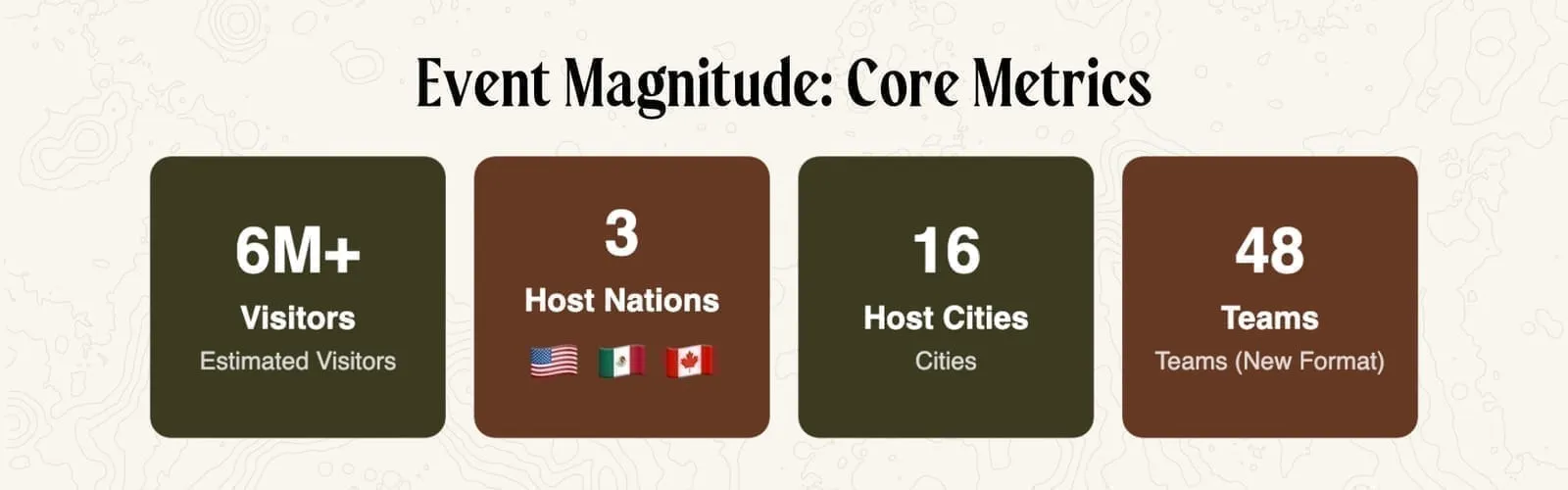
The FIFA World Cup isn’t just big. It’s massive. It’s one of the most-watched sporting events on the planet, and the 2026 edition will be the first to feature 48 teams, up from the traditional 32. That means more games, more fans, and more demand for accommodations.
The tournament will take place across 16 cities in three countries: the United States, Mexico, and Canada. We’re expecting an estimated 6 million visitors specifically for this event. These aren’t people looking for budget hostels or camping options. World Cup attendees typically have significant disposable income and are willing to pay premium rates for quality accommodations.
Why This Is Different from Regular High-Demand Events
You might be thinking, “I’ve hosted during busy weekends before. How different can this be?” The answer is very different.
Regular events, even major concerts or conferences, typically draw local or regional crowds. The World Cup attracts an international audience. Fans will be flying in from Europe, South America, Asia, and Africa. They’re not just coming for a single game. Many will stay for multiple matches, potentially booking your property for extended periods.
The demand curve is also unique. Unlike a single-day event where demand spikes and drops quickly, the World Cup spans an entire month. From the group stages in June through the finals in July, you’ll have consistent, rolling demand. This creates opportunities for strategic pricing that you simply don’t get with shorter events.
Which Cities Should Be Paying Attention?
Not every market will benefit equally from the World Cup, so let’s get specific about where the opportunity lies.
The 2026 World Cup will be hosted across 16 cities. In the United States, the host cities include Atlanta, Boston, Dallas, Houston, Kansas City, Los Angeles, Miami, New York/New Jersey, Philadelphia, San Francisco, and Seattle. In Mexico, games will be held in Guadalajara, Mexico City, and Monterrey. Canada’s host cities are Toronto and Vancouver.
If you own property in any of these cities, you’re sitting on a potential goldmine. Even if you’re not directly in these cities, properties within a 30 to 60-minute commute could still see significant spillover demand as primary accommodation in the host cities fills up and prices rise.
Secondary Markets and Spillover Opportunities
Here’s something most hosts don’t think about: when major events hit, the immediate area often sells out quickly, pushing demand outward to neighboring communities.
If you’re in a suburb or smaller city near a host location, don’t assume you’ll miss out. Smart travelers often look for accommodations outside the epicenter, especially if they can save money or find more space. Properties with good transportation links to host cities, whether by train, metro, or highway, can capture this overflow demand.
The key is to market your property correctly. Emphasize your proximity to the host city, transportation options, and any advantages you offer, like parking, larger spaces for groups, or quieter neighborhoods for families.
The Revenue Opportunity: What the Numbers Really Mean
Let’s talk about money, because that’s ultimately what this is about.
When I say you could make in two months what you normally make in a year, I’m not exaggerating. During major sporting events, short-term rental rates can increase anywhere from 200% to 500% or more compared to typical rates. Some properties in prime locations on peak-demand days have commanded rates 10 times their usual price.
Think about your current revenue model. If you’re making $3,000 per month on average, you might be looking at $36,000 in annual revenue. Now imagine capturing $15,000 to $25,000 just in June and July 2026. That’s the potential we’re discussing.
Breaking Down the Revenue Timeline
The tournament structure creates multiple pricing opportunities. The group stage matches in June will have steady demand as fans travel to see their teams play. As teams advance to the knockout rounds, demand intensifies. The quarterfinals, semifinals, and finals in July represent peak pricing opportunities.
You’ll want to think strategically about minimum night stays. While you might normally accept one or two-night bookings, during the World Cup, you can implement longer minimum stays. Three, five, or even seven-night minimums are common during major events. This reduces turnover costs and maximizes your revenue per booking.
Starting Your World Cup Strategy Now
Here’s the most important thing I need you to understand: the time to act is now, not next year.
Savvy travelers and groups start booking accommodations for major events 12 to 18 months in advance. We’re already approaching that critical booking window for the summer 2026 tournament. If you wait until early 2026 to adjust your pricing and availability, you’ll miss the early booking wave.
Early bookers are often the least price-sensitive. These are organized groups, corporate clients, and dedicated fans who prioritize securing accommodations over getting the absolute lowest price. They’re your ideal customers, and they’re searching right now.
Setting Your Initial Pricing Structure
This is where many hosts make a critical mistake. They either underprice out of fear that no one will book, or they overprice and end up making last-minute corrections.
Start by researching what happened in previous host cities of the World Cup. Look at 2014 in Brazil, 2018 in Russia, or even the 2022 World Cup in Qatar. While each market is different, historical data gives you a baseline for understanding demand patterns and pricing multipliers.
For most properties in host cities, I’d recommend starting with rates that are 2.5 to 3 times your normal rate for June and July 2026. You can adjust upward as bookings come in and you see how the market responds. It’s easier to lower prices if needed than to raise them significantly after you’ve already accepted bookings at lower rates.
Revenue Management Strategies for Maximum Profit
Effective revenue management during the World Cup requires more sophistication than your typical pricing strategy.
Dynamic pricing tools can help, but they’re not perfect for one-time mega-events like this. Many automated pricing systems look at historical data, but there’s no historical precedent in your market for an event of this magnitude. You’ll need to supplement automation with manual adjustments based on the specific match schedule and your property’s location relative to different stadiums.
The Match Schedule Is Your Pricing Calendar
Not all World Cup days are created equal. The tournament schedule will be released, and you need to study it carefully.
Matches featuring popular teams like Brazil, Argentina, Germany, France, or host nations will drive higher demand than other games. If a major team is playing in your city, expect peak demand for those specific dates. The opening match, any matches involving the host nations, and all knockout stage games command premium pricing.
Create a tiered pricing strategy based on the match schedule. Your highest rates should be reserved for the most high-profile matches and knockout rounds. Group stage matches with less popular teams can still command elevated rates, just not your absolute peak pricing.
Optimizing Your Listing for World Cup Bookings
Your standard listing description won’t cut it for this event. You need to optimize specifically for World Cup guests.
Update your listing title and description to explicitly mention the World Cup and your proximity to the stadium or stadiums if your city hosts multiple matches. International travelers will be searching specifically for “World Cup accommodation” or “FIFA 2026 housing,” so make sure those keywords appear naturally in your listing.
What World Cup Guests Are Looking For
Understanding your target guest is crucial to effectively positioning your property.
World Cup attendees often travel in groups. Families, friend groups, and organized fan clubs frequently book larger accommodations together. If you have a property that can sleep 6, 8, or more people, emphasize this capacity. Multi-bedroom homes and apartments with common gathering spaces are particularly valuable.
Location matters, but so does the experience. Highlight any features that would appeal to soccer fans, such as large TVs for watching other matches, outdoor spaces for pre-game gatherings, proximity to restaurants and bars, or easy stadium access. If you have parking, that’s a significant advantage since many guests will be renting vehicles.
Real-World Example: Learning from Past World Cups
Let me share what happened to short-term rental owners during previous World Cups to illustrate the potential.
During the 2014 World Cup in Brazil, property owners in Rio de Janeiro saw nightly rates increase by an average of 300% to 500%. A modest apartment that normally rented for $100 per night was easily commanding $400 to $600. Properties near the iconic Maracanã Stadium, which hosted the final, saw even more dramatic increases.
One host I spoke with who had a three-bedroom apartment in São Paulo normally earned about $2,500 per month. During the World Cup month, he earned $18,000 from a single 28-day booking to a corporate group. That single month accounted for 60% of his total revenue for the year.
The key lesson? He had prepared six months in advance, optimized his listing for corporate bookings, and set his pricing based on comparable events rather than his normal market rate. He also offered flexibility in his cancellation policy initially to capture early bookings, then tightened it as the event approached.
Managing Risk and Cancellation Policies
Let’s address the elephant in the room: what if you block out your calendar at high rates and then don’t get bookings?
This is a legitimate concern that requires a balanced approach. You want to capture the premium rates the World Cup offers, but you also don’t want to end up with empty dates if you’ve overpriced or if demand doesn’t materialize as expected.
Start with a more flexible cancellation policy for bookings made far in advance. This reduces the risk for early bookers and makes them more likely to commit to your higher rates. As you get closer to the event (say, within 90 days), you can switch to a strict cancellation policy for any remaining dates. By that point, demand should be clear, and guests booking close to the event are less likely to cancel.
Beyond Pricing: Operational Excellence During the World Cup
High rates mean high expectations. Guests paying 3 to 5 times your normal rate will expect an exceptional experience.
This is not the time to cut corners on amenities, cleanliness, or communication. Consider upgrading your linens, ensuring your Wi-Fi can handle multiple devices, and stocking your property with thoughtful welcome amenities. For international guests, simple touches like universal power adapters, local transit information, and recommendations for watching other matches nearby can significantly enhance their experience.
Communication with International Guests
Many World Cup guests will be from countries where English isn’t the primary language. Consider how you’ll handle communication barriers.
Having basic information about your property translated into Spanish, Portuguese, French, and German can be valuable. Include Wi-Fi passwords, house rules, and emergency contact information in multiple languages. Apps like Google Translate can help with ongoing communication, but preparing key information in advance shows professionalism and reduces confusion.
Also, be prepared for questions about getting to the stadium, purchasing match tickets (though you should never directly involve yourself in ticket sales), and navigating public transportation. Create a simple guide with this information to send to guests before their arrival.
Marketing Your Property for Maximum Visibility
Don’t rely solely on Airbnb or VRBO to bring you World Cup bookings. Proactive marketing can help you capture demand early.
Consider listing your property on multiple platforms, including international vacation rental sites that might be more popular in countries with major soccer followings. Websites that cater specifically to European or South American travelers could give you access to your ideal guest demographic.
Targeting Corporate and Group Bookings
Some of the highest-paying guests during the World Cup won’t come through traditional channels at all.
Corporations often send clients or employees to major sporting events, and they prefer the space and privacy of vacation rentals over hotels. Media companies, sponsors, and team officials also need accommodations. These bookings typically involve longer stays and less price sensitivity.
Reach out to corporate travel agencies, event planners, and sports marketing companies that work with World Cup-related businesses. Let them know you have premium accommodations available. These bookings often happen 6 to 12 months in advance through direct negotiations rather than online platforms.
Preparing for Operational Challenges
Managing a property during a mega-event isn’t business as usual. You’ll face unique operational challenges that require planning.
Cleaning and turnover will be more complex when you’re hosting at full capacity with back-to-back bookings. Make sure you have reliable cleaning staff lined up well in advance, and consider paying premium rates to ensure they prioritize your property during this crucial period. The last thing you want is a cleaning no-show when you have guests arriving in a few hours, paying $500 per night.
Handling Noise and Neighbor Relations
Let’s be honest: World Cup guests are there to celebrate, and celebrations can get loud.
If you’re in a residential neighborhood, proactively communicate with your neighbors about the upcoming World Cup. Let them know you’ll have more guests than usual but that you’re committed to maintaining reasonable standards. Provide your contact information so they can reach you directly if issues arise.
Set clear noise expectations in your house rules and in your pre-arrival communication with guests. Many hosts install noise monitoring devices that alert them to potential issues without recording conversations. This allows you to address problems before they escalate to neighbor complaints or property damage.
The Long-Term Impact on Your Rental Business
The World Cup isn’t just about two months of revenue. It can transform your entire rental business if you approach it strategically.
Successfully hosting during a major event builds your reputation and review portfolio. Positive guest reviews during high-demand periods demonstrate that you can deliver under pressure. These reviews are valuable social proof that helps you command higher rates year-round.
Additionally, the operational systems you develop for managing the World Cup—from advanced booking procedures to guest communication templates—become assets you can use during future high-demand periods. You’re essentially building scalable processes that make your business more profitable and efficient in the long term.
Summary & Key Takeaways
Let’s consolidate the most important points from this guide:
- Start planning now: The optimal booking window for World Cup accommodations is 12 to 18 months in advance. Early 2025 is the time to optimize your listing and adjust pricing.
- Research and price strategically: Begin with rates 2.5 to 3 times your normal rate, adjusting based on the match schedule, your location relative to stadiums, and booking pace.
- Optimize your listing specifically for World Cup guests: use relevant keywords, emphasize group capacity, and highlight features soccer fans value, such as location, parking, and entertainment options.
- Implement smart minimum stays: Use 3 to 5-night minimums for most dates, but be flexible around specific high-profile matches to maximize total revenue.
- Prepare for operational excellence: High rates mean high expectations. Ensure your property, communication, and guest experience are all elevated to match your premium pricing.
Next Steps: Take Action Now
The 2026 World Cup represents a once-in-a-decade opportunity for short-term rental owners in host cities. The difference between capturing this opportunity and missing it comes down to preparation and execution.
Here’s what you should do this week: First, confirm whether your property is in or near a host city. Second, block out June and July 2026 on your calendar and set initial premium pricing. Third, start optimizing your listing with World Cup-specific keywords and descriptions. Fourth, research the match schedule as soon as it’s released and adjust your pricing tiers accordingly.
The hosts who act now will capture the early booking wave and secure premium rates. Those who wait will find themselves competing in a crowded market as the event approaches, likely accepting lower rates than they could have achieved with earlier planning.
What’s your biggest question about preparing your property for the World Cup? Are you in a host city, or are you in a secondary market hoping to capture spillover demand? Drop a comment below and let’s strategize together. Your success in 2026 starts with the decisions you make today.
External Links:
- FIFA 2026 Official World Cup Website: [https://www.fifa.com/fifaplus/en/tournaments/mens/worldcup/canadamexicousa2026]