
The distribution channel question comes up with almost every new STR client: which platforms should you actually be on? Airbnb only? All four? Something in between?
In this Rev Up episode, Jasper draws on booking data from 75+ clients and over 4,000 properties under management to give you a real framework for answering that question, along with the history of each major platform, current market share numbers, and the three factors that should drive your decision.
You will learn:
- Why VRBO dominates vacation rental markets but underperforms in urban areas, and what its 1995 founding tells you about its current guest demographic
- US market share data for 2024 to 2025: Airbnb at 43%, Direct at 28%, VRBO at 28%, Booking.com at 8%
- Why the European picture is completely different, with Booking.com at 48% and VRBO nearly irrelevant at 2%
- The three decision drivers behind choosing which channels to use: risk, revenue, and operational complexity
- Why Jasper considers Airbnb and Direct bookings to be must-haves for almost every operator at any stage
We also talk about:
- The Airbnb-only strategy: when it actually works and why some operators genuinely thrive on a single channel
- Why your guest email list is an asset no OTA can ever take from you, and why you should start building it from day one
- How to evaluate whether VRBO or Booking.com is worth the added complexity in your specific market
- Booking.com’s ongoing push to grow its US market share and what that means for operators considering the platform today
- Why Booking.com’s complexity comes directly from its hotel industry origins, and how that affects the onboarding experience
Mentioned in the Episode:
Subscribe for new episodes every Monday on YouTube, Spotify, and Apple Podcasts.
The Direct Booking Playbook
The complete system for growing direct bookings from 20% to 50%. Covers brand strategy, website conversion, email marketing, creator partnerships, Meta Ads, and the 5 biggest mistakes to avoid.
Download Free GuideContinue Listening
July STR Market Update: World Cup Impact, 22% Revenue Growth, and Airbnb's New 15% Discount
Jasper shares the full July market update including June portfolio results (22% YoY growth, $14.4M in client revenue), World Cup market winners and losers, July pacing, August pricing warnings, and a breakdown of Airbnb's brand new 15% discount for top-rated guests and what operators should do about it.

3 Ways to Get Good at Revenue Management
Revenue management is a specialty skill set. If you do not invest in learning it, you are leaving 10 to 40 percent of revenue on the table every year. Jasper breaks down the three pillars of actually getting good at it: experience, resources, and community.
25% YoY Growth and 1.4M Travel Points From His Mortgage: David Dodge on Building a STR Portfolio
David Dodge started with one beach house in Lincoln City, Oregon in 2021. Three years later his portfolio is up 25% year over year and he's earning 1.4 million travel points annually from his mortgage payments using BILT. He and Jasper break down exactly how both happened.
Which Channels Are We Actually Talking About?
Welcome back to Get Paid for Your Pad. It's Monday, and today on Rev Up we're talking about distribution channels. Which platforms should you be on to maximize revenue in your short-term rental business?
The four main channels we recommend to clients are Airbnb, VRBO, Booking.com, and Direct Bookings. There are situations where you might not use all four, depending on your goals and your operational capacity. But I want to walk you through each one, explain why they matter, how big they are in different markets, what kind of guests use them, and what the trade-offs are.
To really understand the distribution game, it helps to understand the history of these platforms.
A Brief History: VRBO, Booking.com, and Airbnb
VRBO is the oldest of the three. It was founded in 1995 by David Klaus from Colorado, who wanted to rent out his ski condo and had no real tool to do it. VRBO stands for Vacation Rentals by Owner. The platform was built from the start around the idea of renting homes specifically designed for vacationers, not rooms in someone's house. That origin still shows up in where VRBO is strongest today: beach markets, mountain markets, traditional vacation rental destinations. It's not particularly strong in urban areas. The guest demographic on VRBO also tends to be older, which makes sense given the platform's age and history.
In 2005 a company called HomeAway was founded and acquired VRBO in 2006. HomeAway consolidated a bunch of smaller vacation rental sites. Expedia Group eventually acquired HomeAway, and the HomeAway brand has since been retired. VRBO now lives inside Expedia.
Booking.com was founded in 1996 in Amsterdam by Geert-Jan Bruinsma. It started as a Dutch startup called Bookings.nl, eventually merged with a UK company called Active Hotels, and was acquired by Priceline Group in 2005. Today Booking.com is the largest OTA in the world by revenue and the dominant vacation rental channel in Europe. But its origins matter: Booking.com started as a hotel booking platform, built for businesses, not for individuals. That's why onboarding with Booking.com has historically been more complex than Airbnb. It has more rate plans, more promotions, more configuration. It was designed as a B2B system, and that architecture is still baked into how it works today.
Airbnb was founded in 2007, though it didn't really get traction until around 2009. Even though Airbnb is now the dominant platform in the short-term rental space, it's actually the newest of the three. What Airbnb did was make short-term rentals accessible to the masses. If you had a house, a room, or even an air mattress, you could suddenly start a business. The barrier to getting started was as low as it had ever been, and that's probably one of the biggest reasons Airbnb scaled as fast as it did.
Market Share Data: What the Actual Numbers Show
Most market data in this industry comes from scraped sources and has accuracy issues, particularly for direct bookings, which can't be scraped at all. Keyed data is one of the few companies with real booking data, pulling directly from property management systems rather than scraping. Based on their 2024 to 2025 data:
In the United States and North America, Airbnb leads at 43% of bookings. Direct bookings come in second at 28%. VRBO is also at 28%. Booking.com is at 8%.
Europe looks completely different. Booking.com holds 48% market share and is the dominant channel. Airbnb is at 40%. Direct bookings are only 11%, which is notably lower than the US. And VRBO is essentially irrelevant at 2%. VRBO is a North American channel.
This is important context for your channel decision. Booking.com's strength in Europe and with international travelers means that if you're in a market with heavy international traffic, like Miami, Booking.com may be worth more to you than it would be in a domestic-only market like Kansas City.
The Three Decision Drivers
When I talk to operators about which channels to be on, there are three factors that matter most.
The first is risk. Being on one channel carries significant concentration risk. If Airbnb blocks your account or changes their policies in a way that hurts you, and you're only on Airbnb, your business takes a serious hit. As Mark Simpson, my friend in the UK, puts it: don't build your business on somebody else's land. We've had clients whose Airbnb listings got banned and couldn't easily create new ones because Airbnb flagged them as duplicates. For those clients, having VRBO and Booking.com as backup channels nearly made up the difference. More channels mean lower risk.
The second is revenue. The more channels you're on, the more potential sources of bookings you have. This is the straightforward case for multi-channel distribution.
The third is complexity. Every channel you add brings operational complexity: separate review systems to build, separate policies to manage, potential for calendar conflicts, and different payout timing and dispute processes. When you're small, you can often absorb this complexity. When you're scaling, it becomes a real constraint. We manage 4,000 homes across 75 clients worldwide, and the complexities we could get away with at 10 clients are now genuine problems at scale. Keep this in mind before you try to be on every channel at once, especially early on.
The Airbnb-Only Case
We do have clients who are only on Airbnb and performing well. There are real advantages to a single-channel strategy.
When all your bookings run through one platform, that platform gives you more visibility. Airbnb's algorithm rewards hosts who generate bookings on Airbnb, and it can detect calendar blocks from other platforms. So if you're only on Airbnb, your momentum on that platform grows faster. You also only have to build one review profile. You can dominate your market on one platform more quickly than spreading yourself across several.
The risk, of course, is that if something goes wrong with that channel, you have nothing else. That's a real trade-off to weigh.
The Framework: Start Simple, Add Channels as You Scale
In my view, Airbnb and Direct are both must-haves for almost every operator.
Airbnb is the largest channel in most US markets, it's the easiest to onboard with, and it's where most operators should start. Direct bookings are a must because your guest email list is an asset that no OTA can take from you. Even if you just maintain a spreadsheet of email addresses from past guests, that's something you own. You can use it to drive repeat bookings, launch a new property, offer a discount, and reach people regardless of what happens to any individual platform.
You don't have to have a sophisticated direct booking website from day one, but start building that list from day one. Most property management systems include a basic direct booking site, and the investment to set one up is pretty low.
VRBO is worth adding if it's strong in your market. In traditional vacation rental markets like beach and mountain destinations, VRBO can drive meaningful bookings. In urban areas, its impact is more limited. A quick way to gauge its relevance: go to VRBO, search your market, and see how many properties are listed and how many reviews they have. If the platform has active inventory and engaged guests in your area, it's probably worth adding.
Booking.com makes sense if you're in a market with international travel, if you're in Europe, or if you're at a stage where you have the operational capacity to manage a more complex platform. Their onboarding has improved significantly in recent years, and they've introduced Booking.com Pay, which removes the need for your own payment processor. But it is still the most complex of the four channels to set up and maintain. Some of our clients who had bad early experiences, particularly around credit card chargebacks, still avoid it. That's a real consideration.
Booking.com is actively investing in growing its US market share, which is worth factoring into your long-term thinking. Being on a channel when it's still building in your market can give you an early mover advantage.
Wrapping Up
The channels that matter are Airbnb, VRBO, Booking.com, and Direct. Start with Airbnb. Add Direct as early as you can. Evaluate VRBO and Booking.com based on your market, your stage, and how much complexity you're ready to take on.
If you want to talk through your distribution strategy, you can get a free revenue audit at freewyldfoundry.com/get-started. We'll look at your portfolio, check the strategy and the data, and show you where we think there's room to improve. If it looks like a win-win, we'll talk about working together.
See you next week.
Related Articles
STR Distribution Channels: Which Platforms Should You Be On to Maximize Revenue?
Airbnb, VRBO, Booking.com, or Direct: which channels actually drive bookings for short-term rental operators? Here is the market share data, the platform history, and the decision framework used across 75 client companies and 4,000 properties.

STR Market Update July 2026: Freewyld at 29.8%, the Airbnb Discount Decision, and What to Fix Before August Ends
Freewyld portfolios are pacing 29.8% ahead in July while the broader market sits at 5%. Here is what is driving the gap, what the Airbnb top-rated guest discount actually means for your pricing, and the August weekday problem most operators are about to walk into.
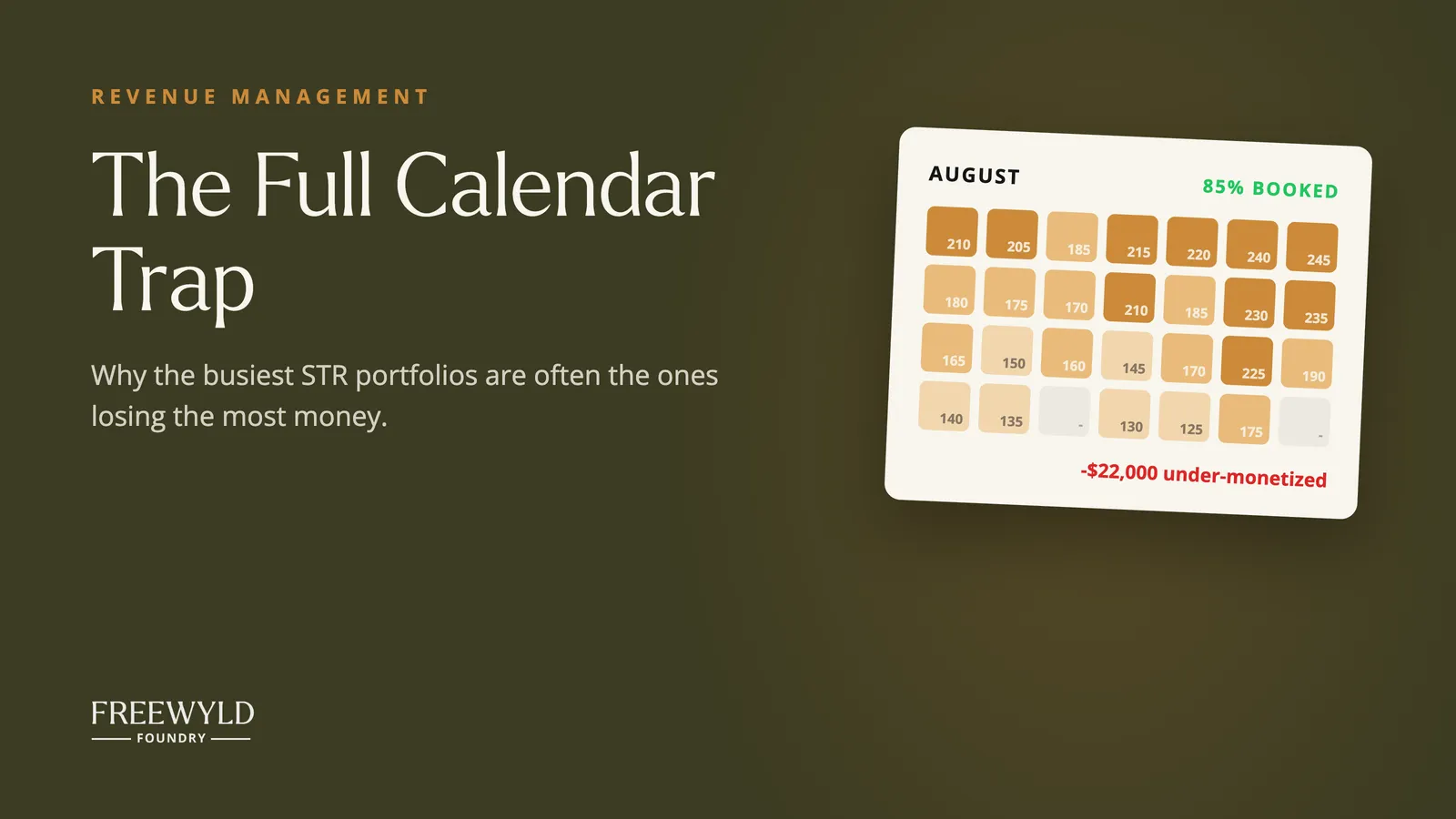
The Full Calendar Trap: Why the Busiest STR Portfolios Are Often the Ones Losing the Most Money
85% occupancy, great reviews, and a pricing tool on autopilot. It looked like a healthy business. It was leaking $22,000 a month.