If you’re managing short-term rentals in 2026, you need to face a hard truth: the market isn’t growing like it used to. Year-over-year demand has plateaued across most markets in the United States. The days of riding a wave of increasing traveler demand are over.
You can still increase your revenue. One portfolio we worked with saw a 35% increase in RevPAR by fixing just one aspect of their revenue management strategy. Thirty-five percent.
In this article, you’ll learn the five specific strategies that will help you maximize your short-term rental revenue in 2026. These aren’t theoretical concepts. They’re battle-tested tactics we use every day managing over 70 clients across the United States. Whether you manage your own properties or handle revenue for multiple clients, these strategies will help you outperform your market and capture more revenue from every booking opportunity.
Invest in Revenue Management Education
Most short-term rental operators wing it when it comes to revenue management. They adjust prices when they remember to check. They react to their competition. They rely on their pricing tool to do all the work. These are classic revenue management mistakes that cost operators thousands in lost income.
That approach might have worked five years ago when demand was exploding. Not anymore.
The challenge is that quality education on revenue management specifically for short-term rentals is hard to find. There’s plenty of training for hotels. Airlines have sophisticated revenue management systems and courses. But for vacation rental operators? The resources are scattered and often superficial.
Where to Find Quality Revenue Management Training
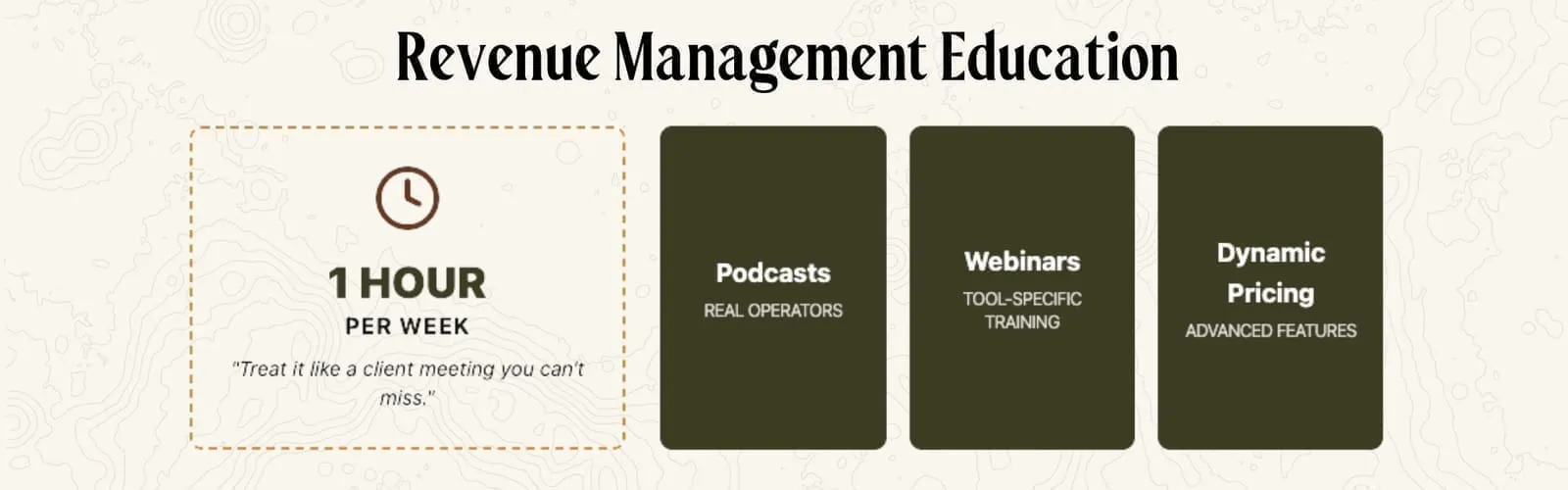
Start with podcasts and webinars focused specifically on short-term rental revenue management. Look for content creators who are actual operators, not just talking heads. Do they manage real portfolios? Do they share specific results and case studies?
If you’re using a dynamic pricing tool like PriceLabs, take advantage of their training center. PriceLabs offers webinars and detailed documentation on their features. Many operators don’t realize the full capabilities of their pricing software. We regularly discover that new clients aren’t using critical functionalities that could boost their revenue.
For example, PriceLabs has the most sophisticated feature set in the industry, but we’ve found that most users only scratch the surface. They set base prices and maybe adjust some seasonal multipliers. But they’re missing orphan day pricing, sophisticated minimum stay management, and advanced pacing controls that could significantly impact their bottom line.
Make Learning a Habit
Block out one hour per week specifically for revenue management education. Put it in your calendar. Treat it like a client meeting you can’t miss.
This isn’t optional if you want to stay competitive. The operators who are crushing it in 2026 are the ones who continuously learn and adapt. They study their booking windows. They understand their market dynamics. They know what drives their pacing.
Remember, investing in yourself is always the best investment you can make. The knowledge you gain compounds over time, improving every pricing decision you make going forward.
Control Your Pacing Like Your Revenue Depends On It
Here’s the single most important concept in revenue management: pacing.
If you take nothing else from this article, understand this. Controlling your pacing means actively managing how your properties fill up across your entire booking window, not just the next 30 days.
Most operators check their pricing tool once or twice a week. They look at last-minute inventory. They see gaps in their calendar for next month and panic-drop their prices. But they ignore what’s happening three, four, or five months out.
This is leaving massive amounts of money on the table.
What Is Market Penetration Index and Why It Matters
Our favorite key performance indicator for tracking pacing is Market Penetration Index (MPI). This metric compares your forward occupancy to the market’s forward occupancy across your entire booking window.
If your market is 40% booked for July and you’re only 25% booked, you’re behind pace. If the market is 40% booked and you’re 50% booked, you’re ahead of pace.
The key is setting the right pacing targets for different seasons. Going into the low season, you want to pace ahead of the market. Get your bookings locked in early when demand is softer. Going into high season, you can afford to pace with the market or even slightly behind it, especially in markets where final occupancy typically reaches 85-90%.
The 35% RevPAR Increase Case Study
Let me share a real example that illustrates the power of pacing control.
We started working with a client early last year who thought they were doing great. Their occupancy was always high, often reaching 90% or more. On the surface, everything looked good.
But when we dug into their data, we found a critical problem. They were getting most of their bookings late in the booking window at discounted prices. Their calendar was priced way too high four to six months out, so they weren’t capturing any bookings in that timeframe. Then they’d panic as dates approached and slash their prices to fill gaps.
They were only paying attention to the last 30 days of their booking window when the actual booking window for their market was five to six months.
We adjusted their pricing strategy to be more competitive further out in the booking window. We lowered their prices at the four to six-month mark to match booking velocity in their market. We stopped the panic discounting at the last minute.
The result? A 35% increase in RevPAR.
We didn’t change their property descriptions. We didn’t add new amenities. We didn’t even touch their distribution channels. We controlled their pacing across the entire booking window instead of just the last 30 days.
How to Implement Pacing Control Today
Start by analyzing your booking window length. Look at when your bookings typically come in. Is it 90 days out? 120 days? 180 days?
Next, set up tracking for your forward occupancy versus market occupancy at different points in that booking window. Most dynamic pricing tools can show you this data.
Then set targets. For low season, aim to be 10-15% ahead of market pace. For shoulder season, aim to be roughly even with the market. For high season in high-demand markets, you can afford to be 5-10% behind the market.
Check your pacing daily or at least several times per week. When you’re falling behind pace in a period, adjust your pricing further out to stimulate bookings. When you’re ahead of pace, you can afford to hold or even increase your rates.
This single shift in strategy can transform your revenue performance. For a deeper look at the secrets behind professional pricing, check out our guide to STR revenue management secrets.
Establish Daily and Weekly Revenue Management Rhythms
Revenue management isn’t something you do when you have free time. It’s not something you squeeze in between guest messages and cleaning coordination.
It requires dedicated, consistent attention.
Think about it this way. If you managed a hotel, would you check your rates once a week when you felt like it? Of course not. You’d have systems and processes to review your inventory, pricing, and market conditions every single day.
Your short-term rental business deserves the same level of discipline.
The Power of a Daily Revenue Management Cadence
Carve out 15 to 30 minutes every single day to review your revenue management. If you manage a larger portfolio, you’ll need more time. But even if you only have a handful of properties, this daily check-in is essential.
Put it in your calendar at the same time every day. This consistency matters. Your brain will adapt to the routine, and you’ll start to spot patterns and opportunities more quickly.
During your daily review, check:
- New bookings that came in and at what rates
- Changes in market occupancy for key dates
- Competitor rate changes
- Any gaps forming in your calendar
- Current pacing versus targets
This doesn’t need to be a lengthy analysis session. It’s a quick pulse check to make sure nothing is going wildly off track.
Your Weekly Review
Once per week, block out at least one hour for a deeper revenue management analysis. This is when you look at broader trends, make strategic pricing adjustments, and evaluate your performance.
For weekly reviews, focus on:
- Reviewing your entire booking window and pacing
- Analyzing which properties are performing above or below expectations
- Adjusting seasonal pricing strategies based on how the market is evolving
- Planning for upcoming events or demand shifts
- Reviewing and optimizing minimum stay requirements
Here’s what this looks like in practice. Every morning at 8 AM, the first four hours of the day are blocked for revenue management work. No meetings. No messages. Complete focus on the portfolios being managed.
During that time, each property gets attention. Prices get adjusted based on overnight market changes. Bookings are analyzed. Strategies are refined.
This isn’t glamorous work. But it’s the work that drives results.
Why Most Operators Fail at Consistency
The biggest challenge isn’t knowing what to do. It’s doing it consistently.
Revenue management requires discipline. There will be days when you don’t feel like checking your rates. Days when you’d rather focus on operations or marketing or dealing with guest issues.
But the operators who win are the ones who show up every day, even when it’s boring. Even when it feels like nothing is changing. Because small, consistent adjustments compound into significant revenue gains over time.
If you can’t commit to daily reviews, at minimum commit to three times per week. Less than that and you’re flying blind, reacting to problems instead of preventing them.
Capitalize on World Cup Soccer Demand
2026 has a massive revenue opportunity that many operators aren’t preparing for: the FIFA World Cup.
The tournament runs from June 11th through July 19th, with games held across multiple cities in the United States. This is the first time the World Cup has been held in North America since 1994, and it’s expected to bring millions of international travelers to the country.
The opportunity isn’t limited to cities hosting games.
Why World Cup Impact Extends Beyond Host Cities
Think about how international travelers behave. If you’re flying from Germany or Brazil or England to watch a World Cup match, you’re not flying 10 hours just to watch one game and fly home.
You’re making a trip out of it. You’re staying a week or two. And you’re visiting other places while you’re here.
This means major tourist destinations across the United States should expect elevated demand during the World Cup window, even if they’re not hosting games. Think about places like:
- National parks (Yellowstone, Grand Canyon, Yosemite)
- Popular beach destinations
- Theme park cities (Orlando)
- Other major tourist attractions near host cities
If your properties are in or near these areas, you need to be ready.
How to Prepare for World Cup Demand
First, don’t get booked up too early at normal rates. This is crucial. If you typically have properties fill up for summer by March or April, resist that urge this year.
Keep your rates elevated through the spring. Monitor your pacing closely. You can afford to pace slightly behind your market this year because the late-booking international demand will materialize.
Second, pay attention to your distribution channels. International travelers, especially Europeans, heavily use Booking.com. If you’re not currently on that platform, consider adding it now during the slower winter months. This gives you time to build up reviews and visibility before the summer rush.
Third, extend your minimum stay requirements strategically during the World Cup window. International travelers are more likely to book week-long stays, so you can be more restrictive during peak World Cup weeks without hurting your booking velocity.
Finally, watch your market data closely starting in March and April. You’ll start to see if elevated demand is materializing in your area. Adjust your strategy accordingly.
The Extended Impact Window
Don’t just focus on June 11 through July 19. The impact window is longer.
Travelers will arrive in the days before the tournament starts. Many will stay after it ends. So from early June through the end of July, you should expect elevated demand if you’re in a market that will benefit from World Cup travel.
Even the weeks immediately before and after could see spillover demand as travelers extend their trips.
This is likely where most of the growth in the short-term rental market will come from in 2026. Don’t miss it.
Make It Easy for People to Book Your Properties
We’re in a phase of the short-term rental market where demand growth has stalled. Pacing data across 70+ clients shows that January, February, March, and even summer booking patterns are tracking similarly to 2024 and 2025.
When demand isn’t growing, you have to capture a bigger share of the existing demand. Tools like AI in the STR industry are helping operators do exactly that. But one of the simplest levers? Remove friction from the booking process.
Every barrier you put between a potential guest and a confirmed booking is costing you revenue. Let’s break down the specific changes that will make your properties easier to book.
Instant Book Is Non-Negotiable
If you’re not using Instant Book on Airbnb, you’re losing bookings to competitors who are.
Travelers want immediate confirmation. They don’t want to send a request and wait 12 hours for you to respond. They want to book now and move on with their planning.
Yes, Instant Book comes with some risk. You might get a guest you wouldn’t have approved. But the data is clear. Properties with Instant Book enabled get more bookings at higher rates because of the visibility boost Airbnb provides.
The benefits far outweigh the minimal additional risk, especially if you have proper guest screening through the platform’s verification systems.
Open Your Calendar Further Out
Look at your calendar right now. How far out can people book?
Many hosts only open their calendar three to six months in advance. This is a mistake.
Open your calendar at least nine months out, preferably twelve. This improves your visibility in search results. It also captures early bookers who plan far in advance, particularly for peak season travel.
We recently analyzed a portfolio where the calendar was closed starting May 1st. The market was already 25% booked for summer. This operator was missing out on all that early demand because they weren’t bookable.
Don’t let this happen to you.
Rethink Your Minimum Stay Requirements
Here’s a controversial take: most minimum stay restrictions are hurting your revenue, not helping it.
Many operators have a standard minimum stay ladder set up. Two nights for the next 30 days. Three nights for 30-60 days out. Four nights for 60-90 days. Five nights beyond 90 days.
This approach made sense years ago when demand was higher and booking windows were longer. It doesn’t work anymore.
Every time you set a minimum stay requirement, you’re restricting demand. If you require four nights, everyone who wants to book three nights goes to your competition.
There are exceptions. Holiday weekends like Memorial Day or Fourth of July benefit from three-night minimums to capture the full weekend. If someone books Friday through Sunday, you’ll struggle to rent that Sunday night at a premium.
But these are specific, strategic restrictions. Not blanket policies applied across your entire calendar.
Default to a two-night minimum as your baseline. Anything more requires a specific, defensible reason based on your market dynamics and booking patterns.
Flexible Cancellation Policies Drive More Revenue
This is the hardest pill to swallow for most operators.
Airbnb now highlights properties with flexible cancellation policies with a special badge. They’re pushing hosts toward more flexible policies because it improves the guest experience and drives more bookings.
The challenge is that you feel the pain of flexible cancellation policies, but you don’t see the benefit.
When someone cancels your Fourth of July weekend booking the day before, you feel it. You have to rebook at a lower price. Your revenue takes a hit. That pain is visceral and memorable.
But you don’t see all the bookings that came in at premium rates because you offered a flexible policy. Those bookings are invisible. They just show up in your calendar as normal reservations.
So you feel all the downside and none of the upside, which makes you think flexible policies are bad for business. But the data shows the opposite.
Here’s a practical framework for cancellation policies:
- One and two-bedroom properties: Moderate cancellation policy
- Three and four-bedroom properties: Limited cancellation policy (two weeks protection)
- Five-plus bedroom properties: Firm cancellation policy (one month protection)
Strict cancellation policies should be avoided entirely. Airbnb actively deprioritizes properties with strict policies in search results.
The larger the property, the more protection you need because rebooking is harder and guests book further in advance anyway. But for smaller properties with shorter booking windows, the flexibility drives significantly more revenue despite the occasional painful cancellation.
Reduce Your Booking Lead Time
Some operators have a 24-hour lead time before guests can book. This means people can’t book in the last 24 hours before check-in.
This kills your last-minute bookings.
If you have smart locks and automated check-in systems, there’s no reason to block same-day bookings. Allow bookings up until check-in time, or even later if your operations can support it.
Last-minute bookings, even at slightly discounted rates, are pure profit. The night was going to go empty anyway. Capture that revenue.
Summary and Key Takeaways
The short-term rental market in 2026 won’t look like the growth markets of 2019 through 2021. Demand has plateaued. Competition has intensified. The operators who thrive will be the ones who master revenue management fundamentals.
Here are your action steps:
- Invest in education: Block one hour per week for revenue management learning. Study your pricing tool’s full capabilities and learn from operators with proven results.
- Control your pacing: Track Market Penetration Index across your entire booking window. Set targets based on seasonality. Adjust prices to stay on track.
- Build consistent habits: Review your revenue management for 15-30 minutes daily. Do a deeper one-hour analysis weekly. Make it non-negotiable calendar time.
- Prepare for World Cup impact: If you’re near host cities or major tourist attractions, keep rates elevated through spring. Consider adding Booking.com for international visibility.
- Remove booking friction: Enable Instant Book. Open your calendar 9-12 months out. Reduce minimum stay restrictions. Consider more flexible cancellation policies.
These aren’t theoretical concepts. They’re proven strategies that are working right now across dozens of portfolios. The 35% RevPAR increase wasn’t an outlier. It’s what happens when you take revenue management seriously and execute consistently. If you want to learn how property managers are maximizing revenue across their portfolios, start with these fundamentals.
Next Steps: Take Action Now
You’ve learned the five strategies that will transform your revenue in 2026. But knowledge without implementation is worthless.
Pick one strategy from this article and implement it this week. Don’t try to do everything at once. Start with the area where you’re weakest.
Not tracking your pacing? Set up Market Penetration Index tracking today.
Don’t have a daily revenue management routine? Block out 30 minutes tomorrow morning and start the habit.
Still have restrictive booking policies? Review your minimum stays and cancellation policies this afternoon.
Small, consistent action beats grand plans that never get executed.
What’s the biggest revenue management challenge you’re facing right now? Which of these five strategies do you think will have the most impact on your portfolio? Drop a comment below and let’s discuss.
Internal Links:
- Ep679 - 2026 Pricing Strategies Every Short-Term Rental Operator Must Use
https://freewyldfoundry.com/ep679-str-pricing-strategies-2026/ - Ep673 - FIFA World Cup 2026: How STR Hosts Can Win (Action Plan)
https://freewyldfoundry.com/ep673-fifa-world-cup-2026/ - Ep652 - How to Maximize 5-Star Guest Reviews on Airbnb
https://freewyldfoundry.com/ep652-how-to-maximize-5-star-guest-reviews-on-airbnb/
External Links:
- Airbnb Flexible Cancellation Policy Information: https://www.airbnb.com/help/article/475 (Official policy guidelines)
- FIFA World Cup 2026 Schedule: https://www.fifa.com/fifaplus/en/tournaments/mens/worldcup/canadamexicousa2026 (Official tournament information)