When you think about holiday pricing for your short-term rental, Thanksgiving and Christmas probably come to mind first. But there are at least seven other long weekends throughout the year that deserve just as much strategic attention.
These “hidden holidays” represent massive revenue opportunities that are often overlooked or mismanaged. If you’re leaving money on the table during Memorial Day, Labor Day, Presidents Day, and other long weekends, you’re not alone. Most operators either ignore these dates entirely or apply blanket pricing rules that don’t match their specific market dynamics.
In this guide, you’ll learn exactly how to approach minimum night stay settings, when to implement restrictions, and how to adjust your strategy based on your market type. By the end, you’ll have a clear framework for maximizing revenue during every long weekend of the year.
Understanding Hidden Holidays in the United States
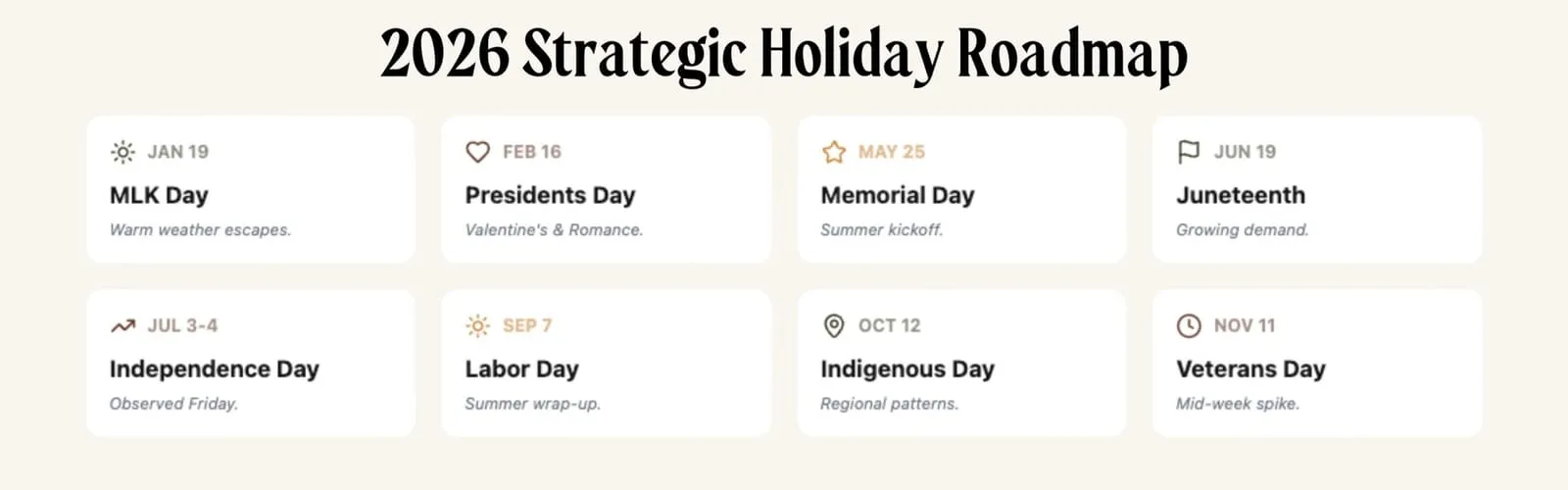
Let’s start with the complete list of long weekends that deserve your attention in 2026:
Martin Luther King Jr. Day falls on Monday, January 19. This kicks off the year and often sees increased demand, especially in warmer destinations where people escape winter weather.
Presidents’ Day lands on Monday, February 16, this year. This is particularly significant because it coincides with Valentine’s Day weekend (February 14 falls on Saturday). The combination creates exceptional demand in romantic getaway markets.
Memorial Day arrives on Monday, May 25. This is the unofficial start of summer and one of the biggest travel weekends of the year.
Juneteenth is Friday, June 19, a federal holiday that’s still establishing its travel patterns but shows growing demand.
Independence Day on July 4 is obvious, but this year Friday, July 3 is an observed holiday for federal workers, potentially extending the weekend.
Labor Day falls on Monday, September 7, marking the unofficial end of summer with traditionally strong travel demand.
Columbus Day/Indigenous Peoples Day is Monday, October 12, with regional variations in observance affecting demand patterns.
Veterans Day lands on Wednesday, November 11, which doesn’t create a traditional long weekend but may see midweek demand spikes.
The key insight here is that each of these holidays behaves differently depending on your specific market. A strategy that works perfectly for a mountain cabin might fail miserably for a city apartment.
The Core Question: Should You Require Three-Night Stays?
This is where most operators struggle. Should you force guests to book the entire long weekend (typically Friday through Monday), or should you stay flexible and allow two-night or even one-night stays?
The answer depends on several critical factors about your market.
Factor One: Drive-To vs. Fly-To Destination
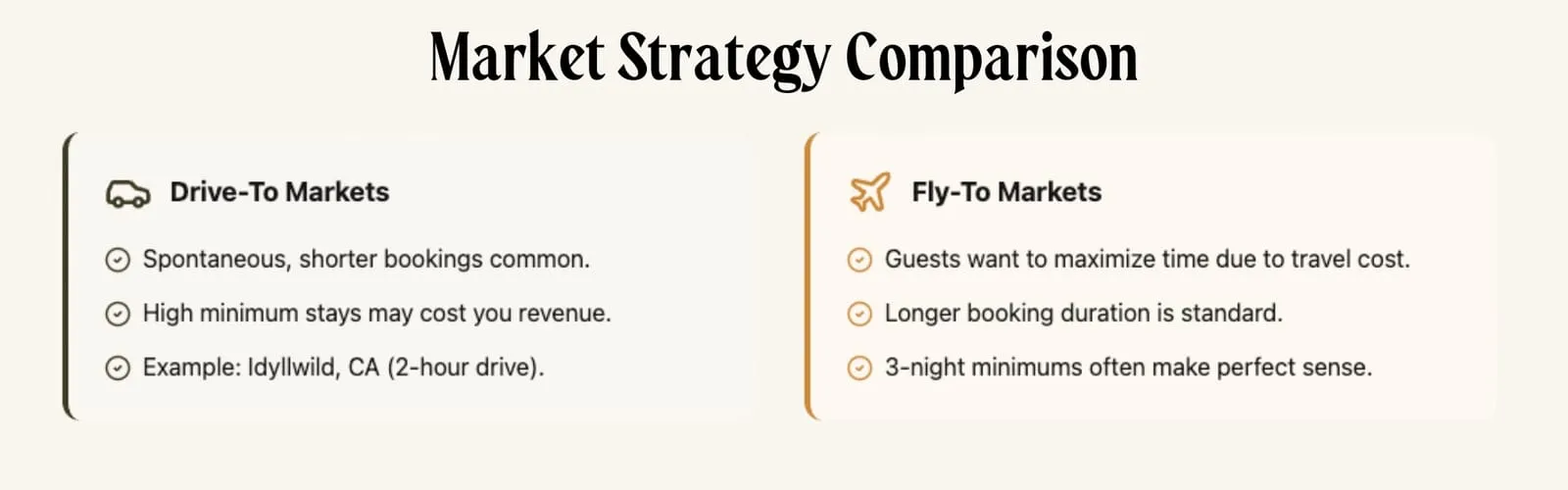
If guests are flying to reach your property, they’re much more likely to book longer stays. The hassle and expense of air travel means they want to maximize their time at the destination. In fly-to markets, implementing three-night minimums on long weekends often makes perfect sense.
Drive-to markets operate completely differently. When guests can reach you in two hours or less, you’ll see much more spontaneous, shorter bookings. A family might decide Sunday morning to take a quick overnight trip. Restricting these bookings with high minimum night stays often costs you revenue.
Take the example from Idyllwild, California, where Freewyld Foundry operates cabins. It’s only a two-hour drive from San Diego and Los Angeles. The market sees constant demand for one-night and two-night stays, even during long weekends. While competitors enforce three-night minimums on Labor Day weekend, staying flexible allows capturing those Sunday-to-Monday bookings at premium rates.
Factor Two: Can You Fill Broken Weekends?
Here’s a scenario: Someone books Friday through Saturday for your Labor Day weekend. Now you’re stuck trying to fill Saturday through Monday. Can you do it?
In urban markets with consistent business and leisure travel, absolutely. Cities almost always have demand for any combination of nights. But in traditional vacation rental markets, especially seasonal ones, a broken weekend can be nearly impossible to fill.
Before implementing flexible minimum stays on long weekends, look at your historical booking data. Can you consistently fill two-night gaps? Do you get last-minute bookings that would fill these splits? If not, protecting the full weekend with a three-night minimum might be your best bet.
Factor Three: One-Night Stay Policy
This is huge. If you don’t allow one-night stays at all, your strategy changes dramatically.
When one-night stays are allowed, you have a safety net. If someone books Friday through Sunday, you can still potentially book that Monday night standalone or as part of a Sunday-through-Tuesday stay. This flexibility means you can often afford to be more lenient with your minimum night stay requirements.
Without one-night stays, every split weekend becomes a problem. That lone Sunday night becomes much harder to book as part of a two-night minimum stay.
Factor Four: Guest Willingness to Pay Premium for Short Stays
Here’s a counterintuitive truth: guests often pay significantly higher average daily rates for shorter stays.
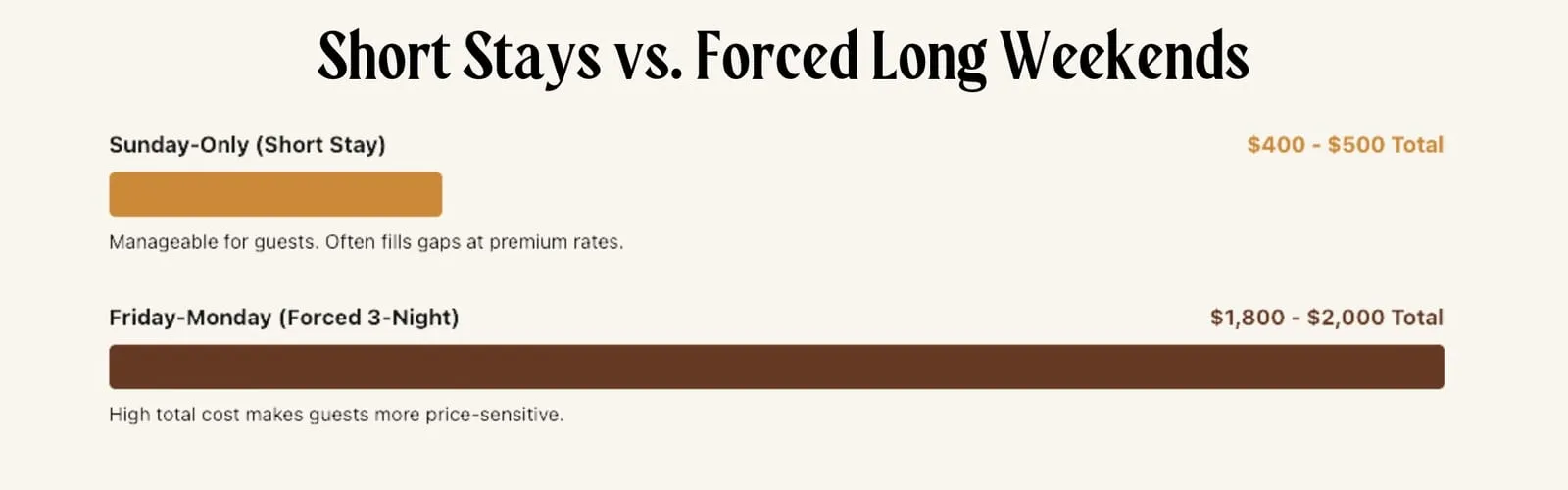
Think about it from the guest’s perspective. A one-night Sunday-to-Monday stay during Labor Day weekend might cost $400-500 total including cleaning fees. That feels manageable. But a full Friday-through-Monday stay could total $1,800-2,000. The larger total cost makes guests much more price-sensitive.
In the Idyllwild example, allowing that one-night Sunday stay at $400-500 often generates more revenue per night than forcing a three-night weekend at a lower average daily rate to ensure it books.
This doesn’t work in every market, but it’s worth analyzing your data to see if short stays command premium pricing in your area.
Strategic Minimum Night Stay Placement: Which Days Matter Most
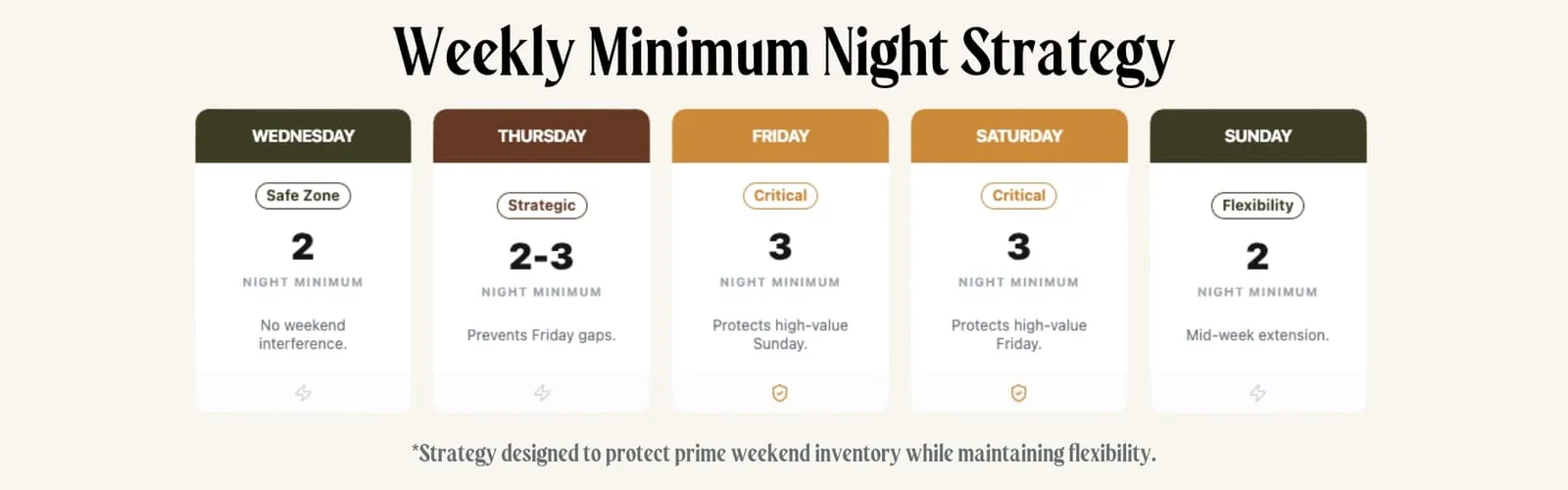
If you decide to implement three-night minimums for long weekends, which specific days should have that restriction? This gets tactical quickly.
Wednesday: Keep It at Two Nights
A two-night minimum on Wednesday (checking out Friday) doesn’t interfere with your weekend at all. But requiring three nights (Wednesday through Saturday) splits your weekend and may leave Thursday-Saturday unsold while blocking the prime Friday-Monday combination.
However, if someone does book Wednesday through Saturday (three nights), you’re getting that typically slower Wednesday and Thursday night filled while still leaving Saturday-Monday available. This can work well, but generally a two-night Wednesday minimum is safer.
Thursday: Two or Three Nights
Thursday gets interesting. A three-night minimum (Thursday through Sunday) prevents the problematic Friday-Saturday-only booking. You get Thursday booked (usually slower) and keep Sunday available for a potential Sunday-Monday booking.
A two-night minimum (Thursday through Saturday) risks that Friday-Saturday booking but provides more flexibility. Market-dependent decision.
Friday: Definitely Three Nights
This is non-negotiable in most markets. If someone books Friday-Sunday only (two nights), your Sunday night becomes very difficult to sell. That Sunday is a high-value night, and leaving it isolated rarely ends well.
A three-night minimum on Friday protects your full weekend revenue potential.
Saturday: Three Nights
Same logic as Friday. A Saturday-Monday two-night booking leaves Friday hanging, which is your highest-demand night of the weekend. Protect it with a three-night minimum.
Sunday: Two Nights
Here’s where strategy shifts. A Sunday-Tuesday two-night booking is actually excellent. You’ve likely already booked Friday-Sunday (the core weekend), and now you’re extending revenue two more days into the week.
Most markets still have decent Friday-Sunday demand even when Monday is a holiday, so leaving Sunday at a two-night minimum provides useful flexibility.
Dynamic Restrictions: When to Loosen Your Requirements
Setting initial restrictions is only half the battle. The real skill is knowing when to adjust them as your booking window closes.
Starting with aggressive three-night minimums makes sense when you’re 60-90 days out from Labor Day. You’re fishing for that ideal Friday-Monday booking. But what if you hit 30 days out and still haven’t booked?
This is where dynamic restrictions become critical, especially if you’re managing properties for owners. Owners watch these high-demand weekends closely. An empty property on Labor Day weekend will generate unhappy phone calls, even if your overall performance is strong.
The Risk-Reward Balance
You face a trade-off: hold out for the premium three-night booking, or loosen restrictions to ensure you book something.
If you wait too long and have to drop prices dramatically at the last minute to fill the weekend, owners won’t be happy about the low rate either. They’ll wonder why you didn’t capture better revenue earlier.
For owner-managed portfolios, err on the side of caution. A good booking secured 30 days out beats a risky shot at a perfect booking that might not materialize.
Setting Up Dynamic Changes in Your Pricing Tool
Most modern pricing tools (PriceLabs, Wheelhouse, Beyond) allow you to create seasonal profiles with dynamic minimum night stay rules.
The advantage of seasonal profiles over manual overrides is automation. You can set rules like “three-night minimum on Friday and Saturday until 30 days out, then switch to two-night minimum.” The system adjusts automatically without requiring you to remember to make manual changes.
Manual overrides require annual updates. Every year, when Labor Day falls on a different date, you’ll need to go in and manually adjust those override dates. With seasonal profiles, you just update the date range once per year, and all your rules apply automatically.
Another benefit: seasonal profiles keep your pricing tool cleaner. When you stack multiple manual overrides, it becomes difficult to see at a glance what rules are affecting which dates. Clean setup reduces errors and makes your pricing more transparent and easier to audit.
Real-World Example: Presidents Day Weekend Strategy
Let’s walk through a specific scenario to see how this works in practice.
Presidents Day 2026 falls on Monday, February 16. Valentine’s Day is Saturday, February 14. This creates a unique four-day opportunity: Friday-Monday covers both Valentine’s and the federal holiday.
For a romantic cabin in the mountains or a luxury condo in a resort town, this weekend is premium inventory. The strategy:
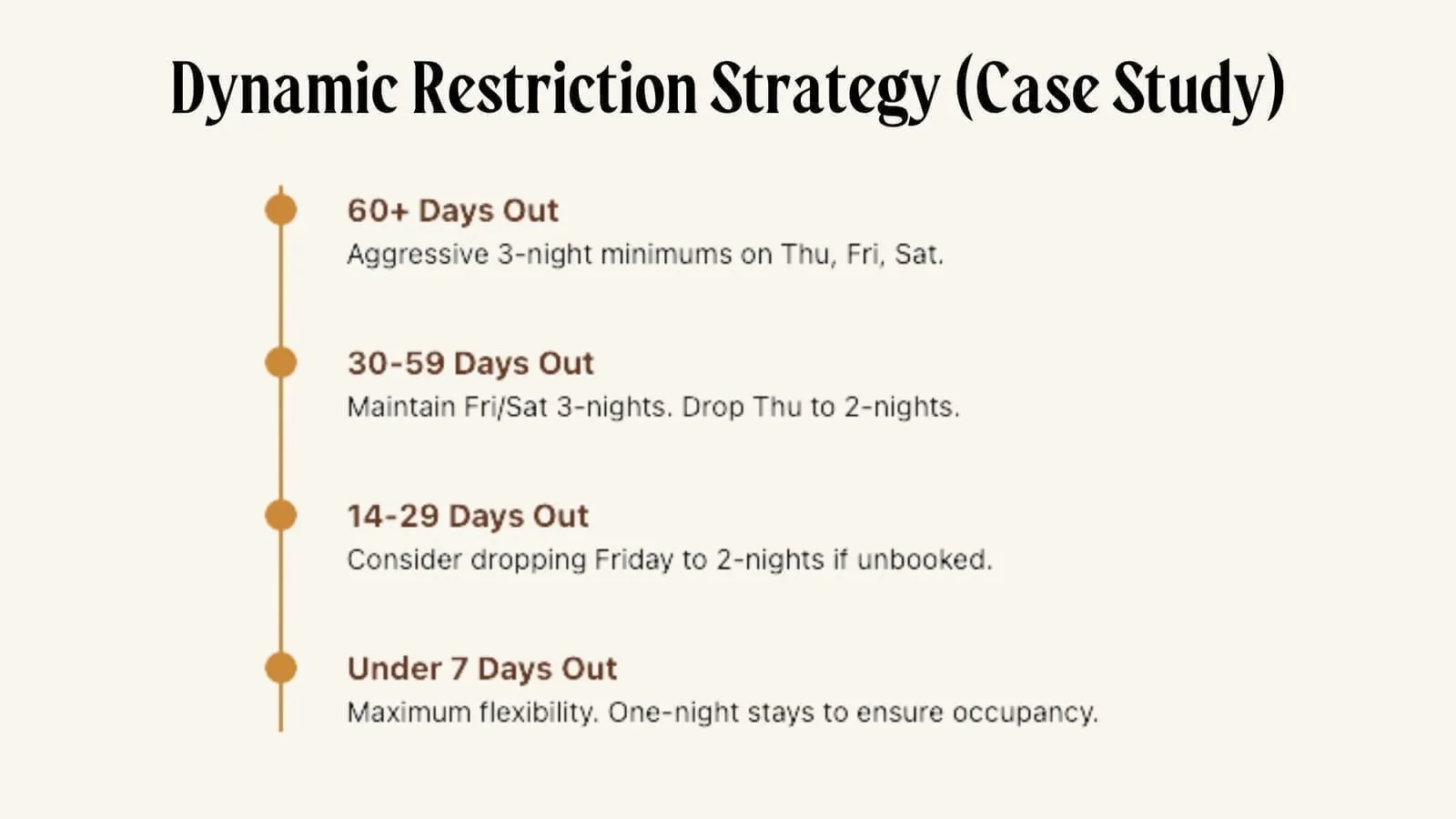
60+ days out: Three-night minimum on Thursday, Friday, and Saturday. You’re targeting Thursday-Sunday (couples celebrating Valentine’s early and extending through the long weekend) or Friday-Monday (traditional long weekend with Valentine’s included).
30-59 days out: Maintain three-night minimum on Friday and Saturday. Drop Thursday to two nights. You’re still protecting the core weekend but allowing more flexibility on the front end.
14-29 days out: If Friday-Sunday is still open, consider dropping Friday to two nights while keeping Saturday at three nights. This allows a Friday-Sunday Valentine’s booking while protecting Sunday-Monday.
7-13 days out: If you’re still not booked, open up two-night minimums across the board. Better to capture Friday-Sunday at a premium rate than risk the weekend sitting empty.
Under 7 days: Maximum flexibility. Even one-night stays if your policy allows it. A Saturday-only Valentine’s booking at a premium rate is better than nothing.
The key is having these rules set up in advance through seasonal profiles, so they execute automatically without requiring your daily attention.
Avoid the Rolling Window Trap
Here’s a common mistake: operators set up rolling minimum night stay windows that get progressively more restrictive as you book further out.
For example:
- Under 30 days: 2-night minimum
- 30-60 days: 3-night minimum
- 60-90 days: 4-night minimum
- 90+ days: 5-night minimum
This sounds logical but creates problems. Your lowest-demand periods (low season) shouldn’t have any restrictions, regardless of how far out you’re booking. Meanwhile, your highest-demand periods (peak season, holidays) should have strategic restrictions even at 7 days out if necessary.
Season matters more than booking window for minimum night stay strategy. Set your restrictions based on seasonal demand profiles and holiday calendars, not on rolling time windows.
Additional Operational Considerations
Beyond pure revenue optimization, operational factors affect your holiday strategy.
Some operators don’t want to schedule property turnovers on the holiday Monday itself. If you’re trying to give your cleaning crews the day off for Memorial Day or Labor Day, you need to adjust your strategy.
In this case, disallow check-ins on Monday while still allowing check-outs. This lets you capture the ideal Friday-Monday booking (they check out Monday morning) while preventing a Monday check-in that would require a Monday turnover.
These operational restrictions should be built into your seasonal profiles just like your revenue-based rules.
Summary and Key Takeaways
Managing hidden holidays effectively requires understanding your specific market dynamics and implementing strategic minimum night stay policies that adjust over time.
Here are your key action steps:
- Identify all long weekend holidays in your market and treat them as strategically as you treat Thanksgiving and Christmas. Memorial Day, Labor Day, and Presidents Day deserve dedicated pricing strategies.
- Determine whether your market is drive-to or fly-to, as this fundamentally affects whether three-night minimums make sense. Drive-to markets often perform better with flexibility.
- Implement strategic minimum night stays on Friday and Saturday to protect core weekend integrity, while keeping Wednesday at two nights and Sunday at two nights for maximum flexibility.
- Use seasonal profiles in your pricing tool rather than manual overrides to enable dynamic restrictions that loosen as your booking window closes. This automates the balancing act between premium rates and occupancy certainty.
- Keep your pricing tool setup clean and simple to reduce errors and improve transparency in your revenue management process.
Take Action Now
Ready to maximize your revenue on every long weekend this year? Start by auditing your current minimum night stay settings for the upcoming holidays. Are you protecting your high-value weekend nights while maintaining enough flexibility to capitalize on your market’s demand patterns?
At Freewyld Foundry, we manage revenue for over 50 vacation rental properties and obsess over these details daily. If you want expert eyes on your portfolio, get your free revenue analysis at freewyldfoundry.com/get-started. We’ll personally review your pricing strategy, identify specific opportunities, and estimate your revenue upside.
What’s your biggest challenge with long weekend pricing? Have you found that three-night minimums help or hurt your revenue in your specific market? Share your experience in the comments below.
Internal Links:
- Ep679 - 2026 Pricing Strategies Every Short-Term Rental Operator Must Use
https://freewyldfoundry.com/ep679-str-pricing-strategies-2026/ - Ep654 - Are Minimum Night Rules Costing You Thousands on Airbnb?
https://freewyldfoundry.com/ep654-are-minimum-night-rules-costing-you-thousands-on-airbnb/ - Ep651 - STR Revenue Management Isn’t Optional, It’s Everything
https://freewyldfoundry.com/ep651-revenue-management/
How to Audit Your Own Settings
Ready to find out if you’re making these mistakes? Here’s a quick self-audit you can do in the next 30 minutes: Maximum Prices: Open your pricing tool. Check your customization settings for any max price values. If you have them set, ask yourself: what would happen if I removed them? Consider testing with manual overrides on specific dates instead of blanket caps. Unbookable Nights: Toggle on unbookable night warnings. Review your entire calendar, not just the next month. Look for gaps shorter than your minimum stay requirements. Check for check-in/check-out restrictions that might create hidden gaps. Minimum Prices by Season: List your peak demand dates for the next year. For each one, verify you have an elevated minimum price set, not just an elevated base price. If you’re using one global minimum, create seasonal profiles today. Minimum Night Stay Logic: Review your MNS settings. Are you using a restrictive rolling window? Consider resetting to a flexible baseline and adding restrictions only where data supports them. Pacing: Pull up your market dashboard. Look at where bookings are happening in your market 60-120 days out. Compare your booking velocity to the market. If you’re behind, investigate why and adjust.
When to Get Professional Help
These fixes aren’t complicated. But they do require time and attention, two things most operators don’t have in abundance. If you’re running a portfolio that generates $1M+ in annual revenue, the math changes. A 10% improvement on a $100,000 month is $10,000. A 35% RevPAR lift on a million-dollar portfolio is $350,000. At that scale, having a dedicated revenue manager, someone whose full-time job is optimizing your pricing, isn’t an expense. It’s a profit center. This is what we do at Freewyld Foundry. We manage revenue and pricing for the top 1% of STR operators. We watch pacing daily. We adjust for market signals. We catch the mistakes before they cost you money. On average, our clients see an 18% performance lift above market in their first six months with us.
Get a Free Revenue Report
Want to know which of these mistakes you’re making? We offer a free Revenue Report for qualified operators. We’ll get access to your pricing tool, analyze your settings, and identify exactly where you’re leaving money on the table. Some operators get the report and decide to fix things themselves. Some realize they want professional help. Either way, you walk away knowing where your biggest opportunities are. If you’re generating $1M+ in annual revenue and running 15+ properties, apply for your free Revenue Report at FreewyldFoundry.com/report. In today’s flat market, you can’t afford to leave money on the table. These five mistakes are fixable. The question is whether you’ll fix them, or keep paying the price. This article is based on insights from the Get Paid for Your Pad podcast, where Jasper Ribbers shares revenue management strategies from managing $190M+ in STR bookings. [Listen to the full episode here.] Related Resources:
- Cashflow Mastery: Learn Revenue Management Yourself
- Get Paid for Your Pad Podcast
- Revenue & Pricing Management Service
About Freewyld Foundry: Freewyld Foundry provides Revenue & Pricing Management (RPM) for the top 1% of STR operators. Managing $190M+ in bookings across 4,000+ properties, we deliver an average 18% performance lift above market for our clients.