The Hidden Cost of CEO Distraction
If you’re a CEO or business owner, there’s a good chance you’re spending almost half your workday on tasks that don’t move your business forward. According to research from Harvard Business Review, 30 to 50% of a CEO’s time is spent on low-value activities. That’s potentially 20 hours each week spent on things that barely impact your bottom line.
The challenge gets more complex as your business grows because what matters today might not matter six months from now. Your priorities need to shift as your company evolves, but most leaders struggle to identify when and how to make those shifts.
In this article, you’ll learn how to recognize patterns in your business, identify bottlenecks before they become crises, and focus your energy on the activities that create momentum. You’ll discover practical frameworks for deciding where to invest your time and how to let go of tasks that feel urgent but aren’t important.
The Real Problem: Action Doesn’t Equal Momentum
Many CEOs confuse being busy with being productive. You can spend an entire day responding to emails, jumping on back-to-back Zoom calls, and putting out small fires, yet your business hasn’t moved forward.
This happens because of decision fatigue. When you’re making dozens or hundreds of decisions daily, you get mentally exhausted. That exhaustion leads you to default to the easiest path rather than the most important one. You tackle whatever lands in front of you instead of what will create the biggest impact.
The key distinction is this: not all action creates momentum. You need to constantly ask yourself whether what you’re doing right now is pushing your business toward its goals.
Common Low-Value Activities That Trap CEOs
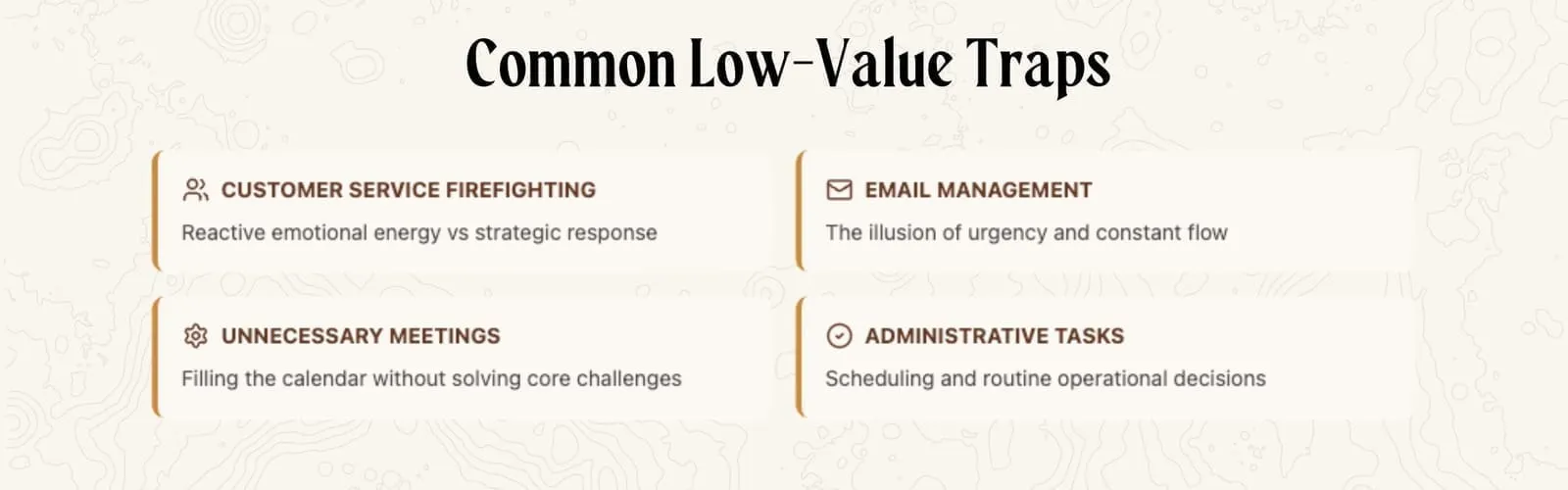
Through experience managing both Freewyld and Freewyld Foundry, certain patterns emerge in how leaders waste time. Here are the most common culprits:
Customer service firefighting. When someone posts a negative comment or sends an unhappy email, it’s tempting to jump in immediately. These situations can grab not just your attention but your emotional energy, causing you to react rather than respond strategically.
Email management. The constant flow of messages creates an illusion of urgency. You feel productive clearing your inbox, but most emails don’t require CEO-level attention.
Unnecessary meetings. Taking one phone call or Zoom meeting after another fills your calendar but doesn’t necessarily solve your biggest business challenges.
Administrative tasks. Scheduling, minor approvals, and routine operational decisions are necessary but rarely require executive judgment.
The solution isn’t to ignore these tasks entirely. It’s to build systems and teams that handle them without your direct involvement, escalating only the true fires that need your attention.
Pattern Recognition: The Most Important CEO Skill
One of the most valuable capabilities you can develop as a business leader is pattern recognition. This means noticing when one action connects to another, where opportunities might emerge, and which challenges are likely to appear next.
Pattern recognition isn’t just for CEOs. Anyone in a high-level position benefits from developing this skill. But for business owners, it becomes essential because you need to see around corners and anticipate what’s coming.
How Pattern Recognition Works in Practice
Consider how growth creates predictable bottlenecks. When Freewyld Foundry invested heavily in building its marketing department, we spent months developing the website, social media presence, teams, and systems. Eventually, the marketing efforts paid off, and qualified leads started flooding in.
Success in marketing immediately created a sales challenge. The sales team couldn’t handle the volume of qualified companies reaching out. Once the sales process gets optimized, the next bottleneck becomes fulfillment. More clients mean you need more revenue managers, support staff, and systems to deliver on promises.
After solving fulfillment challenges, the cycle returns to marketing. Now you have an efficient sales team and strong fulfillment capacity, so you need more qualified leads to fill that capacity.
This pattern repeats in every growing company. Marketing creates sales pressure. Sales success creates fulfillment pressure. Fulfillment capacity creates demand for more marketing. Understanding this cycle helps you anticipate problems before they become crises.
The Danger of Trying to Solve Everything at Once
When you recognize multiple challenges simultaneously, the temptation is to attack them all at once. This approach creates two major problems.
First, there’s a functional disadvantage. Spreading resources too thin means you can’t make meaningful progress anywhere. You’re constantly context-switching between different problems, which reduces efficiency.
Second, there’s a psychological cost. Your team never gets to feel the satisfaction of completing something significant. Everyone stays in a state of partial progress, which drains motivation and excitement.
The better approach is sequential problem-solving. Focus your entire organization on the biggest bottleneck until you solve it, then move to the next challenge. This creates momentum, builds team confidence, and allows you to maintain quality standards.
Identifying Your Highest-Value Activities
The critical question every CEO needs to ask regularly is: Where can I put my time that will generate the biggest ROI for the company?
This question becomes easier to answer once you’ve developed pattern recognition skills. You start seeing which challenge is currently the biggest bottleneck preventing growth.
The Ego Problem in Time Allocation
One major obstacle to focusing on high-value activities is ego. It’s easy to think certain tasks are beneath you as a CEO. Sales calls, customer service issues, or operational details might feel like they should be someone else’s responsibility.
But the reality is simple: everything is in your title. If your business needs something done and it’s currently the biggest bottleneck, that’s where you need to focus, regardless of what your business card says.
For example, when the sales department became the primary bottleneck at Freewyld Foundry, the CEO needed to step back into sales conversations. Not because there was no one else to do it, but because understanding those conversations directly revealed patterns about what clients needed and where challenges existed.
Similarly, if you’re a property manager dealing with constant housekeeping problems that generate negative reviews and staff turnover, your best use of time might be stepping into that department directly. Get your hands dirty, understand what’s happening, and rebuild the system from the ground up.
Managing Ego Through Humility Practice
One practical way to keep ego in check is to regularly put yourself in situations where you’re a beginner. Physical activities work particularly well for this. Practicing jiu-jitsu, for instance, provides constant humbling experiences when someone half your size can easily defeat you.
The lesson translates directly to business. You’re always learning. Even with current success, you’re still early in the journey. There’s so much you don’t know that you don’t know.
When you encounter a task and think “I don’t want to do this” or “I shouldn’t have to do this,” that’s often a signal. It might mean the task needs a system or needs to be delegated. But it also might mean you need to do it yourself right now to understand it well enough to build that system later.
The Hourly Rate Test for Task Delegation
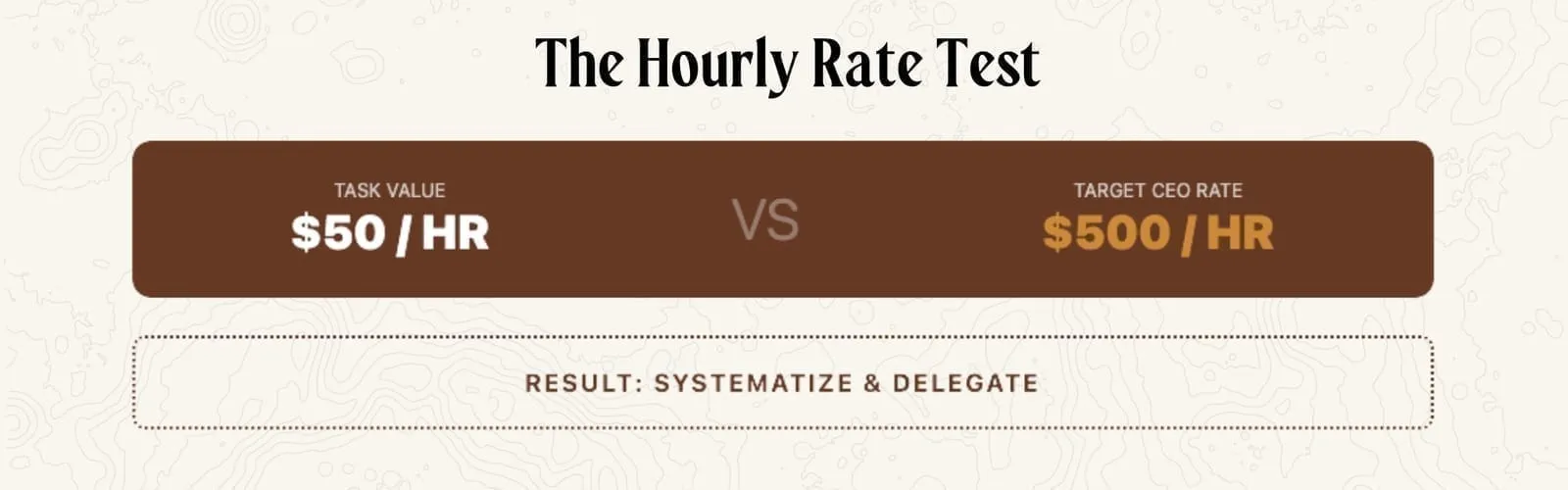
A practical framework for deciding what to delegate is the hourly rate test. Ask yourself: what would I charge someone to do this task?
Calculate your effective hourly rate based on your annual goals. If a task takes two hours and you’d charge $50 per hour for it, but your target rate is $500 per hour, that’s a strong signal to delegate.
This applies beyond business tasks. Personal responsibilities such as laundry, house cleaning, grocery shopping, and car maintenance are necessary but may not be the best use of your time. Hiring someone to handle these tasks for 12-15 hours per week frees up time for higher-value activities or for rest and relationships.
The calculation isn’t just about direct business revenue either. Time spent on your health, your relationships, or genuine relaxation can have enormous indirect value for your business performance.
Real-World Example: Solving the Sales Bottleneck
When marketing success at Freewyld Foundry created an overflow of qualified leads, the immediate response could have been to hire more salespeople quickly. But that would have missed important insights.
Instead, the CEO stepped directly into the sales process. By having conversations with the best companies around the world that were interested in their services, patterns became visible. What were the common challenges? What objections kept appearing? Where did potential clients get stuck in their decision-making?
This hands-on involvement served multiple purposes. It solved the immediate bottleneck by increasing sales capacity. It provided direct market intelligence about client needs. And it revealed what systems and processes the sales team would need once it expanded.
After spending time in the sales department and understanding the patterns, the next step became clear: prepare for the fulfillment challenge that would inevitably come when sales increased. That advance preparation prevented a crisis and maintained service quality as the company grew.
Letting Small Fires Burn
One of the hardest lessons for high-achieving CEOs is learning which problems not to solve. The phrase “let the small fires burn” captures this principle.
Small fires feel urgent. Someone is unhappy. A customer sent a complaint. A social media post got negative comments. Your instinct is to jump in immediately and fix it.
But if you respond to every small fire, you’ll spend all your time firefighting instead of building. The solution is to build systems and teams that handle these situations without requiring your involvement.
Building Escalation Systems
A strong customer service team with clear escalation protocols can effectively filter issues. Most situations get resolved at the front line. Moderate issues get handled by team leads. Only true crises that require executive decision-making reach the CEO level.
This doesn’t mean you ignore customers or quality problems. It means you trust your systems and team to handle routine issues while you focus on solving the underlying patterns that lead to better long-term outcomes.
AI Integration: The New CEO Responsibility
Artificial intelligence has moved from experimental to essential over the past year. The pace of AI development means business leaders can no longer treat it as a future concern or delegate it entirely to technical staff.
Why CEOs Must Lead AI Adoption
Companies that successfully implement AI share a common pattern: the CEO personally leads the effort to determine where to deploy it. They’re not necessarily the technical expert building the tools, but they need to be the strategic leader identifying opportunities.
There’s too much noise and too many shiny objects in the AI space. Without clear leadership, teams can get distracted trying every new tool without focusing on what solves business problems.
The CEO’s role is to identify where the biggest opportunities for AI implementation exist. Once those opportunities are clear, you can hire technical talent or train existing team members to build the solutions. But the strategic direction has to come from the top.
Current AI Applications for Business Leaders
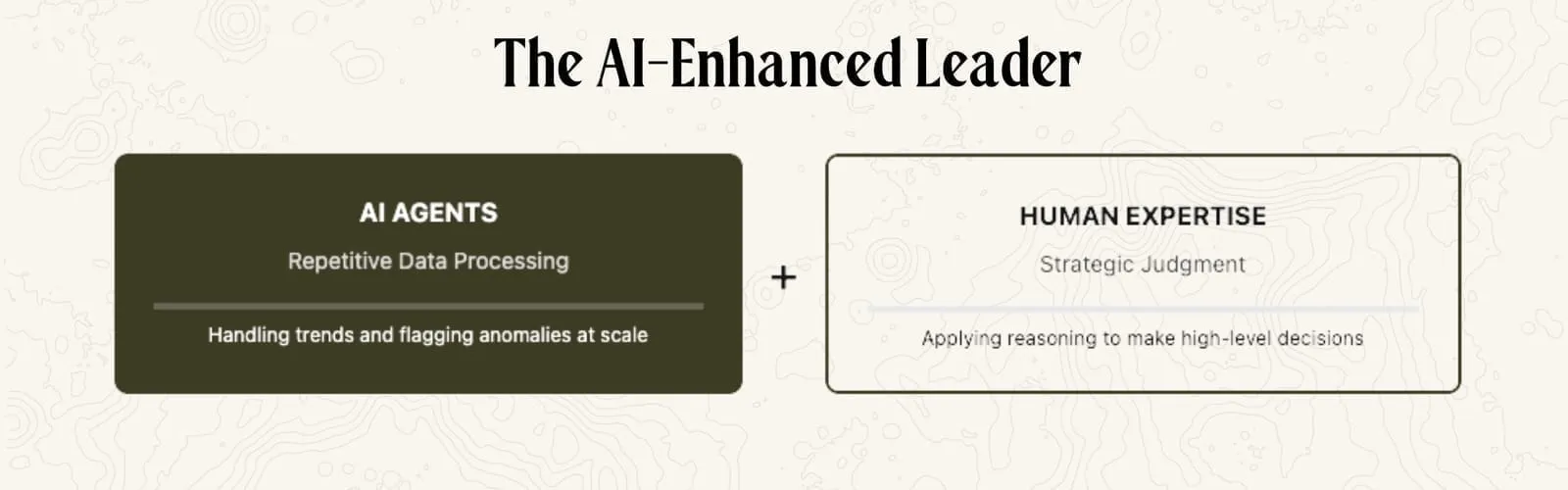
The most promising near-term applications focus on enhancing team members rather than replacing them. AI agents can handle repetitive tasks, allowing humans to focus on reasoning and decision-making.
For example, in revenue management for short-term rentals, AI tools can process data, identify trends, and flag anomalies. The revenue manager then applies judgment to that information to make strategic pricing decisions. The AI doesn’t replace the human expertise; it amplifies it by handling data processing at scale.
This pattern appears across industries. In radiology, AI image analysis initially seemed likely to replace radiologists. Instead, the field has grown by over 40% because AI handles the routine scan analysis while humans focus on diagnosis and treatment decisions.
The key is to identify which parts of each role involve repetitive data processing versus strategic judgment, then use AI to automate the former and enhance the latter.
Every Employee Becomes a CEO of Their Domain
As AI handles more routine work, every team member becomes a CEO of their subject matter expertise. They should be asking the same questions you ask: what are my low-value activities? What’s the 30 to 50% of my time that could be better spent?
When employees can offload routine tasks to AI tools, they free up capacity to focus on the top 10% of activities that drive the most impact. This shift requires leadership to guide tool selection, provide training, and adjust roles to take advantage of new capabilities.
Morning Routines: The Foundation of CEO Effectiveness
While strategies and priorities change, one constant across successful leaders is disciplined daily routines. Morning routines in particular set the tone for effective leadership.
Elements of an Effective CEO Morning Routine
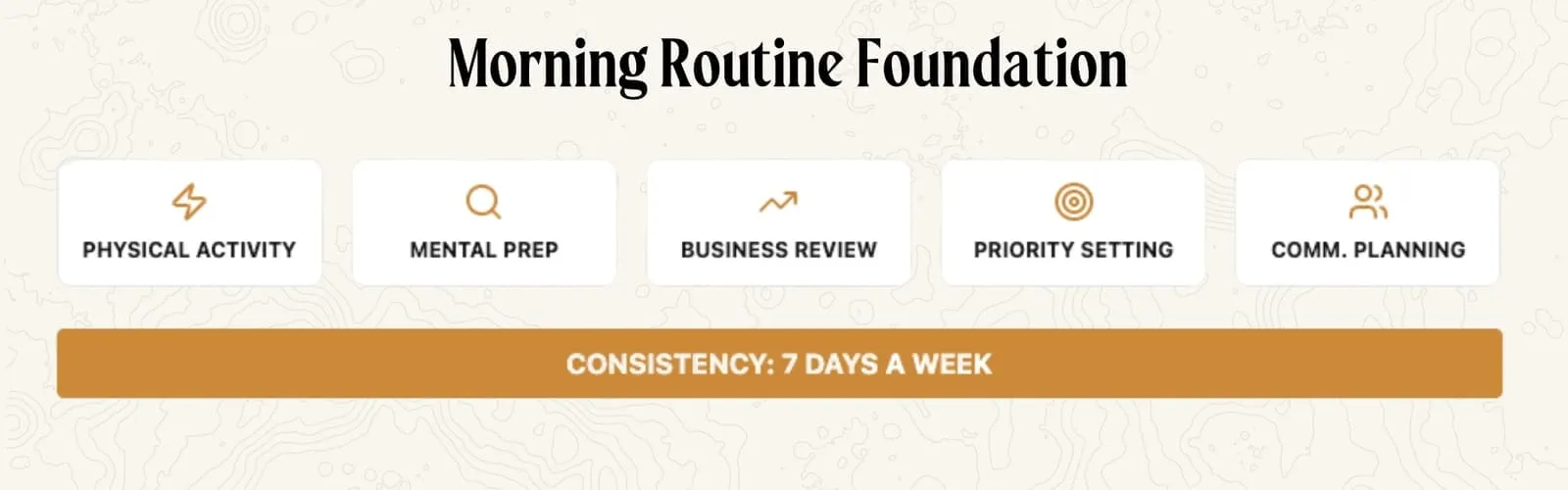
A strong morning routine starts with consistency. Getting up at the same time every day, seven days a week, creates a foundation of discipline. Taking occasional breaks when rest is needed is fine, but the default should be consistency.
The specific activities in your morning routine will vary based on personal needs, but certain elements appear frequently among effective leaders:
Physical activity. Exercise, yoga, or martial arts training prepares both body and mind for the day’s challenges.
Mental preparation. Meditation, journaling, or quiet reflection time helps process thoughts and set intentions.
Business review. Checking key metrics, revenue, bank balances, and customer service alerts gives you situational awareness before diving into specific tasks.
Priority setting. Identifying the most important tasks for the day ensures you tackle high-value activities first when energy and focus are strongest.
Communication planning. Reviewing your calendar and preparing for meetings prevents reactive scheduling from controlling your day.
The goal isn’t to follow someone else’s routine exactly. It’s to develop your own disciplined approach that prepares you to show up as the leader your team needs.
End-of-Day Routines Matter Too
Closing your day with intention is just as important as starting it well. An end-of-day routine helps you transition out of work mode and prevents unfinished tasks from occupying your mental space during personal time.
Consider including a quick review of what got accomplished, what’s carrying over to tomorrow, and what you learned. This reflection builds pattern recognition over time and helps you continuously improve your effectiveness.
Leading Through Listening
The final constant in effective CEO time management is regular connection with team members. Meeting with every person on your team as often as possible serves multiple purposes.
First, it keeps you grounded in operational reality. What’s happening on the front lines? Where are team members struggling? What obstacles are they encountering?
Second, it builds trust and engagement. When team members know their CEO is listening and cares about their challenges, they bring problems forward earlier and work harder to solve them.
Third, it reveals patterns you might otherwise miss. Conversations across different departments often highlight connections or conflicts that aren’t visible from the top level.
While in-person work would be ideal, video calls can accomplish similar goals if you approach them with genuine curiosity and focus. The key is listening rather than waiting for your turn to talk or thinking about your next meeting.
Summary & Key Takeaways
Managing your time effectively as a CEO requires shifting from reactive task completion to strategic pattern recognition. Here are the core principles:
Develop pattern recognition skills. Notice how one challenge creates the next. Anticipate bottlenecks before they become crises. Understand the natural rhythm of growth in your business.
Focus sequentially on the biggest bottleneck. Resist the temptation to solve everything at once. Concentrate your resources on the primary constraint preventing growth, then move to the next challenge.
Set ego aside and work where needed most. Everything is in your title as CEO. If a department needs attention and represents the biggest bottleneck, that’s where you need to focus, regardless of what feels appropriate for your position.
Use the hourly rate test for delegation. Calculate your target hourly rate and assess whether each task is worth your time or should be systematized and delegated.
Lead AI adoption personally. Identify where AI can enhance your team’s capabilities, then guide implementation even if you’re not the technical expert building the tools.
Maintain disciplined daily routines. Start and end each day with intention. Consistency in your personal routine creates the foundation for effective leadership of your organization.
Next Steps: Take Action Now
Start by conducting an honest audit of how you spent the last week. Track your activities in 30-minute blocks and categorize each as high-value, medium-value, or low-value based on business impact.
Calculate what percentage of your time currently goes to low-value activities. If it’s anywhere near that 30-50% range from the Harvard Business Review study, you’ve identified your first major opportunity for improvement.
Next, identify the single biggest bottleneck in your business right now. Not the three biggest challenges or five priorities. The one constraint that, if solved, would create the most momentum for your company.
Finally, decide what you’re going to stop doing. Which low-value activities will you systematize, delegate, or eliminate?
What patterns have you noticed in your own business growth? Where are you currently spending time that doesn’t create real momentum?
Share your experiences in the comments below, and let’s learn from each other’s journeys.
**Internal Links:**1. Ep661 - STR Branding Battle: Human Face vs. Company Logo
https://freewyldfoundry.com/ep661-str-branding/
2. Ep649 - Are you a Hectic Host or Strategic STR CEO?
https://freewyldfoundry.com/hectic-host/
3. Ep645 - The 4 Non-Negotiables of STR Success in 2026
https://freewyldfoundry.com/ep645-the-4-non-negotiables-of-str-success-in-2025/