The Questions Most Operators Can’t Answer
If someone asked you right now why your company exists beyond “managing short-term rentals,” what would you say?
Or what your ten-year goal is?
What makes you different in your market?
Most operators pause on these questions because they’ve never taken the time to answer them.
In this post, you’ll learn the 7 Strata framework from Verne Harnish’s book “Scaling Up.” These seven strategic questions helped Freewyld Foundry define its $1.2 billion revenue-under-management goal and transform how they make decisions. More importantly, you’ll discover how to apply this framework to your own short-term rental business, whether you’re managing 2 listings or 200.
By the end of this article, you’ll have a clear roadmap for strategic planning that separates operators who scale profitably from those who just get busier.
What Is the 7 Strata Framework?
The 7 Strata framework comes from Verne Harnish’s business strategy book “Scaling Up.” It’s a strategic planning system built around seven core questions that force clarity on the things that determine whether your business thrives or just survives.
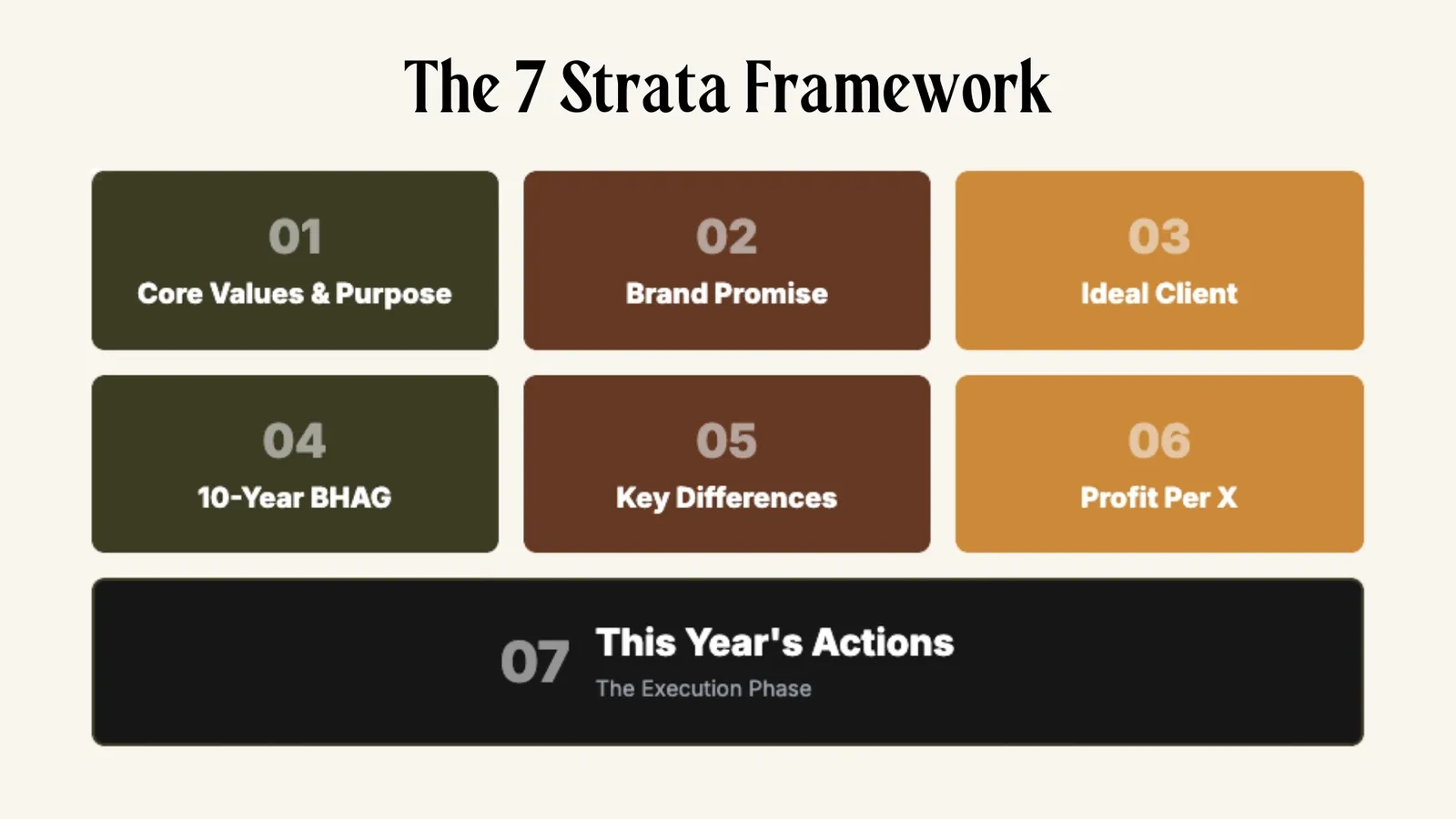
These questions cover:
- Your core values and purpose
- What you want to be known for (your brand promise)
- Your ideal client
- Your ten-year target (called a BHAG: Big Hairy Audacious Goal)
- Your key differences from competition
- How you measure real success (profit per X)
- Your top actions for this year
The framework works because it forces you to think long-term first, then work backwards. Instead of reacting to whatever opportunity comes your way, you build a strategic foundation that guides every decision.
Why Most STR Operators Struggle With Strategic Planning
Eric Moeller, CEO of Freewyld Foundry, talks to short-term rental operators at every stage of growth. From operators running 20 listings to those managing 400 properties, he sees the same patterns repeatedly.
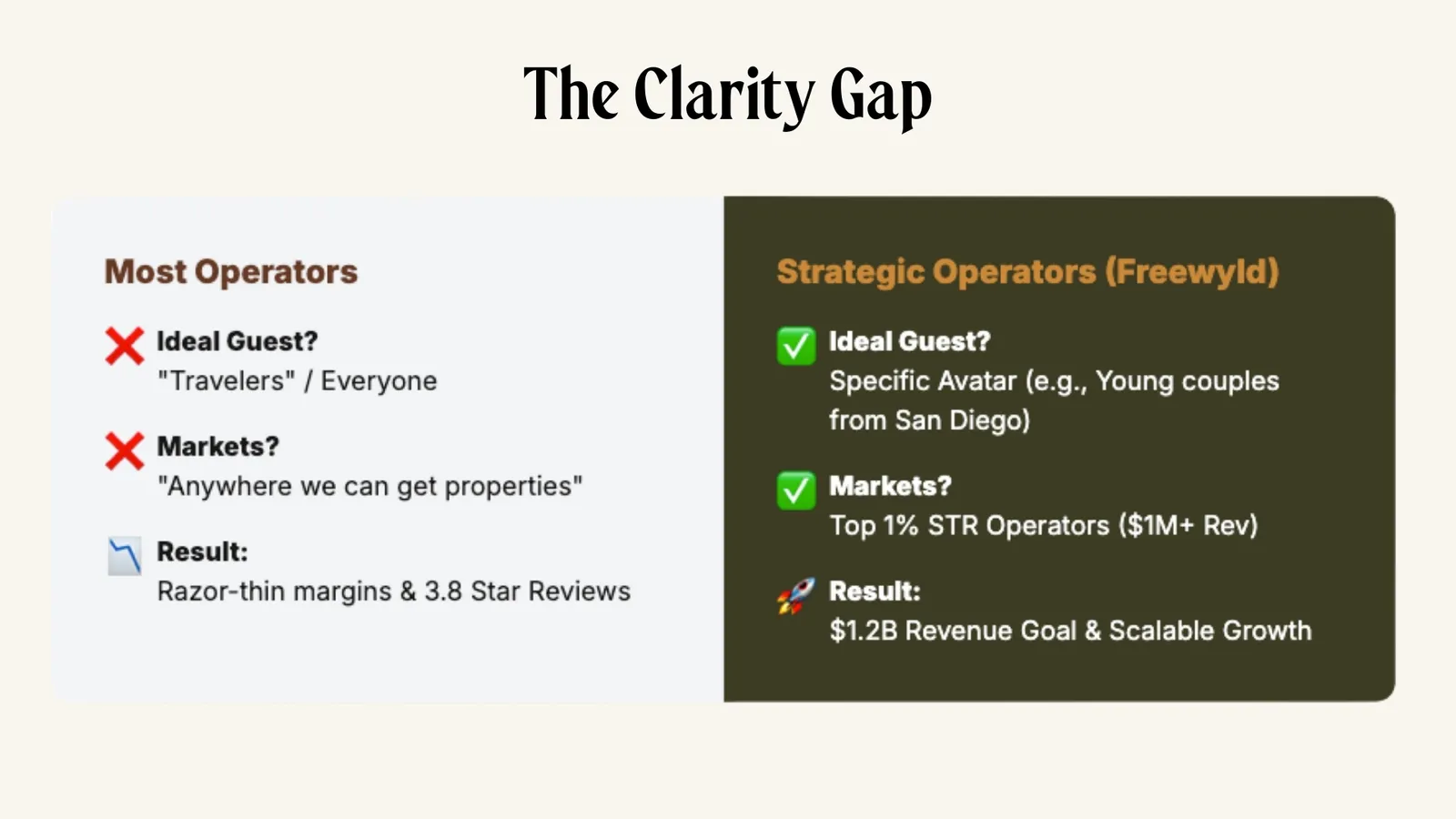
When he asks basic strategic questions like “Who is your ideal guest avatar?” or “What markets do you specialize in?” most operators can’t answer.
One operator he spoke with runs over 400 listings across multiple countries. The business generates $20 million in annual revenue with a large team. On paper, it looks like a massive success.
But when asked who his ideal guest was, the operator said “travelers.” When asked what markets he specializes in, he said, “anywhere we can get properties.” His Airbnb reviews hovered around 3.8 to 4 stars, and his profit margins were razor-thin.
This isn’t unique to large operators. The pattern shows up everywhere. Operators chase every opportunity, say yes to every property, serve every guest type, and eventually wake up to find themselves running a complex operation that barely breaks even.
The problem isn’t effort. It’s clarity.
If you’re constantly firefighting instead of thinking strategically, our episode on the real job of an STR CEO explains how to make that shift.
How Freewyld Foundry Used 7 Strata to Define Their $1.2B Goal
Last year, the Freewyld Foundry team spent two days locked in a house with whiteboards. No phones. No client calls. Just deep, focused thinking about what they’re building and why.
They went through every question in the 7 Strata framework.
By the end of those two days, everything had sharpened.
They could articulate who they serve with precision: top 1% STR operators doing $1M+ in annual revenue. They defined their ten-year BHAG: $1.2 billion in revenue under management. They identified what sets them apart in a crowded revenue management market: managing every listing, every day.
What surprised Eric most wasn’t the answers themselves. It was how much easier every decision became after that.
When opportunities came up that didn’t fit their focus, they could say no immediately. When they were planning their VRMA conference booth and started thinking about serving operators below their threshold, they caught themselves and stayed on the path.
Clarity gave them permission to focus.
Breaking Down the 7 Strategic Questions
Question 1: Core Values and Purpose
Why does your company exist?
This isn’t a fluffy exercise. Your core values shape every hire you make, every decision you face, and every guest interaction your team has.
When Eric looks at a portfolio of listings with consistent three-star Airbnb reviews, he immediately knows that operational excellence or unreasonable hospitality isn’t part of their core values. Because if those values were embedded, the team would show up differently regardless of circumstances.
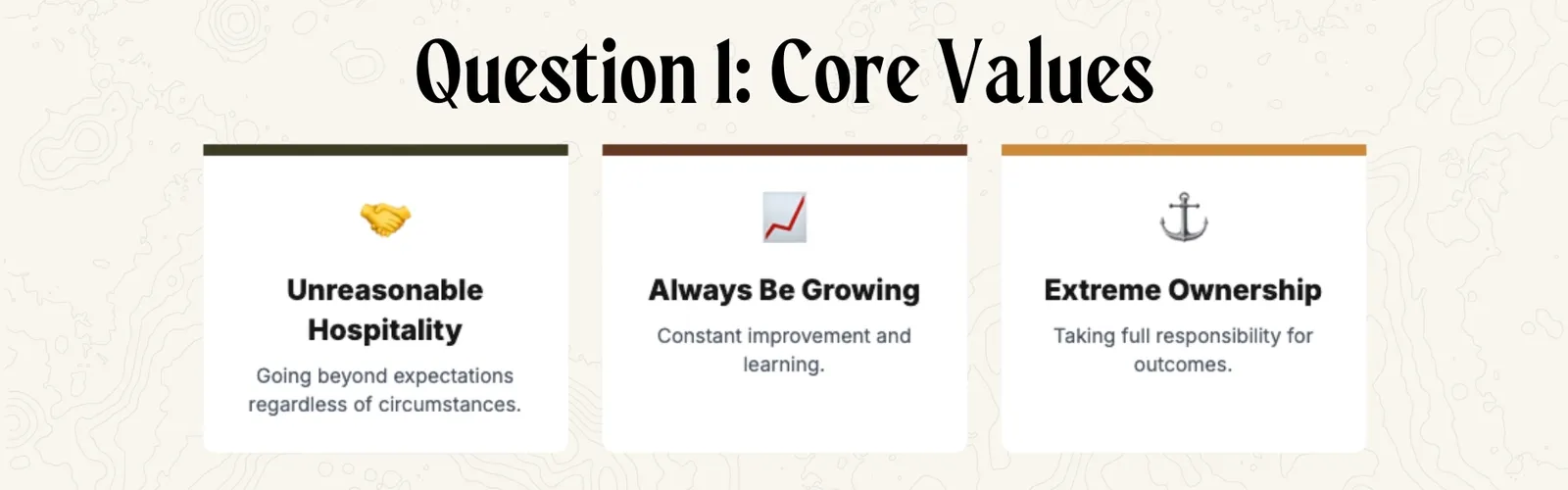
For Freewyld Foundry, core values include:
- Unreasonable hospitality
- Always be growing
- Extreme ownership
These aren’t just words on a website. They’re hiring criteria, performance standards, and decision-making filters.
Question 2: Brand Promise
What do you want to be known for?
Your brand promise should accomplish two things: solve your ideal client’s biggest objection and hold your entire team accountable to world-class execution.
Eric shares the example of a property manager who created a powerful brand promise: if any property gets less than a five-star review, he doesn’t charge commission for that stay.
Bold. Scary. But not impossible.
This brand promise changed his business. He went from being a standard operator to one of the best in his market. Property owners sought him out because of this standard. And his entire team (cleaners, maintenance, customer service) showed up differently because money was on the line.
For Freewyld Foundry, the brand promise is simple: “We’ll grow your revenue, or you don’t pay us.”
Question 3: Ideal Client
Who are you serving?
This question has two parts for short-term rental operators:
- Guest avatar: Who is your ideal guest? Not “families” or “business travelers.” A specific, clear description.
- Property owner profile: What homeowners do you want to work with? What properties fit your model?
Troy Daily is a great example of an operator who scaled from 18 to 95+ properties while maintaining quality standards by getting clear on his values and ideal guest & homeowner early.
For Freewyld Cabins, Eric’s hospitality brand, the guest avatar is clear: young couples traveling from San Diego, Orange County, or LA who want to escape the city. Everything from marketing to property design is tailored toward this specific guest.
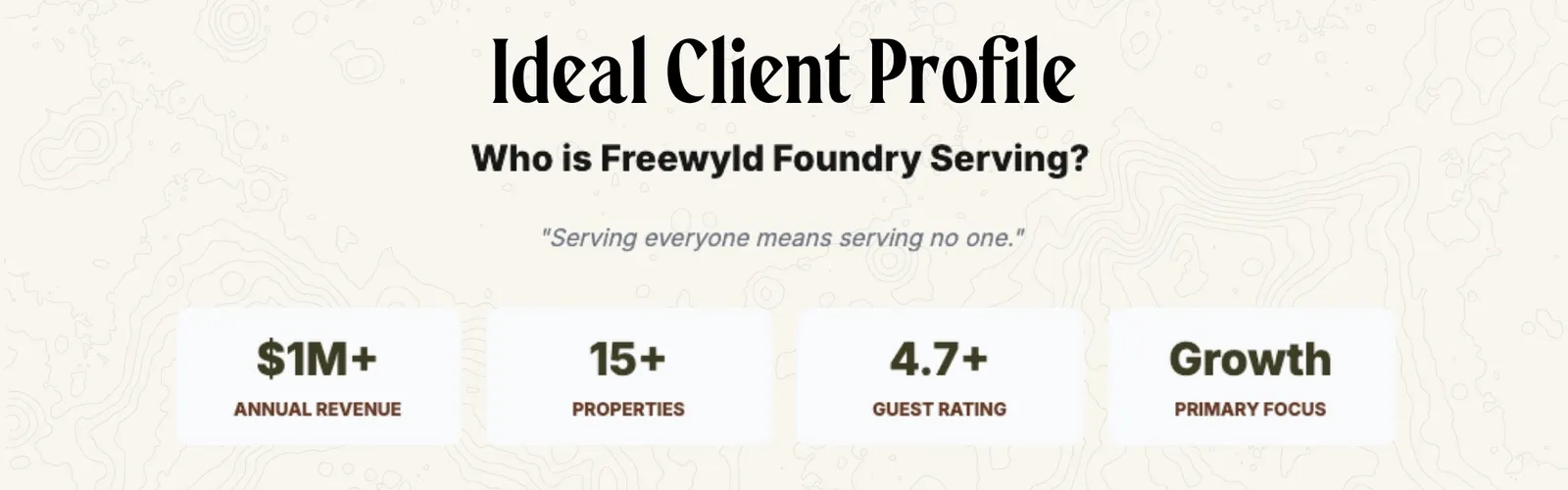
For Freewyld Foundry’s revenue management service, the ideal client is equally specific: STR operators with $1M+ in annual revenue, portfolios of 15+ properties, and guest ratings of 4.7+ or higher. They are focused on growth and scaling.
Serving everyone means serving no one.
Question 4: Ten-Year BHAG (Big Hairy Audacious Goal)
Where are you going?
Your BHAG should serve as a clear North Star that guides you through challenges. It should be stated but exceptionally difficult to accomplish.
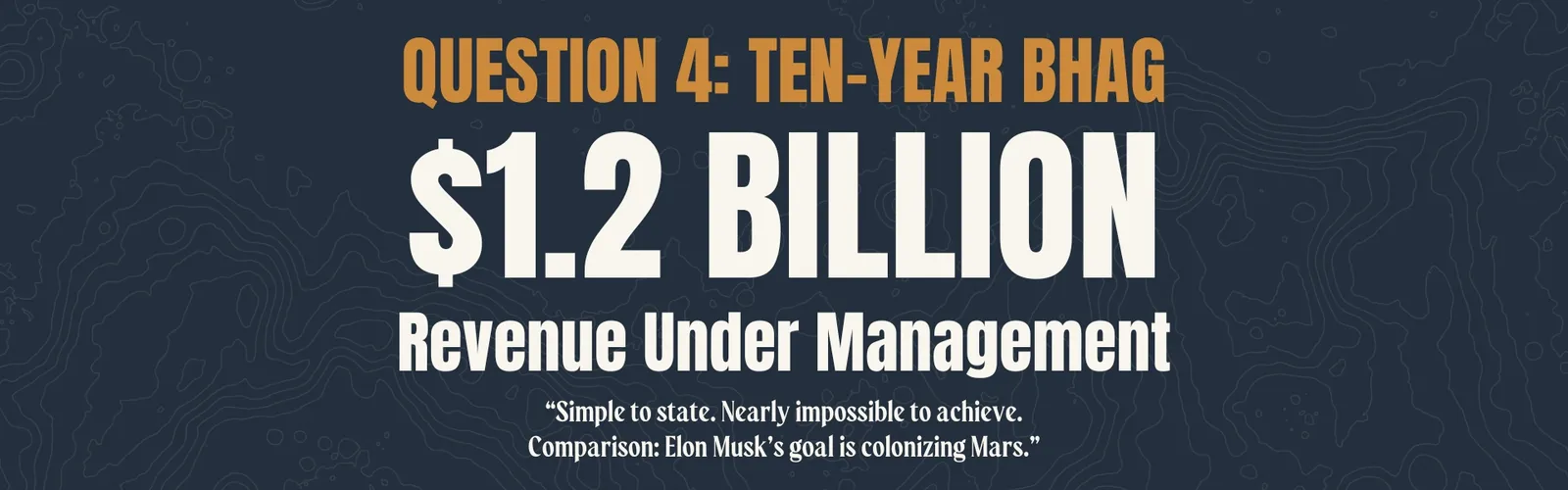
Eric uses Elon Musk as the perfect example. Every company Musk builds (Tesla, SpaceX, The Boring Company, Starlink) supports one goal: colonizing Mars. That’s his BHAG. Simple to state. Nearly impossible to achieve. But every business decision aligns with that vision.
For a tactical breakdown of how to set and achieve ambitious goals like your BHAG, read our guide on single-focus goal-setting.
For Freewyld Foundry, the BHAG is $1.2 billion in revenue under management within ten years.
That number isn’t random. It’s ambitious, measurable, and scary enough to force the team to think differently about how they operate.
Your BHAG should do the same. When you compare your goal to colonizing Mars, becoming the best short-term rental operator in your market suddenly feels achievable.
Question 5: Key Differences
What makes you different from every competitor?
Not better. Different.
This is your fingerprint. The 3 to 5 things that separate you from everyone else in your market.
For Freewyld Foundry, key differences include:
- Every listing, every day: They actively manage portfolios daily, not with set-it-and-forget-it automation
- PriceLabs expertise: They became masters of one tool instead of dabbling in many
- Operators serving operators: The team has built and scaled STR businesses themselves
For a local operator, differentiation might be geographic expertise. One operator Eric interviewed specializes exclusively in Cleveland, Ohio. That singular focus separates him from every other property manager in his market.
Question 6: Profit Per X
How do you measure real success?
Revenue doesn’t matter if you’re not making profit.
An operator running 400 listings and generating $20 million in revenue may earn less profit than an operator running 20 to 30 well-optimized properties.
You need a metric that tells you whether you’re successful. For most STR operators, this should be profit per listing.
Calculate how much profit each property generates after all expenses. Then make hard decisions based on that number. Cut properties that don’t meet your threshold. Say no to owners who don’t align with your values.
For Freewyld Foundry, the metric is profit per revenue manager. How many portfolios can each revenue manager manage while delivering expected results without disrupting client experience?
This metric shapes hiring, pricing, and growth decisions.
Question 7: This Year’s Actions
What are the top 3-5 things you’re doing THIS YEAR to move toward your goal?
Planning means nothing without execution.
After answering the first six questions, map out everything you feel you need to accomplish. Then keep asking “why?” until you narrow it down to five main actions.
For Freewyld Foundry in 2025, key actions included:
- Hiring and training the best revenue managers in the STR space
- Building the best brand and website in revenue management
- Focusing on activities with compounding ROI
They didn’t pursue new properties. They didn’t expand into new markets. They put blinders on and executed the five things that mattered most.
For more on how to execute with singular focus, listen to our episode on the One-Goal Method and how to win by doing less.
Real-World Example: The VRMA Booth Decision
In 2025, Freewyld Foundry sponsored a booth at the VRMA conference for the first time. It was a significant investment and milestone for the company.
As they planned their booth strategy, a question emerged: How do we serve the 99% of conference attendees who don’t qualify for our revenue management service?
They started considering creating offers for smaller operators. Maybe they could sell their Cash Flow Mastery course. Maybe they could provide consulting for operators below their $1M threshold.
Then Eric pulled out the 7 Strata framework.
Their ideal client is crystal clear: top 1% STR operators doing $1M+ in revenue. The conference attendees who didn’t meet that threshold weren’t their focus.
The decision became simple: provide free education and value to everyone at the booth, but don’t chase operators outside their ideal client profile as potential clients.
This is the power of strategic clarity. Without the 7 Strata answers, they might have diluted their focus trying to serve everyone. With clarity, they stayed on the path.
How to Implement the 7 Strata Framework in Your Business
Step 1: Block Out Dedicated Time
You can’t answer these questions between guest messages and maintenance calls. Block out one to two days with your key team members (or alone if you’re a solo operator) in a distraction-free environment.
Shut off phones. No client emergencies. Just whiteboards and deep thinking.
Step 2: Work Through Each Question Systematically
Start with Question 1 (Core Values and Purpose) and work sequentially through all seven questions. Don’t rush.
For each question, keep asking “why?” until you get to real answers, not surface-level responses.
Why is this a core value? What does it mean to us? How does it show up in our daily operations?
If your brain doesn’t hurt from thinking, you’re not trying hard enough (a lesson Eric learned from an Elon Musk interview).
Step 3: Get Specific
Vague answers don’t help. “We serve travelers” isn’t an ideal client definition. “We serve young couples aged 28-40 from major California cities looking for weekend mountain escapes” is specific.
“We want to grow” isn’t a BHAG. “$1.2 billion in revenue under management in ten years” is measurable and clear.
Step 4: Document Everything
Write down your answers. Put them on your wall. Share them with your team. Make them visible and accessible.
These aren’t answers you develop once and forget. They’re living documents you revisit regularly.
Step 5: Use Your Answers as Decision Filters
Every opportunity, every potential property, every new market, every hiring decision should be filtered through your 7 Strata answers.
Does this align with our core values? Does this serve our ideal client? Does this move us toward our BHAG? Does this fit our key differences?
If the answer is no, say no.
Step 6: Leverage Tools Like ChatGPT
Eric suggests uploading the podcast transcript and the “Scaling Up” book content to ChatGPT and asking: “First time doing a 7 Strata. Teach me how to implement this based on everything you know about my business.”
Let AI help you think through the questions systematically, but the final answers need to come from you and your team’s deep thinking.
Common Mistakes to Avoid
Mistake 1: Rushing the Process
Two days feels like a long time when you have fires to put out. But strategic clarity is worth the investment.
Rushing through the questions with surface-level answers defeats the purpose. Take the time to think deeply.
Mistake 2: Accepting Vague Answers
“Quality service” isn’t a core value unless you can define exactly what it means and how it shows up operationally.
“Business travelers” isn’t an ideal client without specific details about who they are and what they need.
Push for specificity.
Mistake 3: Ignoring Your Answers After Creating Them
The 7 Strata framework only works if you use it to guide decisions.
If you develop beautiful answers but keep saying yes to every opportunity, nothing changes.
Once you have strategic clarity, you need operational systems to execute. Learn how to build systems that scale your rental business without constant firefighting
Mistake 4: Doing This Exercise Alone (If You Have a Team)
If you have key team members, involve them. Their perspectives and buy-in matter.
Strategic clarity shared across a team is exponentially more powerful than clarity locked in one person’s head.
Summary & Key Takeaways
The 7 Strata framework from “Scaling Up” helps short-term rental operators build strategic clarity that transforms decision-making.
Key takeaways:
- Answer seven strategic questions: core values, brand promise, ideal client, ten-year BHAG, key differences, profit per X, and this year’s actions
- Strategic clarity makes every decision easier by giving you permission to focus and say no to opportunities that don’t fit
- Think long-term first, then work backwards to determine what actions matter this year
- Specificity matters, vague answers don’t help you make better decisions
- Use your answers as filters for every opportunity, hire, and strategic choice moving forward
Next Steps: Take Action Now
Strategic planning separates operators who scale profitably from those who just get busier and more stressed.
Block out time this month to work through the 7 Strata framework. Whether you’re managing 2 listings or 200, these questions will give you the clarity you need to build intentionally rather than react to whatever comes your way.
Questions for reflection:
- Which of the seven strategic questions would be hardest for you to answer right now?
- What would change in your business if you had complete clarity on your ideal client and ten-year goal?
Want help implementing strategic revenue management in your STR business? Freewyld Foundry provides white-glove revenue and pricing management for operators doing $1M+ in annual revenue. Apply for a free revenue audit at FreewyldFoundry.com/report.